CDMO and CRO marketing, what the function actually is
Your firm is being shortlisted, or skipped, before anyone fills in a form. Do you know what a sponsor sees when they check you?
Book a CallA CDMO develops and manufactures other companies' drugs under contract. A CRO runs their research and their trials. So "CDMO and CRO marketing" is not a kind of marketing aimed at patients or the public. It is the function that wins these contract-services firms their next program, and it is the work our content marketing practice does for life sciences firms.
Part of Content marketing for life sciences, the complete guide.
The term genuinely confuses people. One of the most common things buyers type into a search box is whether "CDMO" means anything in marketing at all. It does. It just looks almost nothing like the marketing most people picture.
Here is the reframe worth holding onto for the rest of this piece. CDMO and CRO marketing is not demand generation. It is the work of getting your firm shortlisted, qualified, and trusted by a small, named set of sponsors, so that business development can close and keep multi-year programs. That one shift explains nearly everything that feels strange about the job, and it is the same shift that separates content marketing from demand generation in any trust-led sale.
This is written for the person who owns that job. The in-house marketer at a contract-services firm, often a team of one. The business development leader who carries the number. The founder of a lab or a plant who knows the science cold and is trying to work out what marketing is even for here.
What is CDMO and CRO marketing?
It is the function that makes a contract-development, manufacturing, or research organization known, credible, and shortlisted among the sponsors who outsource that work, so business development can win and renew long programs.
Start with the two firm types, because the acronyms hide a simple split.
- A CRO, a contract research organization, runs research and clinical work for a sponsor: trial design, site selection, monitoring, data management, regulatory support.
- A CDMO, a contract development and manufacturing organization, develops and makes the drug itself: formulation, process development, scale-up, and GMP production.
The sponsor in both cases is a pharma or biotech company that has chosen to rent capability instead of building it. If you want the buyer's side of the table in detail, we have written separately about content marketing for pharmaceutical companies and about what biotech marketing actually is. That is a large market. Depending on which analyst you read, the combined CRO and CDMO sector sat at roughly a quarter of a trillion dollars in 2025, and it is fragmented across many providers rather than owned by a handful of names.
Here is the part that matters for the marketing function. Whether you sell research or manufacturing, the job is the same shape, because you are not selling a product at all. You are selling capability, capacity, and trust. A sponsor cannot pick you up off a shelf, try you, and return you. They are handing you a program that may run for years and carries their own regulatory exposure. So the marketing has to make a firm feel safe to choose long before any contract exists.
That is why the CDMO and CRO marketing playbook barely resembles the one used to launch a product. It sits inside the wider set of choices we set out in life science marketing strategy, and it shares its foundations with life science marketing as a whole. The rest of this piece walks through why, one difference at a time.
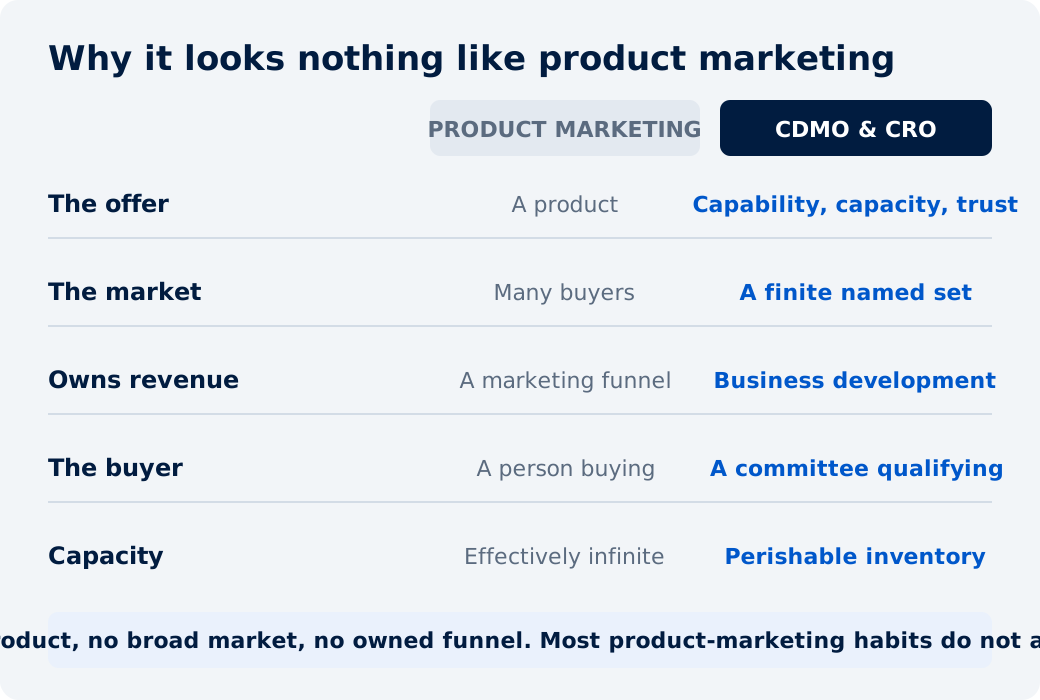
Why does it look nothing like product marketing?
Because almost every assumption product marketing rests on is missing here. There is no product to launch, no broad market to address, no self-serve funnel, and the revenue does not run through marketing at all. Five structural differences do most of the explaining.
There is no product to launch
A product marketer has a thing. A feature set, a price, a release date, a demo. A CDMO or CRO has none of that. Two firms making the same molecule to the same specification produce an identical output on purpose, since the whole point is to hit the sponsor's spec exactly.
So what are you actually marketing? Your reliability. The real "product" a sponsor buys is the confidence that their program will not fail on your watch. That reframes the marketer's job from describing features to proving trustworthiness, which is a much harder and slower thing to communicate.
There is no market, only a finite named universe
Product marketing addresses many buyers, often thousands, and treats them as a market to be segmented. A contract-services firm addresses a small, countable set of sponsors, and the same accounts recur for years. That is the structural case for account-based marketing in life sciences, where the account list is the market.
You can see how finite it is in the numbers. The FDA's drug center approved 50 novel drugs in 2024 and 55 in 2023. New programs enter the world in the tens and low hundreds each year, not the millions. The pool of sponsors you could realistically win is small enough to name on a list, and many of them you already know.
That single fact reshapes everything downstream, from how you measure the work to what "reach" even means. It also makes choosing the right ICP less a segmentation exercise than a naming one.
Business development owns the revenue, not a funnel
In a product company, marketing usually owns the pipeline. It generates leads, scores them, and hands qualified ones to sales. At a CDMO or CRO, the revenue runs through business development relationships and written proposals, not through a marketing funnel.
That inverts the reporting line most marketers are used to. Marketing here is a supporting function to BD, not the owner of the number. It is not a demotion; it is the correct arrangement when revenue is relationship-led and the buyer universe is small. We will come back to where exactly that line sits, because it is the part in-house marketers get most confused about.
The buyer is a committee running a qualification, not a person making a purchase
Nobody at a sponsor buys a CDMO the way they buy software. Scientific, quality, procurement, and executive stakeholders evaluate together, slowly, and they are deeply risk-averse, because a failed or non-compliant program is expensive and hard to undo.
So the thing marketing feeds is not a buyer's desire; it is a committee's due diligence. The winning material is evidence a reviewer can defend to their own colleagues, not a message designed to create want.
Capacity is perishable inventory
This one is strange enough that it gets its own section below. In short, a product company's inventory is effectively infinite, while a plant or a lab is a fixed asset with a utilization number, and empty time is gone for good.
Hold those five together and the picture is clear. No product, no broad market, no owned funnel, a committee instead of a buyer, and perishable capacity. Product-marketing habits do not just underperform here; most of them do not apply.
Where does marketing stop and business development start?
Marketing gets the firm known, qualified, and shortlisted, and arms BD with proof. Business development qualifies real fit, closes, and owns the relationship. Operations delivers. The confusion comes from how much those first two overlap.
At contract-services firms, the line genuinely blurs, and the people doing the work say so plainly. In these companies, business development often is sales. BD writes the proposals, manages the client relationship, and at smaller firms doubles as the contract and account manager. As one person who ran BD at a small CDMO put it, they were "usually contract and relationship managers and often are in charge of writing the sales proposals themselves." Marketers coming from other industries notice the same thing, that a services-side firm may have no marketing leadership at all, only sales.
So it helps to name the handoffs cleanly.
- Marketing makes the firm findable and credible, produces the proof a technical buyer respects, and keeps the firm present in the small world where sponsors form opinions.
- Business development works the specific accounts, reads the signals, opens the conversations, and carries the proposal.
- Operations delivers the program, which, as we will see, is where the next contract is actually won.
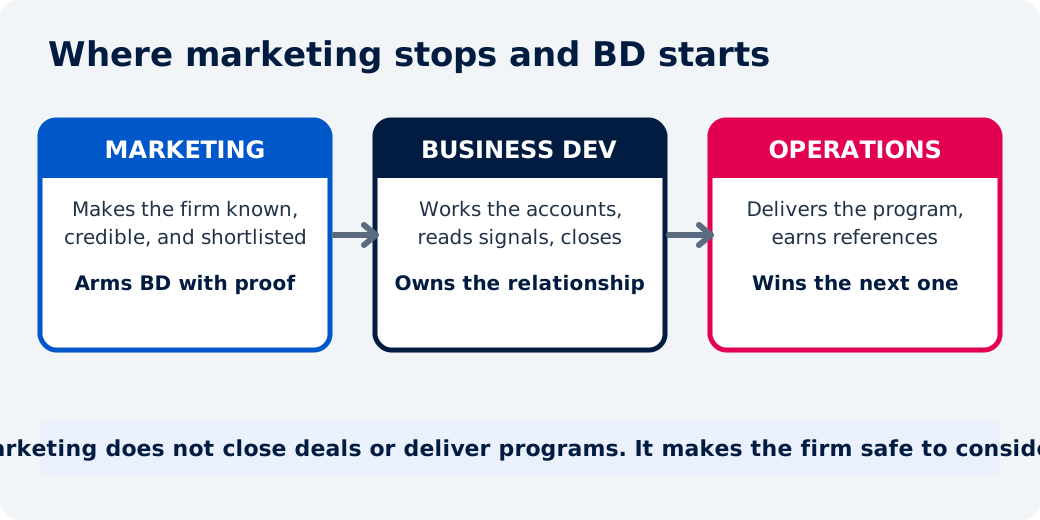
Two things follow from that division, and both are easy to get wrong. Where the baton actually changes hands is worth writing down, which is why we treat the lead handover process as a designed step rather than an assumption.
A lot of the marketing job is arming the field, not running a funnel
Because BD owns the relationships, a large share of marketing's real output is enablement, not lead generation. In our own analysis of life-sciences marketing hiring, field marketing and sales enablement show up as their own named discipline, in roughly one in eleven postings, which is high for what many companies treat as a side task. The signal is that the sector already knows marketing's job here leans toward equipping the people who carry the relationship.
In practice that means the capability decks, the therapeutic-area proof, the case narratives, and the answers to the questions a scientific reviewer will ask. It is marketing built to make BD's conversations land, not to fill a form, and it is closer to building core assets than to running campaigns.
The knowledge marketing needs is trapped in a few heads
At a services firm, the entire differentiation usually lives inside the founders, the BD team, and the technical leads. The way we think about this when we step into that kind of company is that the first job is not to write; it is to get the expertise out of those people and into a form that scales, which is why working with SMEs and extracting raw assets come before any content calendar. A single director carries the therapeutic story, the process know-how, and the reasons past sponsors stayed. Until that is extracted and turned into content, it walks out of the building every evening and shows up on exactly as many sales calls as one person can take.
That extraction is quiet, unglamorous work, and it is most of what good marketing does at a CDMO or CRO before anything gets published.
How do sponsors choose a partner, and what does that make marketing's job?
Sponsors choose through a formal qualification, not a purchase, and they run it against a shortlist they built before you knew a program existed. That single fact turns marketing's target from generating leads into getting onto lists and surviving audits.
The decision runs through an approved-vendor list and an audit
Large sponsors do not evaluate the open market when a program comes up. They keep qualified-supplier lists and they qualify a firm before it can bid. This is written into the standards the industry runs on, not a matter of preference.
Under ICH Q10, the pharmaceutical company that owns the drug stays "ultimately responsible to ensure processes are in place to assure the control of outsourced activities," and it does that by assessing a provider before outsourcing "using a defined supply chain (e.g., audits, material evaluations, qualification)," and sourcing only from "approved sources." The pharmacopeia spells out the mechanics; USP General Chapter <1083> describes selecting a short list, reviewing documentation, running an on-site audit, testing sample batches, then signing a quality agreement, and keeping a central "qualification database, list, or spreadsheet" of who is approved and current.
In manufacturing, the FDA's guidance on quality agreements even contemplates the sponsor defining the approved supplier list outright. Put together, a real selection tends to move through a familiar sequence: define the program, screen a long list, sign confidentiality agreements, send an RFI or RFP, audit a short list of three to five firms on site, negotiate terms, and execute a quality agreement.
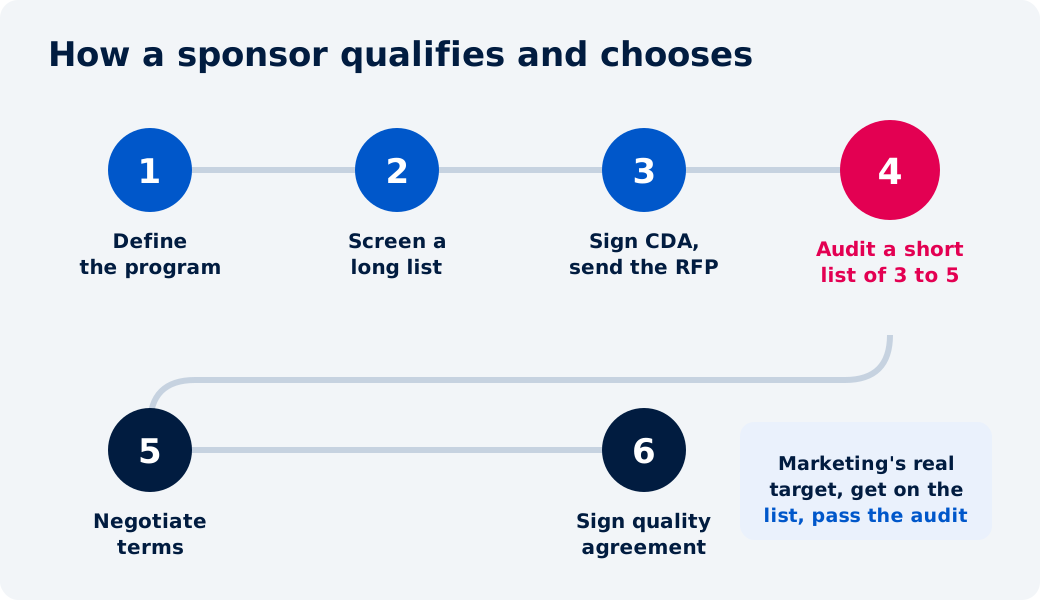
So marketing's real target is not a marketing-qualified lead. It is being on that list and passing that audit. Everything a marketer produces is aimed, whether they name it that way or not, at getting the firm into the qualification and surviving it. That is also why content marketing for CDMOs and CROs is best designed around a buyer who is looking for a reason to rule you out.
Why proof beats persuasion, at the level of the mechanism
The consensus advice is that trust matters more than features here, which is true but usually left unexplained. The mechanism is worth stating exactly, because it is what makes the whole function proof-shaped.
When a sponsor outsources trial work, they do not hand off the risk. ICH E6, the Good Clinical Practice guideline, states that a sponsor "may transfer any or all of the sponsor's trial-related duties and functions to a CRO, but the ultimate responsibility for the quality and integrity of the trial data always resides with the sponsor." The 2025 revision keeps the principle and adds that the sponsor is responsible for assessing and selecting the provider in the first place.
Read that as a buyer and the behavior makes sense. A sponsor is not really buying a service; they are extending their own regulatory accountability onto your systems. If you fail, it lands on their record. That is why a capabilities deck does not move them and evidence does, and why the peer-reviewed work on choosing a partner lists data integrity, problem-solving, scalability of capacity, and the people who execute the science as the factors that decide it, well above price.
For marketing, that means the artifacts are proof, not promotion. Therapeutic-area depth, method and quality-system evidence, inspection track record, and references from comparable programs. You are writing for a reviewer who has to defend the choice, not a buyer you are trying to excite. It is the same discipline that makes real thought leadership work in any technical category, and the same one behind our Westlab work in the lab-supply market.
Why is capacity the strangest thing marketing has to sell?
Because capacity is perishable inventory, and it forces marketing to do two contradictory things at once. Fill the plant or the lab this quarter, and position the firm as a decade-long partner. Product marketing never has to reconcile those.
Empty capacity is gone for good
A drug plant is a fixed-cost machine. The cleanroom's air handling runs whether one batch a week goes through it or ten. Depreciation starts on day one. The GMP quality staff cannot be flexed without losing the discipline that keeps the site compliant. So profitability is a utilization game more than a price game; until a line runs at roughly 60 to 70 percent, its depreciation, interest, and quality wages cost more than the conversion margin it earns.
The effect is brutal on the numbers. In one sterile-injectables contractor's accounts, revenue grew twelve percent in a year while operating margin collapsed from about 17 percent to under 5 percent, because a new suite's fixed costs landed before its volume did. That is the whole shape of the business in one line. An empty slot this month is not deferred revenue; it is revenue that no longer exists.
Supply is also slow and often not real
The instinct is to assume capacity can be added when demand appears. It cannot, quickly. An executive-search firm that recruits for the sector estimates that about 60 percent of the CDMO capacity announced since 2021 is not commercially schedulable today. New builds run 18 to 36 months late, validation adds another 12 to 18 months after the physical build finishes, and the binding constraint turns out to be senior talent rather than equipment.
So a marketer is selling a genuinely scarce, slow-to-build asset, and the scarcity is real even when a press release says otherwise.
The dual mandate this creates
Put the two together and marketing carries a tension product marketing never meets. It has to move real, perishable capacity now, and build the reputation that wins the multi-year master agreement later.
You can see the tension in how capacity actually gets sold, through reservation fees and minimum-volume commitments, where a sponsor pays to hold a slot precisely because a slot held for one client cannot be sold to another. Near full capacity a firm can raise prices; with a suite sitting empty it will cut them to fill it. Marketing has to speak to both states at once, availability and reliability, without letting the near-term "we have room" message undercut the long-term "we are the safe partner" one.
How is CDMO and CRO marketing measured, and where does the function end?
It is measured by whether the firm is in the consideration set when a sponsor reaches partner selection, not by monthly lead counts. And the function ends where business development and operations take over, which is sooner than most marketers think.
The real metric sits before the RFP
By the time a sponsor issues an RFP, most of the outcome is already decided. RFPs go to a pre-qualified shortlist, not to the open market, and a cold bid arriving at that stage reads as a courtesy bid against firms that have been in the conversation for months. The defensible shortlist is usually three to five names.
So the leading indicator that matters is whether you are one of those names before the document exists. That is what marketing is really building toward, and it is why lead volume is the wrong scoreboard. The useful question is not how many forms came in this month; it is whether the firm is on the list, and on the approved-vendor register, when a fitting program appears. If you want the general version of that argument, we have written about which metrics to track and which to ignore, and about seeing which page started the deal.
This is also why business development watches operating signals rather than waiting for inbound. Funding rounds, IND filings, phase transitions, and clinical hiring surges all precede an outsourcing decision, funding often by around nine months, and specialist tools like Zymewire exist to track them, at enterprise prices that tell you how valuable early sight of a program is. Marketing's job is to make sure that when BD opens one of those conversations, the firm is already credible, which is the same logic behind content-led outreach.
Where the function stops
Marketing gets the firm known, qualified, shortlisted, and armed. Then it hands off. Business development qualifies genuine fit and closes. Operations runs the program.
And operations is where the loudest marketing actually happens. A contract-services firm's reputation is built in delivery, in the references a happy sponsor gives, and in the repeat programs that follow a good one. The people who run the science and the plant are, in the end, the product; the peer-reviewed work on partner selection lands on exactly that point, that the success of a partnership depends in large part on the people who execute the work. One person on Reddit summed up the whole business more bluntly, that "a good portion of CDMO work is managing customer expectations and relationships," and the firms that are bad at it lose the next contract no matter what the marketing said.
That is the boundary, and it is a useful one to hold. Marketing does not close deals here and it does not deliver programs. It makes a firm safe to consider, gets it onto the list, and keeps it credible in a small world, so business development can win and delivery can keep winning. The same shape shows up across the sector, whether you are reading about medical device marketing, diagnostics marketing, or the wider life sciences picture.
Is your marketing built to get you onto the list, or just to look busy?
Get a Content RevOps audit, your funnel shape, proof gaps, and AI-search visibility benchmarked against the life sciences 2026 data, with every gap priced in numbers your CFO can argue with.
Frequently Asked Questions
About the Author

Founder & CEO, Content RevOps
Stefan Kalpachev is the founder and CEO of Content RevOps, where he helps B2B SaaS companies transform their content into predictable pipeline. With a background in content marketing and revenue operations, Stefan has developed a unique methodology that bridges the gap between content creation and revenue generation.
Connect on LinkedIn