New trends in pharma marketing for 2026
See where your pharma content actually stands. Benchmark your content against the 2026 pharma study before you plan next year.
Book a CallThe new trends in pharma marketing for 2026 are easy to list and hard to act on. AI search, agentic AI, omnichannel orchestration, first-party data, patient platforms, real-world evidence, and tighter regulation show up on every forecast. The list is not wrong. It is just incomplete, because it describes where the market is going without telling you where pharma actually stands, and that gap is where our content marketing work with pharma and life science teams starts.
Part of Content Marketing for Pharmaceutical Companies.
So this guide does both. For each trend, we state it plainly, then grade how far pharma has really moved, using our 2026 benchmark of content marketing in pharma. The gap between the trend and the reality is where the opportunity sits.
One number frames all of it. Across the pharma sites we studied, only about 4 percent, roughly 1 in 25, run an active, intentional content marketing presence. Almost everything below traces back to that.
There is also a through-line. Every trend on this list is downstream of one change: buyers now start with an AI answer and research on their own time, and pharma is barely present in that layer. That is true whether you sell to patients and physicians or you sell to pharma companies as a contract manufacturer, a research organization, or a supplier. The winning move under all eight trends is the same, and we get to it at the end.
1. Pharma buyers now start with an AI answer
The first trend in pharma marketing for 2026 is that the search box is no longer the front door. Patients and physicians ask an AI assistant first, and they get an answer without clicking anything.
The scale is not subtle. In its January 2026 report AI as a Healthcare Ally, OpenAI said more than 40 million people worldwide ask ChatGPT a healthcare question every single day, and that about 1 in 4 of its 800 million weekly users asks something health related each week. Roughly 7 in 10 of those health conversations happen outside normal clinic hours, when no rep and no doctor is in the room (coverage here).
Physicians moved too. The American Medical Association reports that the clinical AI tool OpenEvidence estimates about 40 percent of US doctors now use it daily to answer medical questions, in place of a general search engine.
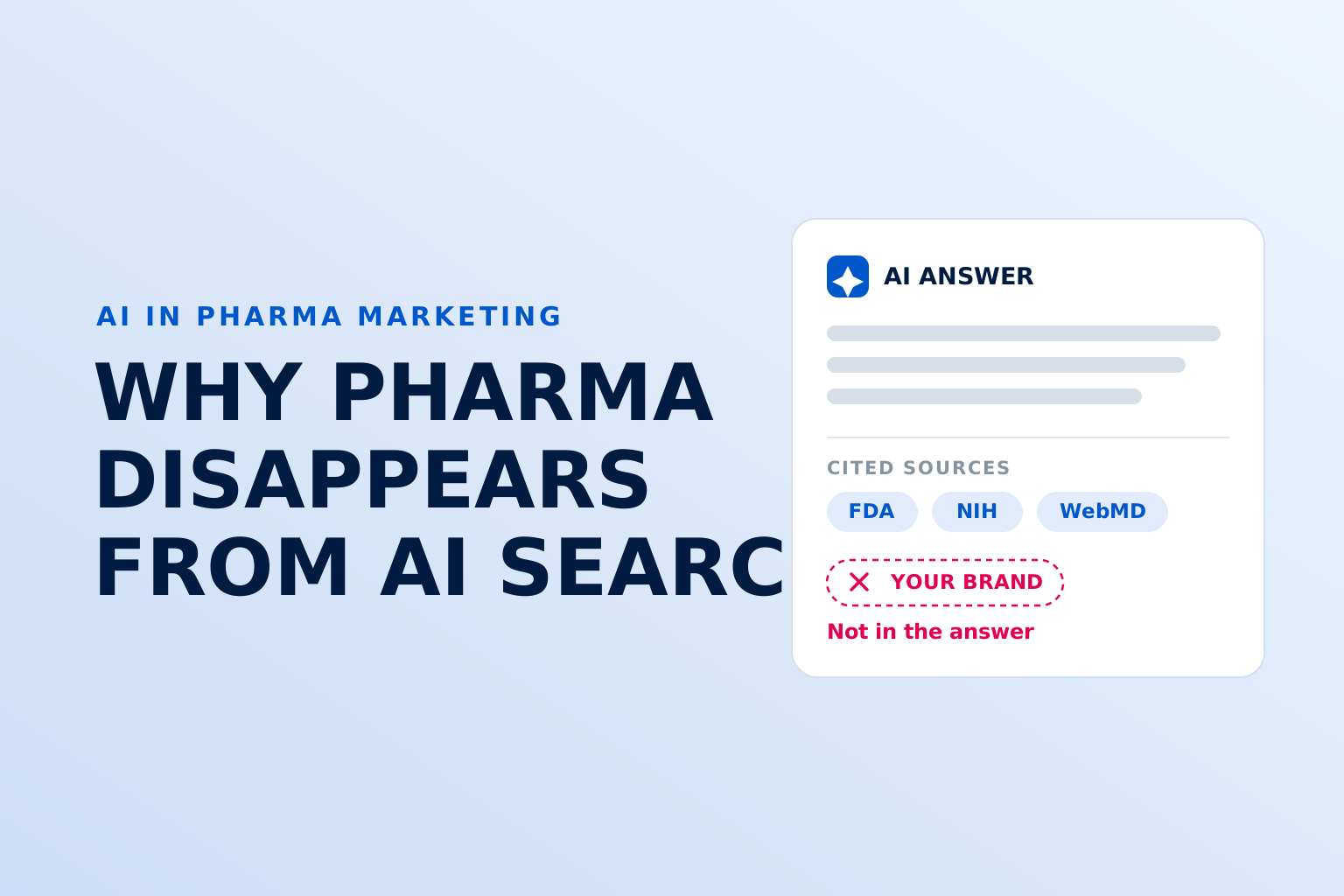
Now the reality check. When we looked at how often pharma brands actually surface inside these AI answers, pharma sites appeared in about 0 percent of AI-generated answers for consideration and decision-stage queries, and in about 33 percent, roughly 1 in 3, of answers for awareness-stage questions. Government and academic sources such as the FDA, NIH, NCI, and ClinicalTrials.gov dominate the medical answers instead. Hiring tells the same story. Answer-engine or AI-search optimization is named in about 0.5 percent of pharma marketing job posts, roughly 1 in 200.
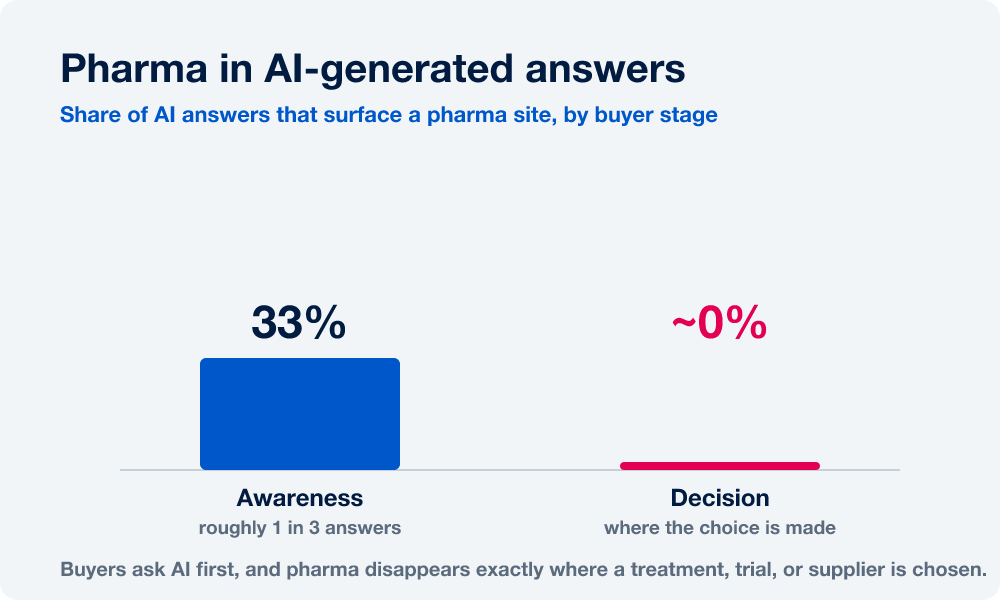
So the audience has moved to AI answers and pharma is not in them, right at the point where someone is choosing a treatment, a trial, or a supplier.
What to do: treat AI search visibility as a real 2026 channel, not a science project. Publish clear, structured, source-backed answers to the questions your buyers actually ask, so the models have something of yours to cite. Our pharma SEO and AI visibility benchmarks show where the openings are, and our answer engine optimization guide covers how the pages themselves are built.
2. AI in pharma marketing is still mostly talk
The second trend is the one every vendor leads with. The AI pilot era is declared over, agentic AI and next-best-action are supposedly standard, and AI is now the operating layer for the whole marketing function.
The reality is more honest, and more useful. AI is the headline far more than it is the practice.
Our benchmark found that about 18 percent of pharma marketing job posts, roughly 1 in 5, mention AI in any form, but a specific named AI product appears in fewer than 1 in 65 posts. Teams talk about AI far more than they name a tool they actually run.
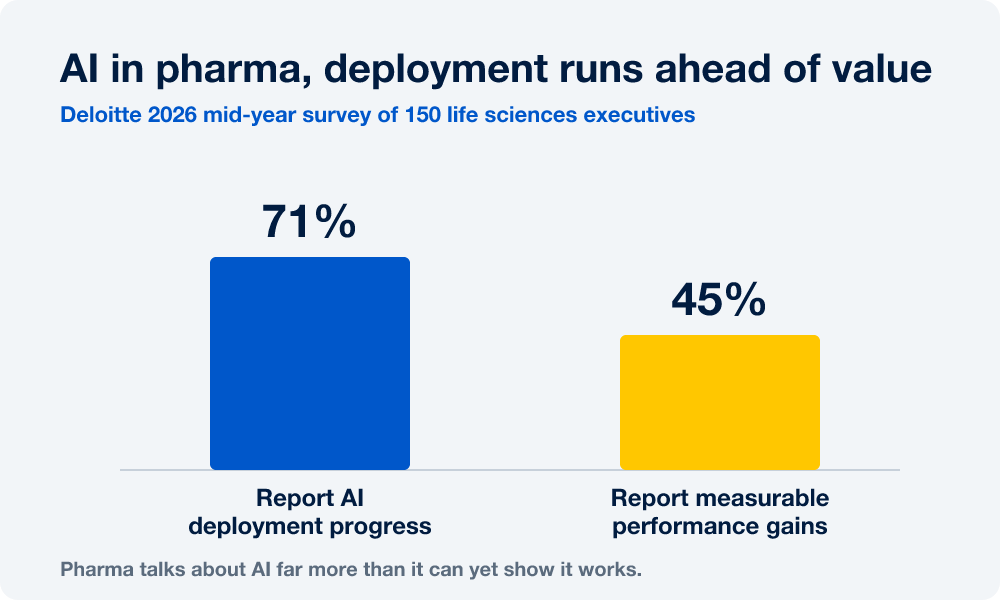
The buyers themselves say the same. In Deloitte's 2026 mid-year life sciences outlook, a survey of 150 senior executives, 71 percent reported progress on AI deployment in the past six months, but only 45 percent reported measurable performance gains. Deloitte's own phrase for the gap is that AI deployment is outpacing value outcomes.
Even in the one place pharma would most love AI to work, compliance review, it is mostly pilots. The consultancy Indegene, in its report on the future of MLR review, notes that most AI success stories still come from limited proofs-of-concept, not production systems.
The useful read for a pharma marketer is that the value is in workflow and production speed, not frontier features. That is exactly where we saw it land in our work with Westlab, a life-science manufacturer serving laboratories, where a human-plus-AI pipeline shipped expert content at speed without losing credibility.
What to do: pick the one or two AI uses that remove a real bottleneck, usually drafting, tagging, and review support, and prove them before you buy the platform. Our view on where automation earns its place is in our guide to pharma marketing automation.
3. Owned content becomes pharma's infrastructure
The third trend hides under the others. Full-funnel strategy, first-party data, real-world evidence, and patient platforms all assume the same foundation: a durable, owned body of content the company controls. In 2026 that foundation stops being a nice-to-have and becomes the infrastructure everything else runs on.
Almost no pharma company has built it.
Across all the pharma sites in our benchmark, only about 4 percent run an active content presence, about 6 percent, roughly 1 in 17, run a blog at all, and about 5 percent, roughly 1 in 21, operate a true resource hub. Publishing thought leadership is just as rare, at about 1 in 20 sites. These are all-site figures, so they describe the field, not a hand-picked sample.
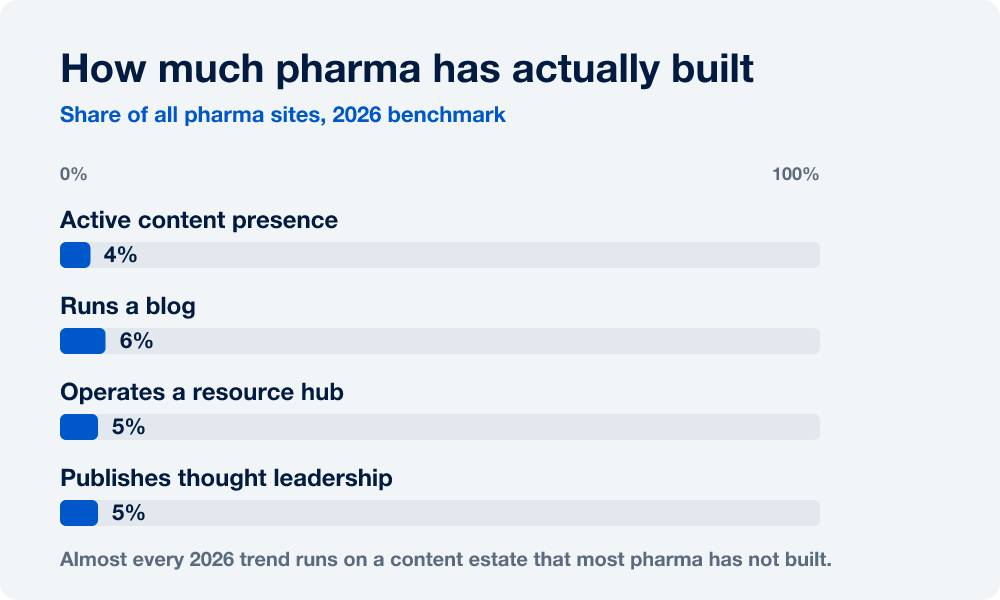
That is the difference between a campaign and infrastructure. A campaign runs and ends. Infrastructure keeps working: it ranks, it gets cited by AI answers, it educates buyers before sales, and it compounds. Pharma has spent decades on campaigns and very little on the estate underneath them.
We saw what the estate does when it exists. With Westlab, education-led content turned a cold, outbound-heavy motion into inbound demand and real quoted pipeline in a narrow, technical market, because the content did a job long after any single campaign ended.
What to do: stop scoring content by campaign and start treating it as an asset you own and improve. Our pillar guide to content marketing for pharma lays out what a content estate looks like, and our pharma marketing strategy guide covers how to prioritize it.
4. Reach stops meaning access in pharma
The fourth trend is a behavior change, not a channel. Physicians and buyers research on their own time now, so showing up broadly is no longer the same as being engaged with by the right person at the moment they choose to look.
Nick Smith, a pharma marketer with more than a decade inside top-10 manufacturers, makes the case cleanly in his video The New Rules of Pharma Marketing (2026). He argues that reach no longer maps to access, citing figures he puts at roughly 45 percent of physicians being unreachable through traditional channels and about 84 percent of physicians wanting to keep or increase how much they engage with pharma online, on their own schedule, between appointments. Those numbers are his, drawn from industry sources he names, and the direction holds up in vendor research too: OptimizeRx's survey of physicians across six specialties found doctors actively seeking brand content across many channels rather than waiting for a rep visit.
The reality for pharma is that most brands have built nothing for that self-service moment. Pharma sits at about 0 percent presence in decision-stage AI answers, and about 20 percent, roughly 1 in 5, of the content pieces pharma does produce end with no next step at all. When a physician finally does come looking, there is often nothing there to meet them.
This is where content earns its keep. With Westlab, the content did the pre-sales education that used to depend on repeated rep contact, so buyers arrived already informed and closer to a decision.
What to do: build for the buyer who researches alone. Answer the real clinical and commercial questions in public, and make each piece lead somewhere. Our guide to pharma HCP marketing covers how to earn that self-directed engagement.
5. First-party data replaces rented reach in pharma marketing
The fifth trend follows straight from the fourth. As third-party cookies and borrowed audiences decay, the data you own becomes the only reliable engine, and the question shifts from how many people you reached to who they were.
Nick Smith frames the shift in the same video with a story every marketer will recognize. He presented a board strong engagement numbers, organic traffic up 21 percent, engagement climbing from 15 to 65 percent, and the chief commercialization officer replied, in effect, this looks great, but who are these people. Attention metrics tell you something happened. They do not tell you who it happened with, and first-party signal you own does not vanish when a browser changes its tracking rules.
The reality is that most pharma has no engine to generate that first-party signal in the first place. With only about 4 percent of pharma sites running an active content presence and about 5 percent operating a resource hub, there is little owned surface where a known buyer can engage, so brands default to renting reach they cannot identify.
Owned content flips that. With Westlab, content-engagement signals separated serious buyers from browsers, and an enriched handover let sales prioritize the right accounts instead of guessing.
What to do: make your owned properties the place buyers engage, then capture and use that engagement. Connect content to your CRM so a known contact's behavior informs the next conversation. Our guide to pharma marketing automation covers how that connection is built.
6. Omnichannel becomes orchestration, and pharma's channel mix is still narrow
The sixth trend is the maturing of omnichannel. The goal is no longer presence on every channel; it is orchestration, sequencing the right message to the right person across a single connected view.
The payoff is real. Veeva, an industry software vendor, reports that synchronizing field engagement with digital promotion lifts marketing effectiveness by about 23 percent, while more than 65 percent of HCP brand interaction still runs unsynchronized. Treat that as a vendor's own data, but the direction is clear: coordination pays, and most pharma has not done it.
The reality check is in what pharma actually staffs for. Looking at pharma marketing job posts, congresses and scientific meetings appear in about 14 percent, roughly 1 in 7, field marketing in about 9 percent, roughly 1 in 11, and speaker programs in about 11 percent, roughly 1 in 9. The owned digital channels barely register: SEO shows up in about 1 in 20 posts, paid search in about 1 in 19, and podcasts in almost none. Yet cross-functional collaboration is named as a wanted skill in about 78 percent of posts, roughly 4 in 5, so teams know the silos are the problem even where the channels are thin.
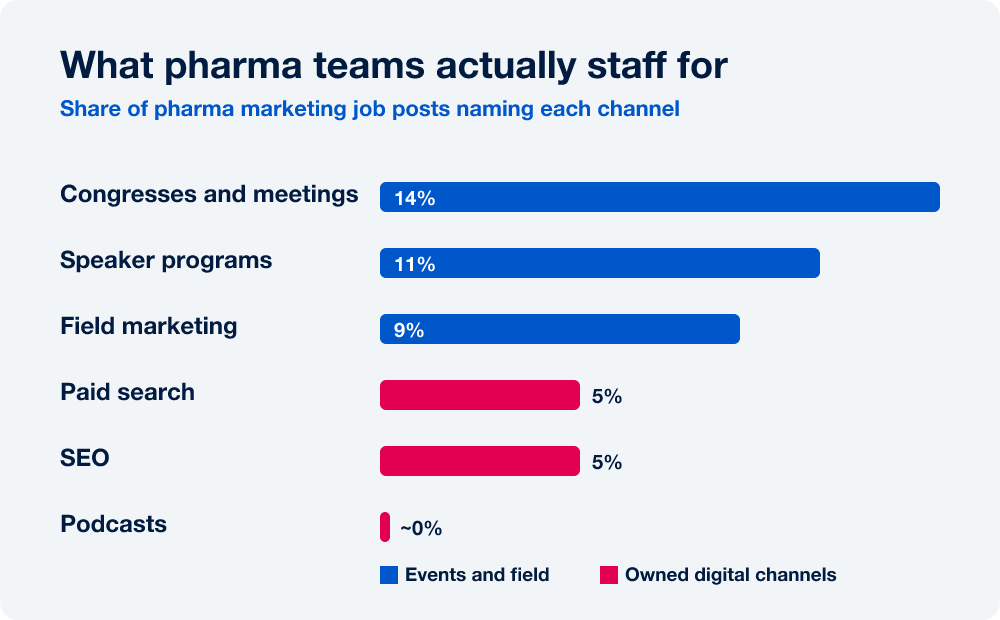
That is not an orchestrated omnichannel operation. It is a well-staffed events motion with a thin digital layer beside it.
What to do: connect the channels you already run before adding new ones, and orchestrate them around the person rather than the platform. Our guides to omnichannel marketing in life sciences and pharma marketing tactics cover the sequencing.
7. Decision-stage content is the gap that costs pharma pipeline
The seventh trend is pressure to prove marketing's contribution to pipeline. The reality is that pharma has almost no content at the stage where pipeline is won, so there is little to convert.
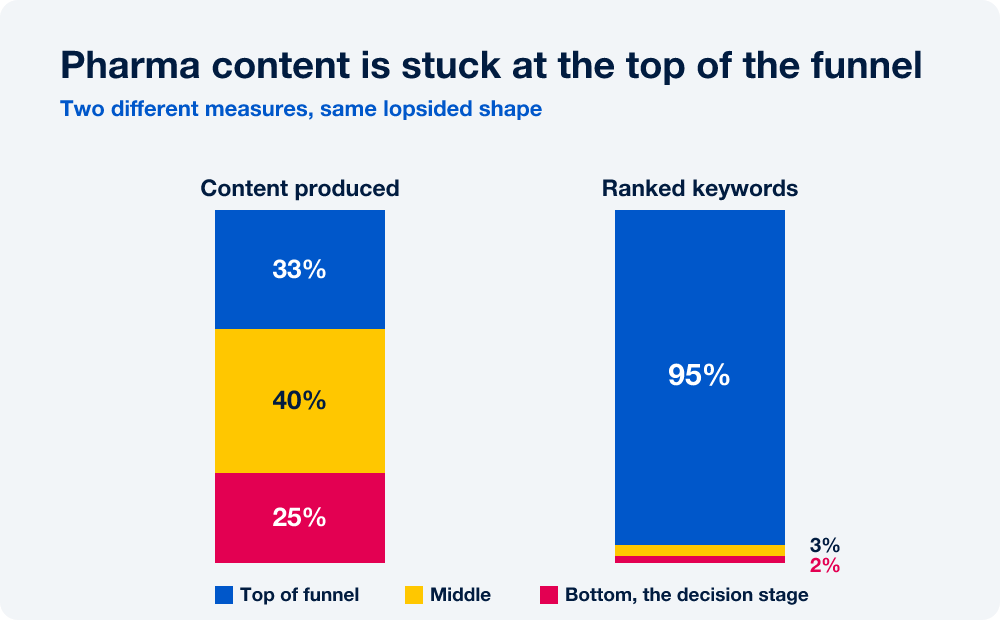
The shape of pharma's content is lopsided. Among pharma companies that produce content, about 33 percent, roughly 1 in 3, run no decision-stage content at all, and the content that does exist splits to roughly 33 percent awareness, 40 percent consideration, and only 25 percent decision. Those are shares of content produced. The ranked-keyword picture is even more top-heavy: about 95 percent of pharma's ranked keywords are top-of-funnel, about 3 percent middle, and about 2 percent bottom. On top of that, about 1 in 5 of the pieces pharma publishes end with no next step.
The organic footprint shows how little traffic this leaves on the table to begin with. In our benchmark, a pharma company in the $1M to $10M revenue band gets a median of roughly 110 monthly organic visits from about 16 ranked keywords. At $10M to $50M it is about 360 visits and 57 keywords, and at $50M to $100M about 1,100 visits and 94 keywords. There is not much demand being captured, and almost none of it is being pointed at a decision.
Westlab is the counter-example. Educational content there drove real quoted pipeline, not just traffic, because the estate was built to carry a buyer from a first question to a conversation.
What to do: audit where your content sits in the funnel, then fill the decision stage first, the comparisons, the evidence, the specific answers a buyer needs before they act. Our pharma content marketing benchmarks and pharma SEO performance benchmarks show what good looks like by revenue band.
8. AI slop raises the value of expert, cited pharma content
The eighth trend is a reaction to the first two. AI made generic content free, so the market flooded with it, and expert, human, well-sourced content became the thing that stands out. In a field built on trust, that matters more for pharma than for almost anyone.
HubSpot's 2026 State of Marketing report frames AI as the baseline, not the differentiator, and finds that most AI-generated content is average. In its data, about 80 percent of marketers now use AI for content creation, most say they struggle to stand out in an AI-saturated market, and a majority say they need more unique, human-centered content to differentiate. When everyone has the same tool, the same output stops working.
The reality for pharma is that expertise signals are rare. Among the small active cohort that publishes real content, about half show subject-matter-expert credentials such as an MD or PhD and about 60 percent cite external authoritative sources. But that active cohort is only about 4 percent of all pharma sites, so most pharma shows neither the credential nor the citation that would make its content trustworthy to a reader or a model.
The blocker is not talent, it is speed. Medical, legal, and regulatory review is slow and getting slower. Vodori's 2025 promotional review benchmark puts the average review job at 14.8 days, up from 13.8 the year before, with video content averaging more than 32 days from start to approval. Expert content that takes a month to clear is expert content that rarely ships.
We solved that for Westlab with a human-plus-AI production pipeline that kept the expertise and cut the time. The credibility came from real specialists; the speed came from the system around them.
What to do: put your named experts on the page, cite real evidence, and fix the review bottleneck with modular, pre-approved, reusable content so expert work actually ships. Our benchmark on life science content maturity shows where most teams stall.
The one job under all eight trends
Read the list again and the eight trends collapse into one. Buyers moved to AI answers and self-service research, rented reach is decaying, and trust decides everything, so the company that wins is the one that owns a machine-readable, citable content estate that ranks, gets cited, educates buyers, and feeds first-party data back into sales.
Pharma companies invested in content for years, and most of it lost its job. It sits as cost: pages nobody reads, PDFs nobody tracks, expertise trapped in people's heads and slide decks. The 2026 move is not another campaign or another tool. It is giving that content a job again, as revenue infrastructure that attracts the right buyers in search and in AI answers, educates them before sales, and turns trust into provable pipeline.
If you want to see where your own content stands against the field, start with our pharma content benchmarking tool, or read the full 2026 benchmark of content marketing in pharma that the numbers on this page come from.
Give your pharma content a job again
Talk to us about turning your content into revenue infrastructure that ranks, gets cited, and feeds pipeline.
Frequently Asked Questions
About the Author

Founder & CEO, Content RevOps
Stefan Kalpachev is the founder and CEO of Content RevOps, where he helps B2B SaaS companies transform their content into predictable pipeline. With a background in content marketing and revenue operations, Stefan has developed a unique methodology that bridges the gap between content creation and revenue generation.
Connect on LinkedIn