Why pharma disappears from AI search, and how to come back
Only about 1 in 43 pharma sites publish content a model can lift, which is the real reason your brand vanishes from AI answers. Want to see where you disappear?
Book a CallYour pharma brand can hold position one on Google and still be missing from the answer a patient or physician actually reads. The answer now arrives inside an AI box at the top of the page, and that box is written from a different set of sources than the blue links below it, which is why a content marketing system built only for rankings now misses the answer buyers read first.
Part of Content Marketing for Pharmaceutical Companies.
This is the gap that catches most pharma marketers off guard. The old scoreboard still looks fine. Rankings hold, traffic reports look stable, and the site passes every technical SEO check. Then someone asks ChatGPT, Perplexity, or Google's AI Overview a real question about your condition or your drug, and your brand is nowhere in the reply.
We work on AI search visibility for pharma, and our own data puts a number on the gap. Pharma sites show up in about 1 in 3 AI answers at the top of the funnel, and in almost none of them once the question turns to a decision. This piece explains why that happens, in three causes, and then walks through how to come back, in four steps you can start this quarter.
Is your pharma brand invisible in AI search? Here is how to tell
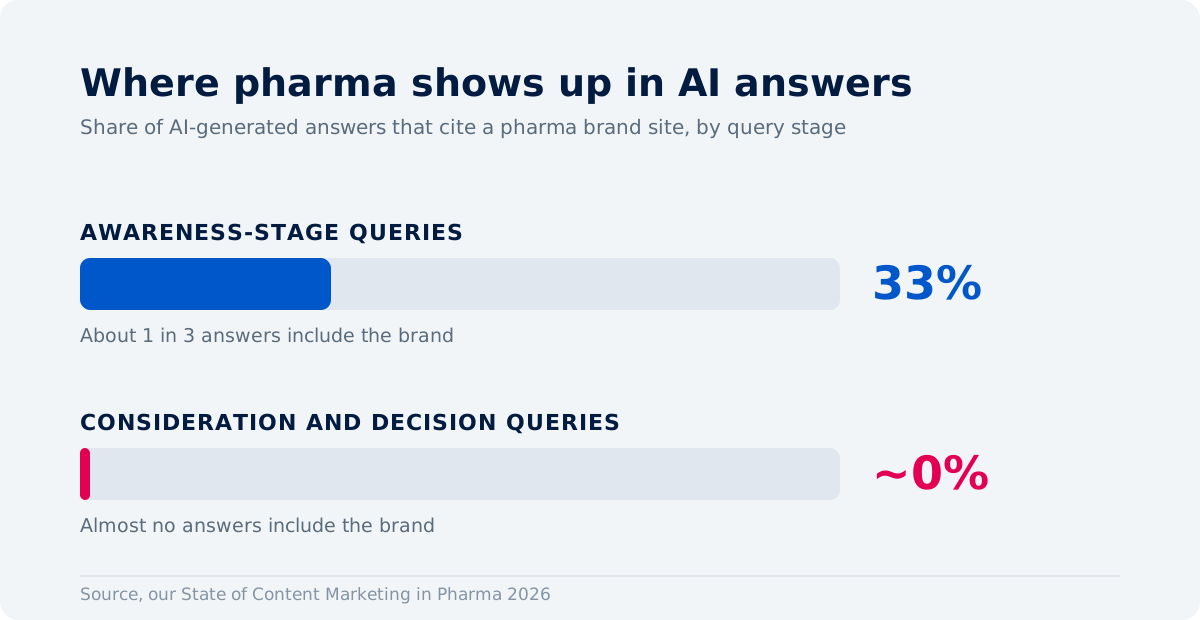
Start by assuming the answer is yes, because for most of the industry it is. When we analyzed how pharma and biotech companies appear in AI answers for our State of Content Marketing in Pharma 2026, pharma sites turned up in about 33 percent, roughly 1 in 3, of AI-generated answers for awareness-stage queries, and in about 0 percent of AI answers for consideration and decision queries. Government and academic sources take the top of the funnel, and third parties take the bottom. Commercial pharma earns a minority share where a buyer is still learning, and effectively no share at all once that buyer is ready to choose.
The pattern repeats one industry over. In our State of Content Marketing for Life Sciences 2026, corporate life-science sites appeared in close to zero AI Overviews, while the AI answer box now fires on 100 percent of the industry queries we checked. The box is always there. Your brand usually is not.
This is not a small or shrinking surface. In a pharmaphorum interview, Josie Black, VP and Head of SEO and GEO at EVERSANA INTOUCH, reports that Google's AI Overviews now trigger on 75 percent of pharmaceutical searches, up from 50 percent a year earlier. The AI answer has become "both the front door and the gatekeeper" for pharma discovery, in her words.
Ranking well does not protect you from this. The agency PharmaForward describes an oncology brand that had everything a classic SEO program chases: position one on its branded terms, page one on its condition terms, and clean technical health. When they ran the brand's own priority queries through the AI layer, 19 of 22 triggered an AI Overview, and the brand appeared in almost none of them. It sat at the top of the blue links and nowhere in the answer written above them.
Run the test yourself
You do not need a vendor tool to see where you stand. You need a fixed set of questions and a couple of hours. Build the test the way pharma AI-monitoring specialists do.
- Write the questions around the condition and the drug class, not your brand name. DrugChatter, which monitors AI answers for pharma, is blunt about this: a query set has to target the condition, drug class, or patient scenario where you want to be present, not queries that already name your drug. A prompt that names your product tells you nothing, because you have handed the model the answer.
- Cover all three stages, then lock the list. Following the query-set method in Indexly's tracking guide, write 25 to 50 questions as full natural-language sentences, tag each one by stage, and then freeze the list so every future run measures the same questions. An awareness prompt states a problem. A consideration prompt asks for a shortlist. A decision prompt compares two named options.
- Ask each question on every engine, twice. Run the list through ChatGPT, Perplexity, Google's AI Overview, and Gemini. AI answers shift from one run to the next, so a single pass tells you almost nothing. Ask each question at least twice per engine.
- Score presence and prominence separately. For each answer, log whether your brand is named at all, whether a page from your own domain is cited as a source, where you land in the answer, and which competitors show up instead. A bare mention is presence. A cited link from your domain and a high placement are prominence.
- Read the number against a real benchmark. A tightly condition-aligned prompt set that returns your brand in 40 to 70 percent of answers is strong; 15 to 30 percent is normal for a broad set, per the ranges AuditAE reports from live monitoring. Anything under 100 percent is not a failure. Zero at the decision stage is.
Run this once and you will know, in an afternoon, whether you have the problem this article describes. Almost every pharma team that runs it does.
Why does pharma disappear from AI search? Three causes
The vanishing follows a pattern, and brand size does not drive it. Three specific, fixable causes explain almost all of it. Each one maps to a fix later in this piece.
AI trusts clinical and government sources, not your brand site
AI answers about medicine lean hard on a short list of trusted institutions. In our pharma analysis, the sources that dominate AI responses for medical queries are government and academic domains, the FDA, NIH, NCI, and ClinicalTrials.gov. On the life-sciences side, the same pattern surfaces Mayo Clinic, Cleveland Clinic, Wikipedia, NCBI and NIH, YouTube, and the CDC. Corporate blogs barely register. AI engines apply a conservative trust filter to health content, and your brand site starts on the wrong side of it.
The mechanism behind this is worth understanding, because it tells you what to do about it. As the agency Gravton explains, a model judges authority from the entity graph it builds, meaning how an entity is described and reinforced across the sources it already trusts, not from how a page reads to a human. Being well known is not the same as being reinforced in those sources. A brand earns citations by being structured and corroborated where the model already looks, not by being famous.
This is why AI visibility does not track market share. The 5W Pharma Rx AI Visibility Index 2026 measured citation share across 25 pharmaceutical companies and found the leaderboard scrambled. Eli Lilly and Novo Nordisk lead on citation share because their GLP-1 drugs are the ones patients research and discuss in public. Merck, maker of one of the best-selling drugs in the world, trails, because oncology drugs get prescribed, not self-researched. Visibility in AI answers is a different game than revenue, and you can be enormous and still absent.
Your content is buried in PDFs the models cannot lift
The second cause is structural. Pharma keeps its most useful content in PDFs and brochure pages built to pass review and print cleanly, and the machines reading the web cannot use them. In our pharma study, only about 2 percent of pharma sites, roughly 1 in 43, publish technical documentation in any structured form. The formats built for direct answers are just as scarce: FAQ sections appear on about 1 in 8 active pharma sites, and Key Takeaways or TL;DR summaries on about 1 in 8. Buyers who need real depth leave the brand site and trust a third party instead, and so does the AI.
Here is what actually breaks. The crawlers that decide AI citation read raw HTML and stop. A field guide to OpenAI's crawlers describes it plainly: GPTBot, OAI-SearchBot, and ChatGPT-User fetch the markup, parse it, and do not run scripts or wait for anything to render. Whatever is not in the plain HTML response is invisible to them. OpenAI's own documentation confirms the split, and names OAI-SearchBot as the crawler that governs whether ChatGPT can cite you at all.
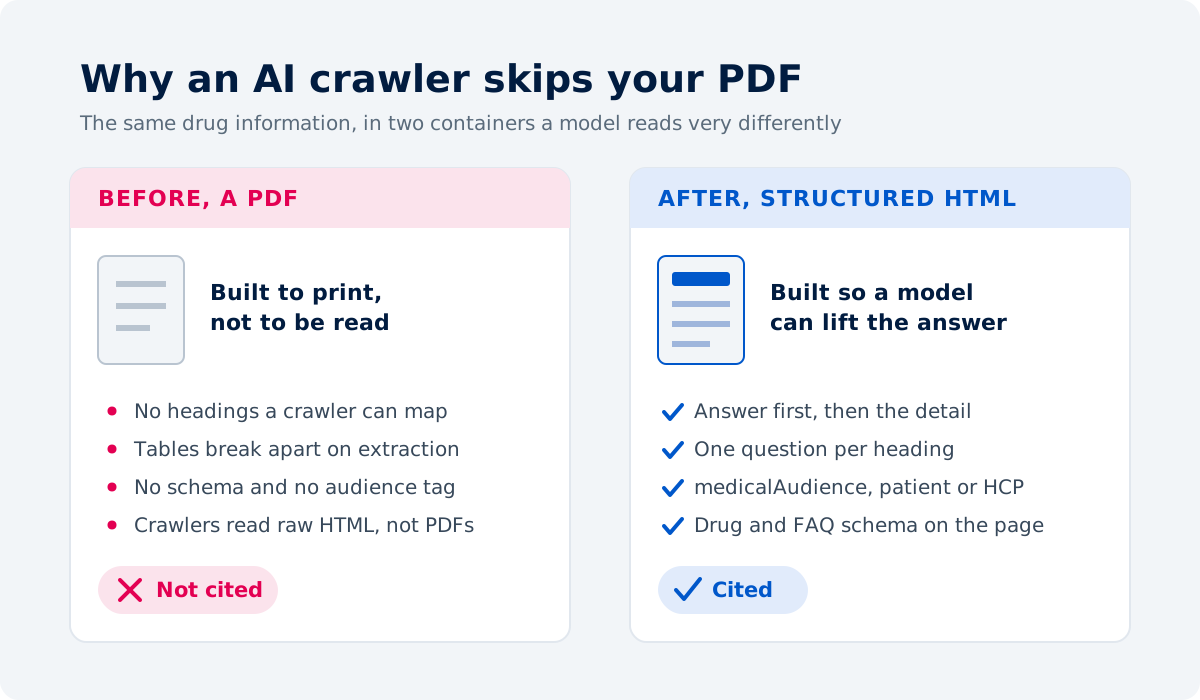
A PDF fails that test by its nature. As one engineer building a document pipeline put it, a PDF is a presentation format, not a data format; extracting meaning from it is reverse-engineering a printed page, not reading structured content. A dosing table locked in a PDF has no markup that tells a model "this is the dosing section." An HTML page with a plain heading does.
This is not just a pharma complaint. A peer-reviewed 2025 study that built an AI assistant over a real policy PDF found that naive PDF chunking fragmented coherent passages and disregarded the document's structure, and that citation accuracy only reached an acceptable level after the team rebuilt the content to preserve headings and sections. The lesson for a pharma marketer is direct. HubSpot's AEO guidance states the rule: AI crawlers rely on HTML, and content that only makes sense in the context of a whole page, or only appears after scripts run, is hard for a model to quote and easy for it to skip. As XDS Health puts it for safety data specifically, if your safety profile exists only as a PDF, AI tools answer safety questions without your official language in the mix at all.
You publish nothing at the decision stage for AI to cite
The third cause explains the most alarming number in our data, the near-zero share of decision-stage AI answers. It is not that the models refuse to cite pharma at the decision stage. It is that pharma publishes almost nothing there for them to cite.
About 33 percent of pharma content producers, 1 in 3, run no decision-stage content at all, in our pharma analysis. Buyers who arrive ready to compare and choose find nowhere on the brand site to land, so they bounce or get redirected to a third party that answers with no input from the company. Life sciences looks the same: only about 1 in 5 pieces helps a buyer actually decide.
Follow that through and the 0 percent stops being a mystery. A model cannot cite a comparison, a decision guide, or a straight answer to "which option fits which patient" if the brand never wrote one. The awareness content exists, which is why pharma earns its 1 in 3 share at the top. The decision content does not, so at the bottom the answer gets built entirely from someone else.
How pharma comes back to AI search, in four steps
Every cause above has a fix, and none of the fixes requires a bigger content team or a new campaign. They require restructuring and reinforcing content you mostly already have. Here is the order that works.
Step 1, Convert your buried PDFs into structured HTML pages
Take the content trapped in your most important PDFs and republish it as structured HTML answer pages a model can read and quote. This is the single cheapest win available, because the substance already exists and already passed review. You are changing the container, not the claims.
Picture a standard before and after. The before is a prescribing-information or clinical-summary PDF: one long file, dosing and safety and mechanism laid out for print, no headings a crawler can map, tables that turn to soup on extraction, and nothing that lets a model lift a clean, self-contained answer.
The after is a set of HTML pages built so a machine can read them. A few things make the difference, and they belong to the page, not to a generic checklist:
- Lead each page with the answer, then explain. Put the direct answer to the question in the first lines, so a model can quote a passage that stands on its own without the rest of the page for context.
- One question per section, phrased the way people ask it. A plain <h2> naming the exact question is what a model maps a query onto.
- Tag the audience explicitly. Use medicalAudience in your markup to mark a page as patient-facing or clinician-facing, so the model knows which questions your page should answer and stops offering patient content to a physician query. The properties come straight from schema.org's MedicalWebPage type.
- Mark up the drug and the page with medical schema. Schema.org's Drug type carries the fields that identify a product cleanly, active ingredient, dosage form, prescription status, warnings, and the approving authority. A pharma-specific schema guide from Indegene maps which type fits which content, MedicalCondition for a disease page, ClinicalTrial for trial data, FAQPage for question-and-answer content.
- Get the trust signals right first. Of all the schema you can add, reviewedBy with a named credentialed reviewer, sameAs linking your entity to its authoritative profiles, and lastReviewed carry the most weight, per a detailed medical schema breakdown. Fix those three before anything else.
One nuance keeps this current. Google retired the FAQ rich result in its search listings in May 2026, so FAQ markup no longer earns a visual snippet. It is still worth deploying, because Gemini, Perplexity, ChatGPT, and Copilot still parse FAQPage content to map questions to answers. The point was never the snippet. It is the retrieval.
The compliance guardrail on all of this is simple. As DrugChatter notes, every answer-ready summary has to trace back to your approved prescribing information and label data, not to a marketing one-pager. That constraint is what makes Step 3 the real unlock, and it is coming.
Step 2, Earn authority on the sources AI already trusts
Since AI models cite a short list of trusted medical and clinical sources, the way back in is to make sure your drug is represented accurately on those sources, not to try to out-rank them. There is no G2 or Capterra for a medicine. The pharma authority stack is clinical, and it is specific. Work it in this order.
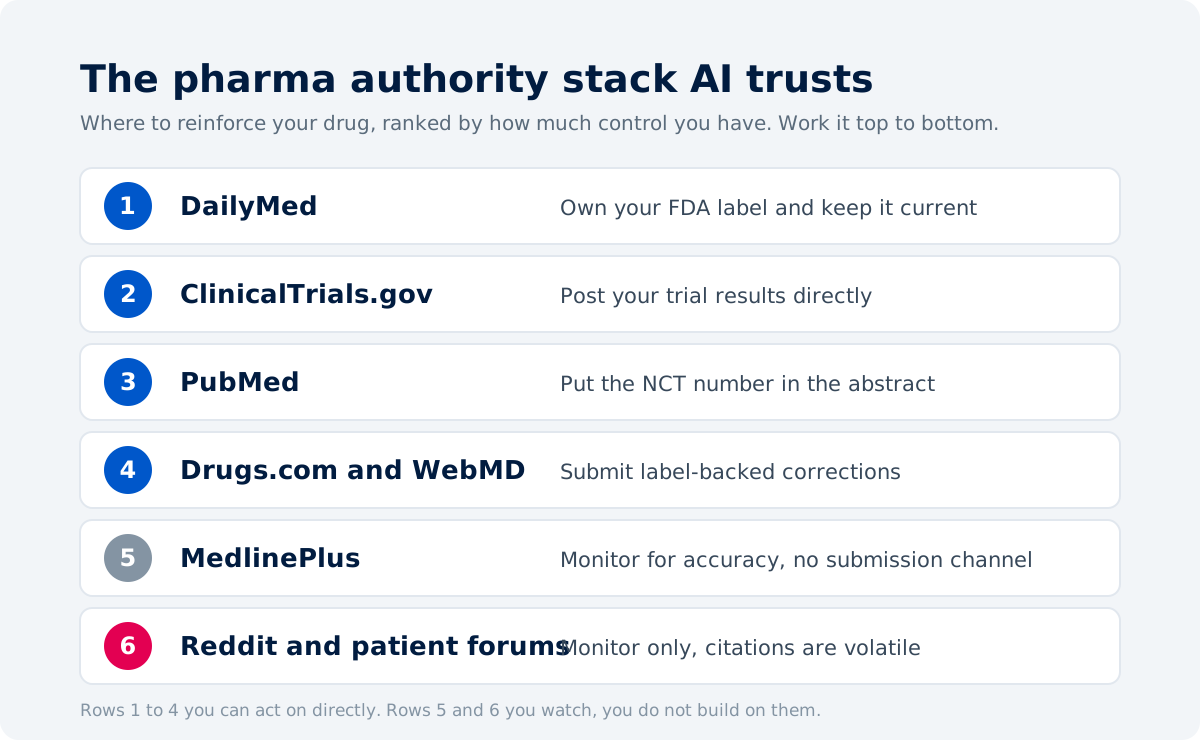
- DailyMed, own your label. Your FDA-approved labeling lives on DailyMed as a structured product label, machine-readable XML under a stable identifier that persists across every revision. This is the cleanest authoritative source a model can pull, and it is entirely within your control. Keep the label current and know its identifier. A structured label on DailyMed beats the same label as a PDF on your own site every time.
- ClinicalTrials.gov, post your results directly. Do not wait for a journal. A peer-reviewed JAMA Network study found that trial results reach the public through ClinicalTrials.gov a median of about seven months faster than through a PubMed-indexed publication. For many trials, a decade-in review found, the registry is the only public source of results that exists. Posting results puts your data into a structured, trusted, retrievable record while the journal pipeline is still running.
- PubMed, confirm the trial link. A published trial article becomes cross-linked and discoverable when its NCT number appears in the abstract, which PubMed indexes automatically, per the linkage mechanism documented in PLOS ONE. Have your publications team check that the NCT number is in the abstract, not just the body.
- Drugs.com and WebMD, correct the record. These consumer sources carry errors, and you can fix them. A peer-reviewed study across 11 pharmaceutical companies reviewed drug summaries on five common online compendia and found a median of 782 errors per compendium, concentrated in dosing, patient education, and warnings. The companies' standard practice was to submit correction requests backed by their own approved prescribing information. Both sites take them: Drugs.com commits to correcting content errors within 48 hours of notice, and WebMD posts corrections it accepts. This is a real, documented channel, not a theory.
- MedlinePlus and condition communities, monitor only. MedlinePlus is a high-trust NLM service worth watching, though it does not take manufacturer submissions the way Drugs.com does. Patient communities and Reddit are where a lot of AI citation currently comes from, and where it is least stable. ChatGPT's citations of Reddit fell roughly 80 to 86 percent in a four-day window in August 2026, even as Reddit stayed present in Google's AI Overviews and Gemini. Treat these as signals to watch, not a foundation to build on, because you do not control them and they move.
Our own data shows how much of this pharma leaves on the table. Only about 1 in 4 active pharma sites uses PR or syndication to place content off its own domain, and only about 3 in 5 cite external authoritative sources in their content, which is a free credibility signal the other 2 in 5 skip. Off-domain authority is the cheapest reach lever the industry underuses.
Step 3, Publish decision-stage answers using language MLR already approved
This is the fix that closes the 0 percent, and it is the one competitors gesture at without solving. The reason pharma has no decision-stage content is not that marketers do not want it. It is that new claims mean a new medical, legal, and regulatory review cycle, and those run long. So build the decision-stage answer pages out of language that already cleared review, and the cycle mostly disappears.
Pharma already has a discipline for exactly this. A peer-reviewed study in JMIR AI, drawing on a survey of 33 pharmaceutical Medical Information departments through the phactMI consortium, documents how these teams build Scientific Response Documents. The method is two steps: extract key sentences directly from already-approved and published sources, then summarize and paraphrase without introducing new claims. The surveyed departments produce hundreds of these documents a year. The capability is sitting inside your own Medical Information function, pointed at one-off inquiries instead of at your website.
The regulatory logic is what makes this safe. As the MLR-technology firm Juncture explains, a claim that already survived review, extracted and recombined, is not a new claim; a sentence an AI writes fresh is a new claim and needs full review. So you assemble decision-stage pages from approved building blocks, your label, your published trial data, your cleared standard responses, and the review is a check of recombination, not an approval of new assertions. Most large teams already keep these blocks in a claims library in their existing content-operations setup.
This is not hypothetical. It is how PharmaForward took the oncology brand from earlier in this piece from an AI Visibility Index of 0 to 82 in 60 days, with the first citation landing at week five. No new copy was written. The content was assembled from language that had already passed review, restructured so the models could read it.
Step 4, Measure AI visibility as an ongoing audit, not a one-time fix
Treat AI search visibility as something you monitor, not a project you finish, because the sources AI pulls from keep shifting. The Reddit citation collapse in a single week is the clearest reminder that a snapshot goes stale fast.
This is where the self-test from the top of the article becomes a standing instrument. Run the fixed query set on a schedule, and price what you find. When we audit content, we treat AI-search invisibility as a measurable leak: the share of category prompts where the brand is absent, run through the same funnel math as any other gap, so the cost of being missing shows up as a number a CFO can read rather than an adjective. Presence at the top of the funnel and absence at the bottom is not one problem; it is a set of specific queries where a competitor or a third party is answering in your place, each one countable and each one addressable.
Monitoring also tells you when a fix worked and when a source moved. The point is not a one-time cleanup. It is a system that keeps your approved language present in the answers your buyers actually read.
Give your pharma content a job in AI answers
The ground under pharma search has already moved. The AI answer sits on 75 percent of pharmaceutical searches and on effectively every industry query, and it is written from clinical registries, medical databases, and third-party sources, not from your brand site. Your content still exists, still cost real money, and now does very little of the job it was bought to do, because it is invisible exactly where buyers decide.
The way back is not more content. It is giving the content you already have a job in AI answers: restructured from PDF into HTML a model can read, reinforced on the clinical sources AI trusts, extended to the decision stage using language that already cleared review, and monitored so it stays present as the answer layer shifts. That is a modernization of how your content operates, in the same family as moving records onto a system of record, not a campaign.
It works when content runs as infrastructure rather than decoration. In an adjacent corner of life sciences, we built an education-led content system for Westlab, a lab-supply company selling into a narrow technical market on cold outbound. Structured, problem-led content turned that motion into inbound: 241 inbound leads and $120,000 in influenced quotes in three months, 40 pieces shipped in two, and an 869 percent return on the content investment. Pharma is more regulated, and the mechanism is the same. Content that is structured, authoritative, and present where buyers look does the pre-sales work the brand used to pay for one conversation at a time.
Start with the test. Run your fixed query set through the AI engines this week, look at your decision-stage number, and you will know exactly how much of your market is being answered by someone else. Then give your content its job back. If you want the full picture, our State of Content Marketing in Pharma 2026 and for Life Sciences 2026 show where the whole industry stands, and where the openings are.
Could your already-approved language be answering the AI questions your buyers ask?
Get a Content RevOps audit, your AI-search visibility scored query by query, your PDF and decision-stage gaps priced, and a path to bring your content back into the answers, with the assumptions printed next to every number.
Frequently Asked Questions
About the Author

Founder & CEO, Content RevOps
Stefan Kalpachev is the founder and CEO of Content RevOps, where he helps B2B SaaS companies transform their content into predictable pipeline. With a background in content marketing and revenue operations, Stefan has developed a unique methodology that bridges the gap between content creation and revenue generation.
Connect on LinkedIn