Pharma marketing analytics and ROI, connecting content to pipeline
Most pharma sites cannot connect a single download to a sales conversation. Want to see where your content leaks pipeline?
Book a CallPharma marketing analytics is two different jobs wearing one name, and that is why the answers you find online rarely fit your problem. One job measures prescribing behaviour at enterprise scale. The other job proves your content generates qualified sales conversations. This guide is about the second one, and about the plain reason most pharma teams cannot do it yet. The measurement plumbing is missing, so the content has no way to reach pipeline, which makes this a marketing automation problem before it is a reporting one.
Part of Content Marketing for Pharmaceutical Companies.
If you lead marketing at a pharma or life science company and you have been asked to prove that content drives revenue, this is the decision guide for you. It tells you what to measure, what to install first, and where to start at your level of maturity.
What is pharma marketing analytics, and why does the term keep confusing people?
Pharma marketing analytics splits into two jobs that need completely different data. The usual thinking treats them as one, which is why the term confuses people.
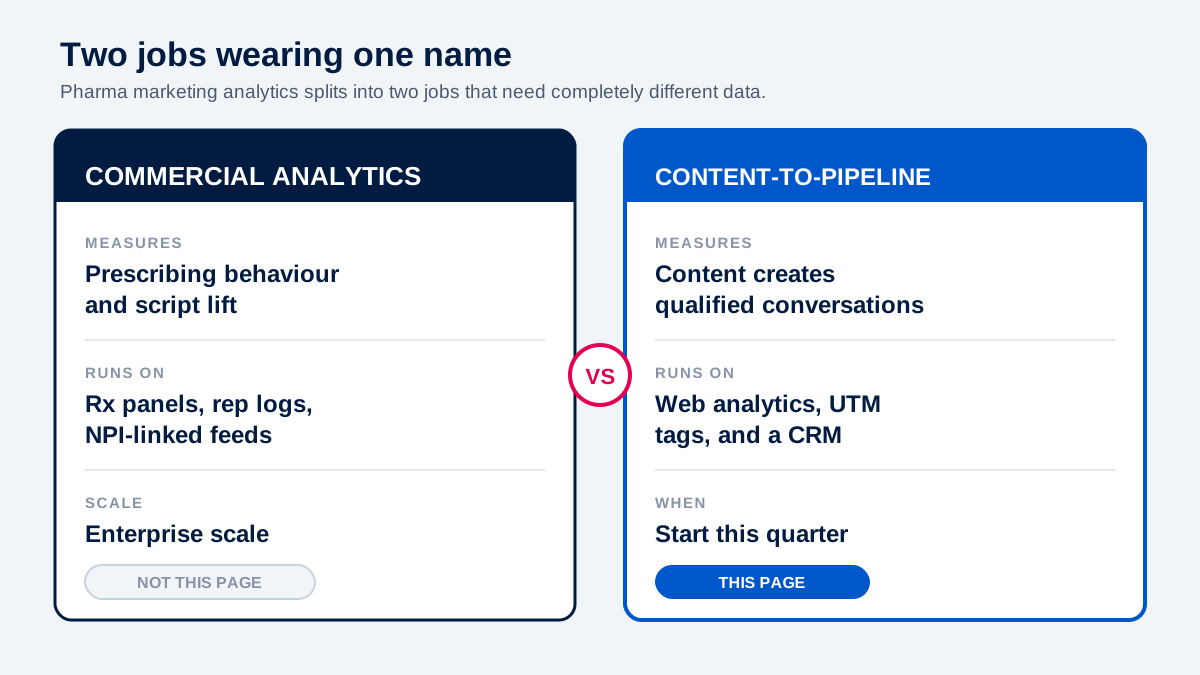
The first job is commercial analytics. It measures prescribing behaviour and script lift. It runs on data a content team never touches, contracted prescription panels, rep activity logs, and media spend, often linked by prescriber NPI. This is the world of "pharma sales and marketing analytics" and "pharma market analytics," and it is enterprise-scale. Marketing mix modeling here works backwards from aggregate weekly prescription totals, and true HCP-level attribution needs promotion feeds linked to Rx feeds. As one industry explainer puts it plainly, clicks on an HCP email are not prescriptions. Different data, different job.
The second job is content-to-pipeline measurement. It proves your content creates qualified conversations, and you can start on it this quarter with web analytics, UTM tags, and a CRM. No script panels, no patient data. This page owns that second job, and it is the measurement layer underneath every tactic in our guide to pharma content marketing tactics that compound.
The four types of analytics, in one breath
People arrive asking about the four main types of marketing analytics, so here they are. Descriptive analytics tells you what happened, diagnostic tells you why, predictive tells you what is likely to happen, and prescriptive tells you what to do about it, each rung building on the one below. For proving content ROI, you need the first two rungs done well, not a prescriptive AI model. Knowing which whitepaper turned into a sales call is descriptive and diagnostic work. That is where the value sits for a lean pharma team, so that is where this guide stays.
Why cannot most pharma teams prove their content drives pipeline?
Most pharma teams cannot prove content drives pipeline because they never instrumented it. You cannot attribute what you do not measure, and the measuring tools are simply not installed.
In our analysis of pharma websites, we could detect web analytics on only about 3 in 10 sites. A CRM showed up on fewer than 1 in 12. Those two systems are the prerequisites for any attribution at all, and most pharma sites are missing at least one of them. It is the same infrastructure gap we mapped in marketing automation for pharma, seen from the reporting end.
Put the CRM number the same way round as the wider B2B world, so it reads straight. Roughly 1 in 12 pharma sites has a detectable CRM, against more than half of high-growth B2B firms that run one. In that same B2B benchmark, web analytics and tag management are basic table stakes, present on about 79% of firms. Pharma sits well behind the general B2B floor on the exact systems that make revenue measurement possible.
The pressure has arrived anyway. Data and analytics is now a named skill in about 64% of life-science marketing roles. Companies now hire people to prove ROI without giving them the instrumentation that would let them. Even the better-instrumented B2B average now names measuring content results one of its biggest challenges, so pharma with the plumbing missing has no chance of it by accident.
This is the modernisation gap in one picture. The content exists. It just has no measurement job, so it cannot report back what it earned.
Do you even need a CRM to measure content marketing ROI in pharma?
Yes. Without a CRM the content has no way to become a tracked conversation, so ROI stays a guess. That is the whole prerequisite, stated once, and the rest of this section answers the harder question no competitor does. How do you link an anonymous content visitor to a named CRM contact inside pharma's constraints?
Your web analytics can tell you a page was read. Only the CRM can tell you that read became a conversation and, later, revenue. It is the difference between a page view and a lead pipeline you can forecast against. Two clean mechanisms join the two, and neither one touches patient or prescription data.
The gated form that stamps its own origin
The first mechanism identifies the person who raises their hand. Build the landing page with UTM tags, so the link carries its source, medium, and campaign. Those values drop into hidden fields on the gated form. The moment a reader downloads your whitepaper or registers for your webinar, the new CRM lead is stamped with exactly where it came from.
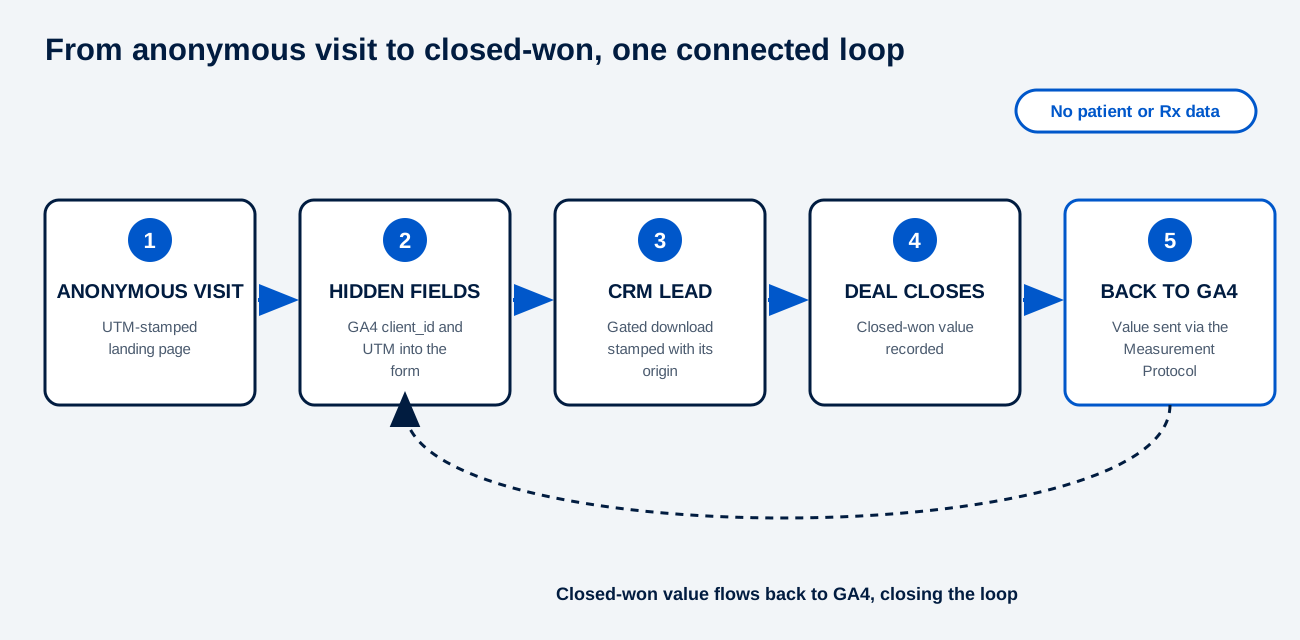
Pass GA4's client_id into a second hidden field, and the anonymous browsing session and the named CRM record join on one shared key. When that deal later closes, send the value back to GA4 through the Measurement Protocol. Now the loop runs the whole way, from a first page view to a booked revenue number. This path works for every pharma team, needs no special data, and takes a few hours to wire up.
We saw this pay off with Westlab, an adjacent life-science proof; Westlab sells to lab scientists, not prescribers, so it is not a pharma or HCP campaign. Engagement and readiness signals from the content hub, handed to sales through an enriched CRM, told the team which leads were genuinely serious. The download was the start of the funnel, not the finish line. Pipeline was made when the CRM caught the lead and a fast follow-up ran.
Naming the company for everyone who never fills a form
The second mechanism covers the majority who read and leave without converting. A JavaScript tag matches session network signals against reverse-IP and firmographic databases to name the company, not the person. In one study of 1.2 million sessions, about 47% resolved to a company and only about 7% to a named individual, which tells you what account-level identification can and cannot do. It gives you the account, so sales knows which target companies are reading, even before anyone raises a hand.
Both mechanisms live entirely on the marketing side of the compliance fence. No Rx data, no claims data, no patient data. Attribution in pharma is a company-and-consent problem you solve with tagging and a CRM, and it is a very different thing from patient tracking.
What is the minimum analytics stack to prove content ROI in pharma?
The minimum stack to prove content ROI in pharma has four parts, and you need all four before any modelling is worth attempting. Treat this as a decision list, not an install manual.
- Web analytics, configured correctly. GA4 for the web layer, set up to exclude any personal data.
- UTM discipline. One agreed tagging taxonomy so every link is attributable back to a campaign.
- A CRM the content connects to. The place a reader becomes a lead, then a deal.
- A defined conversion event. A gated download, a webinar registration, or a demo request that marks the hand-raise.
That fourth item is the cheapest fix in pharma and it is mostly absent. In our analysis, about 1 in 5 pharma content pages end with no next step at all, and around 55% use a generic call to action regardless of the reader's funnel stage. A page with no conversion event cannot convert, so measurement has nothing to catch, and the conversion layer is where a pharma marketing strategy usually leaks first.
UTM discipline is the boring item that decides everything
Tagging is unglamorous, and it breaks more reporting than any regulator does. GA4 reads UTM values as case-sensitive text, so Email and email become two separate rows. One untidy team splinters a single channel into dozens of variants that will never roll back up.
The fix is a small governance framework, not a heroic effort. One owner. One approved value per concept, linkedin rather than LinkedIn or li. A link builder that serves those values as dropdowns instead of a free-text box, plus a monthly check of GA4 to catch drift.
At enterprise scale the same point holds. In a Claravine webinar on pharma marketing data, Tom of Forge DC and Marybeth of Novartis explained at 24:05 that measurement starts with tagging and taxonomy consistency across dozens of brands and nearly a hundred websites before any analytics can be trusted. Whether you run one site or a hundred, the tagging comes first.
Can you just use GA4?
For the web layer, yes, with two honest limits. GA4 gives you an event taxonomy you define, Consent Mode so denied-consent traffic still gets counted through modeled data, and a free BigQuery export of raw event-level rows you can join to CRM records on client_id. In a regulated setting that raw export matters, because the reporting screen hides small segments under a thresholding rule and shows "data not available."
The hard rule is that GA4 must never collect personal or health data, and user consent does not exempt you from HIPAA. No names, emails, or appointment IDs in URLs or events, ever. And GA4 on its own still cannot tell you a download became a deal. That is the CRM's job, which is why the CRM sits in the stack beside it.
Why does your pharma traffic look good but still not prove revenue?
Your pharma traffic can look healthy while proving nothing, because most of it is demand you already created rather than content generating new demand. This is the branded-traffic trap, and no competitor names it.
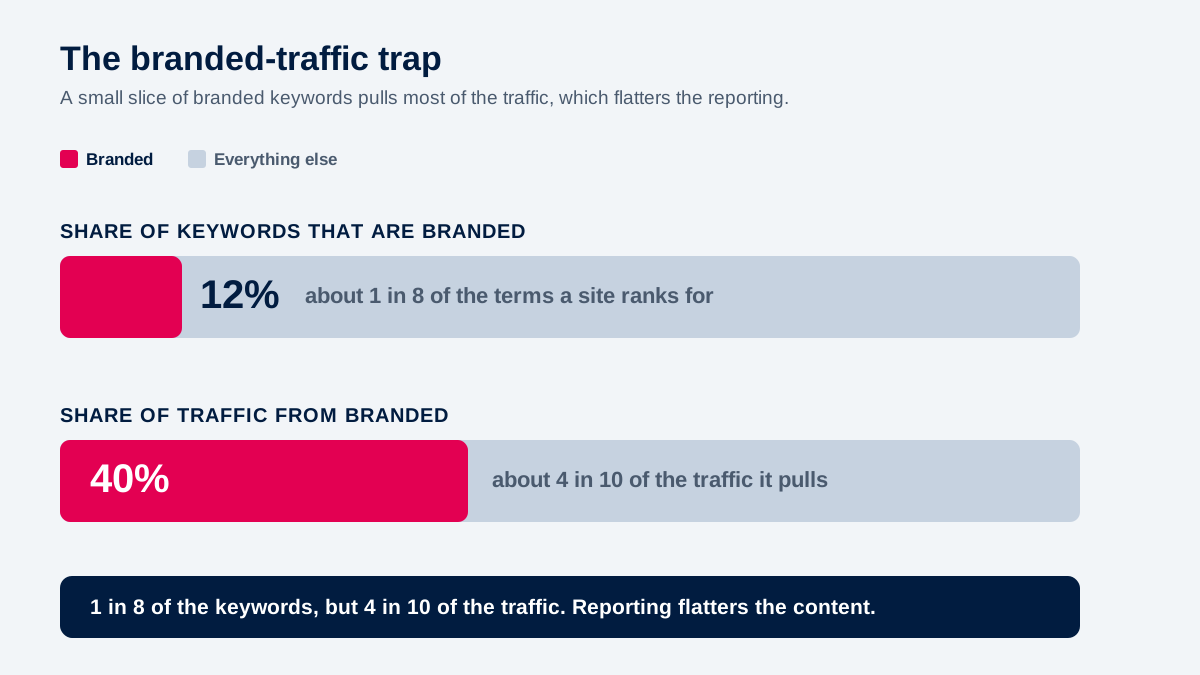
In our analysis of pharma sites, branded keywords make up only about 1 in 8 of the terms a site ranks for, yet they pull about 4 in 10 of its traffic. People searching your drug or company name were already looking for you. When that traffic fills your dashboard, reporting flatters the content, and the content gets credit for demand it did not build.
The mix underneath makes it worse. Only about 2% of the keywords pharma sites rank for sit at the bottom of the funnel, while roughly 95% sit at the top, a split we break down in the pharma SEO performance benchmarks. The traffic that looks like content performance is mostly early-stage and non-commercial, a long way from a buying decision.
There is a second failure mode, and it is sharper. You can measure the right metric on entirely the wrong audience. In a Fierce Pharma conversation on measurement, Joshua Alvernaz, the CEO and founder of Ringle, told publisher Rebecca Williamson at 6:39 that most of the clicks from a campaign came from patients, not prescribers, so the team was measuring clicks and engagement while missing the audience entirely. Healthy engagement from the wrong people is not pipeline. It is noise that reads like success, and it is why HCP content marketing needs its own audience check before any reporting is believed.
Is it compliance or your own systems stopping you from measuring content ROI in pharma?
It is almost always your own systems. Compliance is the alibi teams reach for, and it hides the real blocker, which is disconnected systems and a missing CRM link.
The dominant story in pharma is that regulators are why nobody can measure. In the same Claravine webinar, Tom and Marybeth pushed back at 1:26, saying that people claim compliance slows things down, but that is not entirely true; disconnected systems, teams not working together, and manual processes slow things down even more. Our own figures point the same way. Analytics on about 3 in 10 sites and a CRM on fewer than 1 in 12 is a systems gap, not a regulatory one.
It helps to separate two things readers pile together.
- MLR review is a real process drag. It slows how fast you can publish. As one pharma marketer put it on Reddit, the real bottleneck is MLR review cycles killing campaign momentum, and most brands underperform because of slow approvals, not poor channel choice. That is a genuine cost, and it lives in the approval workflow.
- Measurement plumbing is a different problem. Missing analytics, missing tags, and a missing CRM link are what break attribution, and none of them sit inside the MLR queue.
Only the second problem is the one this guide fixes. Measurement can sit entirely outside the MLR-governed path, because approval workflows govern creative and claims, not counting. "Compliance blocks measurement" is a category error. Your architecture blocks measurement, and you control your architecture.
Which content metrics count as pipeline signal, and which are vanity, in pharma?
The pharma content metrics that count are the ones tied to a person moving toward a sale. The vanity metrics are the ones that count crowds. Sort every number you report into one of those two piles, the same test we apply to demand generation metrics worth tracking.
Funnel stage | Pipeline signal (report this) | Vanity (stop leading with this) |
Awareness | New non-branded organic entries | Raw sessions, impressions |
Consideration | Engagement depth, return visits, resource downloads | Branded search traffic, social likes |
Decision | Gated conversions, sales-accepted leads, influenced pipeline | Total pageviews, bounce rate alone |
The test is simple. If a metric goes up when a stranger who will never buy shows up, it is vanity. If it goes up only when a real potential buyer takes a step toward you, it is signal. Our guide to reporting on content marketing success sets out how to present that split to a leadership team without losing the room.
Putting a money number on one download
Content ROI becomes real when you price a single outcome. The way we do it is to run a short chain with visible assumptions, so anyone can check the math. Take the qualified leads a piece produced, apply a lead-to-customer rate, then multiply by the average deal value for that product line. A common working set is about 2% of visitors becoming leads and about 20% of leads becoming customers, but you swap in your own rates.
This maps onto a clean funnel with named stages, aware, interested, engaged, and marketing-qualified lead, and one tight definition of what an MQL actually is. Once those stages carry timestamps in the CRM, the money number stops being a story and becomes arithmetic, which is the same discipline behind how life science companies justify and measure marketing spend.
Westlab, again the adjacent life-science proof and not a prescriber campaign, shows the payoff. The content hub drove 241 inbound leads in three months and about $120,000 in influenced quotes, a return on content investment of roughly 869%. Content-engagement signals separated the serious buyers from the browsers, so sales spent time on the right conversations. That only worked because an instrumented CRM was there to catch and score each lead.
MMM, MTA, GA4, or incrementality, which pharma marketing analytics approach do you actually need?
For most lean and mid-size pharma teams, the honest answer is a connected GA4 and CRM baseline first, and nothing fancier yet. Our own data is why. Most pharma teams sit nowhere near the data volume the advanced models assume, with only about 2% of ranked keywords at the buying stage and analytics missing on most sites. Choosing a heavy model on thin data gives you confident-looking noise, not truth.
Here is what each approach is actually for.
Approach | What it answers | What it needs | Who it is for |
GA4 + CRM | Which web activity became a lead and a deal | Web analytics, UTM tags, a CRM | Every team, from day one |
MTA (multi-touch attribution) | How to split credit across touches inside a channel | Clean user-level tracking | Teams with steady conversion volume |
MMM (marketing mix modeling) | How offline and online spend together move outcomes | Years of weekly data, real spend per channel | Large budgets only |
Incrementality / geo tests | The true causal lift of one channel | A controlled 4 to 8 week holdout | Any team, one channel at a time |
The spend rule is short. Under about $1M in media spend, use GA4 and CRM attribution plus the occasional geo lift test, and only consider MMM once you are past roughly $5M. Below the first threshold, MMM has nowhere near enough data to say anything reliable. Above the second, its ability to value offline spend starts to earn its keep.
Offline spend is the real tension for pharma. In an EMARKETER discussion on pharma marketing, senior analyst Rajiv Leventhal and Tap Native's Rafael Cosentino noted around the 5:00 mark that healthcare and pharma spend the most on linear TV of any industry EMARKETER measures, because the target populations skew older. That heavy offline spend is exactly what pure digital attribution cannot see, and only MMM can. Yet MMM needs data volume a lean team does not have. So the honest move is to measure the digital-to-pipeline slice well rather than chase a full-mix model you cannot feed.
Do you need a pharma marketing analytics platform?
Probably not yet. A full marketing analytics platform bundles identity resolution, cross-channel attribution, real-time activation, and unified reporting, and assembled enterprise stacks run into six figures a year. A lean team's honest baseline is GA4, a free or low-cost CRM, and a simple dashboard for well under $50 a month. Configuring that baseline takes hours, while a comparable custom pipeline takes months.
The trap is buying the platform before you have the baseline it assumes you already run. A pricey tool that sits unused reports less than GA4 with disciplined tagging and a connected CRM. Buy the baseline, prove it works, and reach for a platform only when your data volume genuinely outgrows off-the-shelf tools. The same sequencing applies to omnichannel marketing in pharma, where the platform usually arrives before the layers it depends on.
Where should you start with pharma marketing analytics at your level of maturity?
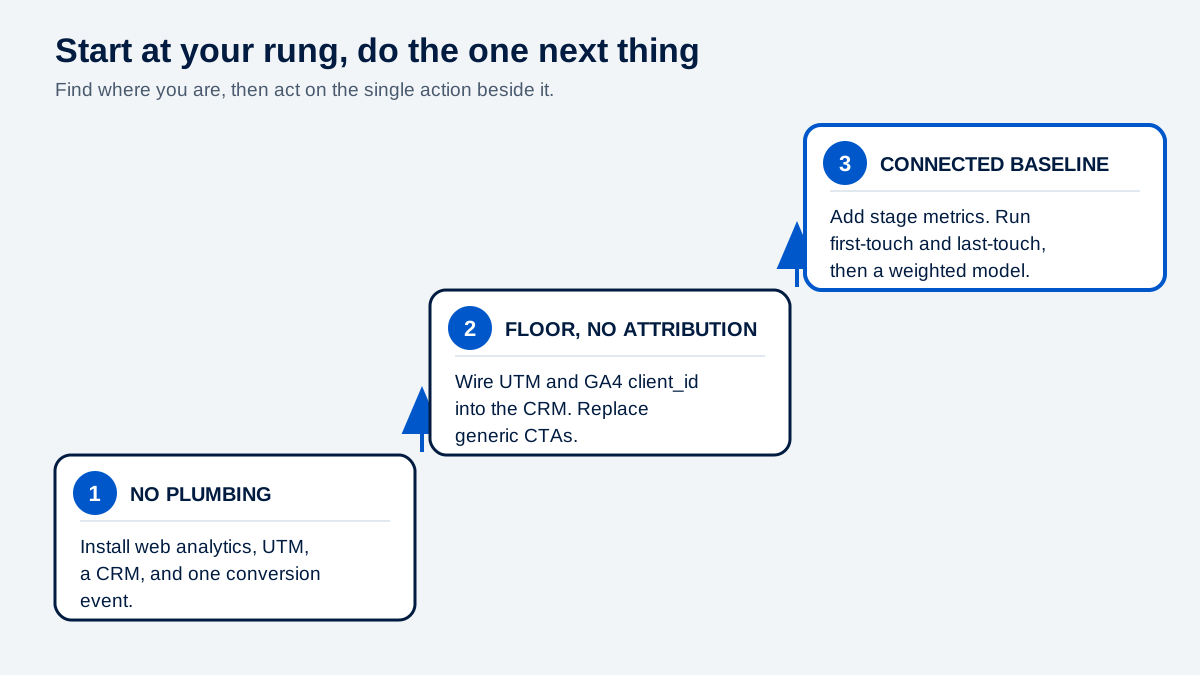
Start at the rung you are on, and do the single next thing rather than the whole ladder. The point of all of this is to give your content a real job, measured in pipeline, so it stops being a cost and starts reporting revenue. Find your rung below and act on the one action beside it.
You have no plumbing yet
If your site is close to a brochure, with no analytics and no CRM, your job this quarter is to install the floor. Put in web analytics, agree one UTM taxonomy, connect a CRM, and define a single conversion event on your best-performing page. Nothing else matters until a reader can become a tracked lead.
You have the floor but no attribution
If analytics and a CRM exist but nothing connects the content to a deal, your job is to wire them together. Pass the UTM values and the GA4 client_id into the CRM on your gated forms. Then fix the conversion layer, because about 55% generic calls to action and 1 in 3 pharma sites with no decision-stage content at all are leaking the pipeline you already earned. Replace generic CTAs with intent-matched next steps.
You have a connected baseline
If content already feeds an instrumented CRM, your job is to layer measurement on top. Add stage metrics, tighten your MQL definition, and run first-touch and last-touch attribution side by side before you attempt anything heavier. Graduate to a weighted model only once your CRM carries clean lead-creation and opportunity timestamps.
Wherever you start, the destination is the same one Westlab reached as an adjacent life-science proof, where a connected baseline turned content into a roughly 869% return on content investment. The content did not change. It finally had the plumbing to prove what it was worth. Pick your rung, do the one action, and measure it.
Is your pharma content reporting revenue, or just traffic?
Get a Content RevOps audit, your funnel shape, measurement gaps, and AI-search visibility benchmarked against the pharma 2026 data, with every gap priced in numbers your CFO can argue with.
Frequently Asked Questions
About the Author

Founder & CEO, Content RevOps
Stefan Kalpachev is the founder and CEO of Content RevOps, where he helps B2B SaaS companies transform their content into predictable pipeline. With a background in content marketing and revenue operations, Stefan has developed a unique methodology that bridges the gap between content creation and revenue generation.
Connect on LinkedIn