AI in pharma marketing, where it helps and where it is just language
Most AI spend in pharma marketing chases the loud claims, not the real wins. Want to see where AI actually moves your content pipeline?
Book a CallPharma marketing has adopted the language of AI far faster than the practice of it. Look at what pharma marketing teams actually hire for and the gap is easy to see. AI shows up as a word in about one in five pharma marketing job posts. Generative AI, the specific new thing everyone is talking about, shows up in only about one in twenty-eight. A named tool a marketer would actually open, like ChatGPT or Copilot, shows up in fewer than one in sixty-five. The gap matters most in content marketing, which is the part of the job AI is supposed to have already changed.
Part of Content Marketing for Pharmaceutical Companies.
So most of what gets called "AI in pharma marketing" today is vocabulary, not operating reality.
That is not a criticism. It is the thing you need to know before you spend a budget or restructure a team. AI is real in a few corners of pharma marketing, where it genuinely changes what content costs and how fast it ships. It is mostly still a promise in others, where it sounds solved and is not. And it is changing one part of a pharma marketer's job that almost nobody is talking about.
This guide sorts the three apart, so you can tell the real from the language and put your money where the first is.
How much AI is actually in pharma marketing today?
Less than the noise suggests, and the shape of the gap is the whole story. When we read pharma marketing job posts for our state of content marketing in pharma report, AI in any form appeared in about one in five. That sounds like real adoption until you look at what kind of AI.
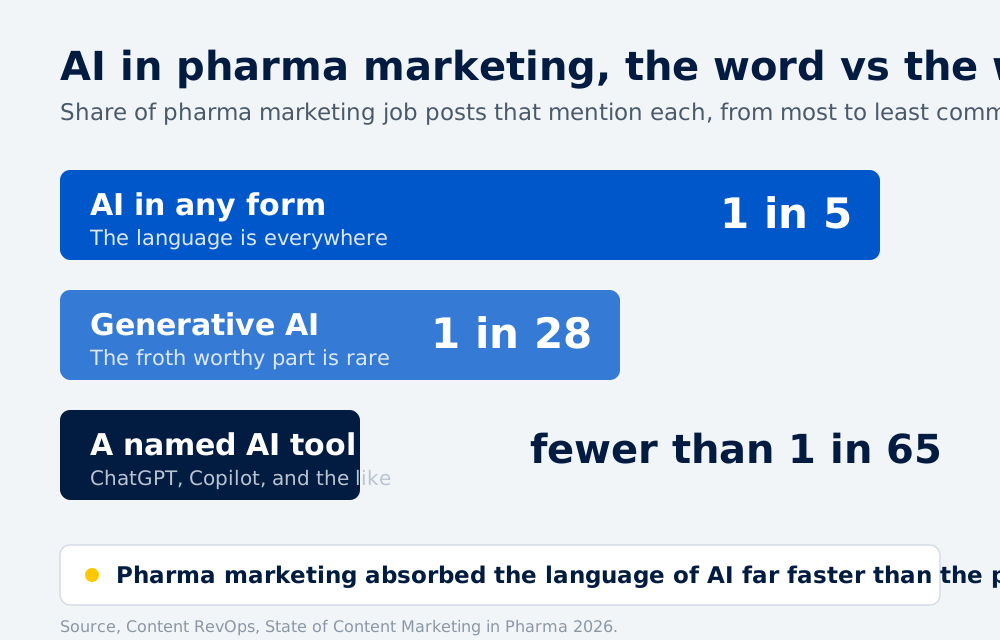
The mentions drop off a cliff as you move from the word to the work:
- AI in any form, about 1 in 5 posts. The language is everywhere.
- Generative AI specifically, about 1 in 28 posts. The froth-worthy part is rare.
- A named AI product, fewer than 1 in 65 posts. Actual tools in the workflow are rarer still.
Read top to bottom, that is a picture of an industry that has absorbed the language of AI faster than the practice. Roughly 18% of posts say "AI." Fewer than 2% name a tool a person would recognize. The word is in the room; the software mostly is not.
What pharma teams actually want from AI
Not magic. When pharma and life science teams do reach for AI in their hiring, the most common thing they ask for is automation and workflow help, named in about one in five posts, which is more than ask for frontier or generative AI at all. Teams want the boring win of doing routine work faster, not a robot strategist.
Who is experimenting, and who is holding back
The smaller and less regulated the company, the more it plays. AI shows up more often in the hiring of small life science firms than large ones, roughly thirteen percent of posts against seven. Big, governed enterprises move slowly on anything that touches a regulated claim, and their hiring shows it.
None of this is unique to how one firm sees it. When Trinity's TGaS Advisors surveyed the industry, they found that essentially every organization had adopted generative AI in some form, yet rated its real impact low, with innovation confidence averaging three out of five and every respondent calling themselves only "somewhat prepared." Universal adoption, limited impact. That is the language-faster-than-practice gap, measured a second way. It is also the pattern sitting under most of this year's forecasts, which is why we graded each of the 2026 pharma marketing trends against what the sector has really moved on.
The practitioners feel it too. On Viseven's Pharma Talks podcast, the team behind its content tool put it plainly: AI-driven pharma marketing is still in its early days. Believe the people building the tools before you believe the slides selling them.
The three things people call "AI in pharma marketing"
Part of the confusion is that one word, "AI," is doing three very different jobs. Untangle them and the hype and the reality separate on their own, because the claims that sound magical almost always sit in the newest, least proven bucket.
Classical AI and machine learning
This is the old, boring, real one. Machine learning has run inside pharma commercial teams for years, out of the headlines, doing targeting, next-best-action recommendations, and predictive models that tell a rep which account to call. Tools like Veeva sit here. It works because it does one narrow thing on well-defined data. Almost nobody argues about it, which is exactly why it never makes the headlines.
Generative AI
This is the new one, and the source of nearly every 2023-onward claim you have heard. It drafts text, images, and video from a prompt. Content tools like Viseven's eWizard, plus general models like ChatGPT, Claude, and Gemini, live here. It is genuinely useful and genuinely unproven at scale inside a regulated workflow, which is a distinction the rest of this guide turns on.
Our own hiring numbers show where the froth actually sits. Almost all of it is in this bucket: generative AI appears in only about one in twenty-eight pharma marketing posts, and named generative tools in fewer than one in sixty-five. The loudest part of "AI in pharma marketing" is the part least present in real teams.
Agents
This is the mostly-future one. Agents are AI that acts on a goal without step-by-step instructions, the move from an AI tool to an AI coworker. In pharma marketing it is largely still in pilots and pitch decks. Treat any "autonomous agent" claim as a bet on next year, not a description of this one.
When a vendor says "AI," ask which of the three they mean. The answer usually tells you whether you are buying something that runs today or something that demos well.
Where AI genuinely helps pharma marketing
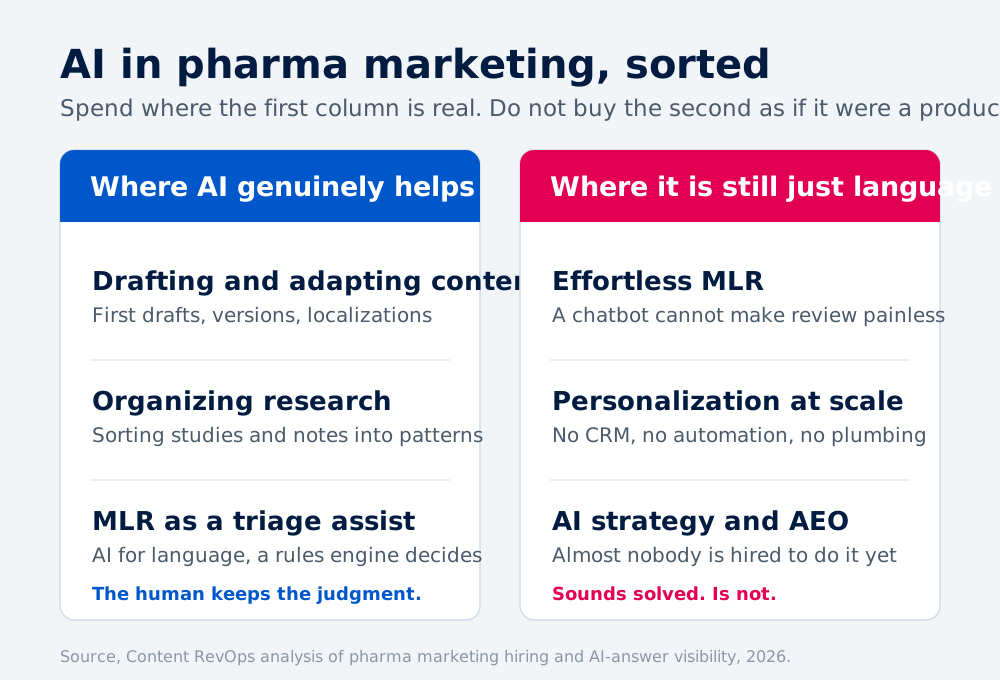
In a few places, AI is not hype at all. It changes what content costs and how fast it ships, and pharma marketing teams are already banking the gain. The pattern in every real win is the same: AI does the drafting and the sorting, and a human keeps the judgment.
Drafting and adapting content
This is the clearest real win in pharma marketing. Making a first draft, a second version, or a localized variant used to be slow and expensive. AI makes it fast and cheap.
The examples are concrete and named. Incyte and its agency Real Chemistry built a campaign called Unseen Journey that used generative AI to turn patient interviews into images of the hard-to-see symptoms of a blood cancer, so patients could show what they could not otherwise describe. At Childhood Cancer Canada, director of development Kyle Smith described generating medical illustrations "in 30 seconds or less" that used to be too costly to make at all, which is what let the charity build a site explaining forty-eight types of pediatric cancer.
We see the same economics in our own work. Working with Westlab, a life science manufacturer, a human-plus-AI production pipeline shipped forty educational pieces in two months without losing scientific credibility. That is the shape of the real win: not a robot writer, but a team that drafts faster and keeps its experts in the loop.
Organizing information and insight
The other honest win is sorting, not creating. AI is good at reading a pile of studies, market reports, or customer notes and pulling out the patterns, which saves a marketer hours of manual reading. The way we treat it in our own content work is simple: AI organizes and expands options, and a human decides. We draft the real thinking, the angles and the titles, by hand first, because AI left to generate ideas from scratch produces neat, plausible, edge-less work that says nothing.
The honest limit
AI drafts; it does not decide. That line is where the real wins stop. Graham Johnson, chief operating and product officer at IPG Health, gave the best description of it: AI is like a really promising intern, useful and improving, but the thing that keeps him up at night is trusting it to execute something faithfully in a context where a small misfire is not acceptable. In pharma, a plausible-but-wrong sentence is not a typo; it is a regulatory problem. So the drafting is real, the judgment stays human, and the teams getting value are the ones that keep both facts straight.
Where AI in pharma marketing is still just language
Now the other side of the sort. Some of the loudest claims about AI in pharma marketing sound solved and are not. Naming them is not cynicism; it is how you avoid buying a promise as if it were a product.
"Effortless MLR"
The single most oversold claim in pharma marketing AI is that it will make medical, legal, and regulatory review painless. The Viseven team, who build for exactly this problem, called it out on their own show: you always hear the promise of smoother MLR and effortless compliance, and it is a Utopia. Their warning is sharp; if AI just generates more content without following the approved structure, you are not speeding up approval, you are "speeding up the rejection process." A neutral industry read lands in the same place. The MM+M and Publicis Health 2025 innovation survey found that marketers are learning content generation alone does not remove the downstream bottleneck; speeding up production without speeding up approval only moves the constraint, it does not clear it.
Start with the real baseline. In Vodori's 2025 review benchmarks, the average pharma marketing asset took about fifteen days to clear review, and cycles got slightly slower year over year, not faster. That is the number AI is supposed to be crushing.
Is it? Mostly in pilots, not in production. Indegene, which sells MLR technology, is refreshingly clear that early adopters can cut cycle times, yet most success stories stem from limited proof-of-concepts or pilots, with real gaps when teams try to scale. The big cut-time numbers you see from platform vendors, like Veeva's reported 57% or Viseven's 30%, are vendor-reported and come mostly from redesigning the workflow and reusing pre-approved content, not from the AI itself.
The one production result worth studying proves the point. Klick's Guardrail tool, used across about fifty drug brands, cut average MLR time by sixteen days in one engagement. It works because it "uses AI where it helps, language handling and automation," and routes the actual compliance decisions through a rules engine, not the language model. AI for the language, a deterministic system for the decision. That is real MLR help. "Effortless MLR" from a chatbot is not.
"Hyper-personalization at scale"
This one fails on plumbing, not on ambition. Personalized content at scale needs somewhere to store who each customer is and something to fire the right message at the right moment. Most pharma marketing sites do not have it.
In our audit for the pharma report, fewer than one in twelve pharma sites ran a detectable CRM, and fewer than one in ten ran marketing automation. Without those, "AI-driven personalization at scale" has nothing to personalize through. You can generate a thousand tailored variants and still have no system to deliver them to the right person. The AI is the easy part; the infrastructure it needs is the part nobody is selling. If you are weighing that build, start with the automation stack decision rather than the AI layer on top of it.
"AI strategy" and answer-engine optimization
The tell here is the hiring. If pharma marketing teams were really building AI strategy functions, the job posts would show it. They do not. In our pharma data, AI-search optimization appeared in about one in two hundred posts, and answer-engine optimization in effectively none. The strategy talk is running well ahead of the roles that would make it real.
What AI search is doing to pharma marketing
Here is the part almost nobody in this conversation mentions. Every discussion of AI in pharma marketing treats AI as a tool inside the marketing team. Almost none asks what happens when the buyer's own search moves into AI answers. That shift is already underway, and it changes a pharma marketer's job more than any drafting tool does. We took that shift apart on its own terms in why pharma disappears from AI search.
The buyer has moved. As Jesse Wolfersberger, global lead of I/O Health at Weber Shandwick, put it, AI is now the first place people go to for answers, and that chat box has become the most important battleground in health. An AI answer box now sits on effectively every industry query we tracked.
Where pharma shows up, and where it vanishes
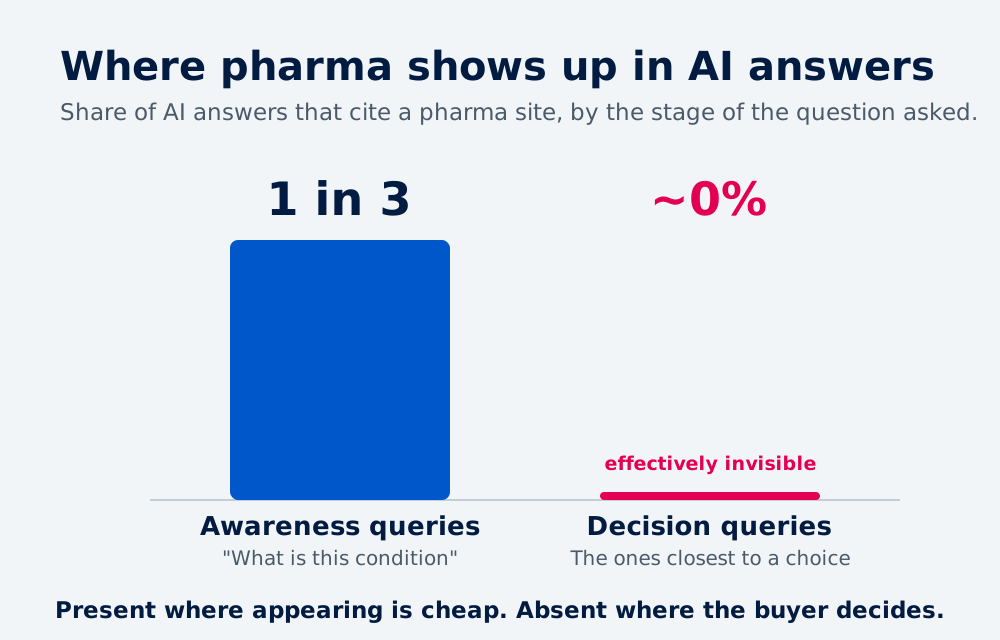
The demand-side gap looks exactly like the hiring gap. Our audit found pharma sites appearing in about one in three AI answers for awareness-stage questions, the "what is this condition" queries, and in effectively zero percent of answers for decision-stage questions, the ones closest to a choice. Pharma shows up where appearing is cheap and disappears where the buyer actually decides. That pattern is not unique to pharma, and it has a diagnosable cause: ranking on Google does not get you cited in an AI answer.
The reason is trust. AI engines lean on government and academic sources, the FDA, NIH, and the big medical institutions, and treat corporate blogs with suspicion. So earning a citation is not about being well known; it is about being structured and authoritative enough for a model to trust.
Some teams are already playing this game. Real Chemistry's Mary James described making clients' science-based information available in machine-readable formats so that when a patient asks, the model favors the accurate source. That is answer-engine optimization in practice, and with pharma sitting at zero percent on decision queries and nobody hired to fix it, the space is wide open for whoever moves first.
What a pharma marketing team should actually do with AI first
The sort points to a short list. You do not need an AI transformation program. You need to spend where AI is real, skip where it is language, and claim the one gap nobody else is working. In order:
- 1. Use AI where it drafts and organizes, and keep a human on the decisions. First drafts, versions, localizations, and reading through research are the real wins. The final call on any claim stays with your experts. Every production win, from Westlab to Klick, follows this split.
- 2. Fix the plumbing before you buy "personalization at scale." If you do not run a CRM and marketing automation, personalized content has nowhere to go. Build the infrastructure first; the AI layer on top is the cheap part.
- 3. Treat MLR AI as a triage assist, not a solved bottleneck. The gains are real when AI handles the language and a rules engine handles the compliance decision. They are a fantasy when a chatbot is supposed to make review effortless. Buy the first; ignore the second.
- 4. Claim the AI answer layer now, while it is empty. Pharma sits at zero percent on decision-stage AI answers and almost nobody is hired to change that. Structuring your best content to be cited is the highest-leverage move available, precisely because your competitors are still arguing about content generation.
There is a bigger reason this ordering matters. AI made producing pharma content cheap, which is exactly why so much of it now has no job. Faster content is not the win. Content that does a job, earns a citation, moves a buyer, holds up under review, is the win. AI is a good way to produce more of it and a terrible substitute for deciding what it should do. Sort on that, and the rest of the noise sorts itself. If you are rebuilding from the ground up, the pharma marketing strategy playbook and the tactics that compound are the places to start.
Is your AI spend landing where it helps, or where it just sounds good?
Get a Content RevOps audit, your content, search, and AI-answer visibility benchmarked against the pharma 2026 data, with every gap priced in numbers your CFO can argue with.
Frequently Asked Questions
About the Author

Founder & CEO, Content RevOps
Stefan Kalpachev is the founder and CEO of Content RevOps, where he helps B2B SaaS companies transform their content into predictable pipeline. With a background in content marketing and revenue operations, Stefan has developed a unique methodology that bridges the gap between content creation and revenue generation.
Connect on LinkedIn