Life science marketing trends for 2026
See what your own content is actually staffed to do, benchmarked against the same life science research behind this article.
Book a CallMost trend lists for the year ahead are predictions. They are written before the year starts, nobody can check them, and almost nobody goes back to see which ones happened.
Part of Content marketing for life sciences, the complete guide.
So we counted job postings instead, because a job posting is one of the few marketing artifacts a company writes down and attaches money to. We build content marketing programmes for life science companies, so what a company commits to hiring for tells us more than what it says it plans to do.
What came back does not look like the trend lists.
Life science companies are not buying marketing intelligence. They are buying the removal of work. Automation and workflow language appears in about 21% of postings, more than twice as often as AI language of any kind, in postings that can name both. The commitment the sector has actually made is a capacity purchase wearing an AI label, and that gap is why the trend lists and the job specs describe two different industries.
One thing to be straight about before any of the numbers land. This is a snapshot, not a time series. We are reading the year off what companies have committed to right now, and everything below is a contrast measured at one moment rather than a rate of change. For the sector's standing figures, what companies publish and how well it converts, the life science marketing statistics carry the base behind each one.
What are the main life science marketing trends for 2026?
Three contrasts run through the whole picture, and each one sets what the rest of the year looks like for a marketing team in this sector.
The contrast | What it rests on |
The channels sold as this year's story are not the ones companies staff | Omnichannel appears in about 13% of life science marketing postings, webinars in about 11% |
Automation is the language the sector hires against, more than AI | Automation and workflow language appears in about 21% of postings, AI or machine learning in under 9% |
The smallest companies name AI most often, not the largest | AI mentions run at about 13% in the smallest firms against about 7% in the largest, directionally |
The through-line is that the sector is answering a resourcing question rather than a technology question. Read together, the numbers describe a sector whose binding constraint looks like capacity rather than capability, which is the same conclusion the budget and headcount picture keeps arriving at from the other direction.
There is a fourth story, the move toward AI answers, and it is covered properly in our work on content marketing for life sciences, which is where the evidence and the fix both live. For pharma specifically, we ran the same exercise across eight forecasts and graded each one against what the sector has actually built, in new trends in pharma marketing for 2026.
Which life science marketing trends are companies adopting?
Start with how the counting works, because it decides how much weight any of this carries.
We read life science marketing job postings and counted a channel or capability only when a posting named it. Named, not implied, so every share below runs conservative. It is the same counting method we used on demand generation leadership roles across all industries. All of the shares here are shares of life science marketing postings specifically, and all of them come from a single scan rather than a year-over-year comparison.
The channels the sector actually names
What gets called a trend | Share of postings that name it |
Social media | ~32% |
Omnichannel or integrated marketing | ~13% |
Webinars | ~11% |
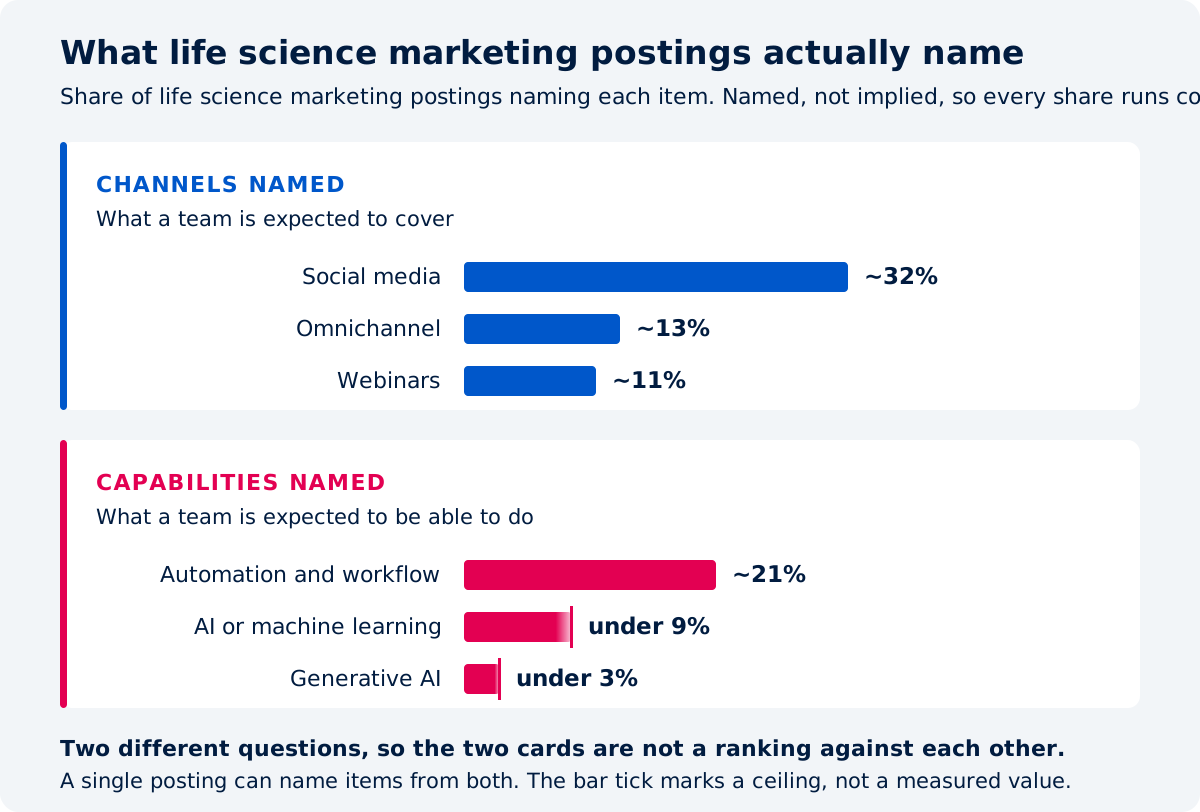
Omnichannel is the sharpest case. Every trend list calls it the defining trend of the year, and roughly one posting in eight names it. That is not a sector rejecting the idea. It is a sector that has heard the idea and has not staffed it, and those are different things with very different consequences for whoever is reading this and wondering why their omnichannel plan keeps not happening. Which of the two commitments a company should actually make, and what each one costs to run, is the subject of multichannel and omnichannel marketing in life sciences. The same shortfall shows up in account-based programmes, which need the same coordination layer and rarely get it.
Social media is the most-named channel in this table. At roughly a third of postings, it is a digital baseline rather than a funnel. The row describes a channel companies keep alive rather than one they build to convert.
Webinars sit at about one posting in nine, so the format is rarely staffed. We are deliberately not making a claim about whether webinars work in life sciences. No independent 2026 benchmark of webinar performance in B2B life sciences exists outside webinar platforms.
The wider market is adding channels while this one is not staffing them
The CMO Survey, which Duke University's Fuqua School of Business has run since 2008, now with Deloitte and the American Marketing Association, published its 35th edition in March 2026 reporting 308 US marketing leaders, 97% of them at VP level or above. It is cross-industry rather than life sciences, and it is explicitly non-commercial.
It found 57.6% of companies increasing the number of channels they use, adding digital channels at 47.9%, social selling at 38.8%, and new face-to-face channels at 30.3%. The finding underneath those numbers matters more than any of them: the survey describes "digital and physical channel growth occurring in parallel rather than as substitutes".
The survey does not show anyone trading events for digital in aggregate. Companies are running both.
Put that next to the shares above and the position a life science marketing team is in becomes clear. The expectation is more channels. The staffing signal for the discipline that coordinates them sits at 13% of postings. The wider gap between what these teams are asked to deliver and what they are staffed for is the subject of what life science companies hire marketers to do.
One note on reading the table, because the numbers invite a comparison they do not support. Channel names and capability names answer different questions in a posting, so social at 32% and automation at 21% are not a ranking against each other. They tell you what a team is expected to cover and what a team is expected to be able to do, and those are separate columns in the same job spec.
Which brings up the loudest trend of all, and the one missing from that table on purpose.
How are life science companies using AI in marketing?
Marketers report using these tools more than they did, and life science companies name AI in fewer than one posting in eleven. Those two facts sit together, and the space between them is the most interesting thing in this year's data. We sorted that same space for pharma, separating where AI genuinely changes the work from where it is still vocabulary.
What the postings name
AI or machine learning appears in under 9% of life science marketing job postings. Generative AI specifically appears in under 3%. Read across those two and AI is on the radar, not yet in the operating model, with frontier capability barely registering as a stated requirement at all.
What they name instead
Automation and workflow language appears in about 21% of postings. More than twice the rate of AI in any form, in the same documents, written by the same companies.
Both figures count what a posting names, and a single posting can name both, so this is a statement about which vocabulary dominates rather than about two separate purchases. That distinction matters, and it is also what makes the finding hold: whatever the overlap turns out to be, the sector reaches for the language of operational efficiency far more readily than the language of intelligence.
Two commenters in the same January 2026 thread describe it from inside. The first, self-identifying at a top-20 pharma company, put the year like this:
"We are being asked to do more with less and expected to automate as much as possible rather than hire. We are not even hiring to backfill positions when people leave."
The second: "Everyone is being asked to solve problems with ai and not headcount."
Those are anonymous comments rather than measurement. What they are good for is telling you what the hiring numbers feel like to the person living inside them.
The pattern is not confined to life sciences either. In Jasper's State of AI in Marketing 2026, a vendor survey of 1,400 marketers fielded in November and December 2025, the most commonly tracked AI ROI metric is "hours saved by full-time employees" at 57%, followed by "reduced outsourced vendor or agency spend" at 43%, while only 8% measure improvements in pipeline or deal velocity. That question was multi-select with no disclosed base, and Jasper sells AI marketing software, so weigh it accordingly. It still points where everything else points. Of the metrics marketers say they track, the ones about work removed lead, and pipeline barely registers.
Why the smallest companies name AI most often
AI mentions run at about 13% in the smallest firms and about 7% in the largest, directionally, so smaller companies experiment while larger, more governed ones hold back. Both figures come from the same population. The under-9% is the overall rate, the 13% is the smallest firms' share of it, and the 7% at the largest firms pulls the overall down.
The obvious explanation is that big companies face more compliance, which is probably right and not very useful. The specific mechanism is better.
Look at what a regulated approval step actually requires. The UK's Prescription Medicines Code of Practice Authority has published guidance on using AI in the review of promotional material, and it is unambiguous. "The use of AI to support Code compliance does not absolve a company of any of its responsibilities under the Code." On certification specifically, where promotional material cannot be issued until its final form has been signed off, the guidance states that "Requirements such as this cannot be fulfilled solely by the use of AI."
The Code's own text sharpens it further. The person certifying must be a registered medical practitioner or a UK-registered pharmacist, and they "must not be the person responsible for developing or drawing up the material."
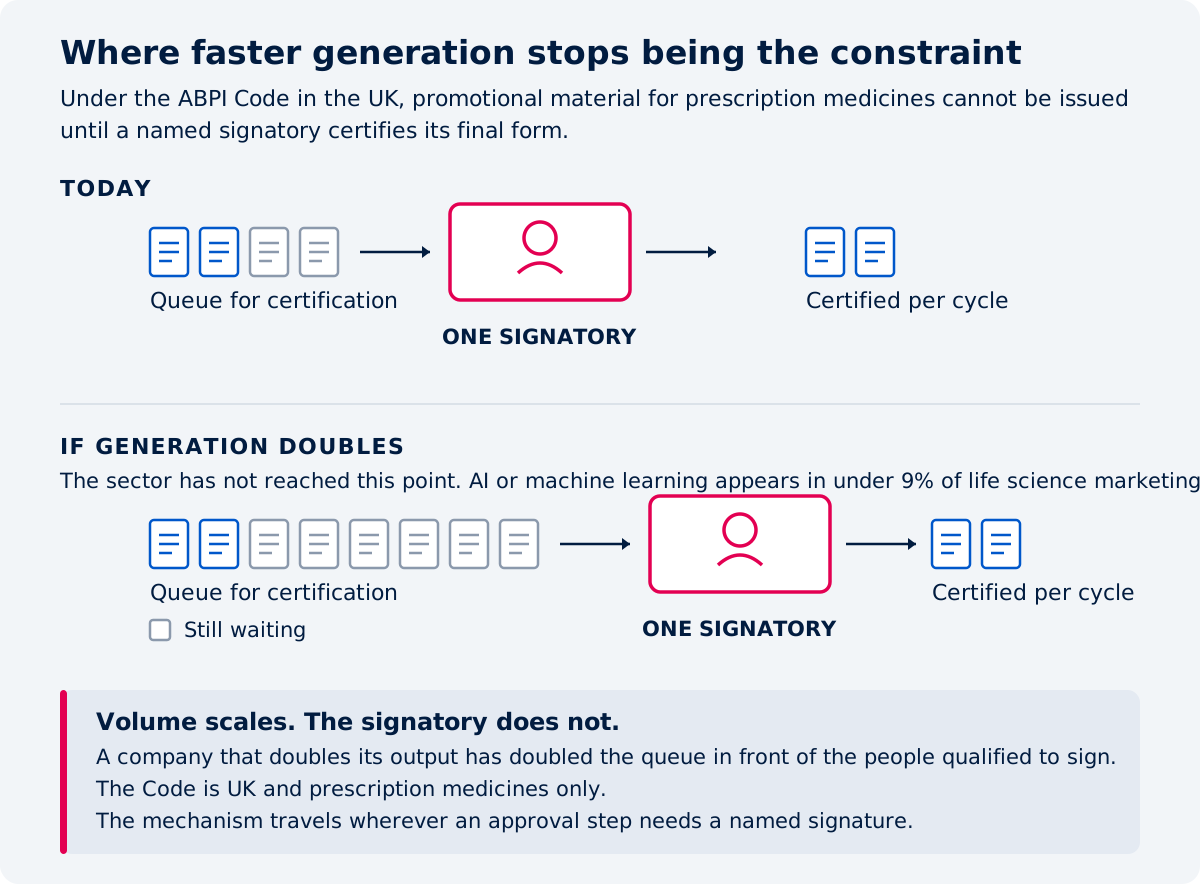
So a named, separately qualified human who did not write the piece has to certify its final form. Volume scales; the signatory does not, and a company that doubles its output has doubled the queue in front of the people qualified to sign. It is the single clearest reason pharmaceutical content programmes behave differently from everyone else's.
To be precise about what this does and does not cover, the ABPI Code is UK and governs prescription medicines promotion. It does not bind a reagents company in Boston or a diagnostics firm in Munich. It is the clearest documented instance of the mechanism rather than a rule that reaches every reader. The general version travels further. Wherever an approval step needs an accountable human signature, that signature becomes the limit the moment generation gets faster.
The obvious objection, and it is a fair one
The CMO Survey reports that "AI use in marketing has more than tripled since 2022", with companies projecting AI will account for more than half of all marketing activities within three years. That cuts against everything above, and it deserves a straight answer rather than a footnote.
Both things are true because they measure different objects. Marketers use these tools, and that usage is real and rising. Hiring measures something narrower: what a company will write into a role and pay a salary against. The gap between the two is not a contradiction to explain away. It is the finding.
Usage sits inside tools and budgets a company already has. Capability is a role and a salary. The sector has plenty of the first and has committed to very little of the second.
What to stop doing
Stop buying capability you cannot staff. That is the one subtraction this year's data supports.
The CMO Survey found marketing headcount growth slowing sharply, declining more than 50% from the prior year's rate, and training budgets at 3.8% of marketing spending against a pre-pandemic high of 5.8%. It also found the most cited capability gap was, in the survey's words, "not a missing skill". What teams named was a shortfall of people, time, and budget rather than expertise, which is the same shortfall that shows up when life science teams justify and measure their spend.
Adding an eleventh channel to a team of two does not solve that. Neither does a tool. If the plan for 2026 involves anything the current team cannot run in the hours it has, the honest move is to cut it now rather than discover it in June, and then structure what is left around the people who have to run it. Our work with Westlab is one worked example of what that subtraction looks like inside a life science team, and the wider case for treating this as content built as revenue infrastructure sits in the guide this article belongs to.
Match the plan to the people you have
We build content operations sized to the team that has to run them. Book a working session and we will map what is worth keeping, what is worth cutting, and what to automate first.
Frequently Asked Questions
About the Author

Founder & CEO, Content RevOps
Stefan Kalpachev is the founder and CEO of Content RevOps, where he helps B2B SaaS companies transform their content into predictable pipeline. With a background in content marketing and revenue operations, Stefan has developed a unique methodology that bridges the gap between content creation and revenue generation.
Connect on LinkedInRelated Articles
What do life science companies hire marketers to do?
Aug 20, 2026
Life science marketing statistics 2026
Aug 17, 2026
Can You Build a Content Marketing Strategy in One Week? Yes — If You Stop Guessing and Start Collecting Competitor Data
Jun 16, 2026