What is diagnostics marketing?
Marketing a test that is cleared but not covered? See where the gate actually sits for your product.
Book a CallThe phrase "diagnostics marketing" gets used for three unrelated things, none of which is the content marketing discipline this page is about.
Part of Content marketing for life sciences, the complete guide.
Sometimes it means a marketing audit, running a diagnostic on your own funnel to find what is broken. Sometimes it means patient acquisition for a scan clinic or a direct-to-consumer lab. And in the trade press it often means market-size research, the reports that tell you the in vitro diagnostics market is worth somewhere around $100 billion, though analysts disagree by tens of billions on the exact figure.
This page means the fourth thing, and the least written-about one. Diagnostics marketing is the work done by the companies that make diagnostic tests, instruments, and lab services to get those products adopted, ordered, run, and paid for.
It is a distinct branch of life science marketing, and it behaves differently from the marketing of drugs or devices for one structural reason. A diagnostic can be clinically excellent, cleared by the FDA, and loved by the clinicians who use it, and still be commercially dead, because the decision that matters most is made by people your marketing never reaches. Everything else about the discipline follows from that fact.
What is diagnostics marketing?
Diagnostics marketing is the function of getting a diagnostic test used and paid for across its whole commercial life, from the first clinician who orders it to the payer who decides whether to cover it.
The product set is broader than most people picture. It includes lab-run tests and laboratory-developed tests (LDTs), cleared in vitro diagnostic (IVD) kits and the instruments that run them, and the reference-lab services that sell testing as a service rather than a box. IVD marketing is the subset of this work that markets in-vitro diagnostic products specifically, the kits, reagents, and analyzers that examine a blood or tissue sample outside the body.
It helps to say what it is not.
- It is not a marketing audit. A "marketing diagnostic" checks the health of a funnel; diagnostics marketing sells the tests themselves.
- It is not scan-clinic or DTC patient acquisition alone, though the consumer side is now part of it (more on that below).
- It is not IVD market research. Knowing the market is worth $100 billion tells you nothing about how to get one test onto a lab's menu.
It sits inside life sciences next to its neighbours, and the differences are the point: biotech markets largely to investors and partners, CDMOs and CROs market to sponsors running an elimination exercise, and diagnostics markets to a chain of people who each hold a different veto.
Hold onto the distinction between the product and the buyer, because in diagnostics they come apart in a way they rarely do elsewhere. The person who benefits from the test, the patient, is often not the person who orders it, who is not the person who runs it, who is not the person who pays for it. Marketing has to move all of them.
Why is diagnostics marketing its own discipline?
A diagnostic can pass every regulatory test and still fail commercially. Approval and payment are two separate decisions, made by two different parties, and a test that clears the first can stall for years on the second.
This is the wedge that separates diagnostics from its neighbors. A drug is marketed largely to prescribers, which is why pharma content marketing spends so much of its energy inside an approved label. A capital device often runs through a hospital purchasing committee, the constraint that shapes medical device content marketing and most of what medical device marketing has to solve. A diagnostic has to clear a different gate: it has to become something a payer agrees to pay for, priced and coded, before the revenue is real. That payer never sees your marketing, reads your case studies, or attends your webinar.
Clearance proves the test is safe; coverage decides whether it earns
Getting a test through the FDA and getting a payer to reimburse it are different problems with different judges. The FDA asks whether the test is safe and does what it claims. A payer asks whether paying for it is worth it across a whole population, and that is a separate, higher bar.
Government guidance written for diagnostics innovators says this plainly. FDA market authorization is often treated as the finish line, but a test that payers will not cover simply does not get used, so securing reimbursement can matter as much as securing approval. And commercial payers almost always want more than the FDA did; they ask for additional clinical validity and clinical utility evidence before they will cover a new test.
Industry analyses put it the same way from the other side. FDA approval has only a modest effect on whether a test gets paid for, because payers weigh efficacy and cost while the regulator weighs safety. The two are answering different questions about the same test, and a marketer has to satisfy both.
"Cleared and still commercially dead" is a real outcome, not a hypothetical
Plenty of tests have cleared the regulator and then stalled at the payer. Industry analyses of diagnostic reimbursement point to AlloMap, the PLAC test, and the Pathwork tissue-of-origin test as FDA-authorized products that still struggled to secure broad payer coverage.
For a marketer, this reframes the whole job. Getting clinicians to like the test is necessary and nowhere near sufficient. The commercialization arc that experienced diagnostics teams run, which BCG describes as proving actionability, then establishing access, then expanding adoption, puts access in the middle for a reason. Access, coverage and the economic case behind it, is the hinge the rest of the plan swings on.
Who does diagnostics marketing actually talk to?
Three genuinely different customers, and increasingly a fourth. Marketing has to make a case to each of them, in a different language, because each one is asking a different question about the same test.
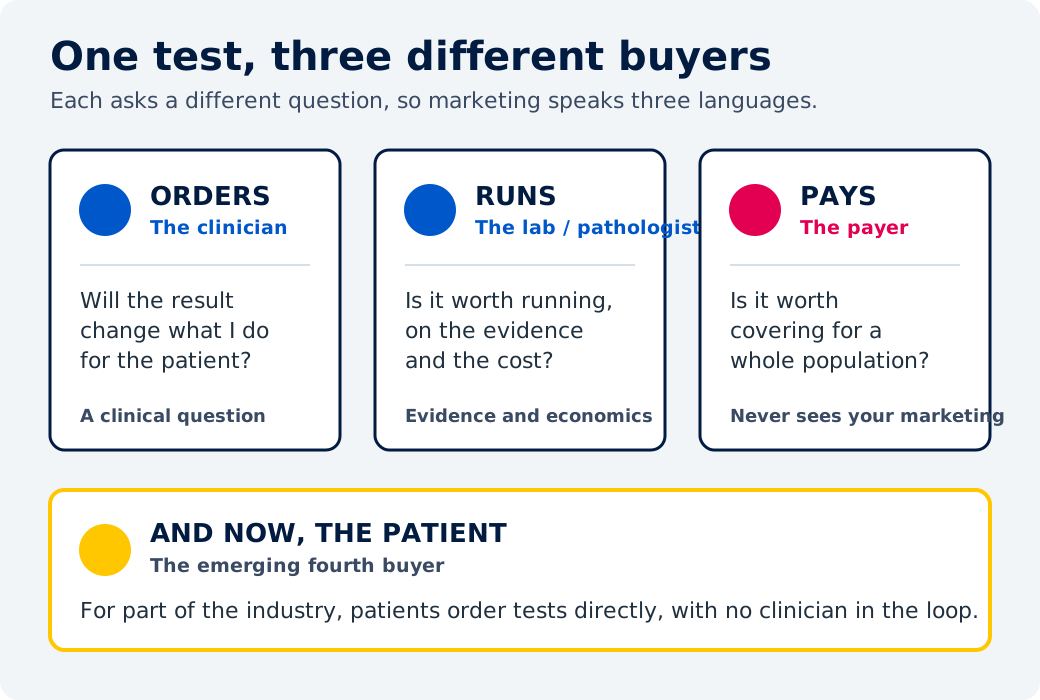
The three are the person who orders the test, the person who runs it, and the person who pays for it.
The clinician orders it, and asks a clinical question
The ordering clinician wants to know whether the result will change what they do for the patient. That is a clinical question about actionability, and it is the one most diagnostics marketing already knows how to answer.
But the clinician is rarely the whole sale, because ordering a test and adopting a test are not the same act.
The lab director or pathologist runs it, and asks an operational and economic question
Whether a hospital actually offers a test in-house is usually decided by the lab, not the clinician who wants it. A growing number of health systems run a lab formulary, a controlled list of approved tests, governed by a committee with a pathologist on it.
At Vanderbilt, for example, a multidisciplinary Laboratory Formulary Committee votes on every new test, and the proposal each test must clear asks for the data supporting its utility, when it should be ordered, how the result should be read, and its financial impact. Utility and money, weighed in the same room.
The lab also decides whether to bring a test in-house at all or keep sending it out, and that choice is a return-on-investment calculation, send-out cost against in-house operating cost, with a payback period the lab director has to defend. So the buyer who runs the test is weighing evidence and economics at once, and marketing to them means speaking to both. That calculation runs on the lab's own three-year plan rather than on your test's specifications, which is where content marketing for diagnostics companies has to start.
The payer covers it, and asks a value question
The payer never orders or runs the test. They decide whether it is worth covering for a population, and they ask for evidence that the test changes outcomes enough to justify the cost. As the reimbursement gap above shows, this is the slowest and least forgiving audience, and it is the one furthest from anything a marketing team can directly influence.
The patient is now a buyer too
For part of the industry, the patient has become a direct customer, ordering tests without a clinician in the loop at all. That is a large enough shift to treat on its own, so it gets its own section below.
What are you allowed to say, and what has to be proven first?
You can say less than in most marketing, and you can say it later. In diagnostics, persuasion cannot run ahead of proof, because the audience will not act until independent evidence exists, and generating that evidence is part of the marketing and market-access job.
To see why, it helps to separate the three things a diagnostic has to prove. The distinction comes from a long-standing evaluation framework, known as ACCE, for analytic validity, clinical validity, and clinical utility, plus the ethical and social questions around a test.
- Analytic validity asks whether the test measures what it claims to measure, accurately and repeatably.
- Clinical validity asks whether the result actually tracks the condition, whether a positive result means the patient has the thing.
- Clinical utility asks whether acting on the result improves the outcome.
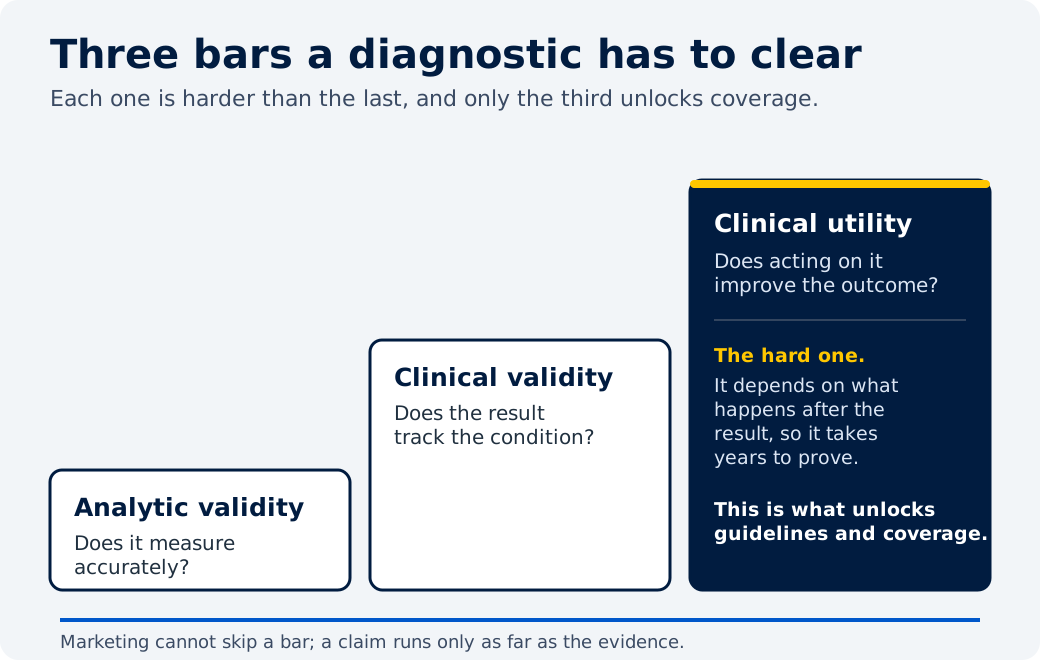
Utility is the hard one, and it is the one marketing most has to help build. A test on its own has no inherent utility; as the framework's authors put it, utility "depends on effective access to appropriate interventions." In other words, a result only has value if there is something useful to do with it. That is why utility is the evidence that unlocks guideline inclusion and coverage, and why it cannot be asserted in a brochure. It has to be demonstrated, usually in studies that take years.
The buyer will punish a claim that runs ahead of the evidence
This is not just a regulatory constraint; it is what the scientific buyer expects. Ask lab professionals what makes a vendor lose their trust and one answer comes up again and again: claiming your product is better than a competitor's without the evidence to back it. The same buyers say the fastest way to earn trust is the opposite move, a rep who admits when a product is not the right fit.
There is a hard regulatory layer underneath all of this too. Whether your product is a lab-developed test or a cleared IVD changes what you are legally allowed to claim about it, and that boundary shapes every piece of marketing a diagnostics company publishes. It is enough here to know the constraint exists and that it is specific to this industry; the mechanics are their own subject.
This is why the field hires scientists
The evidence burden explains the shape of the team. When we look at who the sector actually hires, regulatory fluency shows up as a requirement in about half of life science marketing job posts, roughly one in two. In diagnostics marketing, understanding the evidence is not a nice-to-have bolted onto a creative role; it is the price of admission, because you cannot market a claim you do not understand well enough to know when it is not yet earned.
The two faces, selling to the system and selling to the patient
Diagnostics marketing runs two motions at once, and they are increasingly in tension. One sells into the system, the test-maker reaching the lab, the clinician, and the payer. The other sells straight to the patient, the direct-to-consumer motion, where a person orders their own test with no clinician in the loop.
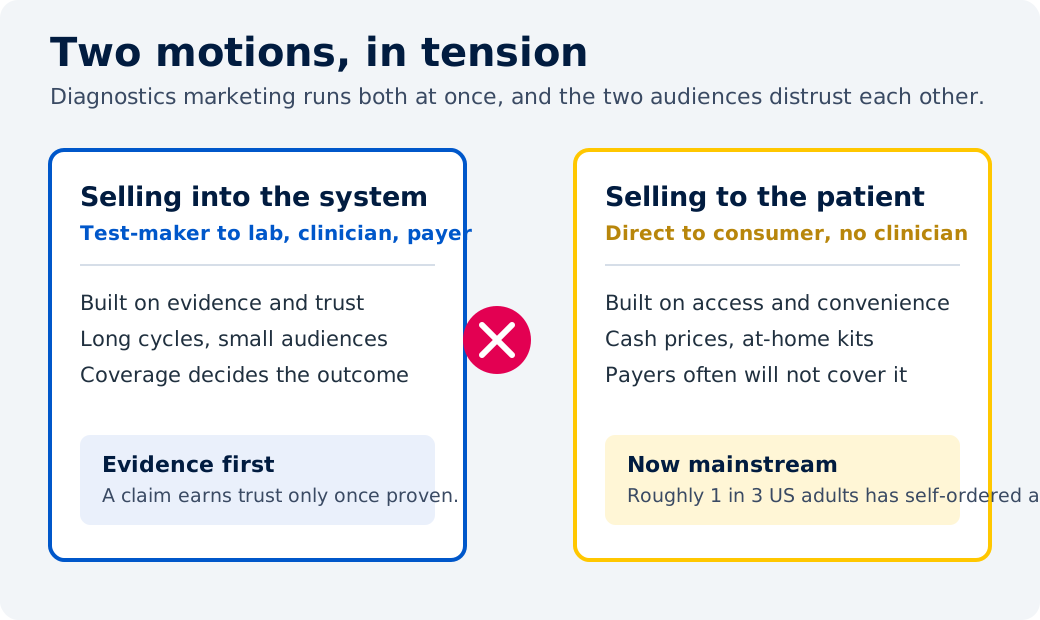
The consumer face is not a fringe anymore. The US direct-to-consumer lab-testing market was worth roughly $1.2 billion in 2025 and is growing at about 9 percent a year. The deeper number is adoption: the share of US adults who have used at least one at-home health test, setting COVID tests aside, rose from an estimated 8 to 10 percent in 2020 to close to a third by 2026. Ordering your own blood work has become an ordinary thing to do.
The two faces do not trust each other
Here is the friction a definition has to be honest about. The professional audience that the first motion depends on often resents the second one.
Clinicians describe direct-to-consumer results landing on their desk as unpaid work; one put it bluntly, that if a patient wants them to interpret labs someone else ordered, they make an appointment, because they do not do other people's work for free. The clinical objection runs deeper than annoyance: large unguided panels generate false positives, and a stray abnormal result sends an otherwise well person into a cascade of follow-up tests and worry.
The counter-case is just as real, and it is mostly about access and price. Patients point out that cash prices for common panels can run under $100, less than the copay on the same test through insurance. And a lab professional will tell you the results themselves are usually fine; the problem is not the assay, it is people ordering tests they cannot interpret with no one to help them read the answer.
So diagnostics marketing in 2026 spans a professional motion built on evidence and trust and a consumer motion built on access and convenience, and the two audiences view each other with suspicion. A definition of the field that only described the first motion would be describing half of it.
Why the field has been sales-led, and what is changing
Both faces have historically leaned on people rather than marketing. The audiences are small, the trust is technical, and it has traditionally been built rep to rep, one lab visit at a time. Marketers moving into the space often notice how sales-heavy it is; some describe medical device and diagnostics companies as running with a strong sales function and a thin marketing one, though that is a practitioner's impression of the field rather than a measured fact.
That is the part that is shifting, and it shows up in the data: life science companies publish credibly and convert badly, which is a marketing problem rather than a science one. Working with a life science manufacturer that sold to labs, we saw the old motion up close, growth through manual research, cold calling, conferences, and lab visits, expensive and entirely dependent on reps. The change came from letting content do the pre-sales trust-building the reps used to do one account at a time, so the education scaled even where a rep could not be in the room. The evidence still has to be real, and the buyer is still technical. What is new is that the trust can be built at scale, not only in person.
Where that leaves your plan is a separate exercise, and we have written it up as the five decisions that make a life science marketing strategy.
Is your diagnostics marketing built around the buyer who actually decides?
Get a Content RevOps audit, your funnel, evidence assets, and answer-engine visibility mapped against the clinician, the lab, and the payer, with every gap priced in numbers your CFO can argue with.
Frequently Asked Questions
About the Author

Founder & CEO, Content RevOps
Stefan Kalpachev is the founder and CEO of Content RevOps, where he helps B2B SaaS companies transform their content into predictable pipeline. With a background in content marketing and revenue operations, Stefan has developed a unique methodology that bridges the gap between content creation and revenue generation.
Connect on LinkedIn