Medical device marketing, explained from the inside
The committee researches you before a rep ever calls. Want to see what they find when they look?
Book a CallAsk an FDA reviewer what it means to market a medical device and they will talk about clearance. Ask a product marketer inside a device company and they will talk about roadmaps and unmet clinical needs. Ask almost anyone else and they will talk about campaigns, which is where most content marketing advice for the sector begins and ends.
Part of Content marketing for life sciences, the complete guide.
All three are right. That is the problem with the word itself; anyone describing the function usually describes only the third job and skips the two that shape it.
This page defines the function properly. It sits alongside our broader explainer on what life science marketing is, and it links out to the deeper strategy work where each topic earns a full treatment.
What is medical device marketing?
Medical device marketing is the commercial function that takes a regulated device from clearance to adoption. It creates demand among the clinicians who will use the device, proves clinical and economic value to the hospital committees that control the money, and does both inside a claims ceiling set by the device's regulatory classification.
That one sentence hides three frictions that make the discipline unlike general B2B marketing:
- The buyer is split. The clinician who uses the device, the institution that pays for it, and the patient it treats are three different parties with three different definitions of value.
- The claims are capped. What marketing may say about a device is bounded by what the FDA cleared or approved it to say, before any copywriter touches it.
- Distribution runs through people. Practitioners describe the "advertising" as reaching buyers through sales representatives and key opinion leaders more than through media.
One device marketer on r/MedicalDevices puts that last point bluntly: "there's very little direct to consumer advertising; the 'advertising' is done almost solely through other people (namely sales reps but also key opinion leader doctors)."
The industry also calls this work medtech marketing. The two terms cover the same function, and we use them interchangeably here.
Why does "marketing" mean three different things in medtech?
The word itself causes confusion, because three different groups use it for three different jobs. Ask three people in the industry what device marketing means and you will get three honest, incompatible answers.
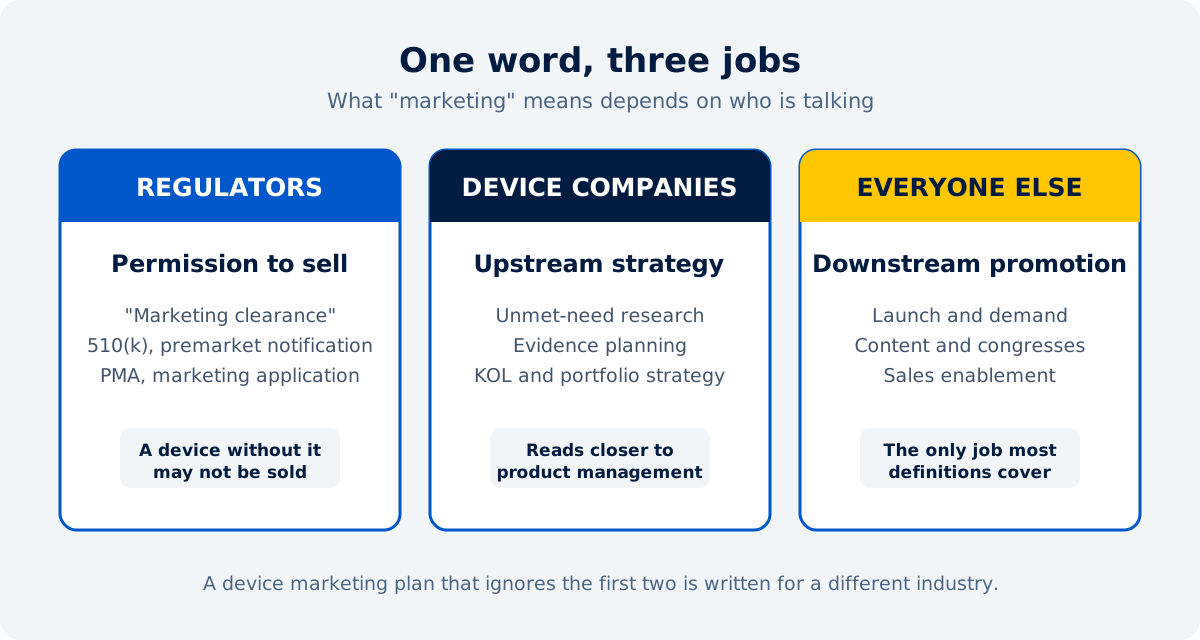
Who says it | What they mean | Where you meet it |
Regulators | Legal permission to sell the device | "Marketing clearance", "premarket notification" |
Device companies, internally | Upstream strategic and product marketing | Roadmaps, unmet needs, evidence planning |
Everyone else | Downstream promotion and demand generation | Campaigns, content, trade shows, sales tools |
The regulatory meaning, permission to sell
To the FDA, "marketing" a device means having the legal authorization to sell it. The 510(k) is formally a premarket notification reviewed for marketing clearance, and the agency calls the PMA "the most stringent type of device marketing application."
So when a regulatory colleague says the device "cannot be marketed yet," they are not talking about your campaign calendar. They mean the company does not yet have permission to sell the product at all.
The inside meaning, deciding what gets built
Inside device companies, "marketing" often names a strategic function closer to product management than to promotion. A practitioner on r/MedicalDevices describes the reality: "Med device 'marketing' typically means product management," with the day-to-day spent managing the development and strategy of a specific portfolio.
The hiring language backs this up. Across the life science marketing job posts we analyzed for our State of Content Marketing for Life Sciences 2026, the strategy vocabulary that appears in about 22 percent of postings is "launch and commercialisation." That is the language of regulated product introductions, not growth hacking, and it tells you what these teams are actually hired to do: carry a cleared product into the market, not run ads.
The outside meaning, driving adoption
The third meaning is the one most people picture: positioning, content, digital presence, congress activity, and sales enablement that move a cleared device toward adoption.
This is real work and the rest of this page covers it. The point of naming all three meanings first is simple: a device marketing plan that ignores the first two is a plan written for a different industry.
Who actually buys a medical device?
For most devices, no single person buys anything. The user, the payer, and the patient are three different parties, and the marketing has to work for all three at once.
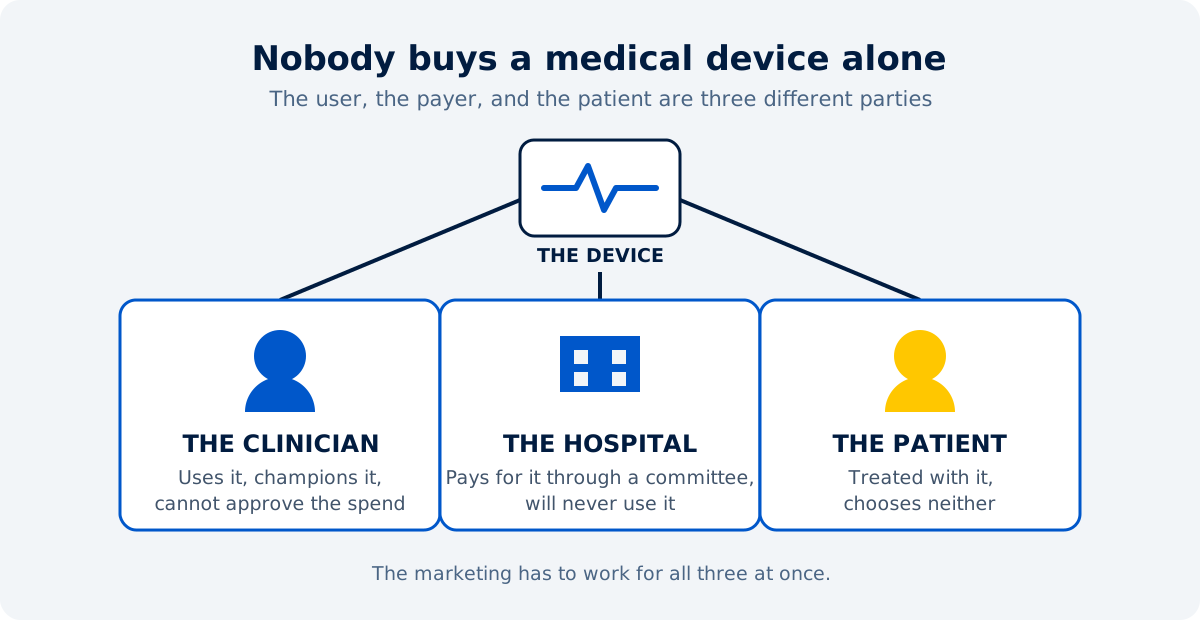
The clinician who uses it
Surgeons and clinicians evaluate a device the way they evaluate clinical research, through outcomes data, peer-reviewed publications, and hands-on trial. They are the champion who requests a device and advocates for it inside the institution.
What they mostly cannot do is approve the spend. That authority moved elsewhere.
The hospital that pays for it
Hospitals route device purchases through procurement and value analysis processes that weigh clinical benefit against cost. A systematic review of how hospitals purchase high-cost devices, covering 24 studies across 12 countries, found the buying side involves clinicians, nurses, biomedical engineers, finance staff, and managers, and that their responsibilities are often ill-defined, siloed, and exercised under pressure.
The same review cites a five-country comparison finding that hospital purchasing focuses more on cost containment than on quality or health outcomes.
Two things follow from that for marketing:
- You are writing for a group, not a person. In the HIMSS 2025 survey of 211 healthcare technology buyers and decision-makers, about 60 percent of organizations involve five or more people in a technology purchase, and 23 percent involve ten or more. Healthcare technology is a broader category than devices alone, but the committee shape is the same one device companies meet.
- The group's default lens is cost. Clinical superiority alone does not answer the question the institution is actually asking, which is what this does to the budget and the workflow.
The value analysis committee deserves its own playbook, and we wrote one; our guide to content marketing for medical device companies covers how to build content a committee can defend. Here the point is structural: the person the device helps most has the least say, and the people with the most say will never touch it.
The patient it treats
For hospital-purchased devices, the patient chooses nothing and marketing rarely addresses them directly.
The exception is the growing consumer edge of the category: hearing aids, continuous glucose monitors, and wearables, where the patient is the buyer and device marketing starts to look like consumer health marketing, with regulatory limits still attached.
How does device classification cap what marketing can say?
Every promotional claim a device company makes traces back to its regulatory position. Classification decides what the marketing may say at all, long before positioning enters the conversation.
Class and pathway decide the claim set
The FDA sorts devices into three classes by risk. The lowest-risk devices, Class I, sit under general controls and are generally exempt from premarket review. Class II devices typically reach the market through a 510(k) premarket notification, a comparative review that clears a device by showing it is substantially equivalent to one already on the market. Class III devices, the ones that support or sustain human life or present the highest risk, need a full premarket approval resting on an independent demonstration of safety and effectiveness.
The pathway then bounds the promotion. Claims must stay consistent with the cleared or approved indications for use, and as legal educators at the Food and Drug Law Institute summarize, promotional claims must be truthful, substantiated by valid scientific evidence, and on-label. A claim, in this world, is any statement about the actual or comparative safety, effectiveness, or performance of a device. That definition covers the headline on your landing page.
Off-label is the sharpest edge. Physicians may lawfully use a cleared device off-label as part of practicing medicine, but the company may not promote that use, and it does not matter if the off-label information is accurate. Truth is not a defense to off-label promotion.
Who actually polices device advertising?
Here is the part most marketers have never heard: for the majority of devices, the FDA does not regulate the advertising. The FTC does.
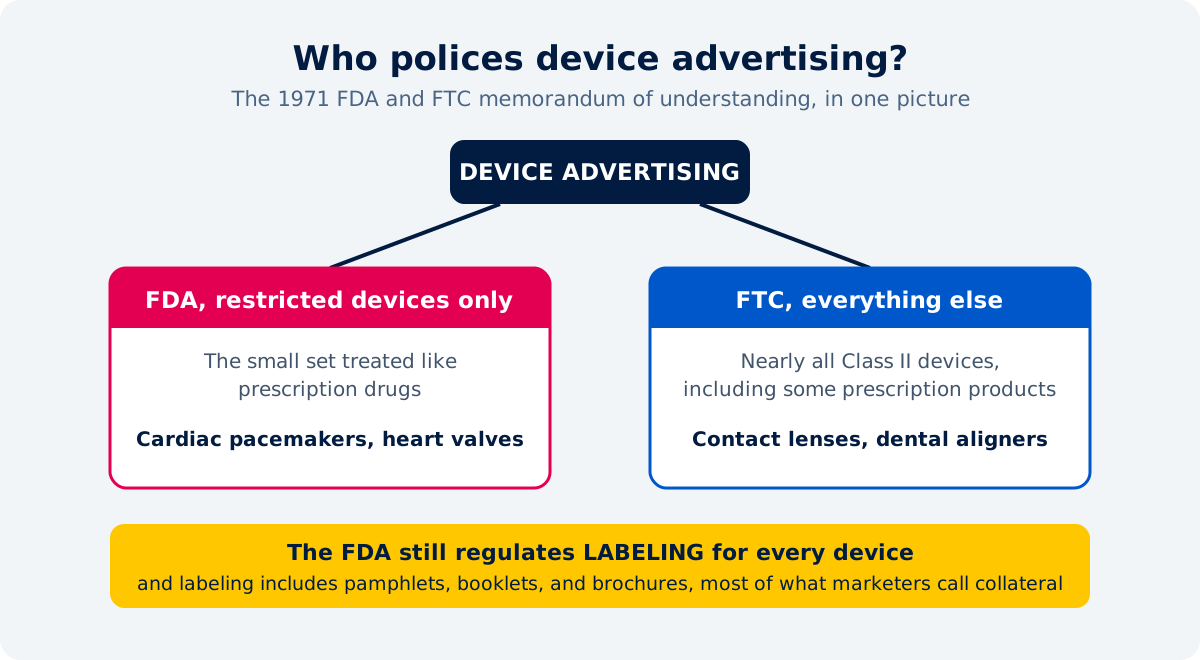
Under a 1971 memorandum of understanding between the two agencies, documented in a 2023 Government Accountability Office review, the FTC holds primary responsibility for the truth or falsity of consumer-directed device advertising, while the FDA's advertising authority covers only restricted devices, the small set both agencies treat the way they treat prescription drugs. Cardiac pacemakers and heart valves sit on the FDA's side of the line; contact lenses and dental aligners, though prescription products, sit with the FTC.
The National Academies put the consequence plainly: because the FDA has declined to restrict almost all Class II devices, responsibility for preventing false or misleading advertising of those devices rests exclusively with the FTC.
That does not mean most device promotion escapes the FDA. The agency regulates labeling for every device, and it has interpreted the materials that count as labeling to include pamphlets, circulars, booklets, and brochures, much of what a marketer would call collateral. In practice a device promotion program answers to both agencies at once, each through its own doorway.
Can you market a device without FDA clearance or approval?
No, with narrow room for groundwork. A device that needs a 510(k) and lacks one may not be legally sold, and a Class III device without an approved PMA may not be marketed at all. Federal rules also limit how an investigational device may be promoted while it is under study. Pre-clearance marketing work happens, but it is positioning, evidence planning, and audience building, never product promotion.
Why this makes regulatory fluency a marketing skill
This claims regime explains a pattern in how the sector hires. Across the life science marketing job posts we analyzed, regulatory, FDA, EMA, or MLR knowledge appeared in about 49 percent, roughly 1 in 2, of postings. Marketing teams across life sciences treat regulatory fluency as the price of admission, because a marketer who cannot tell a cleared claim from an aspiration is a liability.
The same dataset shows compliance demand more than quadrupling with company size, from about 11 percent of postings at the smallest firms to 49 percent at the largest. The bigger the company, the more marketing operates as a governed function, with review workflows standing between a draft and the public. The pattern holds across the sector's other sub-verticals too, which is why biotech marketing and diagnostics marketing read as cousins of this page rather than copies of it.
What do upstream and downstream device marketers actually do?
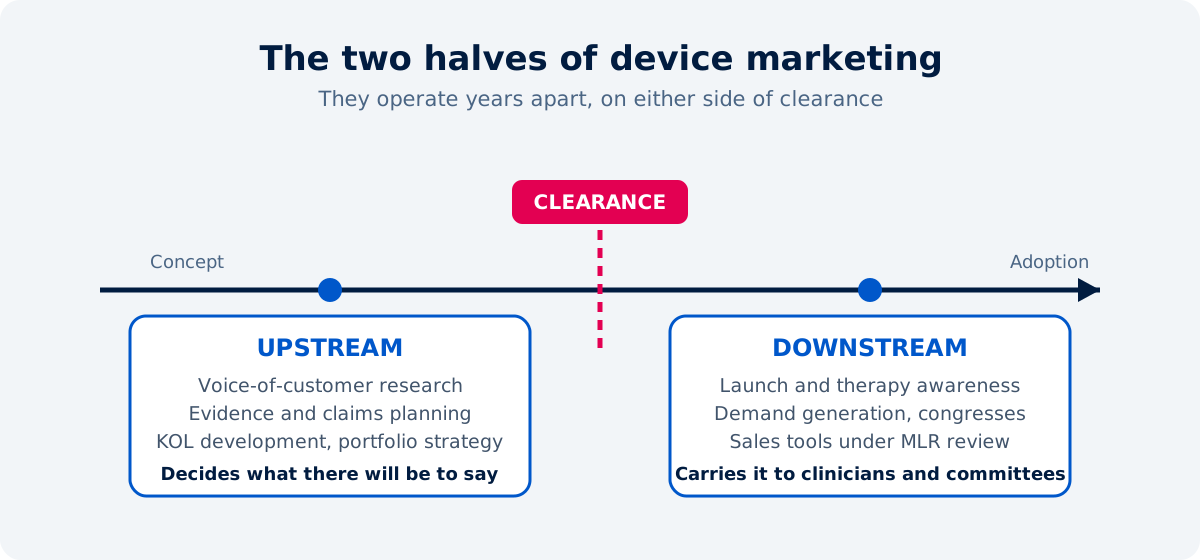
Device marketing splits into two halves that operate years apart. Understanding the split explains most of the job titles, and most of the confusion about what the function does.
Upstream, the work before the product exists
Upstream marketers work with product development while the device is still being defined. As a practitioner writing in MedCity News describes it, upstream marketing makes sure customer input and regulated marketing criteria are incorporated before a product is manufactured, all before handoff to downstream marketers to publicize and sell it.
The day-to-day looks like this:
- Voice-of-customer research with clinicians and hospital stakeholders to find unmet needs
- Evidence planning, deciding which claims the company will need and which studies will support them
- Key opinion leader development, building the clinical relationships that later carry the message
- Portfolio and go-to-market strategy, including how the device will be sold and in which markets
None of that produces a campaign. All of it decides whether a campaign will ever have something defensible to say.
Downstream, the work after clearance
Downstream marketing is the half outsiders recognize: launch planning, therapy awareness, congress presence, digital demand generation, and the sales tools the field team carries.
One structural detail separates it from ordinary B2B execution. In medtech, the collateral itself lives under change control, moving through medical, legal, and regulatory review before release, the same discipline applied to the product. The marketer's timeline includes approval cycles that other industries have never met.
Why the titles blur into product management
Because upstream work is product-shaped, device companies often title it product marketing or product management, and people move between the functions. For marketers entering from other industries, this is the reorientation: in medtech, marketing's center of gravity sits earlier in the lifecycle than the campaigns, and the promotional half inherits whatever the upstream half planned.
What does a working medical device marketing strategy look like?
A working strategy takes the three frictions from the top of this page and builds one motion for each. We think about it as three commitments rather than a channel list, and the same logic underpins the five decisions that make a life science marketing strategy.
Prove value to each half of the split buyer
The clinician needs clinical proof, outcomes data, publications, and hands-on evaluation. The committee needs economic proof, cost impact, workflow fit, and evidence it can defend internally without you in the room.
The second half is where the leverage sits, and one number shows why. In the HIMSS 2025 buyer research, 26 percent of healthcare technology buyers reported putting vendor case studies into their internal documentation to justify a purchase. Your material does not just persuade the reader; the reader files it as the committee's evidence. Content built for that job, self-contained, specific, and defensible, is committee infrastructure, and it is what we mean by building a flagship content product rather than a blog.
Our work with Westlab is the version of this a lab and device audience recognises: evidence content built to be forwarded, not just read.
Publish where the committee researches, before the rep arrives
The same HIMSS research shows vendor websites (60 percent) and industry websites (61 percent) serving as primary research channels, with product demos the most valued content type at 78 percent. Industry peers and professional networks rank as the most trusted sources; 74 percent rate them extremely or very trustworthy. Those peers and networks mostly gather on LinkedIn, and what life science buyers actually use it for is more specific than most device marketing assumes.
Buying cycles are also compressing. Two thirds of organizations now report a technology buying cycle within a year, where the prior year's edition had more than half reporting cycles of 19 months or longer.
Read together, those numbers describe a buyer who self-educates through your site, trusts peers over your claims, and moves faster than the old enterprise-sales picture assumed. An owned informational layer of evidence, comparison, and demonstration content is how a device company shows up in that research window, including in the AI answer engines that now sit in front of it. Ranking on Google is no longer the same thing as being cited, which is why strong pages can still go missing from ChatGPT and Perplexity answers.
The sector leaves this open. Across the life science hiring data we analyzed, content marketing appears as a named discipline in about 2 percent of marketing job posts. The function that fills the committee's research window is the one the industry has structurally declined to staff, which is precisely the opening for the companies that build it. We wrote the full playbook for this in our guide to content marketing for medical device companies, and the same pattern holds in content marketing for pharma.
Arm the people who carry the message
The practitioner description from the top of this page holds at the strategy level too: the message reaches clinicians through sales representatives and key opinion leaders more than through media. Treating sales enablement and KOL programs as core marketing output follows directly; the field team and the faculty speaker are the distribution layer.
The strategy, in one line, returns to where this page started: know which of the three jobs each piece of work is doing, permission, product, or promotion, and never let an asset pretend to do one while the company needs another. If you want a number on where your own content sits against the sector, start with the benchmark below.
Common questions about medical device marketing
How much does it cost to bring a medical device to market?
The most-cited answer comes from the Stanford-led Makower survey of over 200 medtech companies, which found an average of roughly $31 million from concept to clearance for a 510(k) product and $94 million for a PMA product, excluding reimbursement and sales costs. The number nobody quotes from the same study: about 77 percent of the 510(k) figure went to FDA-dependent activities.
The survey dates to 2010, so treat the dollar amounts as a floor. StarFish Medical's 2024 meta-analysis still lands on approximately $30 million in total funding for a Class II 510(k) device and notes that adjusting the underlying data for inflation raises the values by roughly 40 percent.
Is medical device marketing the same as pharma marketing?
No. The FDA regulates prescription drug advertising directly, while advertising for most devices sits with the FTC under the split described above. Device marketing also sells into hospital purchasing committees as much as to individual clinicians. The disciplines share the regulated-claims mindset, which is why our pharma content marketing guide and the wider pharma marketing strategy read as cousins of this page, not copies.
Do medical device companies market directly to patients?
Mostly no, with a growing exception. Hospital-purchased devices reach patients through clinical decisions, so patient-facing promotion plays little role. Consumer-adjacent devices such as hearing aids, continuous glucose monitors, and wearables do market to the end user directly, with the advertising rules described above still attached.
How do people get into medical device marketing?
The upstream and downstream split above maps the two doors: downstream roles tend to draw on clinical and sales experience, upstream roles on product backgrounds. The clearest differentiator is the hiring pattern covered earlier; regulatory fluency shows up in about half of the postings we analyzed, and it is the skill campaigns cannot substitute for. That pattern is not confined to devices, and what life science companies hire marketers to do traces the same requirement across the sector.
Which of the three jobs is your marketing actually doing?
Get a Content RevOps audit, your evidence content, committee-facing proof, and AI-search visibility benchmarked against the life sciences 2026 data, with every gap priced in numbers your CFO can argue with.
Frequently Asked Questions
About the Author

Founder & CEO, Content RevOps
Stefan Kalpachev is the founder and CEO of Content RevOps, where he helps B2B SaaS companies transform their content into predictable pipeline. With a background in content marketing and revenue operations, Stefan has developed a unique methodology that bridges the gap between content creation and revenue generation.
Connect on LinkedIn