Omnichannel marketing in pharma, beyond the buzzword
Fewer than 1 in 12 pharma companies run a CRM, the plumbing omnichannel actually needs. Want to see which layer your setup is missing?
Book a CallFewer than one in twelve pharmaceutical companies runs a detectable customer relationship management system on its site. Hold that number next to the pitch decks for a second. Omnichannel marketing in pharma is sold as the new standard, the thing every brand team is either doing or racing to do. Yet the single piece of plumbing that makes it possible, a CRM that ties a person to what they read and what they did next, is missing from most of the field, which is where our content marketing work with life science teams starts.
Part of Content Marketing for Pharmaceutical Companies.
That gap is the whole story. Omnichannel marketing in pharma is not hard because the strategy is complicated. It is hard because it sits on top of data infrastructure that most teams have not built yet. When the infrastructure is missing, "omnichannel" becomes a word for something a company wishes it were doing.
This guide is for the pharma and life science marketer deciding whether to attempt omnichannel, and how far to go. We will define it plainly, show why most of the market is still stuck at the buzzword, then walk the five things you actually need in place before it is possible, in the order you need them. By the end you should be able to look at your own setup and know whether you are ready, and if you are not, what to build first.
What omnichannel marketing in pharma means, and how it differs from multichannel
Omnichannel marketing in pharma means connecting your channels so each interaction is aware of the last one, and the next one builds on it. A doctor who opens an email, clicks to a page, and later joins a webinar meets one continuous story, not three disconnected messages.
Multichannel is the version most companies actually run. The same brand shows up on email, on a website, at a congress, and through a rep, but each channel works on its own. The doctor gets the same message three times, in three places, with no memory between them. IQVIA describes the shift as moving from siloed channels to orchestrated ones, where content adapts based on what the person did before. The two are genuine alternatives rather than two rungs of one ladder, which is the argument we make at length for multichannel and omnichannel marketing in life sciences.
The clearest short explanation comes from Karen Batoosingh at Anthill, who frames omnichannel as the opposite of making a healthcare professional start over every time they change channel.
Here is the example every guide reaches for, and it is a fair one. A doctor gets an approved email about a new therapy. They click through to a landing page with the clinical detail. A few days later a rep follows up to talk it through, and the rep invites them to a webinar where a specialist presents the data. Each step knows what came before, so nothing repeats and the doctor moves forward instead of in circles.
That sequence looks simple on a slide. It only runs, though, if a stack of systems underneath it agrees on who that doctor is and what they have already seen. That is the part the buzzword skips, and the part this guide is about.
Why most omnichannel marketing in pharma is still a buzzword
Almost every pharma leader believes in omnichannel, and almost none of them are running it. That is the gap that makes the word a buzzword.
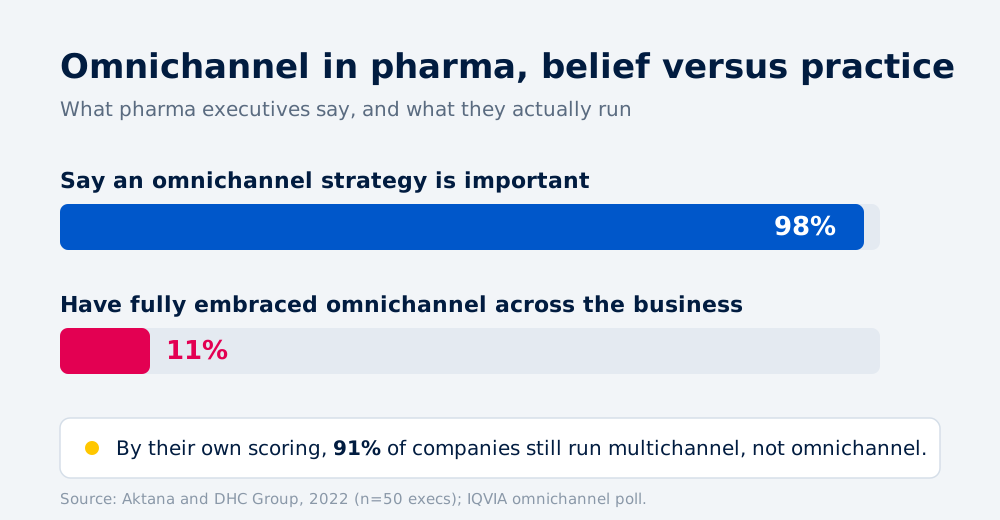
When Aktana and the DHC Group surveyed 50 pharma executives across digital, brand marketing, field sales, and analytics, 98% said an omnichannel strategy was important. Only 11% said they had fully embraced it. More than half admitted they were not yet optimizing engagement across their touchpoints. Belief is nearly universal. Practice is close to a rounding error.
The industry's own maturity checks say the same thing from another angle. In an IQVIA poll on the journey to omnichannel, 91% of companies placed themselves at multichannel or at a halfway "multichannel management" stage, with limited synchronization and incomplete tracking. By their own scoring, nine in ten are not actually doing omnichannel.
Ask a practitioner why, and you hear the real reason. On Viseven's Pharma Talks podcast, Yacin Marzouki told host Nataliya Andreychuk that in most organizations the data is "totally disconnected." Planning lives in one set of tools with one set of goals, sales runs on territories rather than on the individual doctor, and the web channels sit outside the connected world entirely. He also names the trap teams fall into: they create content without an activation plan, then wonder why the journey never runs.
We see the same thing in the hiring. When we analyzed how life science companies staff their marketing, only about 13% of job posts even named "omnichannel" or "integrated" as a strategy the team was building toward. A company cannot operate a discipline it has not decided to hire for.
So the honest read is this. Omnichannel marketing in pharma is not a standard the industry has reached and you are behind on. It is an aspiration most of the industry shares and few have built the foundation for. That reframes the question you should be asking. Not "how do I do omnichannel," but "do I have the layers that make omnichannel possible, and if not, which one do I build first."
What you need before omnichannel marketing in pharma is possible
Omnichannel marketing in pharma runs on five layers, and they stack in order. Each one is a prerequisite for the one above it. Skip a layer and the journey breaks at that point, no matter how good the channels on top look.
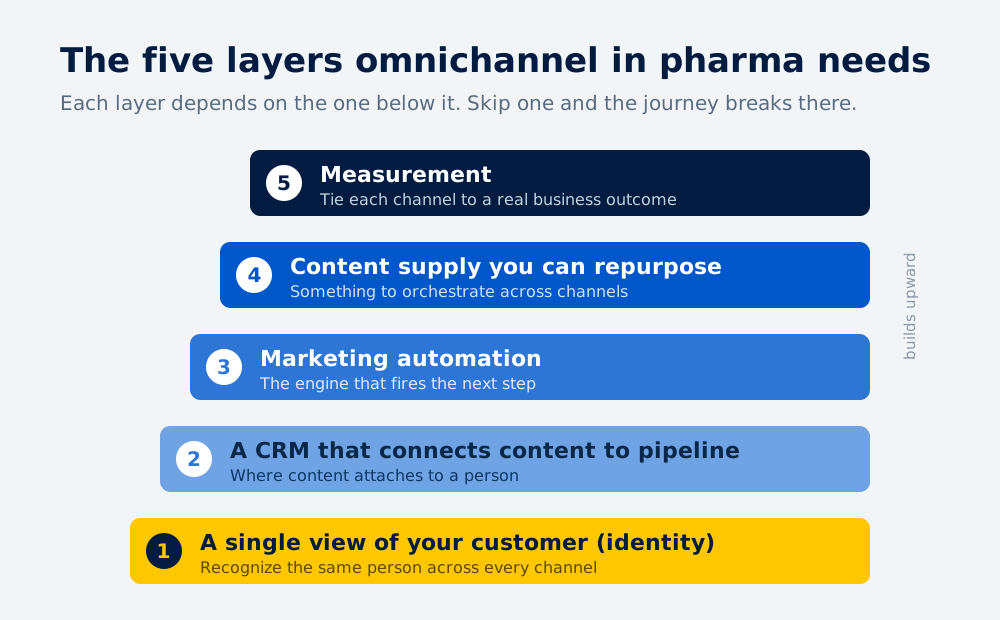
Read these as a checklist for your own setup. For each layer, the question is simple: do you have it, or is this where you stop.
A single view of your customer
The first layer is being able to recognize the same person across every channel. If you cannot tell that the doctor who opened Tuesday's email is the one who joined last month's webinar, nothing downstream can connect, because there is no thread to connect it to.
In pharma this runs on a shared reference identity plus consent, not a spreadsheet of email addresses. IQVIA's OneKey acts as a single source of truth for healthcare professionals, giving each one a stable identifier so their activity can be linked across systems, with consent and opt-out handling built in. Veeva Network can pull that reference data into Veeva CRM to build a single 360-degree view of each customer. McKinsey describes the same move, linking CRM, market research, and third-party data into one view of who the doctor is and what the company has done with them.
You have this layer if a person's identity and consent are resolved in one place that every channel reads from. You do not have it if each channel keeps its own list.
A CRM that connects content to pipeline
The second layer is a CRM, and it is the one most pharma teams are missing. Without it, content has nowhere to attach. An email goes out, a page gets read, and none of it lands against a person or a pipeline, so none of it is measurable or repeatable.
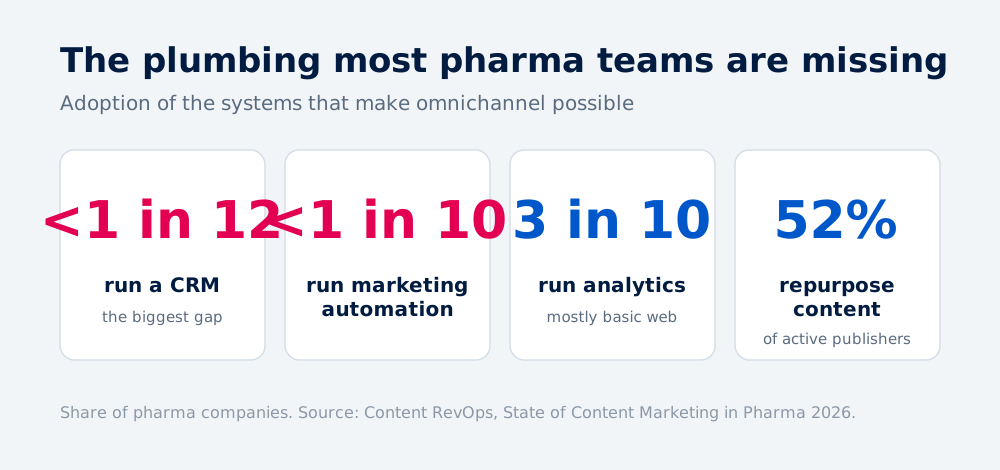
This is the constraint that shows up hardest in the data. Fewer than one in twelve pharma sites runs a detectable CRM at all. The reflex is to assume that is a small-company problem and the big brands are fine. They are not. Even among companies above $500 million in revenue, CRM adoption reaches only about three in ten. A number that would be considered unworkable in almost any other business-to-business sector is normal in pharma.
You have this layer if content activity flows into a CRM where it can be tied to a real contact and, eventually, to pipeline. That connection is the whole subject of pharma marketing analytics and ROI. You do not have it if your channels report to themselves.
Marketing automation that makes journeys run
The third layer is marketing automation, the engine that turns a sequence into a sequence. It is what sends the next step because the last step happened. Without it, a "journey" is just a batch of separate sends that a person has to stitch together by hand, which means it does not scale past a handful of contacts.
Automation is nearly as scarce as CRM. Fewer than one in ten pharma sites runs marketing automation, with HubSpot the most common where it exists at all. The life sciences picture matches it: automation and CRM adoption both sit low, and without that nurture layer, the leads a campaign captures simply go cold. Content drips become content one-shots. Choosing the platform and sequencing the build is its own decision, which we walk through in marketing automation for pharma.
You have this layer if a defined trigger reliably fires the next touch. You do not have it if someone on the team is manually deciding who gets what, and when.
A content supply you can repurpose
The fourth layer is content, and specifically content you can reshape and reuse. Orchestration needs something to orchestrate. If you make each asset once, use it once, and never adapt it, there is nothing to sequence across channels, and the whole model has no fuel.
This is where the field thins out. In the pharma companies actively publishing, only about 52% show any evidence of repurposing content across formats. Half run a flywheel; half make an asset and let it die. Look across the whole population rather than just the active ones and it is starker: only around one in eleven life science companies runs strong distribution or repurposing. The rest post and hope, when the same asset could be carrying several channels at once, as we set out in an effective content distribution strategy.
The executives feel it. In the Aktana and DHC research, 62% named lack of content as a key hurdle to omnichannel success. The tank is empty before the engine even turns over.
The mechanism that fixes this in pharma is modular content, building assets as approved, reusable blocks rather than as finished one-offs. Anthill describes it as create once, approve once, use in any channel. Cognizant frames the same approach for Fierce Pharma, storing content as components that assemble into channel-specific pieces inside compliant templates. It matters more in pharma than anywhere else because medical, legal, and regulatory review is the slow step, and modular blocks let you clear approval once instead of every time. The formats worth building this way are the ones that keep earning, which we cover in pharma content marketing tactics that compound.
You have this layer if your assets are built to be reshaped and reused. You do not have it if every channel needs its own from-scratch production run.
Measurement that ties channels to revenue
The fifth layer is measurement, and it is the one that tells you the journey worked. Counting opens and clicks is not measurement in this sense. Real measurement connects a channel to an outcome the business cares about, a test ordered, a script written, a quote moved.
Most of pharma is not there. Only about three in ten pharma sites run a detectable analytics platform at all, usually basic web analytics. And even among teams that measure, Across Health's long-running Maturometer finds that return-on-investment measurement is the fastest-growing bottleneck, because pharma stays fixed on reach metrics when it needs to connect reach to attitudinal and behavioral change. Across Health frames outcome measurement as its own discipline, not an afterthought.
The good version is concrete. James Turnbull of Camino Communications describes a campaign for a rare condition where the rate of diagnostic testing became the single success marker, and every email, page, and webinar was measured against whether testing went up over six months. That is measurement tied to an outcome, not to a dashboard of opens.
You have this layer if you can name the business outcome each journey is meant to move, and see it. You do not have it if your reporting stops at engagement.
What to build first for omnichannel marketing in pharma
If you walked those five layers and found gaps, the answer is not to buy an omnichannel platform. It is to build the missing plumbing and run one small connected journey, then grow from there.
Start at the lowest missing layer. If you have no CRM, that comes before anything, because every layer above it depends on being able to attach activity to a person. Add one automation next, so a single sequence can run on its own. Then take one asset you can repurpose and wire a two-channel journey off it, email to landing page, or landing page to a follow-up. One journey that actually connects beats a channel map that does not. Where that sits inside the wider plan is the subject of our pharma marketing strategy playbook.
This is also what "optimizing" omnichannel marketing in pharma really means. It is moving up a maturity ladder one rung at a time, not adding more channels.
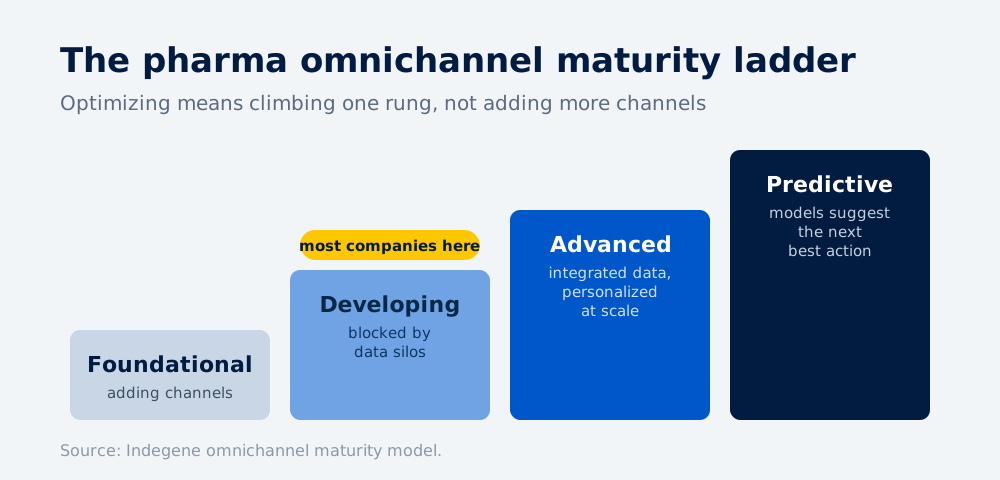
Indegene lays out four stages: foundational, where you are just adding channels; developing, where you start to personalize but data silos hold you back; advanced, where data is integrated and personalization runs at scale; and predictive, where models suggest the next best action. Indegene puts most companies in the developing stage, still fighting silos to build that single view of the customer. Across Health offers a similar health check that scores maturity across ten areas. Use either as a map: find your rung, build the next one. The channel work you layer on top of it is the ordinary business of digital marketing for pharma, and on the open web it means reaching clinicians where they already research.
The payoff for finishing the build is real, and it is worth naming once so the effort has a number attached. When we helped an adjacent life science business, a lab-supply manufacturer called Westlab, replace a cold, rep-dependent motion with a connected content-to-pipeline system, the engine produced 241 inbound leads and $120,000 in influenced quotes within three months, an 869% return on the content investment, off forty repurposable pieces. Westlab sells to labs rather than to prescribers, so treat it as an adjacent proof point, not a pharma brand story. The mechanism is the same one this guide describes: identity, a place to capture it, automation to run it, content to feed it, and measurement to prove it.
At the top of the ladder, the commercial case is large. McKinsey reports that pharma companies which implement an analytics-enabled omnichannel model well see a 5 to 10% revenue uplift, a 10 to 20% gain in marketing efficiency, a 3 to 5% increase in prescribers, and 5 to 10% higher satisfaction among the doctors they engage. That is the prize for teams that finish the build. It is also, read honestly, the reason the buzzword persists: everyone wants the outcome, and most have not laid the track to reach it.
Making omnichannel real, one layer at a time
Pharma already produces content, runs channels, and spends real money reaching doctors. What most teams have not done is connect those pieces so they behave as one system. That is the gap between omnichannel as a buzzword and omnichannel as an operation, and it closes the moment the plumbing does.
The value is not in owning more channels. It is in turning the channels and content you already pay for into connected revenue infrastructure, where an interaction leads somewhere and you can see that it did. Start with the lowest layer you are missing. When you can name the outcome one journey is meant to move and watch it move, you are doing omnichannel marketing in pharma, whatever the buzzword crowd is up to.
If you want the full picture of where the field stands and where the openings are, our state of content marketing in pharma research lays out the infrastructure gaps in detail, and where the first movers are pulling ahead. The wider pharma content marketing guide covers what to build on top of the plumbing once it is in.
Ready to turn scattered channels into one connected system?
Get a Content RevOps audit that maps your five omnichannel layers, names the lowest one you are missing, and shows the first connected journey worth building.
Frequently Asked Questions
About the Author

Founder & CEO, Content RevOps
Stefan Kalpachev is the founder and CEO of Content RevOps, where he helps B2B SaaS companies transform their content into predictable pipeline. With a background in content marketing and revenue operations, Stefan has developed a unique methodology that bridges the gap between content creation and revenue generation.
Connect on LinkedInRelated Articles
Pharma social media marketing, what works past the compliance wall
Sep 16, 2026
Why pharma disappears from AI search, and how to come back
Sep 15, 2026
Pharma marketing compliance and FDA-ready content workflows
Sep 14, 2026