What is biotech marketing?
Do you know which audience has to believe you next? See what your public surface tells them.
Book a CallBiotech marketing is the function that makes a company's scientific claims believable to the audience it needs next. Before the clinic, that audience is investors and recruits. During development, it is partners and the next round. Only late, sometimes a decade in, does it become paying customers, which is why generic content marketing advice lands so badly here.
Part of Content marketing for life sciences, the complete guide.
That definition sounds unusual because the common one describes something else: promoting biotech products and services to niche audiences such as researchers, investors, and clinicians. The common version fails on a structural fact. Most biotech companies have no product to promote, and will not for years. For the ones that do, marketing the product is a different job from marketing the company.
So this page defines the function by its remit instead. What biotech marketing owns, what it feeds, who actually does the work, how the job changes as the company moves through its funding stages, and where it stops.
What is biotech marketing?
Biotech marketing is the work of packaging a company's science as evidence that a specific audience can check, and keeping the company legible between milestones. Positioning, the scientific narrative, the public data surface, conference presence, and the digital estate all sit inside it. Closing, whether a licensing deal, a financing, or a purchase order, almost never does.
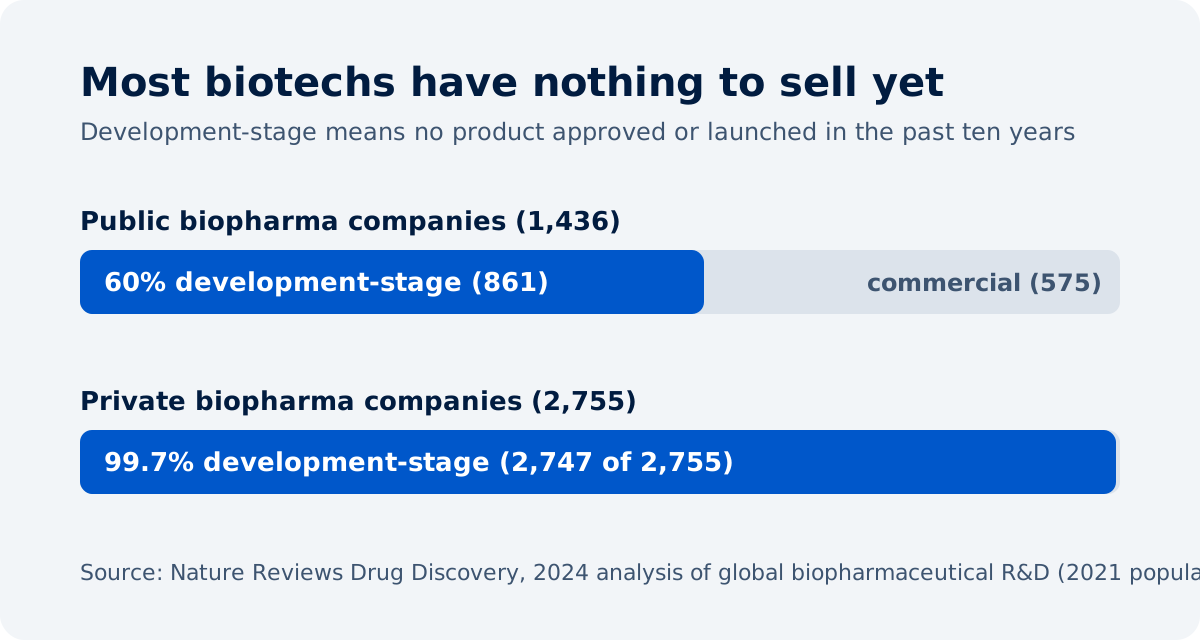
The reason the function looks so different here starts with what a biotech usually is. A 2024 analysis of global biopharmaceutical R&D investment published in Nature Reviews Drug Discovery counted 1,436 public biopharmaceutical companies with active operations as of 2021. It classified 861 of them, roughly 60%, as development-stage: no product approved or launched in the past ten years.
Among private biopharma companies in the same analysis, the split is near total. Of 2,755 private companies counted, 2,747 were development-stage. Effectively every private biotech is a company with nothing on the market.
Going public does not change that quickly. FTI Consulting's review of 151 biotech and life science IPOs from 2018 to 2024 found that nearly 40% still reported no revenue in 2024, and only 23% had reached more than $50M in sales.
Those numbers explain why "promotion" is the wrong frame. A company with no product still has to earn funding, hires, and meetings, and that work is marketing even when nobody calls it that. The function often runs unnamed; a long-tenured member of r/biotech, asked about the field, answered that "'biotech marketing' is a new one for me, at least as an FTE in the company". The job exists in nearly every biotech. The title frequently does not.
Why is demand never the problem in biotech marketing?
Demand is the one thing a biotech does not have to manufacture. If the therapy works, the assay is reproducible, or the platform delivers, the market is waiting. What is scarce is belief that the claim is real.
A marketing operations lead at a biotech put it precisely on r/marketing: in SaaS you have a product and need a market to validate it; in biotech "there is really no limit of demand, but does your product actually solve the problem? Because for the most part, they don't."
He is not being cynical. The base rates back him up.
The base rate every audience carries in their head
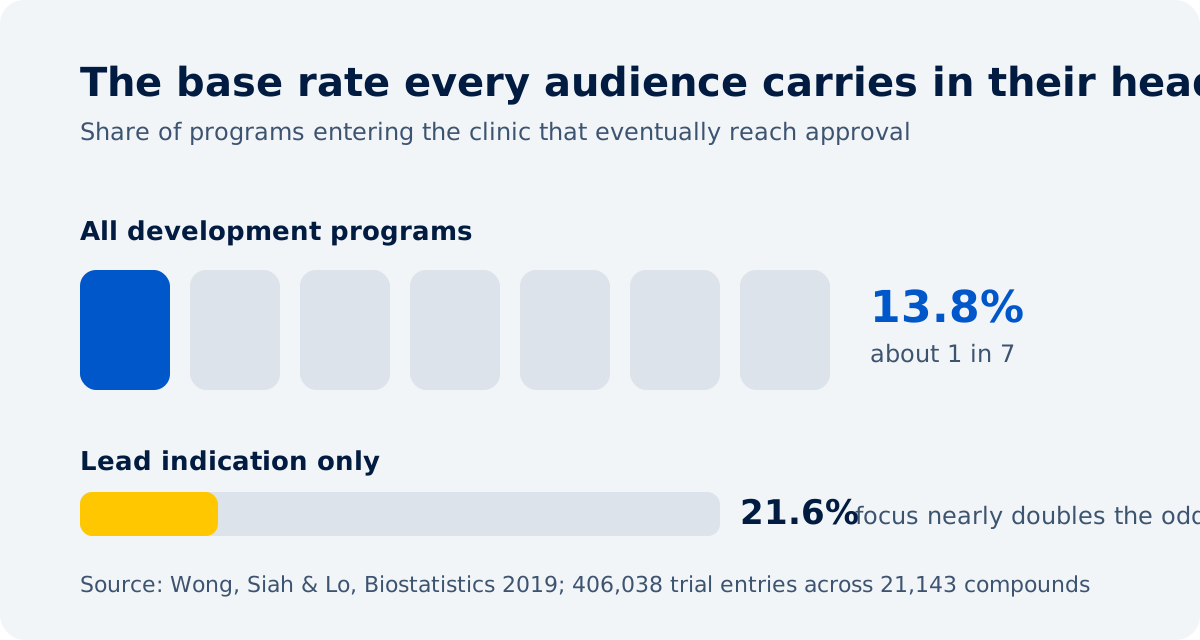
The largest study of clinical trial outcomes to date, covering 406,038 trial entries across 21,143 compounds, found that 13.8% of drug development programs that enter the clinic eventually reach approval. About one in seven.
The same study holds two details more useful than the headline number:
- For a company's lead indication, the one it has prioritised and designed around, the rate nearly doubles to 21.6%. Focus is measurable.
- Trials that use biomarkers to select patients succeed at meaningfully higher rates than trials without them. Precision in who you test is precision in whether you pass.
Every sophisticated audience a biotech faces knows some version of these numbers. Investors, pharma scouts, and journal editors all discount claims by default, because the base rate says most claims will not survive the clinic.
What that means for the marketing function
The industry's own behaviour makes the discounting worse. As one r/biotech commenter observed about the AI drug discovery wave, "all startups are primarily marketing driven until they produce real results." When everyone oversells, every audience recalibrates.
So the real output of biotech marketing is credibility. A claim precise enough to check, presented with the evidence to check it against, beats a bigger claim with adjectives. This holds at every stage, for every audience, and it is the thread that connects everything below. It is also the reason content marketing for biotech looks nothing like the hype-led version the sector is known for.
What does biotech marketing own, and where does it stop?
Biotech marketing owns the company's believability surface. It feeds the functions that close, and it stops at their door.
What the function owns
- Positioning and narrative. What the company is, what the science does, and why it matters, told the same way everywhere. Getting there is a research exercise before it is a writing one, which is why we treat it as the step from research to positioning.
- Evidence packaging. Turning data into legible proof: publications support, posters, the pipeline page, the deck, application notes.
- Category education. Teaching the market the problem, the modality, or the mechanism before anyone buys anything.
- Presence. The website, the conference calendar, and the digital estate that make the company findable and readable.
Where it stops
In this industry, marketing rarely closes. Partnering deals run through business development. Tools and services run through sales and field teams. The raise runs through the CEO and investor relations. Medical affairs handles scientific exchange with clinicians once a company matures; we cover that boundary in our life science marketing definition.
The proportions are honest and worth saying out loud. A biotech marketer on r/marketing estimated that "digital marketing in this vertical is 97% top of funnel"; roughly 3% of search traffic is ready to buy on the spot. Digital keeps the company relevant and legible. The deal happens in a room.
The channel weighting reflects it. In our analysis of life science marketing job posts, events, tradeshows, and congresses appear in about 47% of postings, named roughly five times more often than search or paid. The sector hires for the rooms, not the clicks. Read across every skill the postings name and the shape of the role the sector is buying becomes clearer than any job title suggests.
How the people on the other side of the table find you
Marketing feeds rooms it never sits in, and the feeding is more literal than most teams realise. Large pharma runs dedicated Search and Evaluation teams that put people with advanced scientific training on the hunt; their entire job is finding and assessing external assets.
What do those scouts actually read? Practitioners describe the search as an exhaustive sweep of commercial databases, company pipeline pages, scientific literature, conference presentations and abstracts, and patents. One scouting engagement screened over 8,000 assets down to a shortlist of about 30. Another worked 5,500 assets down to 51 conversations and 3 introductions.
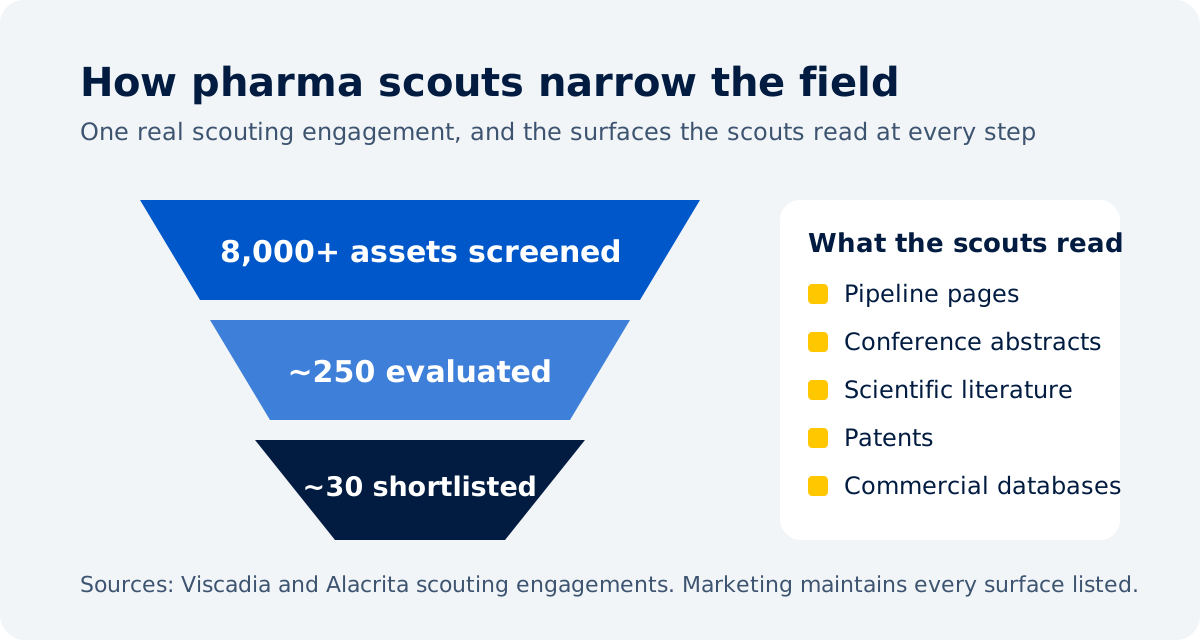
Every surface in that sweep is one marketing maintains. A scout reads your pipeline page, your conference abstracts, and your application notes long before anyone signs a CDA, and that reading decides whether you reach the shortlist of 30 or stay among the thousands screened out.
The buy side says this openly. The Search and Evaluate lead for genetic medicines at Eli Lilly: "No company is too early for my team to review. We love to see technologies at their infancy." Waiting to do marketing until there is something to sell means being unreadable during the years the scouts are already looking.
How does biotech marketing change with funding stage?
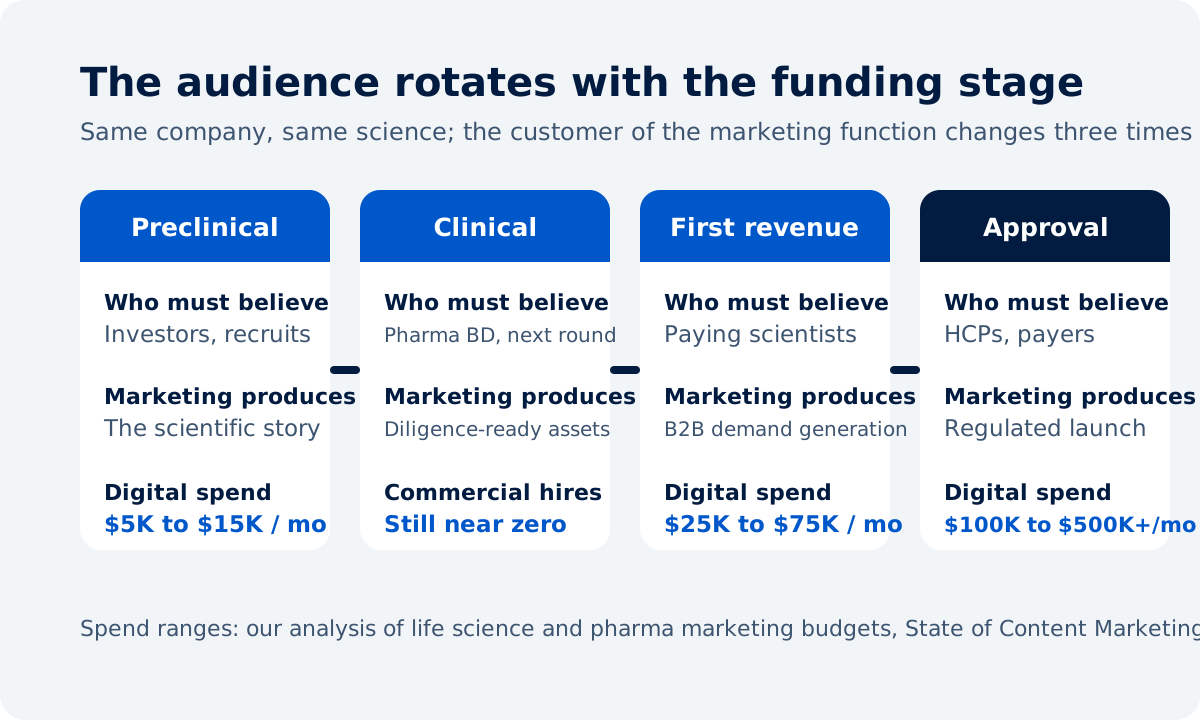
The strangest property of biotech marketing is that the customer of the function rotates underneath it. The company keeps the same name and the same science, and the marketing job changes almost completely three times.
Stage | Who must believe | What marketing produces |
Preclinical and seed | Investors, recruits | Scientific narrative, founder credibility |
Clinical development | Pharma BD, next-round investors | Findability, a diligence-ready surface |
First revenue (tools, platforms, services) | Paying scientists and labs | Classic B2B demand generation |
Approval and scale | HCPs, payers | Regulated launch marketing |
Preclinical and seed, when the product is the story
With no product and no data beyond the bench, the company markets the thesis itself, and the audience is whoever funds and joins the company. The work is the scientific narrative, the founder's credibility, and a public surface that survives a diligence read.
Spending patterns show how real this stage is despite its size. In our analysis of pharma and biotech marketing budgets, companies under $1M in revenue budget an estimated $150K to $350K a year on marketing, which works out to 15 to 35 percent of their funding. The denominator is the tell: at this stage marketing spends investor money, because investor belief is what it exists to produce.
The digital footprint stays lean. Early-stage life science companies typically run $5K to $15K a month in digital spend, weighted toward content and LinkedIn rather than paid.
Clinical development, when partners start reading
Once an asset enters the clinic, the audience widens to pharma scouts and later-round investors, and the scouting mechanism described above becomes the operating reality. The marketing job is making the asset findable, and making what the scouts find hold up.
Commercial hiring stays deliberately thin here. Advisors who guide these builds recommend no commercial hires through Phase 1 beyond a new-product-planning resource or a consultant, with the first real commercial strategy roles arriving around Phase 2.
First revenue, when marketing becomes recognisable
Tools, platform, diagnostics, and contract development and research services companies cross into revenue years before therapeutics do, and at that point biotech marketing starts to resemble B2B marketing anywhere: pipeline, lead quality, and cost per opportunity. The difference is the buyer still reads like a scientist, so the evidence-first posture stays. Our work with Westlab, a laboratory supplies business selling to exactly that buyer, is a worked example of what changes and what does not.
Budgets jump with the mandate. Growth-stage companies run $25K to $75K a month in digital spend, and this is typically where paid search enters the mix at all. Whether it should, and what a click costs once it does, is the question we work through in should you run paid ads in life sciences.
Approval and scale, when launch discipline takes over
For a therapeutic, approval turns marketing into regulated commercial launch work aimed at HCPs and payers, and the timeline is unforgiving. In a Beghou survey of 120 emerging biopharma teams, 88% start launch planning at least 18 months before launch, and the accepted hiring sequence runs market access first, medical affairs and commercial leadership next, and the field force last, because payer evidence takes the longest to build. Late-stage companies back this with $100K to $500K+ in monthly digital spend; programmatic and ABM only appear at this tier. The motion at this point is close enough to a pharma marketing strategy that most of that playbook applies directly.
Timing here is measurably expensive to miss. McKinsey's survey of first-time launchers found successful launchers hired their chief commercial officer and medical affairs lead on average four months earlier than less successful ones; nearly half of the less successful group say they hired those roles too late.
The failure mode is running the last stage's playbook
Each transition invalidates the previous marketing motion. The company that keeps writing for investors after it has a product to sell confuses its first customers. The company that builds a launch team at Phase 1 burns runway on belief it does not need yet. Reading which audience must believe next, and retooling for them ahead of the transition, is the actual strategic skill of the function, and it is the first of the five decisions that make a life science marketing strategy.
Who actually does biotech marketing?
For most of a biotech's life, nobody holds the title. The founder or CSO carries the narrative, the deck, and the website. A first generalist marketer typically arrives once there is a partnering story or an early product to support, and a real team only forms near commercialization, mirroring the stage transitions above. Until then the practical constraint is pulling the story out of the scientists who own it, which is its own discipline; ours is documented in how we work with SMEs.
When the roles do formalise, practitioners sort them into three families:
- Product marketing, closest to the science: positioning, evidence, and launch material for a specific product or platform.
- Commercial marketing, the demand and pipeline engine once revenue exists.
- Field marketing, the conference, KOL, and territory support layer that arms the people in the rooms.
The dominant entry route runs through the lab, and the industry hires accordingly. One scientist-turned-marketer on r/biotech needed an MBA to make the jump, but adds that others did it "by taking a science role at a smaller company and asking to also take on marketing projects." Another well-worn bridge is the applications scientist role, where a PhD blends technical depth with customer work before moving into product marketing proper.
Two structural facts shape the career. The sector is hierarchical, and as one veteran bluntly put it, "a PhD is at the top," which sets a real ceiling for generalist marketers in science-led organisations. And the work is coordination-heavy; in our analysis of life science marketing hiring, cross-functional orchestration appears in about 56% of posts. Companies hire the biotech marketer to connect science, regulatory, BD, and sales more than to run any single channel.
When does a biotech marketing agency make sense?
An agency fits in two situations: when the function does not exist in-house yet, which covers most companies before Series B, and when the company faces a stage transition nobody on the team has lived through, most often the first launch. Across life sciences the second case is the more common reason firms call us.
What stays in-house is the part an agency cannot manufacture. Positioning and the scientific voice come from the people who did the work; an agency can sharpen and distribute credibility, but it cannot create it on the company's behalf.
On cost, one life science agency publishes its own benchmark ranges from work with over 150 companies: $5K to $15K a month for a minimal ongoing program, and $20K to $30K a month for an aggressive one. Benchmarks like these set the ask, and what the spend then has to be measured against decides whether it survives the next review.
Read those against the wider market and the premium is visible. One cross-industry pricing study of 280 agency engagements puts the median retainer around $6,450 a month, and a separate pricing compilation finds specialist agencies typically charging 15 to 30 percent more than generalists for regulated-industry fluency.
In life sciences that premium buys claim discipline and science literacy. Paying it usually costs less than teaching a generalist agency the difference between a research-use-only assay and a device claim. Which specialists actually clear that bar is a separate question, and we reviewed more than 60 of them to rank the demand generation agencies with real life sciences proof.
A practical in-house threshold from the same benchmark: when one skill, such as technical writing or design, fills roughly 40 hours a week, hiring beats outsourcing. Below that threshold the choice runs between an agency and an individual, which is the ground covered by what a life sciences marketing consultant does and what one costs.
Is your marketing still built for the last funding stage?
Get a Content RevOps audit: your positioning, evidence, and search and AI visibility benchmarked against the life sciences 2026 data, with every gap priced in numbers your board can argue with.
Frequently Asked Questions
About the Author

Founder & CEO, Content RevOps
Stefan Kalpachev is the founder and CEO of Content RevOps, where he helps B2B SaaS companies transform their content into predictable pipeline. With a background in content marketing and revenue operations, Stefan has developed a unique methodology that bridges the gap between content creation and revenue generation.
Connect on LinkedIn