How to market a life science product
Your buyers are checking you in a record you do not own. Do you know what it says?
Book a CallAbout 72% of life science company websites publish technical documentation. About 2% publish a page that compares their product against an alternative.
That gap describes the problem. The sector is fluent in explaining what a product is, and close to silent on why anyone should choose it, which makes this a content marketing problem before it is a messaging one.
Part of Content marketing for life sciences, the complete guide.
A researcher planning an antibody panel for microglial activation in rat brain tissue described the consequence while asking colleagues for help: "sometimes I worry I'm just going with whichever vendor has the best SEO, not the best antibody."
They can find you. They can read your datasheet. What they cannot do is tell, from anything you published, whether the product will work in their hands, so they fall back on whichever result the search engine put first.
Marketing a life science product is the work of building the decision layer. Positioning, the part this sector already does well, is rarely the bottleneck. The evidence a scientist needs in order to choose is, and most of them currently assemble it themselves out of sources you do not control. If you are still settling the layer above this one, the five decisions that make a life science marketing strategy is the better starting point.
How do scientists actually choose which product to buy?
They choose on what their lab used last time and on what the published literature shows. Neither of those is something you can publish your way into, which is why the verification route runs somewhere your content does not reach.
A 2026 preprint from a UK-based team surveyed 107 researchers with hands-on antibody experience, alongside focus groups and an analysis of 785 publications, asking how important each factor is when deciding what to buy.
What influences the purchase | Rated important or very important |
Previous use within the laboratory | 77.6% |
Data in the literature | 77.6% |
Reputation of the supplier | 68.2% |
Citations in the literature | 56.1% |
Cost | 46.7% |
Clonality, monoclonal or polyclonal | 44.9% |
Availability of a free sample | 40.2% |
Source: Virk and colleagues, 2026. Worth noting before anyone builds a plan on it. This is a preprint that has not yet been peer reviewed, the sample is 107 people weighted toward UK institutions, and it covers antibody buyers rather than every kind of life science product.
The two strongest factors sit outside your website
Habit and the literature tie for first place, and habit carries more of the strongest ratings.
That is an uncomfortable result for anyone who spends their week producing content. It says the highest-leverage moment already happened, either the last time this lab bought something or the last time somebody published a paper using your catalogue number.
Cost ranks fifth of seven, below supplier reputation and literature citations. In focus groups one participant reported using a high price as a quality signal, which runs against the instinct most challenger brands act on.
Scientists verify you somewhere else before they trust you
The behaviour underneath those numbers is verification.
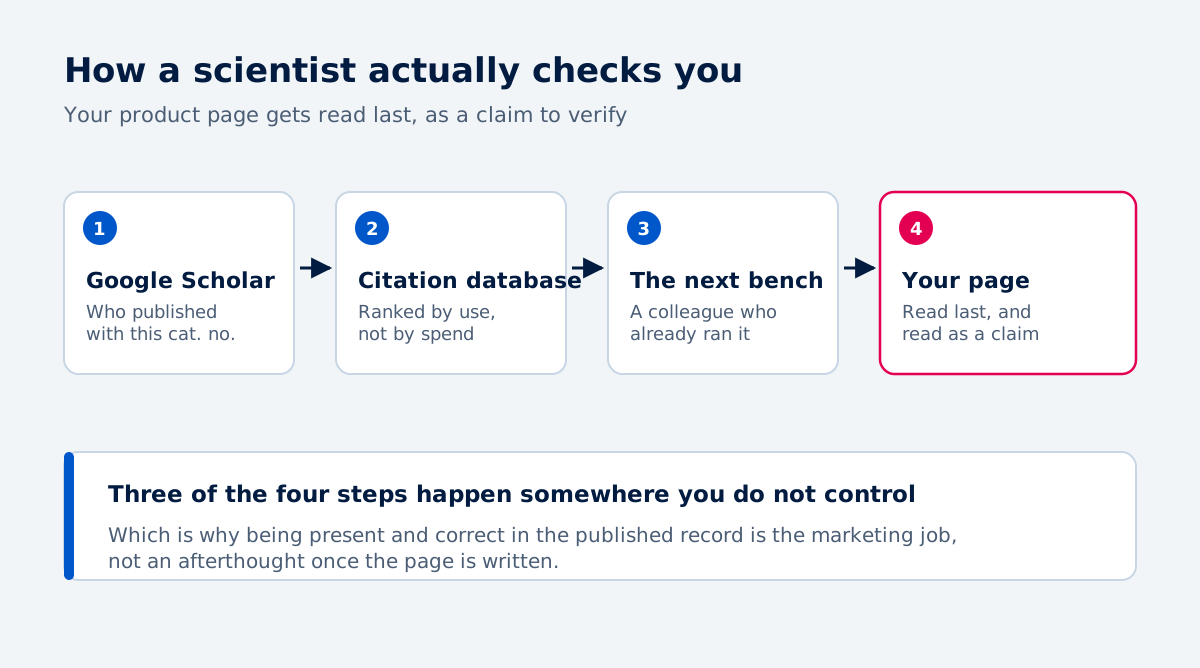
Ask a working scientist how they pick a reagent and they describe a sequence: search the catalogue number on Google Scholar to see who published with it, check a citation database like CiteAb or BenchSci, look at the supplementary figures in papers that used it, ask the person at the next bench, and read the vendor page as a claim to be checked.
One buyer explained how they spot a claim not worth checking: "I can also tell when vendors are contracting someone to make a polyclonal that then goes to many vendors. If I see the same western blot on multiple sites, I'm less likely to buy that antibody."
The rep is no longer the way in
Scientists describe vendor access as something their institution now manages. Appointments required, front desks that will not open the lobby door, spam filters, and blocked numbers.
Buyers describing the etiquette they want converge on three things: make an appointment, email rather than call, and stop sending follow-ups after a quote request.
Being straight about the evidence here. The systematic research on restricted vendor access covers hospitals and physician practices, not research labs. Nobody has measured lab access properly. What we have for research settings is what scientists themselves say, consistently and in public, which is worth taking seriously without dressing it up as a statistic.
What that means for the work
If the education cannot arrive through a rep, it has to exist in a form a buyer can reach without you.
We saw this play out with Westlab, a life science manufacturer selling to labs, whose growth ran on manual research, cold calling, conferences, and lab visits. Every one of those depended on getting a person in front of another person.
The content took over the pre-sales trust building the reps had been doing one lab at a time, so a buyer could complete most of the education alone, at whatever hour suited them. Cycles shortened, and in three months the program produced 241 inbound leads in a market that had run on cold outbound.
The reps kept their role. They stopped being the only door. That shift is the same one behind how we work with life sciences companies, and it is worth reading next to what life science marketing actually covers if the function is new to your team.
What content do you actually need to market a life science product?
You need the artifacts a buyer uses to choose between you and the alternative, and those are the ones the sector systematically does not build.
In our study of life science marketing maturity, two scores from the same instrument tell the story in one line. Positioning and ideal-customer clarity comes in at 3.66 out of 4. Sales enablement, the public material that helps someone actually decide, sits at 2.48 out of 4.
The content inventory says the same thing in a way you can audit on your own site this afternoon.
Asset | Share of sites publishing it | Cohort |
~72% | Life sciences | |
~27%, about 1 in 4 | Life sciences | |
~13%, about 1 in 8 | Pharma active cohort | |
~2% | Life sciences |
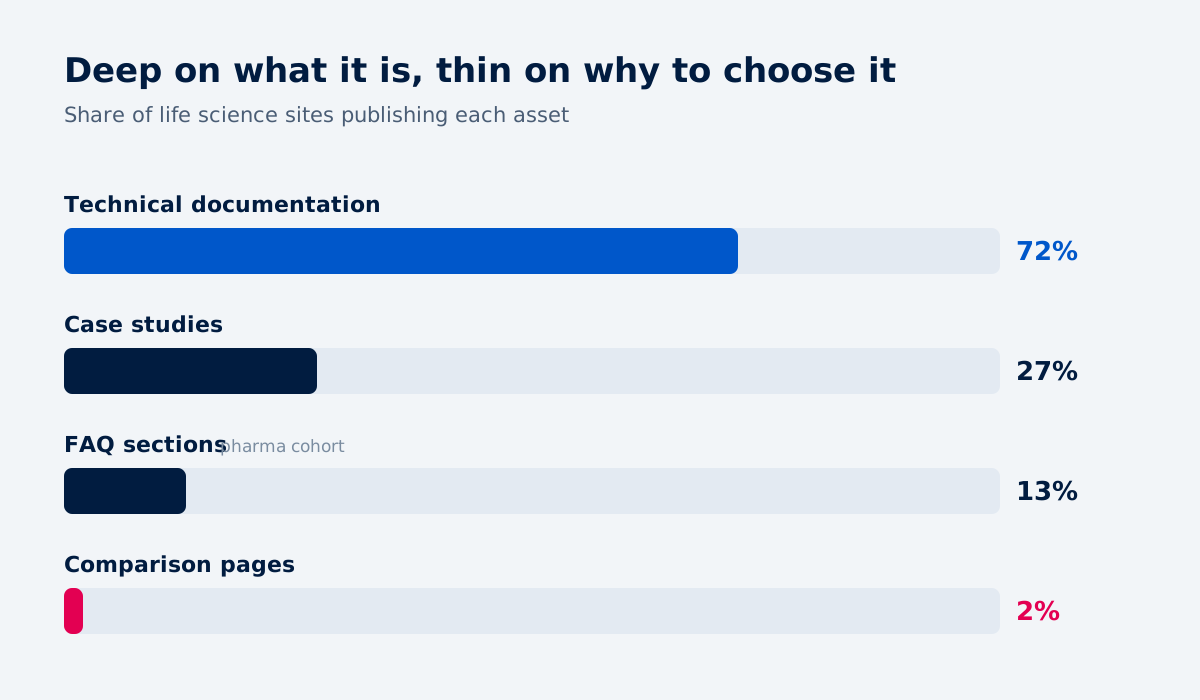
Deep on what the product is, thin on why to choose it. That imbalance is what makes inbound marketing for life sciences attract the right scientists and then stall, because the material that would carry them to a decision was never built.
Before this reads as a life science failing, it is not one. Across every B2B vertical we have measured, comparison pages never rise above 1 in 20, with the range running from 0.1% to about 5%. Life sciences is simply no better than the rest of B2B here, in a category where the buyer's need for comparison is unusually acute.
The comparison page
The buyer is already comparing you. The only question is whether they do it with your input.
A scientist choosing between three antibodies against the same target is running a comparison whether or not you publish one. When you leave it to them, they build it from the vendor pages of everyone in the set, which is slow, and from third-party databases, where they end up trusting a ranking you had no hand in.
An honest comparison names the conditions where a competing product is the better choice. That sounds like giving something away. It is what makes you credible about the conditions where yours wins.
Nobody has published what a comparison page does to conversion in a technical purchase, so the case for building one rests on the inventory gap and on what buyers describe doing, not on a measured lift.
The case study, and what it has to contain
Case studies work because of what a buyer does with them, and the mechanism is more specific than social proof.
Research on how industrial buyers actually use customer references found they use them to validate a decision they are already leaning toward: establishing that the supplier is competent, reducing the risk of being wrong, and making an abstract offering concrete enough to explain internally. Buyers reached for references before, during, and after the purchase, and used them to build the shortlist as well as to choose from it.
The same research surfaced why this matters so much in a technical category. Buyers reported real difficulty judging supplier competence, and the study's explanation was that companies market themselves so heavily that credible information gets harder to find.
Buyers there wanted numbers, calculations, and data from a reference, matched to their own situation. Stories and visuals registered as a nice touch rather than the substance. That preference is the reason our own case studies lead with what changed and by how much, and it is the same discipline behind how life science companies justify and measure marketing spend.
Two caveats, since that work carries real weight here. It is a Master's thesis, qualitative, with a small sample, and it studied buyers of digital solutions rather than laboratory products. The mechanism travels; no number from it should.
Where proof assets stop working
Studying the purchase of a pumped-hydro storage system, researchers found that customer referencing did not influence the decision at all, because the project-finance structure had already removed managerial discretion over the spend. They go further and argue that the influence of reference marketing on organisational buying is not yet proven.
That is a boundary rather than a contradiction. Proof assets work on discretionary technical choices, which is most of what a lab buys, and they lose their grip where procurement or financing has already made the decision for the person reading them. If your product sells into a framework agreement, your proof belongs earlier, with whoever writes the framework, which is closer to account-based marketing for life sciences than to a product page.
The FAQ nobody builds
Life science buyers ask the most specific technical questions in B2B, and the format built for exactly those questions appears on about 1 in 8 sites in our pharma cohort. Every question your support inbox answers twice a month is a page that does not exist.
One buyer's version of this, after asking every vendor in a category the same question about conical tubes and getting nowhere: "not ONE has responded. So yeah, I'll keep donating to the alternative."
How do you prove a product works to a technical buyer?
You prove it by showing evidence that matches the conditions they will use it in. Applicability is the constraint, and it is not the same problem as producing more proof.
The same 2026 survey asked which types of validation data matter in a purchase decision.
Validation evidence | Rated important or very important |
Western blot showing a single band at the correct molecular weight | 70.1% |
Knockout or knockdown controls | 63.6% |
High citation counts in the literature | 59.8% |
Testing across multiple cell lines | 53.3% |
Immunohistochemistry staining pattern | 52.3% |
Immunocytochemistry staining pattern | 46.7% |
Read the top two together. The most-wanted evidence is the simplest, most legible image, and the rigorous genetic control ranks below it. Buyers weight proof they can judge in five seconds above proof that is technically superior, and only 33.6% of them had heard of the IWGAV five-pillar validation framework at all.
That tells you what to put on the page and in what order. It also explains why a blurry, unlabelled figure does so much damage, because it fails the only test most buyers can run quickly.
Proof only counts in the buyer's conditions
Antibody performance varies by application, species, tissue type, and experimental conditions. Evidence generated in one of those does not transfer to another, and buyers know it.
Their version is blunt. "Half the time, the 'proof' on the company's website is some blurry Western blot done with recombinant proteins or in cell lines that have nothing to do with my research. Where are the images for my species?"
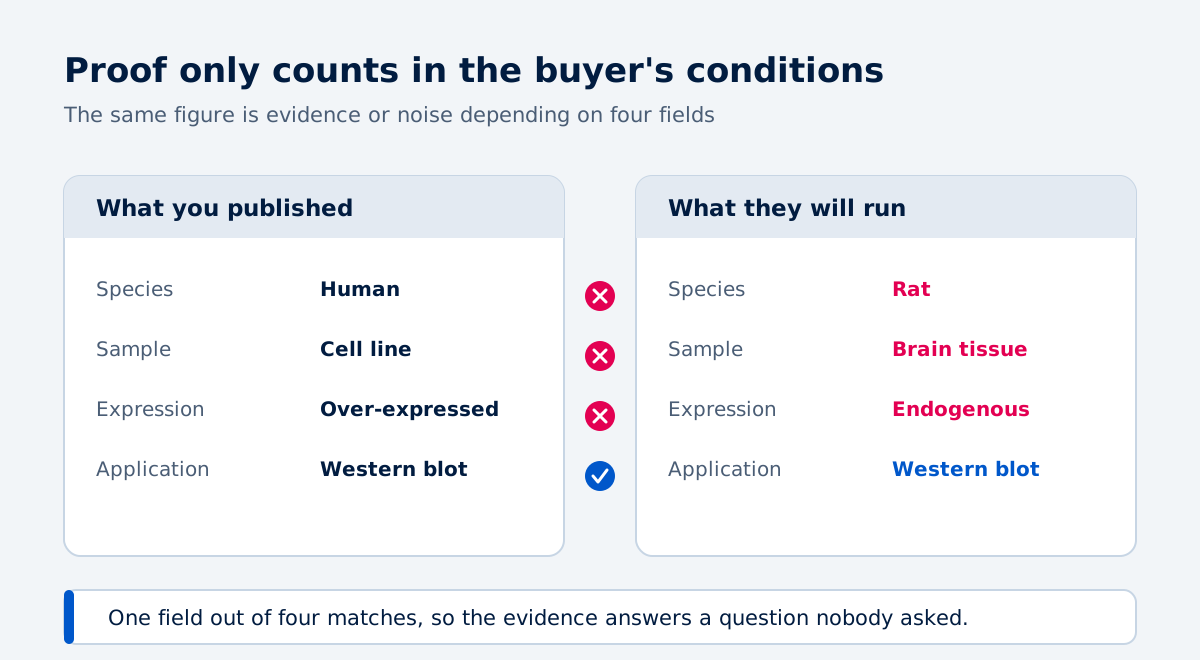
Another named the sharper failure: some antibodies get tested only in a cell line where the antigen was over-expressed, which says little about whether the product will find the protein at natural levels in real tissue.
The gap is measurable. Across 760 publications where validation status could be determined, only 120, about 15.8%, presented any validation evidence at all. More than eight in ten presented none specific to the context the antibody was used in.
There is a quieter finding in the same work. Of 35 antibodies traced through the literature, 17 were not recommended by their own vendors for the mouse applications they appeared in, and 16 had been discontinued. Twenty-seven of the 35 carried at least one of those two flags.
The information sat on the vendor's page. Nobody read it, and nobody surfaced it.
Recycled evidence destroys trust faster than no evidence
The buyer who distrusts a western blot appearing on several vendor sites is describing something scientists have documented.
A 2024 review notes that many antibodies get re-sold through multiple vendors, each using its own catalogue number and characterization data, often copied from another vendor. The authors advise researchers to avoid re-sellers and buy from the original source where it can be identified, because both data quality and responsiveness to questions improve.
If you manufacture the product, saying so and showing which data is yours separates you from every re-labelled version of it. If you distribute, publishing whose data you are showing is worth more than presenting it as your own.
The honest limit, and what it does not excuse
There is a real counter-argument here, and it comes from scientists rather than from vendors.
Validating every product in every species and application is not economically possible. Most antibody products generate under $5,000 in total sales, while knockout-based characterization costs roughly $25,000 per protein target. Universal bespoke validation would ask a supplier to spend five times a product's lifetime revenue on one of its applications.
The production economics are stark too. A 2016 review from Germany's federal materials research institute puts rough development costs at about $1,000 for a polyclonal antibody, about $10,000 for a monoclonal, and up to $50,000 for a recombinant. Research antibodies sometimes never recover those costs, which is why catalogues skew polyclonal and why the exhaustive characterization routine in therapeutics never arrives here.
Scientists also point out that validating a reagent in your own hands is part of doing the work properly, and one commenter frames it as a condition of federal grant funding. "Why on earth would you trust a validation you didn't do yourself... That's your job, not the antibody manufacturer's."
All of that is true, and none of it lets a vendor off the hook, because it argues against an obligation nobody serious is proposing. Nobody expects you to run the customer's experiment.
Two obligations exist here, and only the first one is impossible. Running every buyer's validation is out of reach. Making the applicability of the evidence you already have legible, and lowering the cost of finding out, is cheap, and it is almost entirely undone. In practice that means:
- Stating the species and tissue each figure came from.
- Publishing which applications you have not tested, rather than leaving the field blank.
- Showing the epitope instead of withholding it as proprietary.
- Naming who generated the data.
None of that requires a new experiment. It requires publishing what is already in the file.
Why the market has not rewarded this yet
A 2026 expert panel described the structural reason, and it is worth understanding before concluding that your rivals are simply careless.
The research reagent market runs on a model that prioritises catalogue breadth and low unit cost over rigorous validation, and manufacturers competing on those terms have little incentive to invest in proof while researchers keep buying on previous use and supplier reputation. Look back at the first table and you can watch the loop close. The panel concluded that the equilibrium shifts when purchasing decisions start being informed by independent characterization data, though that is a preprint reporting structured expert opinion rather than measurement.
The commercial read is straightforward. In a market that has been rewarding breadth, being the legible one costs little and is worth something the moment buyers start filtering on it. Some vendors have already moved. In the YCharOS collaboration, participating manufacturers removed about 20% of the antibodies tested and changed the recommended applications for about 40% of them once they saw independent data on their own products.
How do you show up where scientists compare products?
You get your products, and the evidence behind them, into the third-party records where the comparison actually happens. Nobody can buy a position in those records, which is precisely why buyers trust them.
When scientists name where they compare products, they name the same short list: CiteAb, BenchSci, Antibodypedia, Biocompare, and Google Scholar. Understanding how those get built changes what you do about them.
Other people's publications build the record
CiteAb indexes products by text mining publications for mentions, then running machine learning classifiers and human scientific review over the results, which the company reports at better than 99% accuracy against a training set of over a million reviewed citations.
It reaches subscription content through publisher partnerships, including Springer Nature's protocols and methods portfolio and nearly two million already-published Wiley articles. Out of that free text it extracts the fields that decide purchases, application and species reactivity, and collects the published images. Its antibody search alone covers 8.5 million products and 5.6 million citations from 392 suppliers, spanning more than 94% of the human proteome.
BenchSci works the same way at similar scale, with over 27 million full-text publications and more than 85 million products cross-referenced against vendor catalogues and independent validators including the Human Protein Atlas. The company reports more than 50,000 scientists at over 4,500 institutions using it, including 16 of the top 20 pharmaceutical companies. Biocompare runs a directory of more than 8.3 million products with an AI layer built over its own data lake.
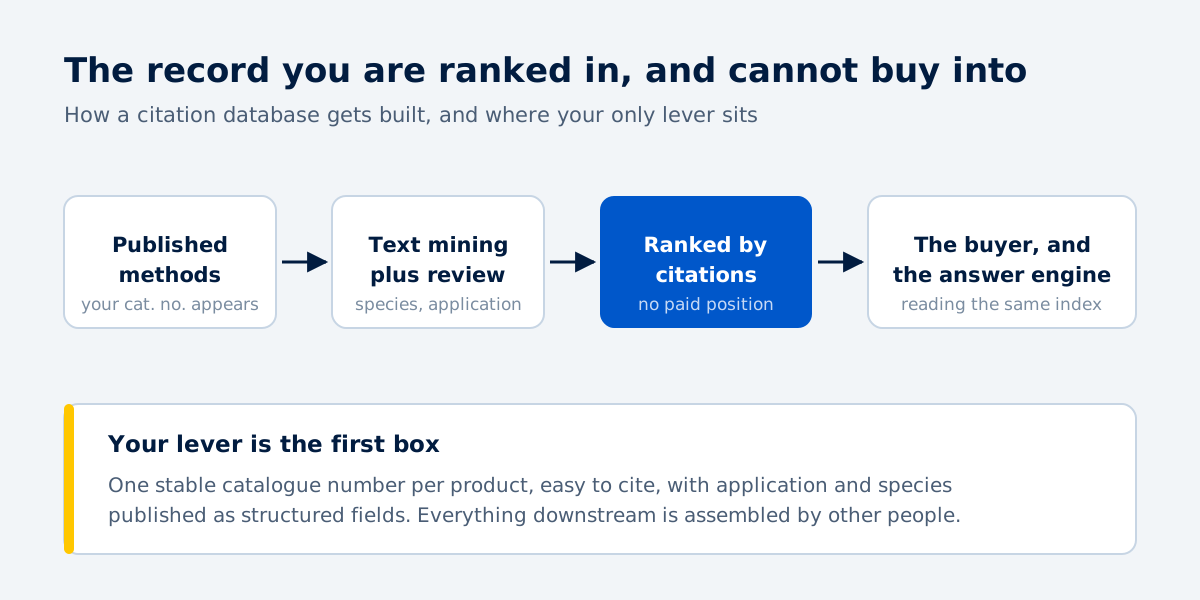
Every one of those numbers comes from the company publishing it, and no independent audit exists. The behavioural corroboration is worth more anyway. The 2026 validation study above used CiteAb and Google Scholar to find publications by catalogue number, and a separate paper uses CiteAb's index as its basis for estimating market size, so researchers doing serious methodological work already treat these indexes as the canonical record.
You cannot pay your way into it
Both platforms say so explicitly. CiteAb ranks results only by citations, so nobody can pay to be at the top of a search. BenchSci states that it does not bias results toward partner vendors, and ranks products by the amount of data supporting them.
Two consequences follow. The ranking lags published use, so it moves slowly and no budget accelerates it. And everything you do to make your product citable, correctly and consistently, compounds on an asset your competitors cannot outspend you on.
What a vendor can actually do about it
The record gets built from published methods sections, so the levers sit upstream of the databases themselves.
- Give every product one persistent identifier and keep it stable. Catalogue numbers that change, or differ between your site and your distributors, fragment your own citation record.
- Make catalogue numbers easy to cite. Put the number where an author writing a methods section will find it without hunting.
- Publish application and species reactivity as structured fields, not buried in prose, since that is what gets extracted.
- Check how you appear in each database and raise anything wrong with the platform. Both run correction routes, and neither will find your errors for you.
- Support the customers who publish with your product. A paper naming your catalogue number outlasts the campaign that would cost the same.
Publishing documentation is not the same as publishing it usefully
About 72% of life science sites publish technical documentation. In our pharma cohort, only about 2%, roughly 1 in 43, publish it in any structured form. Different samples and different tests, so read the pairing as directional rather than as a subtraction.
Documentation exists. It exists as PDFs, as prose, and as images with no machine-readable equivalent. Nearly everything that reads it, from a citation database's extractor to an answer engine, wants fields.
The search data shows where that leaves companies. Across the life sciences, only about 3% of ranked keywords are commercial-investigation terms, the compare-and-choose queries, and about 2% of pharma's ranked keywords sit at the bottom of the funnel. The comparison middle sits nearly empty, so third-party sites win those searches by default.
The same record feeds the machines
Answer engines assemble from the same public material. Life science companies appear in AI Overviews at close to zero while Overviews trigger on essentially every industry query we tested.
When a buyer asks an assistant which antibody to use for a target in mouse tissue, the answer gets built from citation databases, published papers, and review sites. Structured, citable, correctly attributed product data is how you enter that answer, and the mechanics are the same ones behind why one brand gets cited in AI answers while a better-known competitor is ignored. If you rank well and still cannot find yourself in an assistant's reply, that specific failure has its own diagnosis.
How do you get a lab to try your product?
You lower the cost of finding out. Every mechanism in this section removes some of the risk a buyer carries when they cannot tell in advance whether something will work.
Show the price
The most repeated complaint from lab buyers is quote-gating. "If you're selling instrumentation, for the love of god just give me a ballpark price before you make me sit down and listen to you talk for 30 minutes."
Evidence backs the irritation, and it points the opposite way to the standard sales instinct. A randomised field experiment run for a doctoral dissertation at DePaul University assigned website visitors either to see an objective price or not, in a natural setting for a high-cost, high-involvement purchase. Hiding the price reduced how much buyers searched, how many became leads, and how strongly they intended to buy. Fewer leads, and weaker intent among the ones who did make contact.
The mechanism is search cost. A missing price raises the buyer's uncertainty, uncertainty raises the effort required to keep evaluating, and evaluation stops when the effort outweighs the benefit. The buyer collecting quotes from every supplier in a category runs exactly this arithmetic, and every extra step raises the odds they stop at whoever answered first.
That study tested a consumer product, recreational boats, not laboratory equipment, and it is doctoral work rather than settled literature. Its author points out directly that B2B sellers would benefit from the same evidence in their own context.
A public price band, a configurator, or a worked example costs nothing and removes the step buyers hate most.
Make the sample big enough to answer the question
Free sample availability ranked seventh of seven purchase factors, at 40.2%. It matters, and it works as a conversion instrument rather than a strategy.
What matters more is whether the sample can answer the buyer's actual question. One buyer drew the distinction exactly: samples are welcome "especially when they are full size, and sterile. So I could actually do a full experiment with them. (Like, thanks for the 3 cryotubes loose in a bag, but what am I supposed to do with that?)"
A sample too small to run a real experiment does not lower the cost of finding out. It moves that cost somewhere the buyer cannot recover it.
Trials and guarantees do different jobs
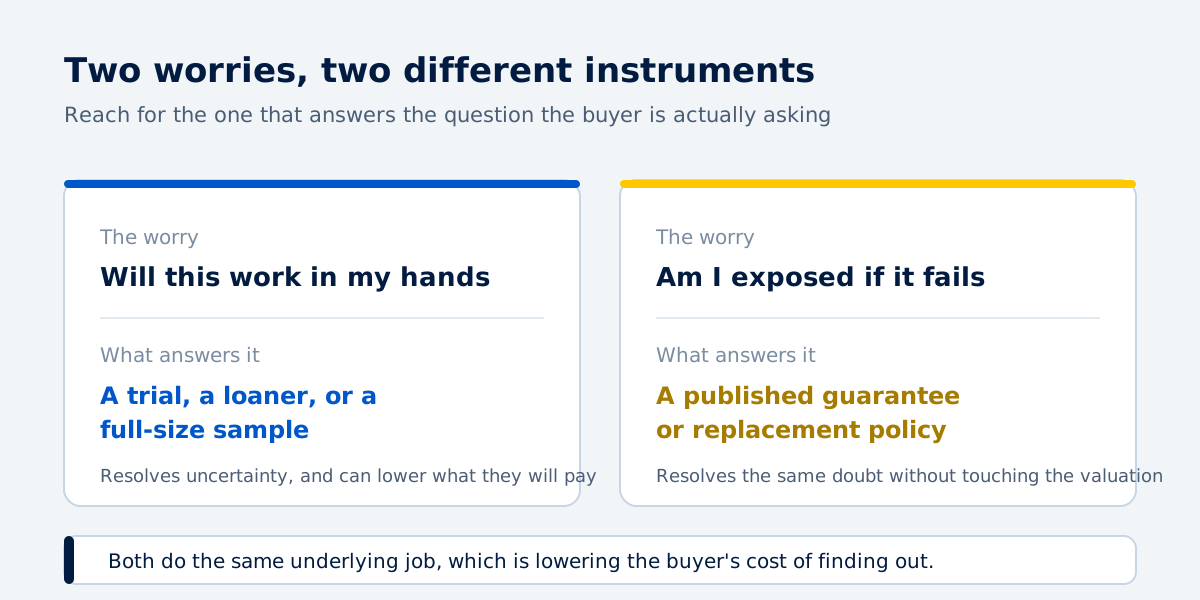
Trials carry a cost most people never account for. Experiments across three studies found that willingness to pay was significantly lower after a product trial than with a money-back guarantee or a normal sale, even though the trial improved attitudes toward the product. Direct experience resolves uncertainty, and it also anchors the buyer's sense of what the thing is worth.
A separate experiment with 396 participants found free trials more likely to be accepted than paid ones, while warning that free trials can devalue a service and undermine engagement.
The two instruments answer different questions.
The buyer's real question | The instrument that answers it |
Will this work in my hands | A trial, loaner, or full-size sample |
Am I overpaying, or exposed if it fails | A published guarantee or replacement policy |
Refund behaviour gets remembered and repeated by name. One scientist listing suppliers: "I've had to get money back from Abcam and Thermo before, but never from CST, MilliporeSigma, SynapticSystems or BioRad." That sentence is a public buying recommendation built entirely on how vendors behaved when something failed.
One field example is worth a line of caution. A UK project gave free trial kits to three SME manufacturers and none converted; the vendor's read was that free attracted the curious rather than the committed, and they later reported 66% conversion when the same kit was sold for £250. Three participants and a vendor-reported follow-up figure make an anecdote, not evidence, though it points the same way the controlled experiments do.
The version that works
The clearest conversion story in this category came from a buyer describing a vendor who arranged for the two instrument models most likely to suit the lab to be loaned for a week. They ordered from that vendor, and explained why: "we knew for certain it would work for us, even if it wasn't necessarily the cheapest option."
The vendor won by removing the uncertainty, and the buyer paid for the certainty.
How do you compete with the brand a lab already buys from?
You make yourself a safe choice. The incumbent is rarely winning on specification.
Look again at what buyers said decides a purchase. Previous use within the laboratory ranked joint first at 77.6% and carried more of the strongest ratings than anything else. Supplier reputation came in at 68.2%, ahead of literature citations. The incumbent's advantage is that it is already there and already known.
The buyer is managing their own risk, not just the product's
The operative question is what happens to the person who chose it if it fails.
One buyer stated it plainly: "I definitely won't be in trouble if I purchase this known-reliable brand for my company, but I might be if I try to save money by buying from something that isn't that."
That risk is personal before it is technical. Three more concrete ones sit underneath it, and each has a different answer.
Continuity risk. "How do I know this company will still exist in 1 year when the unit has a manufacturing fault?" In regulated environments the worry sharpens, because a supplier disappearing becomes a compliance problem rather than an inconvenience. Anyone selling into a CDMO or CRO buying process will recognise the same test applied to their own company.
Process friction. Approving a new supplier costs the buyer time nobody compensates them for. As one described it, the hassle of approval, quality checks, and purchasing means a cheaper option from an unfamiliar name is often not worth pursuing.
Judgment risk. If a familiar product fails, the lab blames the product. If an unfamiliar one fails, the lab blames whoever picked it.
Arm the person who has to defend the decision
Research on reducing buyer perceived risk in technological innovations, studied from both the buyer's and the seller's side, splits the work by phase. Early on, the useful instrument is a life-cycle performance assessment, letting the buyer model cost and benefit across the life of the asset rather than at the moment of purchase. Later, three supplier behaviours carry it: adapting the product to the buyer's actual process, supporting the internal champion who has to argue for it, and implementing cooperatively rather than handing over a box.
That is a single peer-reviewed case study, of a monitoring system sold into copper refining, so treat the phase model as a useful frame rather than a measured law.
The middle behaviour is the one most product marketing misses. Someone inside the lab has to defend this choice to a PI, a procurement officer, or a quality manager, and they will do it without you in the room. Everything they need has to be publishable and portable, which in practice means a page they can forward containing total cost over the instrument's life, service response times you will commit to in writing, named customers who already run it, independent validation rather than your own, and what happens if it fails.
Customer references do this work well. Research on their value to the buying company proposes that they let a buyer establish supplier competence, assess the risk of the decision, and forecast return. A reference moves risk assessment out of the buyer's imagination and into someone else's completed experience.
One thing nobody has measured
What actually triggers a lab to switch suppliers is not well studied. The literature on switching costs lives mostly in consumer telecoms, electricity, and insurance, and none of it transfers cleanly to a research lab choosing a reagent.
We can describe what the barrier consists of. Nobody can yet say reliably what removes it, or when the window opens, and anyone claiming otherwise is guessing with more confidence than the evidence supports.
What follows is a posture rather than a campaign. The trigger arrives on someone else's schedule, and the work is being findable, checkable, and safe on whatever day that turns out to be. Which is the same decision layer this article started with.
If you want a number for where your own decision layer sits before you start building, the benchmarking tool scores your site against the same life sciences instrument the data above came from.
Positioning gets you considered. The decision layer gets you chosen.
What does your decision layer actually look like to a scientist?
Get a Content RevOps audit, your product pages benchmarked against the life sciences 2026 data on proof assets, comparison content, and third-party visibility, with every gap priced in numbers your CFO can argue with.
Frequently Asked Questions
About the Author

Founder & CEO, Content RevOps
Stefan Kalpachev is the founder and CEO of Content RevOps, where he helps B2B SaaS companies transform their content into predictable pipeline. With a background in content marketing and revenue operations, Stefan has developed a unique methodology that bridges the gap between content creation and revenue generation.
Connect on LinkedIn