Patient-centric pharma marketing without crossing the line
Pharma builds 1 in 3 content assets at awareness and just 1 in 30 at post-purchase, where patients need it most. Want to see where your patient content leaks pipeline?
Book a CallAsk people inside the industry what "patient-centric" means and you get a tired answer. On Reddit, a former commercial marketer wrote that "patient-centric" is all about the PR, and most people's roles "are detached from the patient directly." Another put it flatter still: the industry "just cycles through buzzwords," and the words are "meaningless." They are not wrong about the slogans. They are wrong that nothing can be done about it, which is where our content marketing work with pharma and life science teams starts.
Part of Content Marketing for Pharmaceutical Companies.
Patient-centric pharma marketing is real when it is content a patient actually uses to understand a diagnosis, start a treatment, and stay on it. That content either exists on your site or it does not. And our research on pharma content marketing shows where pharma builds it and where pharma leaves patients with nothing. This guide covers what to build, at which stage, and how to keep it inside the compliance line without going sterile.
What is patient-centric pharma marketing?
Patient-centric pharma marketing means building your content around what the patient needs to know and do, not around the product's talking points. It starts from the patient's questions, uses the patient's language, and helps the patient act, whether or not your brand is in the frame.
That is close to how the research defines it. A 2024 systematic review of 46 studies in the International Journal of Consumer Studies describes patient-centricity as an approach that puts patients, their needs, and their preferences at the heart of healthcare by educating them, involving them, integrating their perspective, and giving them the best possible experience.
The sharpest definition came from patients themselves. When AstraZeneca cocreated a definition with patients and caregivers, validated across US and European patient forums, one of their core principles was that a company "provides easy-to-understand and convenient information in plain language because they understand that words matter."
Hold onto that phrase. Words matter. It is a content instruction, and it is the part most pharma teams skip.
The practical test is simple. A product manager once described brand work in pharma as "translating complex clinical trial data into a simple narrative within the guardrails of an approved label." Patient-centric marketing is that same job aimed at the patient instead of the prescriber. It is the mirror image of HCP content marketing, which does the same translation for clinicians. The buzzword is the mindset. The work is the content.
Where does pharma's patient content sit today?
Pharma builds patient content at the top of the journey and almost nothing at the bottom. That single imbalance is the reason patient-centricity keeps reading as a slogan.
Our analysis of pharma and biotech websites found that about a third of content assets, roughly 1 in 3, sit at the awareness stage. Awareness is disease education, symptom explainers, "what is this condition" pages. Pharma's educational instinct is strong, and this is the part of the funnel the industry actually builds.
Then look at the other end. About 3 percent of content assets, roughly 1 in 30, sit at the post-purchase stage. Post-purchase content is what a patient needs after they start a treatment: how to take it, what side effects to expect, how to stay on it. This is the single largest discoverable gap in pharma content marketing, and adherence and support content is exactly what is missing.
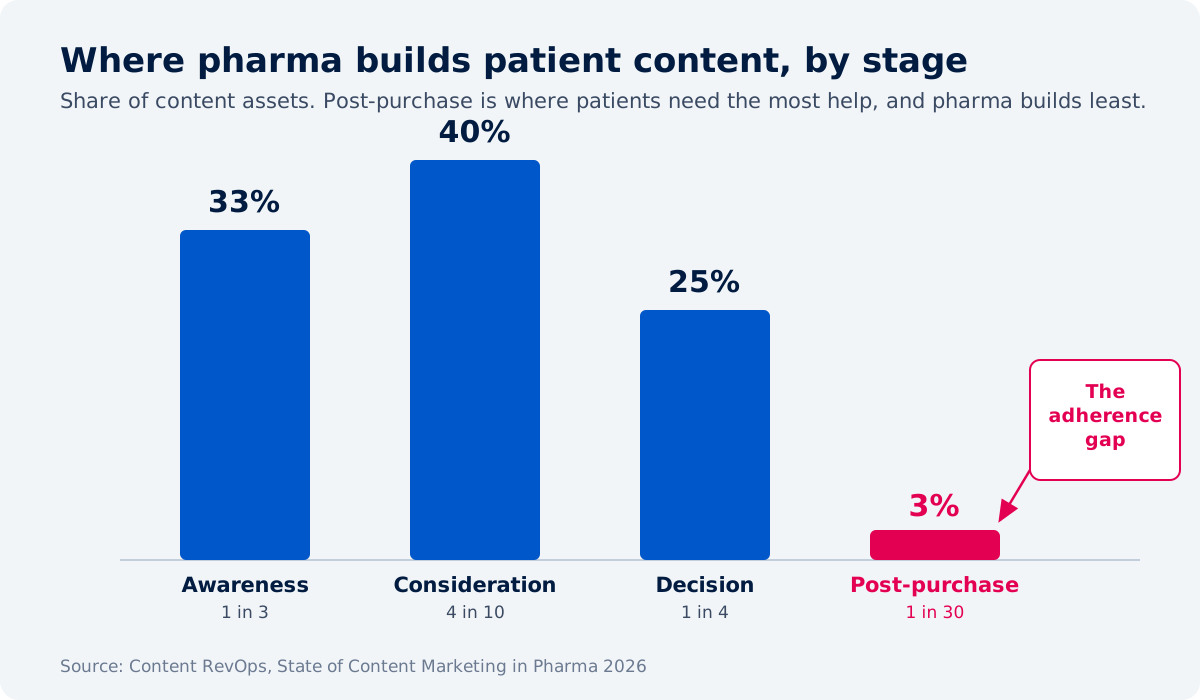
Read those two numbers together. Pharma pours content into the moment a patient is curious and starves the moment a patient is coping. The funnel is inverted from patient need.
The middle is thin too:
- About 1 in 3 content producers run no decision-stage content at all. A patient or caregiver who arrives ready to act finds nowhere to land.
- About 1 in 5 pieces end with no next step, no related link, no offer, nothing. The reader finishes and leaves.
And the baseline is lower than most teams assume. About 90 percent of pharma and biotech sites show no meaningful signs of content marketing at all. The brochure site is still the industry default across life sciences, not just pharma. So the patient-centric opportunity is not crowded. It is nearly empty.
Should you build unbranded disease education or branded product content?
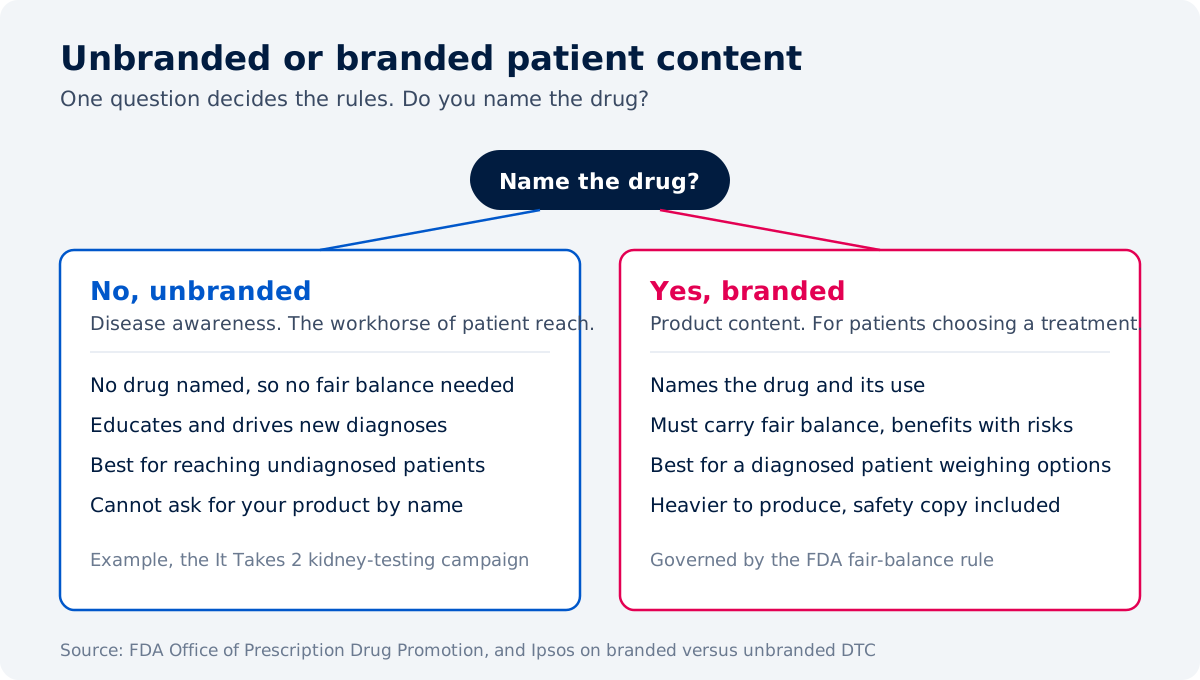
This is the first real decision, and the compliance line runs straight through it. The rule is short: if you name the drug, you carry fair balance; if you do not, you do not.
Every prescription drug ad in the US must not be false or misleading, and it must present a fair balance between a drug's benefits and its risks. The FDA's Office of Prescription Drug Promotion enforces that. In practice, the FDA recognizes three kinds of promotion: a product-claim piece that names the drug, its use, and its risks in a balanced way; a reminder piece that names the drug but makes no claims; and a help-seeking, or disease-awareness, piece that names no drug at all. Getting that split right at the brief stage, rather than at review, is the heart of FDA-ready content workflows.
That third kind is the workhorse of patient content. Because fair balance is not required for a campaign that does not mention the drug by name, an unbranded piece can educate a patient about a condition, its symptoms, and the value of getting tested without carrying a page of safety copy. Unbranded disease-awareness content drives new diagnoses, and it is the most efficient way to reach patients who do not yet know they have a problem.
When to use each
- Unbranded disease education. Use it when many patients are undiagnosed, when the condition is misunderstood, or when you want reach without the weight of full safety information. It builds trust and demand for the category. It cannot say "ask for our drug."
- Branded product content. Use it when a diagnosed patient is choosing a treatment and needs to weigh your product specifically. It names the drug, so it carries the benefits and the risks together, side by side.
One honest caution. The FDA does not pre-clear disease-awareness campaigns, but its own research found that consumers can confuse a disease-awareness site with a branded drug site. Keep the two visibly separate so the unbranded piece stays unbranded.
Real teams already run this play. When CORE Kidney, Boehringer Ingelheim, and Eli Lilly built the It Takes 2 kidney-testing campaign, the message was simple and unbranded: if you have diabetes or high blood pressure, ask for two tests. No product. Just a reason for an at-risk patient to act. It is one of the tactics that compound rather than burning out with the campaign flight.
What content do patients actually need at each stage of treatment?
Patients do not move through a marketing funnel. They move through a diagnosis, a decision, and a life with the condition. The content need changes at each step, and the post-purchase gap becomes obvious once you map it.
When patients helped define patient-centricity, they said the job is to "understand the patient journey, which begins and ends at their home and not with your product," and they asked for support on "how I can live with my condition," not just the medical facts. So build for the whole journey, not the first click. That is also the honest test of omnichannel marketing in pharma: whether the channels add up to one continuous journey or just more places to repeat the same awareness message.
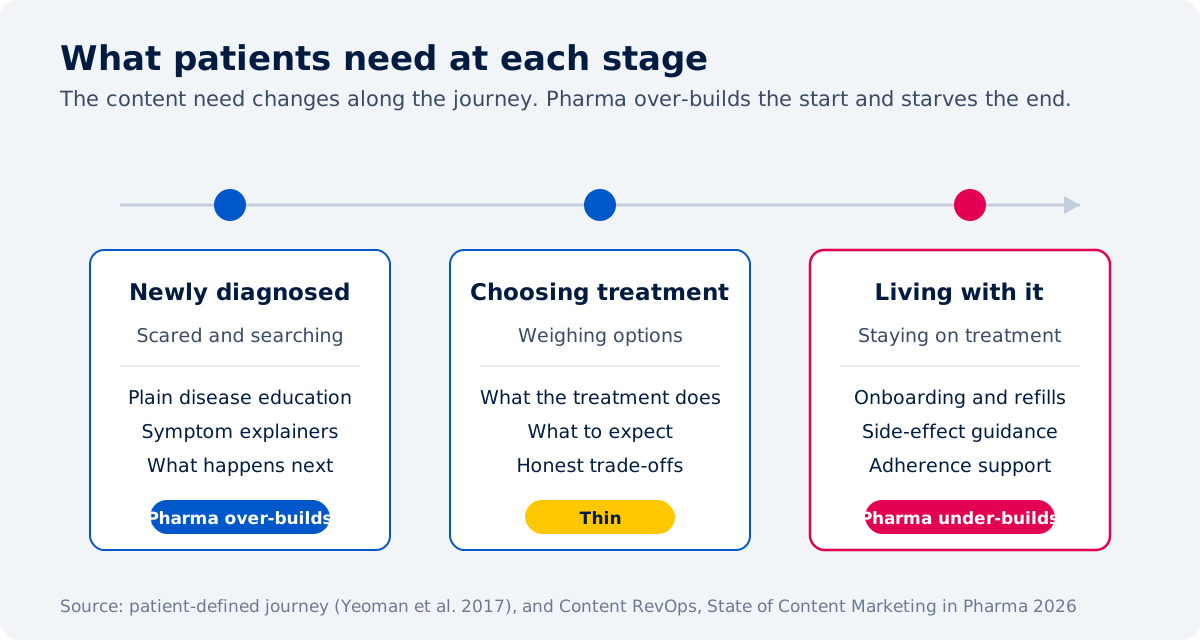
Newly diagnosed
The patient is scared and searching. They need plain answers about the condition, what it means, and what happens next. This is unbranded disease education, and it is the stage pharma already over-builds.
Choosing a treatment
The patient is weighing options with a clinician. They need to understand what the treatment does, what to expect, and the honest trade-offs. This is where branded content belongs, with benefits and risks together.
Starting and staying on treatment
The patient is now living with it. They need onboarding, side-effect guidance, refill reminders, and encouragement to keep going. This is the post-purchase stage, and it is where pharma builds almost nothing.
There is a cheap fix hiding in that last stage. About 55 percent of pharma content pages place the same generic call to action at the end of every post, regardless of stage. Match the ask to where the patient actually is, an enrollment link for a new starter, a support resource for someone mid-treatment, and you improve conversion without writing a single new page.
Named programs show the stages in action. Bristol Myers Squibb's Live Your PosSCZible campaign built peer stories, community resources, and "Get Ready with Me" videos for people already living with schizophrenia. That is post-diagnosis, living-with-it content, and it is exactly the stage most brands leave blank. Peer stories also travel further than brand copy on the channels covered in pharma social media marketing.
How much adherence and patient-support content does pharma build?
Almost none, and that is the most expensive gap on this list. Adherence content is where patient-centricity and revenue meet, because a patient who understands and stays on a treatment is a patient who keeps filling a prescription.
Start with the human problem. Adherence to long-term therapy for chronic illness in developed countries averages about 50 percent, according to the World Health Organization. Half of patients do not take their long-term medicine as prescribed.
It shows up early and often. The CDC reports that about 1 in 5 new prescriptions are never filled, and among those that are filled, about half are taken incorrectly. Wrong timing, wrong dose, stopping too soon.
The cost is enormous. Researchers estimate that between $100 billion and $300 billion in avoidable US health care costs are tied to nonadherence every year, which works out to roughly 3 to 10 percent of total US health spending. Some of that is a patient who did not understand what the drug was for, or gave up when a side effect hit, because no one gave them content that helped.
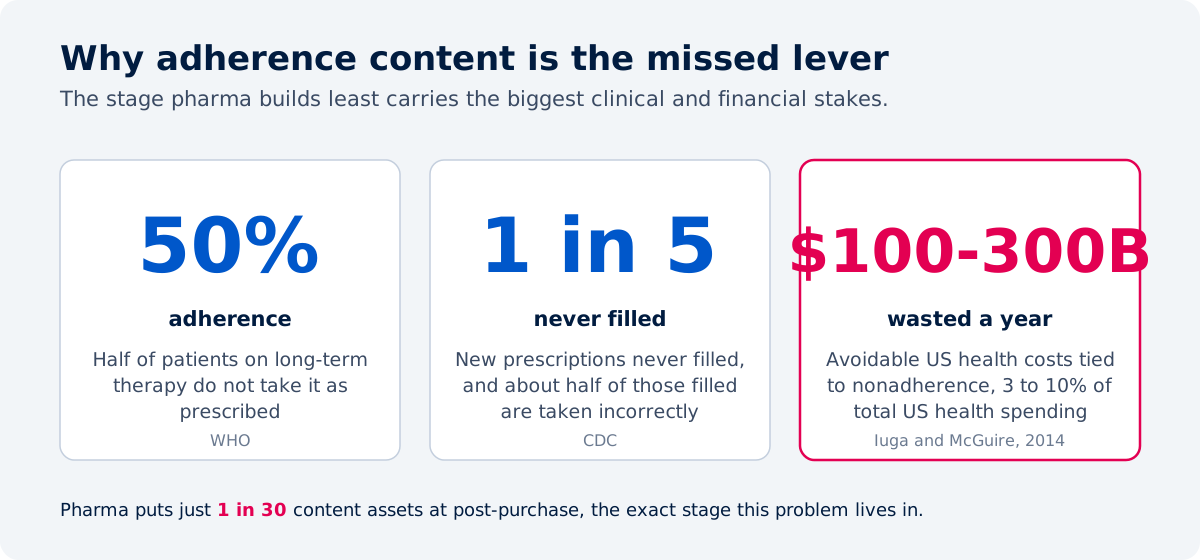
Now put that next to the 1 in 30 pharma content assets that sit at post-purchase. The stage with the biggest clinical and financial stakes is the stage pharma builds least. That is the definition of a missed lever.
Pharma already pays for this problem in other budgets. In mid-market pharma, patient support and disease-state work already split the paid-search spend with brand protection. The intent to support patients is funded. The owned content that would make it compound is not.
The engine to run it is half-built
Adherence content works as a sequence, not a one-off. You need to reach a patient again next week, not just today. Most pharma sites cannot.
- About 2 in 3 pharma sites offer a newsletter signup. The owned audience mechanism exists, and it is the starting point for pharma email marketing and nurture.
- But fewer than 1 in 10 run marketing automation, and fewer than 1 in 12 run a CRM. Without those, a nurture sequence becomes a single email that never follows up. This is the infrastructure decision behind every adherence program that works.
We have watched education-led content do this job in an adjacent life-science market. Working with Westlab, a lab supplier that sells to lab professionals rather than patients, a structured content engine did the trust-building and pre-sales education that used to depend on repeated human contact, and it influenced $120,000 in quotes in three months. The audience is different, so treat it as a parallel, not a patient case. The mechanism travels: content can carry the education a person used to deliver one conversation at a time.
How do you keep patient content readable without crossing the line?
You write plainly and stay accurate at the same time. Health literacy is the craft that makes patient content usable, and it is the discipline almost no pharma page treats seriously.
The problem is real. According to the CDC, almost 9 in 10 people struggle to understand health information. And it gets worse under stress: a person's reading skills can drop about four grade levels when they are frightened or reading about a stressful topic, which is the exact state a newly diagnosed patient is in.
A pharma marketer on Reddit named the tension exactly: how do you simplify all the complexities and disclaimers "into a simple narrative without being misleading?" That question sounds like a trap, but it has a clear answer.
Plain language is not dumbing down. The CDC is blunt about it: you can use plain language and still be scientifically accurate. Clarity and accuracy are not a trade-off. Vague simplification is the danger, not simple language.
The rules that make patient content readable
The CDC's plain-language guidance gives a short, usable set:
- Keep sentences to about 20 words or fewer, and one idea each.
- Put the main message first, before the background.
- Write in the active voice.
- Swap jargon for everyday words, and define any term you must keep.
Fair balance lives comfortably inside those rules. Nothing about plain language lets you drop a risk; it just means the risk is stated in words a patient can read. The FDA itself encourages sponsors to write drug risk information in consumer-friendly language. Readable and compliant are the same goal.
If you want a check, the CDC's Clear Communication Index scores a piece against 20 research-based items, and 90 or higher passes. Run it on a patient page before your medical, legal, and regulatory review, and you save everyone a round.
How do you reach patients compliantly when you can't advertise to them directly?
You get found where patients already look, and you partner with the groups patients already trust. Direct-to-consumer rules limit what you can say, but they do not stop patients from searching, and search is where the compliant reach lives. That makes owned search and answer visibility the quiet backbone of digital marketing for pharma.
Patients research everywhere. A 2026 Pew Research Center survey found that Americans pull health information from doctors, health websites, peers with the same condition, and increasingly from AI, and that about a third of Americans use AI chatbots for a health reason, including a quarter who use them to help make sense of symptoms. The same body of Pew research found that half of Americans struggle to tell whether health information is accurate, and that 72 percent want their health sources to be easy to understand.
That is an opening. If patients are drowning in health information they cannot verify, the credentialed, plain, easy-to-find answer wins by default. But pharma is not showing up for it.
Our keyword analysis found that about 95 percent of pharma's ranked search terms are top-of-funnel and only about 2 percent are bottom-of-funnel. Pharma ranks for what patients ask early and disappears for what they ask when they are ready to act. In AI answers the pattern is starker: pharma sites appear in about a third of AI answers to awareness questions, and in essentially none of the answers to decision-stage questions. Third-party sites own the moment that matters most, which is the mechanism behind why pharma disappears from AI search.
The second route is partnership. Marketers on Reddit describe the compliant way to reach patients as "indirect, through patient advocacy groups or disease-awareness campaigns." Advocacy partnerships carry the message with a voice patients already trust. AstraZeneca's 35-year partnership with the American Lung Association, which has funded lung-cancer screening education and living-well programs for asthma and COPD, is the long-form version of that move: education delivered through a trusted patient organization, over years, not a campaign burst.
Where should you start with patient-centric pharma marketing?
Start by finding your gap, then fix the cheapest thing first. You do not need a new content factory to become more patient-centric. You need to move weight to where patients actually are.
- Map your patient content to the journey. Sort what you have into newly diagnosed, choosing treatment, and living-with-it. You will almost certainly find the same shape as the industry: heavy at awareness, empty at post-purchase.
- Fix the call to action before you write anything new. Match the ask on each page to the patient's stage instead of a generic default. This is the largest conversion fix available and it needs no new content.
- Choose unbranded or branded on purpose. Use unbranded disease education for reach and diagnosis, and branded content, with fair balance, for treatment choice.
- Rewrite for a stressed reader. Short sentences, plain words, main message first, and run the Clear Communication Index before your review cycle.
- Build the missing adherence content. Onboarding, side effects, and staying-on-treatment guidance, delivered as a sequence through the newsletter and automation you likely already half-own.
- Get found and get partners. Rank for the decision-stage questions patients ask, and work with advocacy groups to reach patients through a voice they trust.
Those six moves belong inside a single plan rather than six side projects, which is what a pharma marketing strategy is for, and what pharma marketing analytics has to prove once the content is live.
Here is the part that turns patient-centricity from goodwill into a business case. The post-purchase and adherence content pharma is missing is the same content that keeps a patient on therapy. A patient who understands their treatment and stays on it is the revenue you already won, protected. Nonadherence drains that revenue every month, and useful patient content is one of the few levers that pushes back.
That is why we treat content as revenue infrastructure, not a marketing extra. Patient-centric pharma marketing done properly is not a campaign you run and switch off. It is the system that carries a patient from a first scared search to a life managed well, and it defends the pipeline your commercial team paid to fill. Give your content that job, and "patient-centric" stops being a slogan the moment a patient uses it.
Is your patient content built for the whole journey, or just the first search?
Get a Content RevOps audit, your funnel shape, conversion gaps, and AI-search visibility benchmarked against the pharma 2026 data, with every leak priced in numbers your CFO can argue with.
Frequently Asked Questions
About the Author

Founder & CEO, Content RevOps
Stefan Kalpachev is the founder and CEO of Content RevOps, where he helps B2B SaaS companies transform their content into predictable pipeline. With a background in content marketing and revenue operations, Stefan has developed a unique methodology that bridges the gap between content creation and revenue generation.
Connect on LinkedIn