Pharma go-to-market strategy for new launches
Fewer than 1 in 3 content producers publish anything for the moment a prescriber or payer decides. Want to see where your launch goes silent?
Book a CallA pharma go-to-market strategy is the plan for turning an approved drug into a prescribed one. It covers how you understand the market, position the therapy, price it, win access, and reach the prescriber, the patient, and the payer. The part that usually goes unbuilt is the one our content marketing work with launch teams keeps finding empty.
Part of Content Marketing for Pharmaceutical Companies.
Most guides stop there and hand you an eleven-step checklist. That checklist is not wrong, but it describes the launch a pharma company runs on the inside. It says almost nothing about where the launch is actually decided now, which is on the open web and inside AI answers, long before your sales team is allowed in the room.
This guide covers that gap. It is written for launch leaders, commercial and medical teams, and the marketing operators at pharma and life science companies who have to build the plan. It lays out a launch content architecture that answers the buyer at every stage, shows who owns it, and gives directional budget bands by company revenue so you can size the work. It is the launch-specific view of the wider pharma marketing strategy that runs once the drug is on the market.
What a pharma go-to-market strategy has to do now
A modern pharma go-to-market strategy has to win the prescriber before a rep ever meets them. The old plan assumed the field force was the front door to the market. For most launches, it is not anymore.
The field force reaches fewer prescribers than it used to
The channel every launch plan is built around has been shrinking for fifteen years. In 2008, nearly 80 percent of physicians were "rep-accessible," meaning they met with most of the reps who tried to reach them. By 2016 that number had fallen to about 44 percent, and non-personal outreach like email had already overtaken in-person rep visits, according to ZS AccessMonitor data.
In the specialties where the biggest launches happen, access is even tighter. ZS found that in oncology, only about 32 percent of providers are fully accessible to reps, and an oncology rep now averages just 2.6 calls a day.
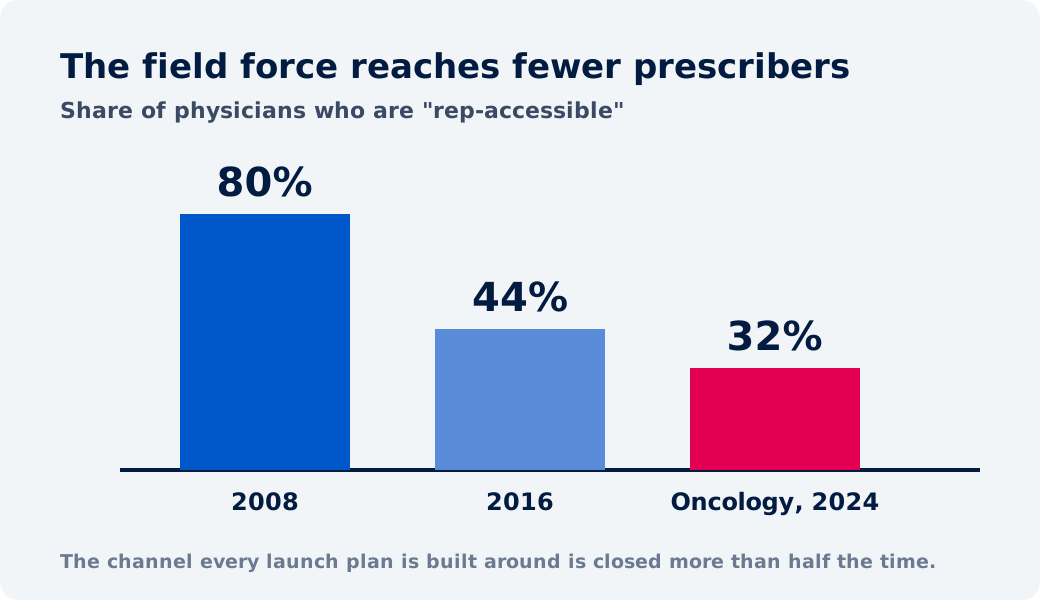
So a launch that leans on the field force to build the market is leaning on a door that is closed more than half the time. That is the case for building reach that does not depend on a calendar slot, which is what omnichannel marketing in pharma is supposed to deliver and rarely does.
Prescribers research the drug before they meet a rep
While the rep waits outside, the prescriber is already researching. Physicians now do most of their professional learning online, and 85 percent say they do "most" or "all" of their engagement with medical news and education digitally, per the Doximity Physician Learning Report. Three in four prefer to deal with reps virtually, as-needed, or not at all.
They also research on their own terms instead of waiting to be told. Physicians globally now conduct their own online research, and sales reps are no longer their top preferred source for medical information, according to Sermo's HCP content survey. Meeting them there is the whole job of HCP content marketing for pharma.
Patients have moved the same way. As pharma marketer Michael Bramble put it on the Finding Pharma podcast, patients "aren't going to the bricks-and-mortar doctor and sitting in a waiting room," they are starting on telehealth services and searching their symptoms first. His advice for a launch is to work "outside-in, not inside-out," and meet people where they already look. That is also the test of whether your patient-centric pharma marketing is real or a slogan.
That is the shift a pharma go-to-market strategy now has to answer. The buyer forms a view through search and AI before your plan ever reaches them.
Where new pharma launches are won now, the discovery layer
New pharma launches are won or lost in the discovery layer, the open web and AI answers where prescribers and patients research a therapy before anyone decides anything. This is the part of go-to-market that the standard plan treats as an afterthought, and it is expensive to get wrong.
Launches miss their forecast often. About one-third of US drug launches miss expectations, and Deloitte found that a leading cause of launch failure is an inadequate understanding of market and customer needs, named in 47 percent of cases. A launch that never shows up where customers research is a launch that never learns what they need.
Pharma is missing from the AI answers that decide the shortlist
The clearest sign of the gap is in AI answers. Our analysis of the pharma sector found that pharma sites appear in about 0 percent of AI-generated answers for consideration and decision queries. When a buyer asks an AI assistant which option fits their case, G2, Capterra, and Gartner-style sources answer, and pharma vendors are absent.
Pharma does slightly better at the top of the funnel, appearing in roughly 1 in 3 AI answers for awareness-stage queries, but even there government and academic domains like the FDA and NIH carry most of the weight. We broke down the mechanics of that collapse in why pharma disappears from AI search.
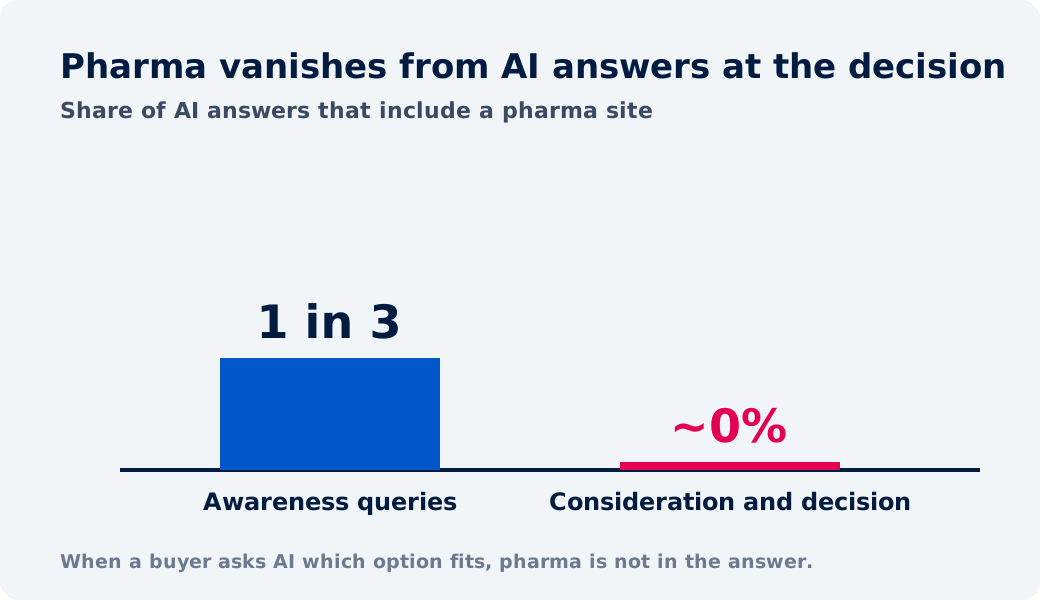
This matters because prescribers are already inside those AI tools at the moment of decision. A 2025 survey found that 78 percent of healthcare providers use AI for literature search and that AI already influences pharmaceutical treatment decisions for 86 percent of them. If your therapy is missing from those answers, you are missing from the decision.
The AI answer box is not a niche channel either. Our life sciences analysis found that 100 percent of industry queries now trigger an AI Overview, and that AI engines cite authoritative sources like Mayo Clinic, NCBI, and the CDC rather than corporate blogs. You earn a place in the answer by publishing content structured and credible enough to be cited, not by being a big brand. Our AEO guide covers how that citation actually gets earned.
The search terms pharma ranks for stop at the top of the funnel
Pharma's organic search footprint has the same shape as its AI footprint. About 95 percent of pharma's ranked keywords sit at the top of the funnel, the awareness and education terms. Only about 3 percent are middle-of-funnel commercial-investigation terms, the compare-and-choose queries, and roughly 2 percent are bottom-of-funnel.
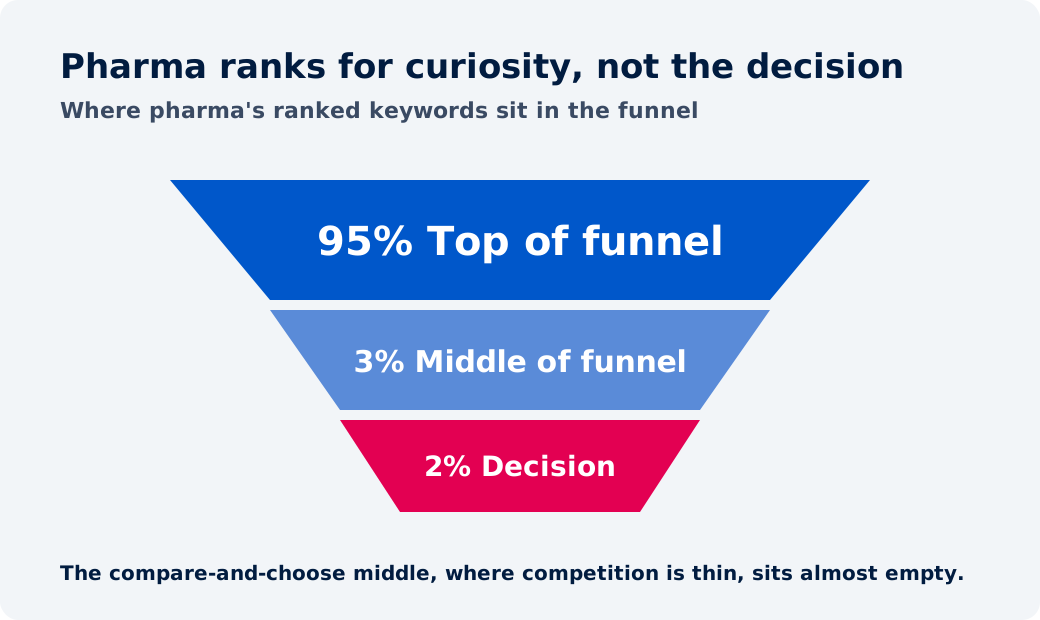
So even where pharma does rank, it ranks for curiosity, not for the moment a prescriber or payer is deciding. The discovery layer is not just thin at the decision, it is nearly empty there.
Bain's launch research points the same way. It found that at least 40 percent of a physician's brand preference comes from customer-experience factors beyond the product itself, and that physicians are shifting toward online sources and peers to form that preference. The experience they have while researching you is now a large part of whether they choose you.
The decision-stage content pharma launches skip
The reason the discovery layer stays empty is simple. Pharma builds content for the top of the funnel and stops before the parts that help a buyer choose and stay.
Our analysis found that about 1 in 3 content producers run no decision-stage content at all, and that only about 1 in 5 published pieces actually help a buyer make a choice. The rest inform and hope.
The funnel is front-loaded and the far end is unbuilt. Awareness content makes up about 1 in 3 assets, while post-purchase content is only about 1 in 30. So the content that keeps a patient on therapy after launch, the part that protects the revenue you fought to win, barely exists.
Even the calls to action miss the moment. About 55 percent of sites place the same generic call to action at the end of every article regardless of funnel stage, and close to 0 percent publish a comparison page or an ROI calculator, the exact tools a payer or a practice manager wants at the decision. Those are the unglamorous pharma content marketing tactics that compound, and they are the ones that go unfunded.
A pharma go-to-market strategy that stops at awareness leaves the prescriber, the payer, and the patient to find their answers somewhere else. Usually they find a competitor, or nothing.
A launch content architecture for your pharma go-to-market strategy
The fix is to build the discovery layer as a launch content architecture, one grid that maps every stage of the buyer's journey to the question people ask, the content that answers it, and the team that owns it. This is the artifact most pharma go-to-market strategies are missing, and it is what makes one launch both create and capture demand instead of only announcing itself.
Build it before approval, and the market meets a full set of answers on day one instead of a product page and a press release.
The launch content architecture, stage by stage
Read the table as a checklist. For each row, if you cannot point to a live page or asset that answers the question, that is a hole in your launch.
Stage | Audience | What they type or ask AI | Content that answers it | Who owns it |
Disease awareness | Patient | "why am I so tired and short of breath" | Plain-language condition and symptom explainers | Medical, unbranded |
Disease awareness | HCP | "new treatment options for [condition] 2026" | Disease-state and mechanism-of-action education | Medical affairs |
Consideration | HCP | "[your drug] vs [standard of care]" | Honest comparison pages, efficacy and safety summaries | Medical plus commercial |
Consideration | Patient | "is [drug] right for someone like me" | Patient-fit guides, "what to ask your doctor" | Commercial, branded |
Decision | HCP | "[your drug] dosing, eligibility, prior authorization" | Prescribing guides, eligibility checkers, PA support | Commercial plus market access |
Decision | Payer | "cost-effectiveness of [drug] vs alternatives" | Value dossiers, budget-impact and ROI tools | Market access |
Access | Patient | "how much does [drug] cost with insurance" | Copay, financial-assistance, and coverage pages | Patient services |
Adherence | Patient | "side effects of [drug] and how to manage them" | Onboarding, adherence, and support content | Patient services plus medical |
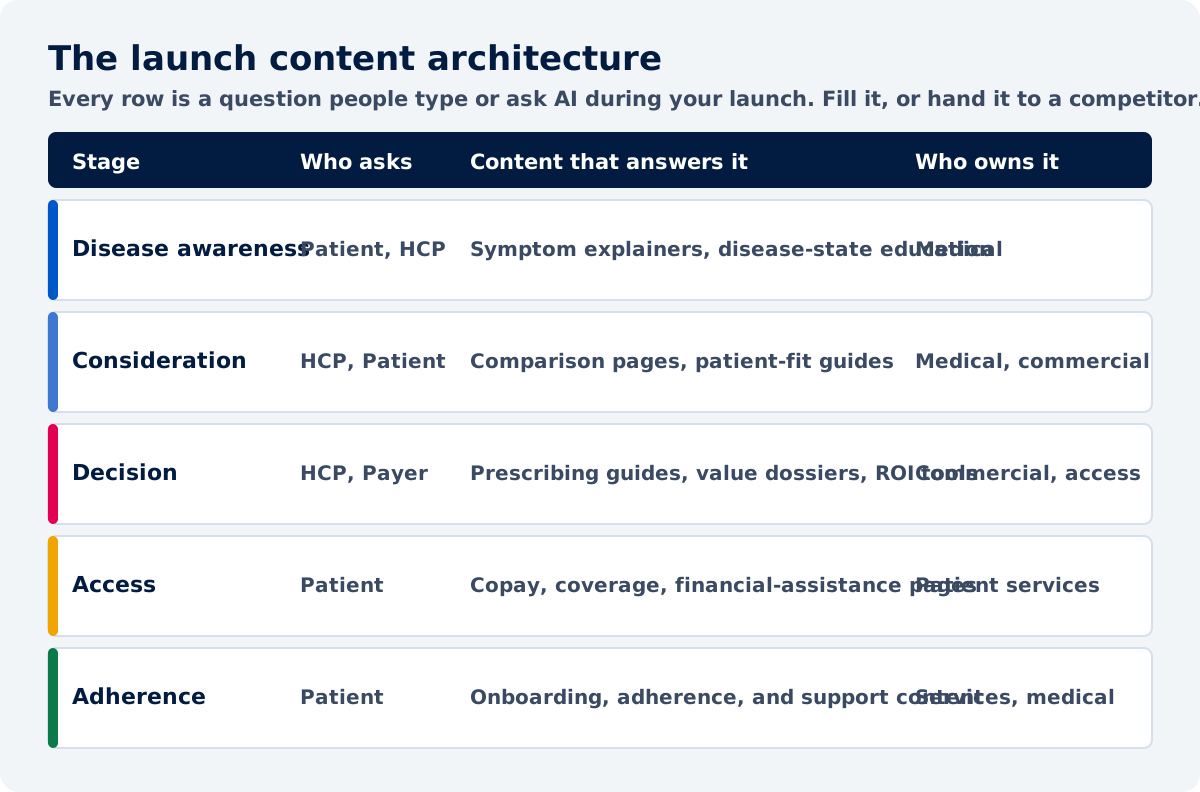
Every row is a query someone types into a search box or an AI assistant during your launch. Fill the rows and you own the discovery layer. Leave them blank and you have handed those moments to whoever did fill them. The adherence row in particular only works if something delivers it on time, which is where marketing automation for pharma and compliant email nurture stop being optional.
How we build the architecture
The way we build this is top-down and publish bottom-up. You start from the single commercial and educational problem the launch has to solve, break it into the sub-questions each audience asks, then build the core assets and the supporting pages that answer them.
We design the funnel before we make any content. That means naming the stages a buyer moves through, deciding what counts as a qualified signal at each one, which is also what makes pharma marketing analytics possible later, and building fast paths for buyers whose intent is already clear, so a ready prescriber or payer is not forced through a long nurture.
And we treat the whole thing as a content product, not a blog. It has an information layer that teaches and a conversion layer that routes each reader to the sensible next step, so a launch site does the pre-sales work your field team can no longer do at scale.
Who owns the pharma go-to-market strategy
No single team owns the pharma go-to-market strategy today, and that is exactly why the discovery layer stays empty. Commercial owns the brand campaign, medical affairs owns the science, and market access owns the payer story. The open web sits between all three, so it belongs to nobody.
Bain found the same pattern inside launch teams. Functional silos hold the budget and the talent, and silo leaders tend to manage the launch by checklist rather than by strategy. Its fix is to run the launch as a single unit under one launch owner with real decision rights, instead of a loose committee.
The content architecture needs that same single owner. Someone has to hold the whole grid, because the buyer does not care which internal team is responsible for the answer they cannot find. In practice that owner also carries the review clock, so the MLR-ready content workflow has to be designed in from the start rather than discovered at the end.
We saw this play out with a life science manufacturer we worked with, Westlab. This is an adjacent case, not a drug launch; the company sells lab supplies rather than a therapy. Its real expertise was locked inside the sales team, where it could only reach one lab at a time. We operationalized that expertise into a content engine so it worked as owned infrastructure instead of a person's job. The lesson carries straight to a launch. The knowledge that wins the market is usually trapped in a function, and it only scales once someone turns it into content the whole market can reach.
What a launch discovery layer costs
A launch discovery layer costs a fraction of a launch budget, and most of that money is already being spent, just pointed at the wrong things. The useful way to size it is against overall marketing spend, which in pharma scales with company revenue.
Directional budget bands by revenue
These are the annual marketing budget ranges we see by company size in pharma and life sciences.
Under $1M in revenue runs roughly $150K to $350K a year, a heavy share of early funding.
$1M to $10M runs about $500K to $1.2M a year.
$10M to $50M runs about $2.5M to $5.5M a year.
$100M to $500M runs about $18M to $35M a year.
Inside those totals, monthly digital spend tends to run about $5K to $15K at early stage, $25K to $75K at growth stage, and $100K to $500K or more at late stage. The discovery layer for a launch fits inside that digital line. You are not adding a budget, you are re-pointing one, and digital marketing for pharma breaks down what each channel in that line is actually worth.
The money is misallocated, not missing
The problem is where the money goes. Almost 0 percent of active pharma sites point their paid search ads at content assets; the ad budget amplifies product pages while the content that would answer a buyer's real question runs unboosted.
ZS reached the same conclusion about launches overall. Its study of 340 launches found that launch underperformance is mostly capital misallocation, and that "when 80 percent of launch resources go to the roughly 20 percent of factors that least predict adoption, increasing spend scales inefficiency." Returns improve when the money shifts from promotional intensity toward infrastructure, the durable systems that help a prescriber decide and a patient stay on therapy.
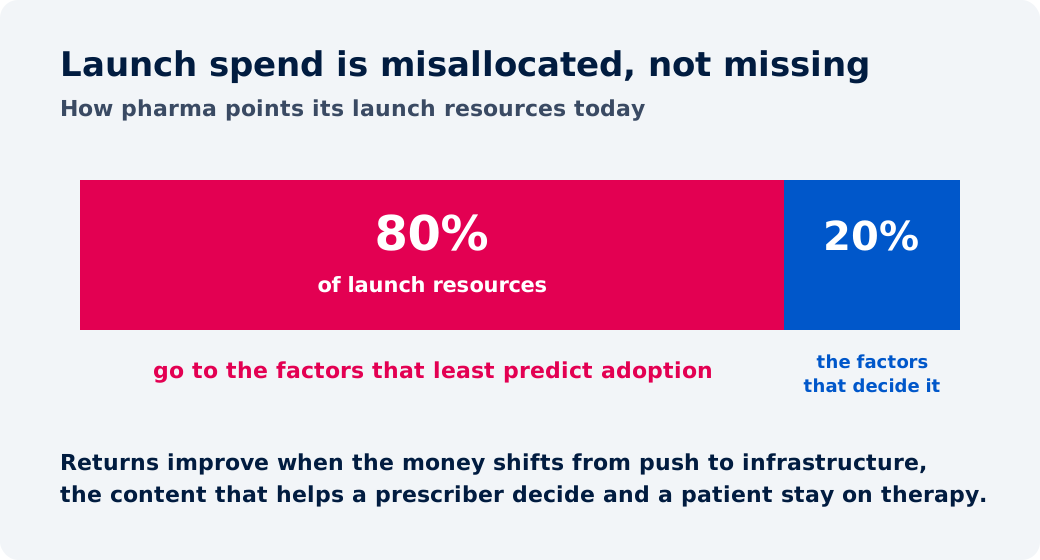
The launch content architecture is that infrastructure. It costs a slice of the digital budget you already hold, and it works long after a campaign flight ends.
How to stand up your launch content architecture before approval
Stand up the launch content architecture in the 18 to 24 months before approval, on the same runway you already use to prepare the market. Bain found that strong launches put their evidence plan in place about 18 months before launch and dedicate launch resources from 24 months before to 24 months after. The content architecture belongs on that clock.
Work it in four moves.
Map the grid for your therapy. Fill the stage-by-audience table with your actual disease area, your comparators, and your access questions. The blank rows are your launch backlog.
Give it one owner. Put the whole architecture under a single launch owner with decision rights across commercial, medical, and market access, so no row falls through a functional gap.
Build decision and access content first. Everyone builds awareness content. Start where pharma is emptiest and competition is thinnest, the comparison, eligibility, cost, and support pages that help a buyer choose and stay.
Publish early and treat it as GTM collateral. Ship the content as it clears review, not at launch, so the market and the search engines have found it before your reps arrive.
That is not a theory. Jason O'Neill, a former Dendreon CEO who wrote a book on drug launches, lists "underinvestment in preparing the market" among the root causes of launch failure. Preparing the market is exactly what a content architecture does, and the 2026 pharma marketing trends that matter are the ones that make that preparation findable.
We have watched a version of this work in an adjacent life science market. With Westlab, a company that had run on cold outbound, an education-led content engine generated 241 inbound leads and influenced $120,000 in quotes within three months, returned 869 percent on the content investment, and shipped 40 educational pieces in two months. Again, that is a lab-supply company, not a drug launch, but the mechanic is the one a launch needs. Content did the pre-sales trust-building that people could no longer do one conversation at a time.
That is the real job of a pharma go-to-market strategy now. Your launch content is not a campaign that runs and ends. It is infrastructure that answers the buyer at every stage, carries the trust your field force used to carry, and gives your launch a job it can keep doing long after day one.
Could your launch answer the buyer before your reps arrive?
Get a Content RevOps audit, your full-funnel discovery layer mapped against the questions HCPs, patients, and payers ask search and AI, with every gap priced before you spend a dollar filling it.
Frequently Asked Questions
About the Author

Founder & CEO, Content RevOps
Stefan Kalpachev is the founder and CEO of Content RevOps, where he helps B2B SaaS companies transform their content into predictable pipeline. With a background in content marketing and revenue operations, Stefan has developed a unique methodology that bridges the gap between content creation and revenue generation.
Connect on LinkedIn