Inbound marketing for life sciences
Your content is attracting the right scientists. Can any of them find out what it costs?
Book a CallA life science company runs inbound the way the playbook describes. It publishes application notes and technical explainers, ranks for the terms its buyers search, and puts a form in front of the best material. Traffic arrives. Downloads land in the CRM. This is the inbound lead generation motion working exactly as designed.
Part of Content marketing for life sciences, the complete guide.
The pipeline does not follow.
The usual explanation is that the content was not good enough. That one is worth retiring, because this sector publishes well. Our scoring puts positioning and credibility among its genuine strengths, and its buyers educate themselves at length before contacting anyone.
The problem sits in the architecture. Inbound in life sciences is built to capture a contact, and the buyer arrived to find something out. Those are two different jobs, and only the second one ends in a purchase order. It is the same gap we keep finding when we work as a systems layer inside life science companies: the library is strong, the route from library to quote was never built.
This piece is about the second job: what a scientific buyer actually needs at the moment of choosing, and how to build the routes out that give it to them.
What is inbound marketing in life sciences, and how is it different from content marketing?
Inbound marketing is the practice of earning a buyer's attention with genuinely useful material, then carrying that buyer to a decision. In life sciences it usually means technical blog content, application notes, webinars, and guides aimed at researchers, lab managers, and the procurement people around them. It sits inside the broader question of what life science marketing is and what it is responsible for.
The difference from content marketing is not cosmetic, and it is the reason this article exists.
The definition worth using
Content marketing builds an audience. Inbound is the part that moves a buyer.
That line is not ours. A content analysis of 191 academic content-marketing studies found the two fields largely resemble one another, then drew the boundary exactly there: inbound marketing is "more metrics- and result-driven" while content marketing "is more concerned about conversations."
So by its own definition, inbound owns the results half. It claims responsibility for turning a reader into a customer. That is the standard the rest of this article measures against, and it is the same boundary we draw between content marketing and demand generation, and again between demand generation and inbound marketing.
The model has already changed once
The attract, convert, close, delight funnel that the sector's how-to literature still teaches was retired by the company that popularized it.
HubSpot replaced it with a three-stage flywheel of attract, engage, and delight. The stated reason was that funnels "produce customers but discard the momentum it took to win them," and the two levers in the replacement are speed and friction reduction.
Read that with a life science site in mind. The methodology's own authors named friction and speed as the two things worth pulling.
A 2023 review in Systems found the underlying literature "still has its roots in vaguely delimited concepts and varied overlapping notions", with too many competing definitions coming from practitioners rather than research. The method is a working convention, not a law.
It still suits this sector, because scientific buyers research thoroughly before they speak to a supplier. What follows concerns the half of the method that gets skipped.
Why does inbound stall in life sciences when the science is good?
Because the content library is shaped like an introduction, and the buyer needs the ending. It is one of the six biggest life sciences marketing challenges, and the one that reads as an architecture problem rather than a content quality problem.
Seven pieces in ten greet somebody who has not chosen anything
When we scored the sector's published content by buyer-journey stage, the split came out like this:
Stage | Share of published content |
Awareness | ~32% |
Consideration | ~38% |
Decision | ~20% |
Post-purchase | ~10% |
Roughly a fifth of everything published serves the decision, and a tenth serves the customer after they buy.
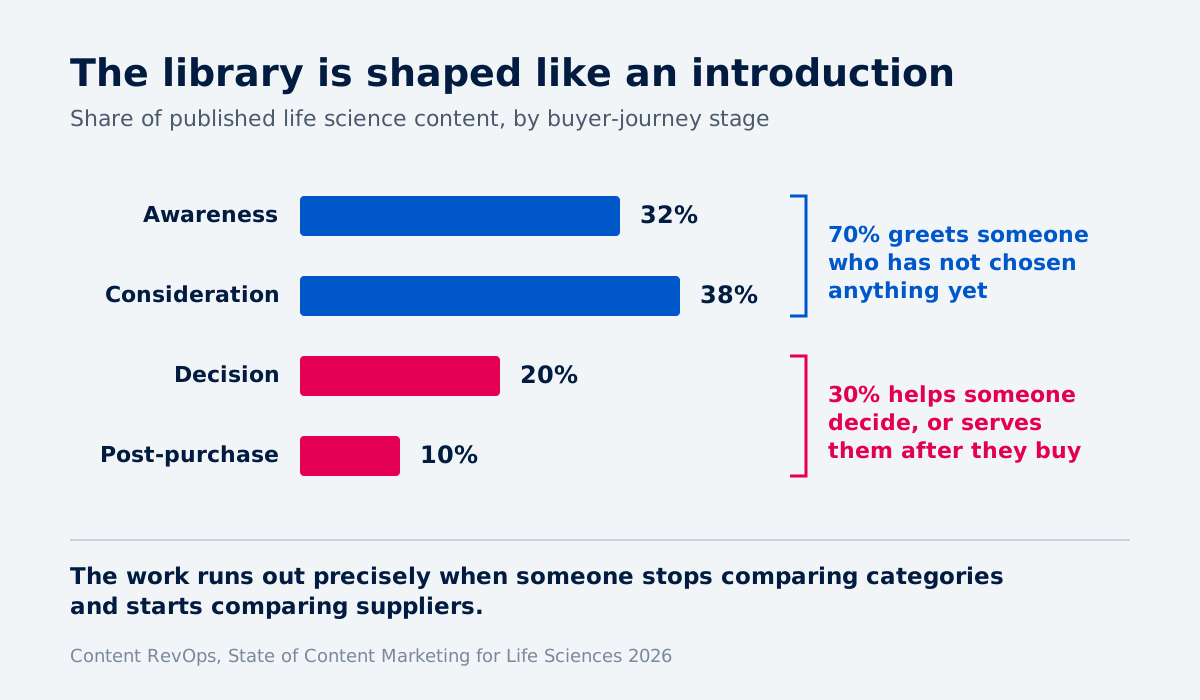
Notice where the weight sits. The largest single block is consideration, which teaches a buyer how to think about a category. That work matters, and it runs out precisely when someone stops comparing categories and starts comparing suppliers. It is the same failure a blog that pulls traffic without producing signups or demos runs into, arriving here through a different door.
The ask exists, it just never changes
Distribution scores lowest of anything we measure in this sector, and demand capture sits just above it. CTA architecture comes in at 1.89 out of 4.
We published the full diagnosis, including how few pages segment the ask or offer any next step at all, in our guide to content marketing for life sciences. The short version is that the machinery is present and asks everyone the same question, whether they arrived to learn a technique or to replace a supplier next quarter. Building the layer that varies the ask is what we mean by a conversion layer.
What do scientists and lab buyers actually need before they choose?
Something surprisingly specific, and almost none of it is a whitepaper.
The buyer's list, in the buyer's words
Here is a researcher on r/labrats describing their own shortlisting process, unprompted:
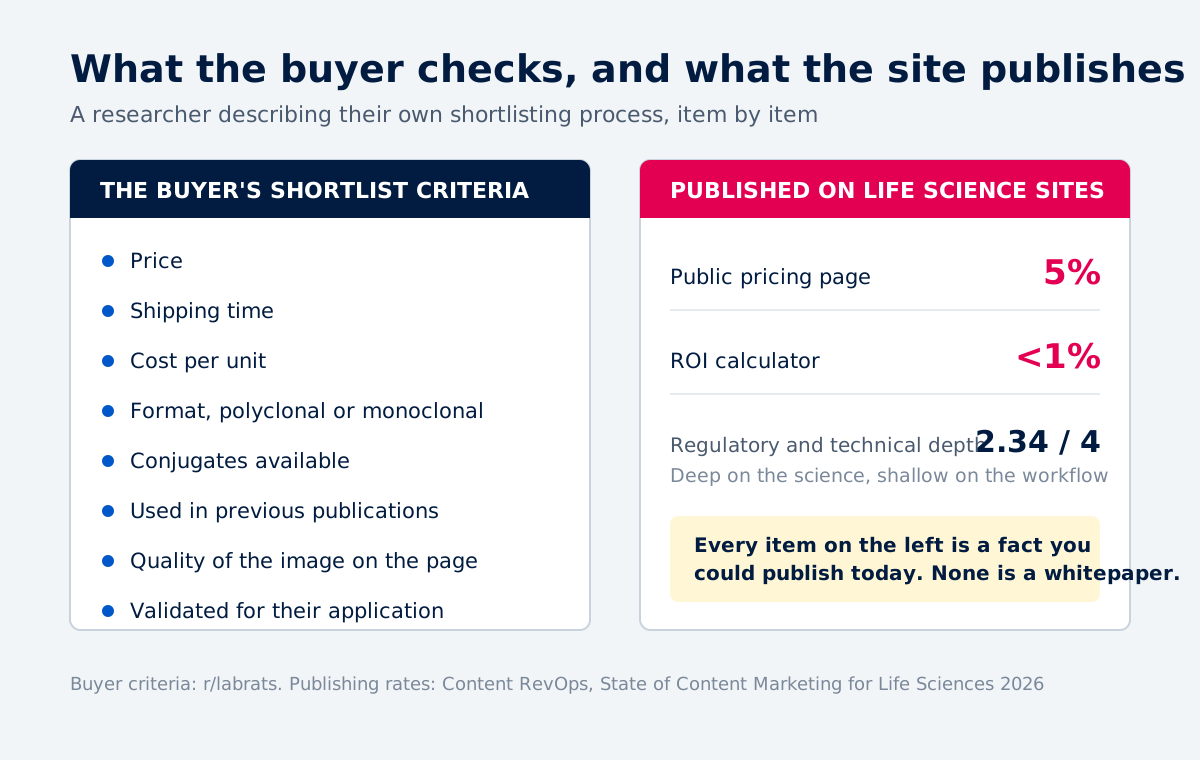
"I look for certain things from each company such as, price, shipping time, possible promotions, cost per unit of antibody, whether it's polyclonal or monoclonal, whether I can add conjugates to the antibody, whether the antibody has been used in previous publications, the quality of the staining shown on the product page, and whether the antibody has been validated for my specific application."
They then shortlist two or three and take them to their principal investigator.
Every item on that list is a fact a supplier could publish today. Price, lead time, unit economics, format, the citation record, the actual image, and validation for a named application. Not one of them is a thought-leadership piece, and not one of them needs an email address to be useful.
Why a product photo proves nothing
The sharpest account of this comes from inside the sector. Andy Birchwood, who led the design team on Abcam's product search, published what they learned from interviewing 34 researchers and running a diary study.
Antibodies, he notes, are "small vials of clear liquid." A picture of the product differentiates nothing. What researchers need instead is citations and charts of experimental data proving specificity, and those images only carry weight when they arrive with "contextual information regarding the experiment in which they were produced."
The failure mode is subtler than an absent citation list. Researchers were "spending a lot of time reading the detail of citations before realising they weren't relevant." The proof sat on the page and still cost them time, because nothing let them filter it by the application they cared about.
The same research found only 23% of users ever added a filter. Everyone else scrolled.
The evidence has to be sortable by the question the buyer is actually asking, which is a different build from simply publishing it. That distinction runs through how a life science product gets marketed at all, and it applies whether you sell instruments, diagnostics, or medical devices.
The facts most likely to be missing are the cheapest ones
Two items on that researcher's list barely exist across the sector.
Public pricing appears on about 5% of life science sites, fewer than one in twenty, so a buyer cannot tell whether you sit inside their budget without asking a person. ROI calculators appear on under 1%.
The missing price is the loudest complaint this audience makes in public. A thread titled "Companies that require quotes to see prices are annoying" collected 664 upvotes and 69 comments, and the objections there are operational rather than emotional:
- Grant budgets need a ballpark now, not a negotiated figure later.
- Some sites require an account before they show anything.
- One commenter described the quote button as sending a request "into cyberspace where it floats around for weeks before a rep ever decides to respond."
A separate thread, a rant about providers not listing pricing, supplies the consequence and the remedy in two lines. On the consequence: "by the time they respond with a quote you've already purchased it elsewhere." On the remedy: "I just need to know the price, and then we can talk about whether or not we'll buy."
This matches what we measure. The sector scores 2.34 out of 4 on regulatory and technical depth, which reads as deep on the science and shallow on the workflow. The molecule gets explained thoroughly. The purchase does not. The same imbalance shows up in biotech content and in CDMO and CRO content, where the buyer is looking for a reason to rule you out.
The catalogue problem nobody markets around
There is a structural reason a form fill often cannot become a purchase, and intent has nothing to do with it.
Institutional lab buying routinely runs through approved-supplier catalogues rather than through your website.
The University of Glasgow instructs staff that e-procurement "should be the only option used to raise a requisition", and tells suppliers this is the only way it will accept orders.
The University of Sussex appointed a preferred supplier after a tender and instructs staff to use them "unless they are unable to meet your supply requirements", reviewing off-contract spend afterwards.
A university staff member in the marketplace discussion above described the consequence from the other side. If a supplier sits outside the system, "I have to email a sales rep and get a catalogue (this is extremely frustrating)."
No credible public figure exists for how much life science spend flows this way, and we are not going to invent one. The mechanism is the point: wherever this applies, being findable and being purchasable are separate problems, and publishing alone does not solve the second. It is one of the reasons a named-account motion matters here, which we covered in account-based marketing for life sciences.
Should you gate your content?
A gate trades reach for signal. The right answer depends on which of the two you are short of, and the evidence for both sides is stronger than the argument usually admits.
What the gate costs
Blue Triangle published the arithmetic from its own campaign. A gated ebook landing page took 3,400 visits and produced 106 form fills at $142 each. Half the addresses were bad, which put the real cost at $284 per usable lead. Visitors averaged 1.2 pages per visit.
Ungated, the same asset reached 175 engaged people in half the time at $11.44 per engagement, and pages consumed per visit went from 1.2 to eight. Over the following year the company reported demo requests up 265% and pipeline up 242%.
Read that as one company's experience. The CMO who made the call reported it himself and now advises others on the approach.
A practitioner selling enterprise IT rather than life science tools described the mechanism more usefully than the numbers do, in a discussion on gating: "If they can't find and consume it freely/anonymously, then they don't see it. The people who do convert are statistically far, far, far less likely to ever buy from you."
What the gate buys
The counter-evidence is real and larger. Storylane, which sells interactive demo software, analysed 535,763 demo sessions across 50 companies. Gated demos took less than half the engagement of ungated ones, 9.2% against 19.4%. They then converted 43% of engaged users into leads, against 0.30% for ungated. Gated demos also held attention longest, at 2 minutes 26 seconds against 1 minute 22.
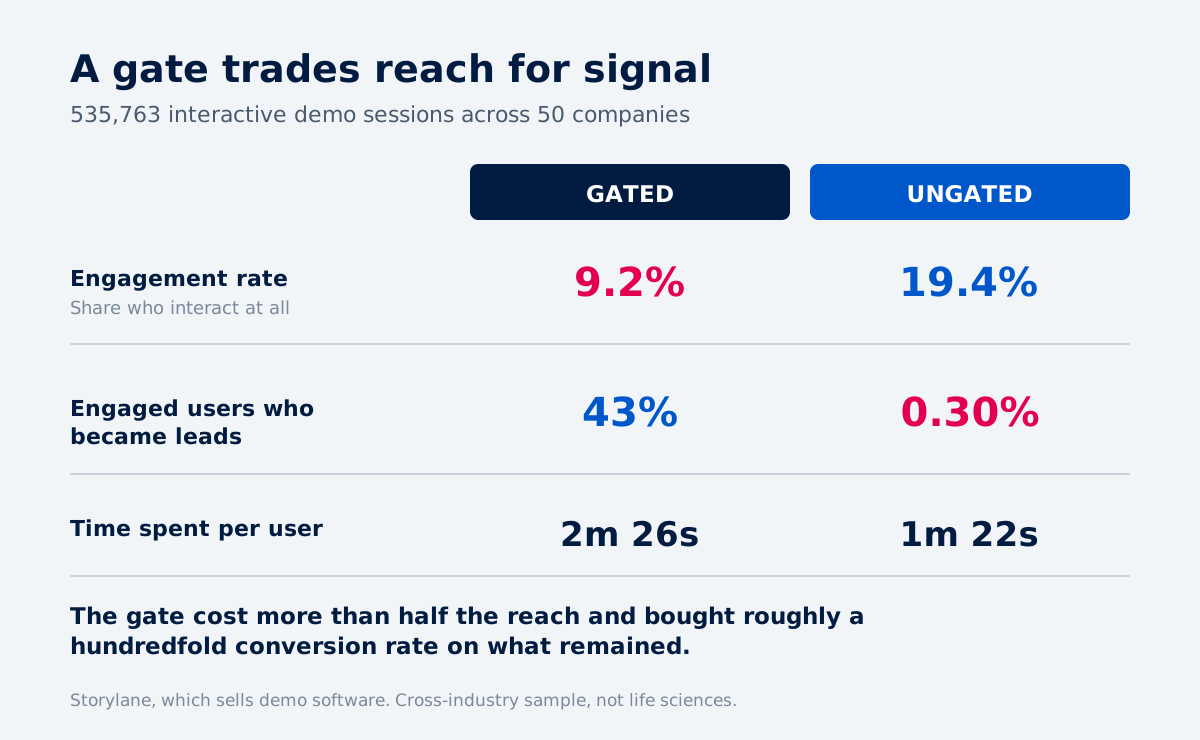
That is the trade, quantified. The gate cost more than half the reach and bought roughly a hundredfold conversion rate on what remained.
Robert Rose, who has advised the Content Marketing Institute on strategy since 2010, draws the distinction that settles most of this argument. Gated content, he writes, "can produce leads, opportunities, and sales", and often starts a successful buying journey.
The mistake is asking one asset to do two jobs. A gate either moves a buyer to the next step or builds an audience member, and "you can't do both at the same time. When you try to count the prospect as both a lead and a subscriber, mediocrity arises."
His practical rule is worth copying. Say on the form exactly what happens next.
What we do
A gated asset earns its gate when it leaves the reader more ready for the next step than they were before. If someone finishes it admiring the writing and unclear what to do, the build failed regardless of how many addresses it collected. That is a capture and qualification decision before it is a content decision.
Every number in this section comes from software and cross-industry samples, because nobody has measured gating against a specifically scientific audience.
What should happen after someone reads or downloads something?
Something specific, fast, and matched to what they just did.
Build fast-track exits for people who already know what they want
When we design a funnel, we build routes straight out for buyers whose intent is already obvious. A demo, a quote, a real conversation, with no eight-email sequence in between.
Someone who lands on a comparison page and wants a number has finished educating themselves. That is what the visit means. Enrolling them in an education programme ignores the only signal they gave you.
One page, one purpose, several sensible next steps
The instinct to give a page a single call to action is close to right and slightly wrong. We build for one primary purpose per page and several reasonable next steps, because readers reach the same page from different distances.
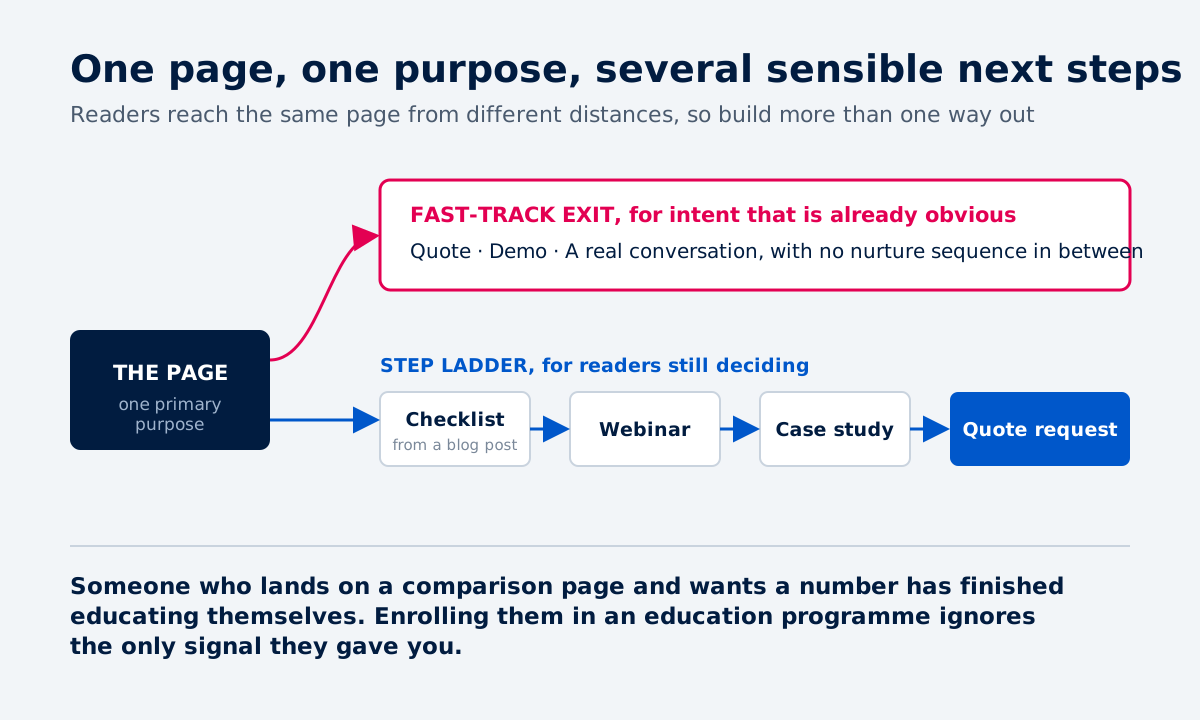
A blog post leads to a checklist. The checklist leads to a webinar. The webinar leads to a case study. The case study supports a request for a quote. Resource pages work as bridges, connecting the problem, the thing the reader just learned, the practical resource, and the action available now.
Answer faster than the buyer expects, because the bar is low
The most useful thing we know about response speed came from filling in competitors' contact forms ourselves during a client campaign. One of several replied quickly. That became a design principle: any inbound trigger drops the lead straight into a sequence, because speed of first follow-up is the lever nobody pulls. It is why we treat the handover from marketing to sales as a build, not an agreement.
Wider audits agree. When RevenueHero, which sells meeting-scheduling software, submitted demo requests to 1,000 B2B software companies, 635 never responded at all. Among the 365 that did, the average wait ran over a day. The average form carried seven fields, and only 113 of the thousand sites offered any way to book a meeting.
One finding there ties this section to the last. Companies that published their pricing responded in about three hours. Companies that made you request a quote took over a day. Withholding the price and making people wait travel together.
That audit covers business software rather than life sciences, and it counted automated replies as responses. No equivalent audit exists for scientific suppliers, so treat it as a strong indication rather than a sector benchmark.
Match the follow-up to how people actually read
Speed matters for a hand-raiser. It arrives too early for a downloader.
People who register for a gated asset now open it 47.7 hours after downloading on average, up from 38.5 hours the year before, according to platform data from NetLine, a gated-content syndication company, written up by Frank Strong. Registrations on that platform also fell across the year, from 7.9 million to 7.2 million.
The classic play is to call every downloader 24 hours later. On those numbers the call lands before the prospect has opened the thing they asked for.
The download starts the funnel. Design the sequence around what the reader will know in two days, not what they knew when they clicked. That is nurture as a build, and in this sector it runs on the channel you own, which is why life science email marketing carries more of the load than it is usually given credit for.
What this looks like when it works
We worked with Westlab, a manufacturer selling into labs, where the buyers were cautious and openly price-sensitive. Two things did the work.
The downloadable resources sat against real day-to-day lab problems rather than general topics, so each one answered a decision somebody was already making. Then content-led nurture kept those cautious buyers moving through a long cycle instead of going quiet after the first download.
Neither move required more content. Both required an obvious next step attached to the content already there. That is the sequencing question at the heart of a life science marketing strategy.
How do you know whether life science inbound is working?
By measuring the exits, which is harder than it sounds, because in this sector the exit often happens somewhere you cannot see.
Your conversion rate may be measuring the wrong thing
The Abcam research surfaced a problem most teams never discover. Many researchers hold no purchasing authority and must route the request through a requisitions system or a lead scientist.
Because they could not share a saved basket, they shared product page URLs instead. Birchwood's conclusion is worth quoting exactly: "our funnel metrics were missing a large number of journeys and our existing conversion rate was distorted."
A major supplier found its measured conversion rate wrong, and the tracking never broke. The buying step simply happened off the site. If your audience buys through requisition systems and shared links, your funnel report describes a smaller building than the one you own.
The infrastructure to see any of this is mostly absent
Marketing automation and CRM adoption both run low across the sector, so captured leads go cold and nobody can trace a piece of content to a quote even when it worked.
Attribution arguments come later. An organization that cannot yet connect a form fill to an opportunity has a sequencing problem, not a measurement philosophy problem. The same sequencing decides how life science companies justify and measure marketing spend at all.
Three measures worth more than traffic
- Time to first human response, timed from the enquiry rather than from when it reached the CRM.
- Share of decision-stage pages that answer a named question, meaning price, lead time, validation, or availability.
- Requests that arrive already specific, quoting a catalogue number or an application, since that tells you the site did the qualifying work.
Quote every figure with its own denominator attached, including your own. The scores this article draws on come from the full sector study, which is where to look if you want the denominators behind them.
Where does your inbound stop short of the decision?
Get a Content RevOps audit, scored on the same dimensions we scored across the sector, with your decision layer, conversion architecture, and response speed priced in numbers you can take to the board.
Frequently Asked Questions
About the Author

Founder & CEO, Content RevOps
Stefan Kalpachev is the founder and CEO of Content RevOps, where he helps B2B SaaS companies transform their content into predictable pipeline. With a background in content marketing and revenue operations, Stefan has developed a unique methodology that bridges the gap between content creation and revenue generation.
Connect on LinkedIn