Content marketing for life sciences, the complete guide
Your science is already credible. Is anything on your site helping a buyer actually choose?
Book a CallLife science companies are good at the part everyone assumes they are bad at.
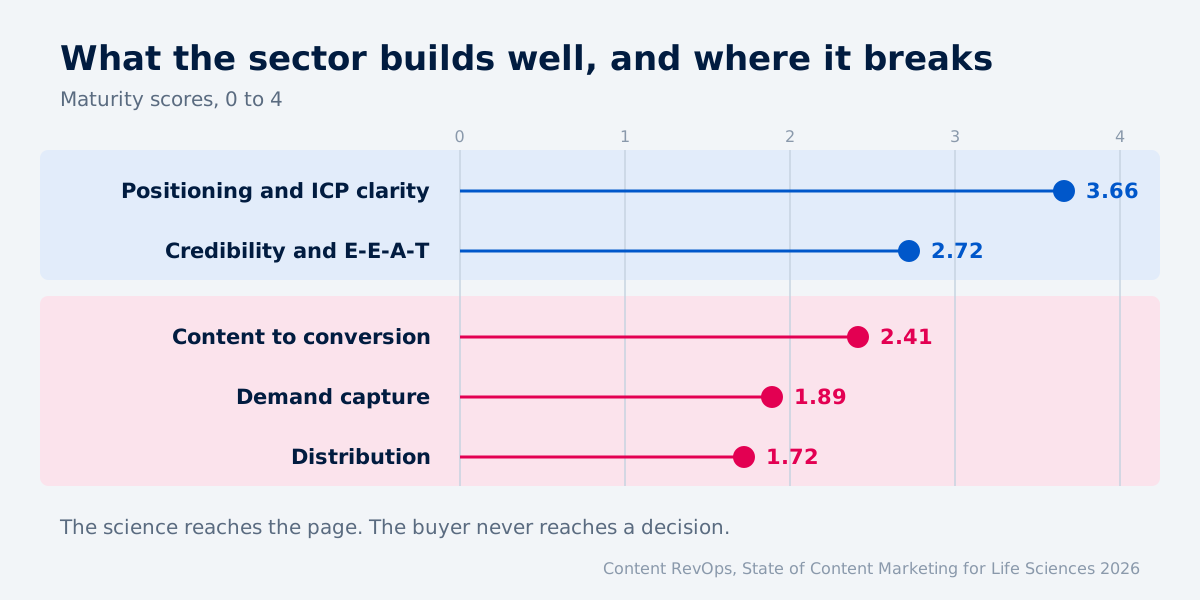
In our study of the sector, positioning and ICP clarity scored 3.66 out of 4, and credibility scored 2.72. These sites publish technical documentation, cite peer-reviewed sources, and put named scientists behind their words.
Then the same companies score 1.89 on demand capture and 1.72 on distribution, the lowest number anywhere in the study. Those two scores sit alongside the rest of the life science marketing statistics, each figure carrying the group it was measured on.
So the standard advice, translate your science into clearer stories, fixes a problem the sector already fixed. The real gap sits later, at the point where a reader turns into a buyer, and that is where content marketing has to do commercial work rather than communications work.
In this industry that point is unusually unforgiving. A reagent, kit, or instrument chosen once gets written into a protocol, and then it repeats for years.
What makes content marketing different in life sciences?
Content marketing for life sciences is the practice of publishing evidence-led content that helps scientific buyers choose, not just understand.
It covers the tools, reagents, instruments, diagnostics, services, and software sold into labs, which is why we treat life sciences as its own commercial problem rather than a flavour of B2B. It also sits inside a wider commercial remit, and what life science marketing actually covers differs enough between therapeutics and tools that two people with the same job title can be doing unrelated work. Three structural differences separate it from ordinary B2B content marketing.
The decision happens once, then repeats
Most B2B content strategy assumes a buyer who re-evaluates. Life science buyers largely do not.
That single fact reorders everything. Timing beats reach, because there is one window in which a choice is live. And content lifetime value runs unusually high, because whoever gets specified collects for years.
The buying group is a chain
The bench scientist specifies, a technician or lab manager places the order, and procurement enforces an approved-vendor list. Each link has a different job and a different fear, which is the reason mapping the funnel matters more here than picking channels.
Buying teams stay small too. 64% of scientific purchases involve one to three people, so your content has to win one champion, then arm that champion to carry the purchase through everyone else.
Credibility is the entry ticket
In most categories, publishing credibly sets you apart. Here it only earns you a reading, because your competitors also employ scientists.
Roughly 48% of life science companies run an active content presence, and about 52% sit absent or superficial. The competitive question is who does something useful with the science, since almost everyone can write it. The same pattern shows up sub-vertical by sub-vertical, in pharma, in biotech, among medical device makers, and in diagnostics. Each sub-vertical also defines the function differently, and medical device marketing is the clearest case, where the buyer splits three ways and the claims are capped before a campaign starts. CDMO and CRO marketing is the other end of that range, a function judged almost entirely on whether a sponsor keeps you on a list.
The credibility is already solved
Look at what the active cohort publishes and the picture is genuinely strong.
- About 73% publish under named authors, and around 60% add credentialed bios.
- Roughly 65% cite peer-reviewed sources.
- About 71% publish original data or first-hand research.
- Technical documentation sits on around 72% of sites.
- Content freshness scores 3.34 out of 4, so what exists stays maintained.
Set that against almost any other B2B category and the sector looks disciplined. The science reaches the page. The authorship is real. The citations are there.
One cheap gap remains. Only about 3% of the active cohort publishes a formal editorial policy, the least expensive credibility signal available and one answer engines increasingly look for.
Where does life science content stop working?
At the decision. Content in this sector educates thoroughly, then goes quiet exactly when a buyer is ready to act. That is a demand capture failure rather than a demand creation one.
Content-to-conversion scores 2.41 out of 4, and demand capture drops to 1.89. That gap is one of the six biggest life sciences marketing challenges, ordered by where each one costs money.
Almost everyone captures, almost nobody routes
A lead-capture form sits on about 85% of life science sites. Only about 19% change the ask depending on where the reader sits in the journey, which is the difference between collecting addresses and running real lead capture and qualification.
So the machinery exists and asks the same question of everyone, whether they arrived to learn a technique or to replace a supplier next quarter. That architecture is the core problem with inbound marketing for life sciences, which is built to capture a contact when the buyer arrived to find something out.
About 17% of content, roughly 1 in 6 pages, ends with no next step at all.
The artefacts that help someone choose barely exist
Count the decision-stage inventory and it collapses:
- Comparison pages appear on about 2% of sites.
- ROI calculators appear on under 1%.
- Case studies sit on about 27%, roughly 1 in 4.
- Public pricing appears on about 5%, so buyers cannot self-qualify.
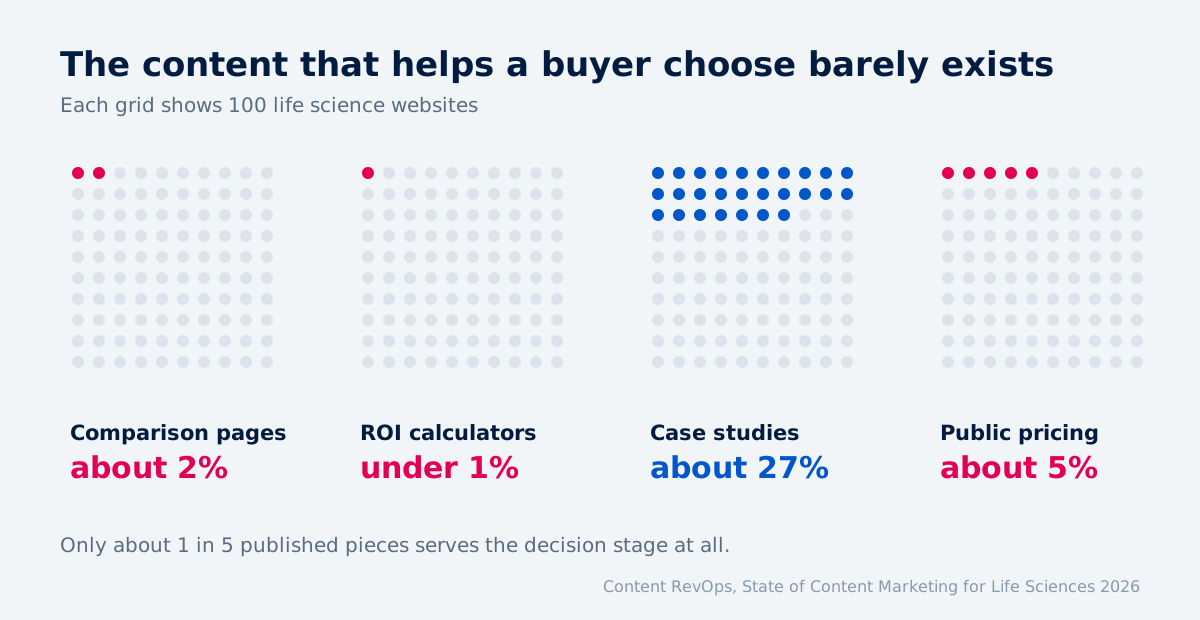
Only about 20% of published content, 1 in 5 pieces, serves the decision stage at all. Fixing that is conversion layer work, and it is almost always cheaper than commissioning more articles.
This gets more expensive every year, because the window keeps shrinking. 42% of scientific purchases now close in under a month, up from 33% the year before.
The same survey found 71% of buyers touched product information before any other content, and its authors put the warning bluntly. Gate your specifications or bury them in PDFs, and you reduce your chance of reaching the shortlist.
The specification moment decides the next five years
Here is the mechanism that makes everything above expensive rather than merely untidy.
In life sciences, a purchase is not really a purchase. It is a specification, and specifications stick in a way almost nothing else in B2B does.
Scientists describe this better than any marketing framework.
Advising colleagues on how to write a protocol, one lab manager warns that catalogue numbers become holy writ, so "if you don't do the comparison shopping now, no one is going to do it later."
A sales rep in the same discussion describes a top-ten pharma site that keeps buying a $15,000 configuration of an instrument that should cost $2,000 to $3,000. Another site wrote the SOP, and this one cannot change it.
Switching costs months, no matter how well they know you
The economics behind that stubbornness are documented. A 2018 Tufts Center for the Study of Drug Development benchmark of 120 drug developers found that qualifying a single-service vendor takes almost five months on average, and nearly seven for multi-service providers.
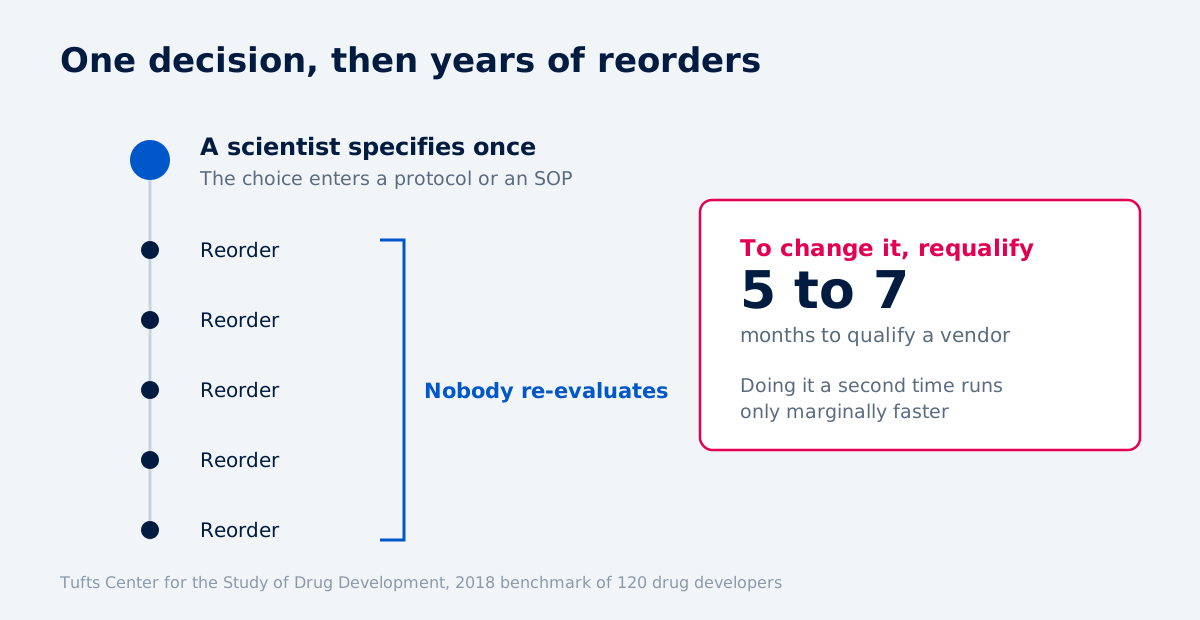
The detail that matters is what happens the second time. Re-qualification runs only marginally faster, so familiarity with a vendor buys back almost none of the time. For the providers on the receiving end of that qualification chain, the whole job is publishing proof that survives the elimination round.
Those figures describe drug developers rather than every lab, but the shape of the problem travels. Wherever qualification is formal, switching costs months of process regardless of the relationship, which is exactly why incumbency here defends itself. A hospital lab defends its incumbents the same way, weighing any new test against the contract it already signed and the validation work a change would force, which is the logic behind content marketing for diagnostics companies.
Papers are where the specification actually happens
If the decision locks into a document, the question becomes where buyers look while writing that document. The answer is the literature, and someone measured it.
A peer-reviewed study of 1,703 research resources across five fields states plainly that the literature is where most scientists look when searching for the right antibody, citing evidence that 63% of researchers use journal references to guide antibody selection.
The same study then measured how well that channel works. Only 54% of research resources were uniquely identifiable from published papers. For antibodies it was 44%, and a catalogue number appeared for just 27% of them.
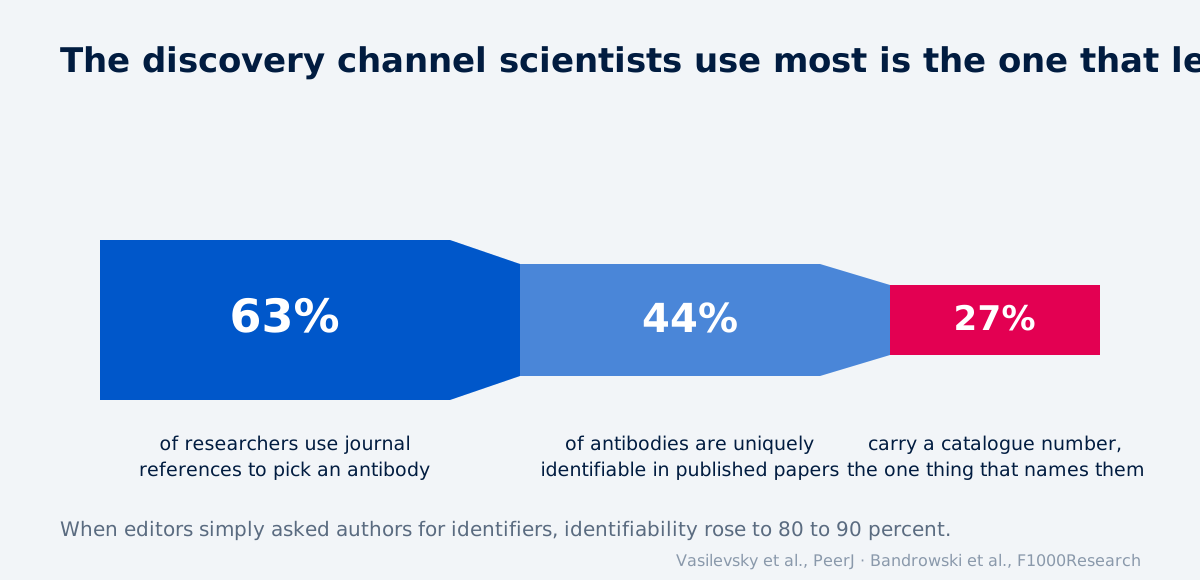
So the most influential discovery route in the sector runs through documents that fail to name the product more than half the time.
The fix turned out to cost almost nothing. When journal editors asked authors to include resource identifiers, identifiability rose from roughly 50-60% to 80-90%. Researchers had the information all along and simply never published it.
Publishing your validation data is product marketing
Documentation decides specifications for a second reason, and this one is about quality rather than trust.
Researchers tested 614 commercial antibodies against 65 proteins using knockout controls. More than half failed in at least one application:
- Of antibodies the manufacturers themselves recommended for western blot, 44% succeeded and 21% failed outright.
- Of those recommended for immunofluorescence, only 39% worked.
- The authors estimate ineffective antibodies waste around $1 billion of research funding a year.
Buried in that study sits the finding every life science marketer should read twice. Genetic control data published on the vendor's own website predicted whether an antibody would actually perform.
Real validation data on a product page correlates with the product being good. Buyers who notice that will start using it as a filter, which turns your documentation into a competitive asset rather than a compliance chore.
Nine percent of the sector distributes what it publishes
Publish-and-pray is the default. Only about 9% of companies, roughly 1 in 11, show strong distribution or repurposing, which is how distribution ends up scoring 1.72, the floor of the whole study.
A newsletter, the most durable owned channel available, appears on about 33% of sites. An active webinar program runs on about 17%.
Hiring shows where the attention goes instead. Events, tradeshows, and congresses appear in about 47% of life science marketing job postings, named roughly five times more often than search. Account-based marketing is named in under 1% of them, even though most of these companies already sell against a fixed list of named accounts. Reading the rest of those same postings is how we arrived at the sector's real trends for 2026.
Buyers moved the other way. In AZoNetwork's 2026 purchasing survey, the influence of search engines rose from 77% to 87% year on year and manufacturer websites reached 88%, while sales representatives fell from 72% to 63% and social media fell from 33% to 24%. That decline is less an argument for leaving the channel than for changing its job, which is the subject of life science social media and LinkedIn marketing.
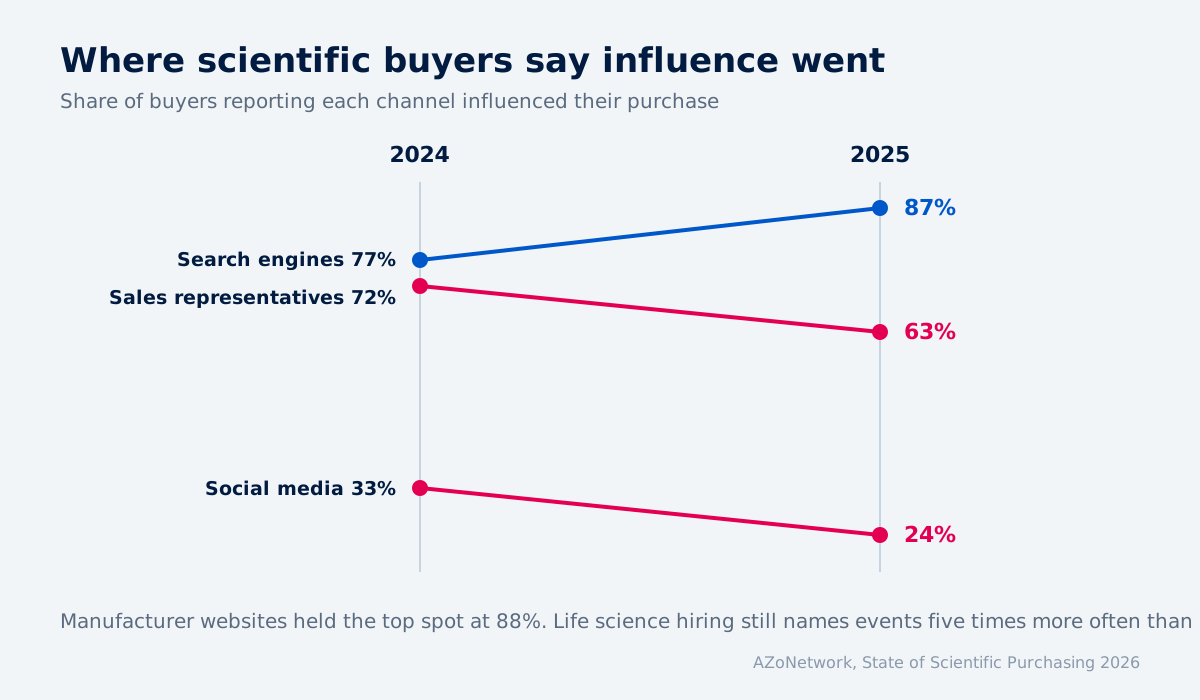
The channels growing fastest are the ones the sector under-resources. The one losing influence is the one it staffs hardest.
What distribution means here
Distribution in this sector means showing up where a specification gets written:
- The literature. Give authors the exact catalogue numbers and identifiers to paste into a methods section.
- Application content. Application notes only work when they state plainly when to use the product.
- Third-party surfaces. Review sites and industry publications rose to 62% influence and reach buyers who never see your blog.
- Owned lists. Two thirds of the sector has no newsletter, and no way to reach a buyer before they specify.
None of that is exotic. It is the standard content distribution strategy problem, aimed at a scientific buyer, and the channel priorities follow from where the specification gets written rather than from where your competitors show up. Our own approach to distribution treats it as a system with owners, not a publishing step.
There is a search dimension to this too. About 69% of the sector's ranked keywords are informational, while commercial-investigation terms, the compare-and-choose middle, make up about 3%. Almost nobody competes in the space where buyers are actively choosing.
Conferences still earn their place, particularly on larger purchases. A 2018 lab purchasing survey found that once a purchase passes $10,000, the influence of a good sales representative and the use of conferences both roughly double. The problem is a channel mix weighted five to one toward events, serving buyers who now start at a search box. What the rest of that mix holds, including how much of the sector is in the search auction at all, sits in digital marketing for life sciences. Whether that mix should run as separate channels or as a joined-up one is the fork in multichannel and omnichannel marketing in life sciences.
Every industry query returns an AI answer, and almost no company is in it
In our testing, AI Overviews appeared on 100% of tested industry queries, and approximately none of the analysed companies earned a citation in them.
Look at who does get cited and the reason becomes clear. Mayo Clinic, Cleveland Clinic, Wikipedia, NCBI and NIH, YouTube, and the CDC dominate the answers, which are all generic health authorities rather than category specialists. No vendor has published anything liftable at the level where these questions actually get asked, so the models fall back on the most general trusted sources available. It is the same mechanism that decides which brand gets cited in AI answers in every other category we have measured.
Answer-engine optimisation appears in 0% of life science marketing job postings, so nobody in the sector is hiring against this yet.
That would be a footnote if the answer layer sat at the top of the funnel. It has moved to the specification moment.
Scientific buyers now use AI to compare, not only to look things up. In the AZoNetwork survey, AI use rose 78% year on year, and while use for finding information actually fell, use for comparing products rose 68%. ChatGPT leads at 58%, and the largest single group of AI users sits in the 46 to 55 age bracket rather than the youngest.
Upstream, the shift runs further than most commercial teams assume. Research by The Linus Group among 226 active scientists found 11% now open an AI assistant as their first action after forming a research idea, before any vendor contact.
Nearly 30% say AI matters most during background research, which the researchers describe as the stage where product inclusion decisions begin.
The scale is not marginal. In Nature's AI for Science survey of 10,480 researchers, 43.8% use AI every time or most times for information gathering, the most common use of all.
That survey also found researcher satisfaction rests mainly on whether a tool points to credible sources and backs claims with references. That demand pushes tool builders toward citable material, which means pages built to be quoted and attributed are the ones that survive the filter. If you rank well and still do not appear in ChatGPT or Perplexity answers, that gap is usually the reason, and the AEO guide walks through closing it. It is also worth knowing whether strong SEO pages still work for AI visibility before you commission anything new.
What it looks like when the engine works
Westlab manufactures for laboratories, and its lab-operations knowledge only ever reached a buyer when a rep was standing in the room. That is always after someone has written the protocol.
So we moved that knowledge upstream, into the window where decisions form.
The Zero Downtime Lab program took the operational problems lab managers were already solving badly and answered them in public. Each guide and downloadable sat against a specific decision, so a manager researching contamination control or equipment uptime met Westlab's thinking while the choice was still open.
Leads reached reps enriched, carrying the engagement signals that showed what the buyer had been reading.
Three months in, the program had pulled 241 inbound leads out of a market worked entirely by phone until then. Traffic climbed 205% in a narrow technical niche. $120k of quotes traced back to it, on an 869% return.
What made it work maps exactly onto the buyer research. Product information opens the relationship, application content carries the influence, and the vendor attributes buyers rank highest are responsiveness and the relevance of what you give them.
Where should a life science company start?
Start by checking whether you are past your own peak, because maturity in this sector rises and then falls.
About 40% of the smallest firms run an active content presence, climbing to over 60% at 50 to 250 staff and around 60% at late-stage venture. Post-IPO it drops to about 35%, and CTA architecture falls to 1.64 out of 4.
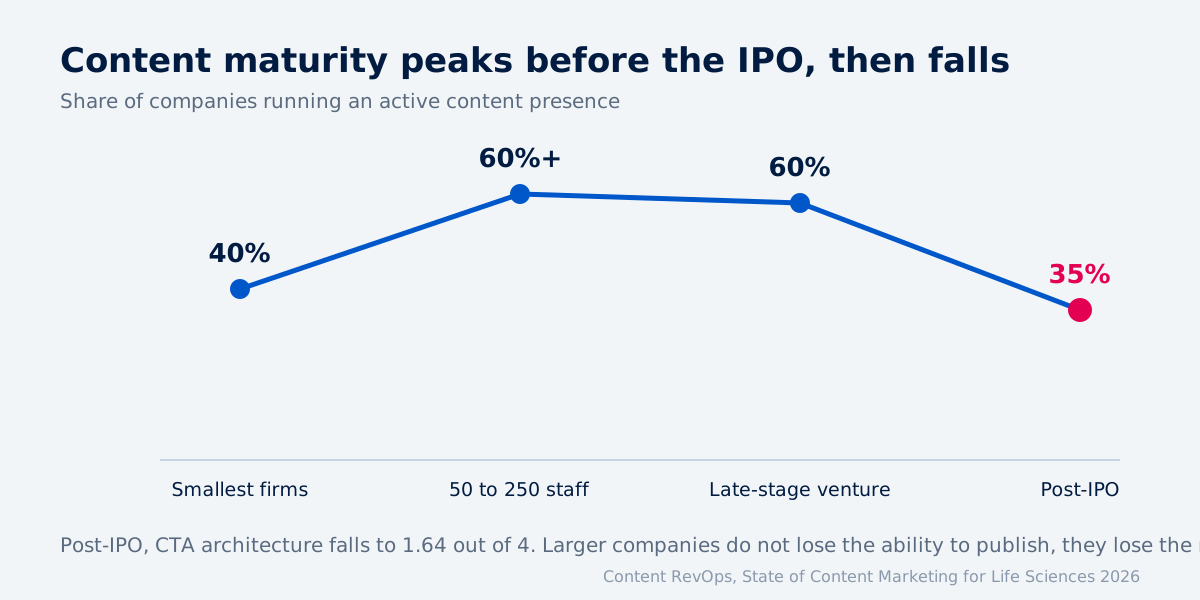
The sequence behind that decline is worth naming. After listing, the primary audience shifts to investors and press. The function often reports into corporate communications. Publishing gets briefed against announcements rather than buyer questions, and the calls to action decay because nobody owns conversion any more. That rotation, and the question of who owns the function at each stage, is the starting point of biotech marketing.
Larger companies do not lose the ability to publish. They lose the reason.
What each stage should fund
Modelled monthly digital spend from the sector, directional rather than prescribed:
- Early stage, $5k to $15k. Product pages that answer specifications, one problem-led cluster, and a newsletter.
- Growth stage, $25k to $75k. Comparison and proof content, intent-matched CTAs, and application notes.
- Late stage, $100k to $500k or more. Distribution as a system, citable identifiers, and answer-layer positioning.
Those ranges size the ask. Getting one approved, and keeping it through the next review, is a separate exercise in justifying and measuring life science marketing spend.
The order that pays
The cheapest work available is also the work that addresses the weakest score. Put comparison pages, case studies, and next steps onto the pages you already have, before commissioning anything new. Which of those to fund first, and what to defer outright, is the concentration decision in a life science marketing strategy.
After that, aim everything at the specification. Make your products easy to cite, publish validation data openly, and write the application content a scientist reads while drafting a protocol.
Then treat distribution as a system rather than an act of publishing, and take a position in the answer layer while the entire sector still has nobody hiring for it. The same gaps show up across every vertical we scored in the cross-vertical study, but the specification lock-in is what makes them expensive here.
The sector spent years earning the right to be believed. The work left is turning that belief into a specification.
A content revenue audit scores your site on the same dimensions we scored across the sector, and prices what the gaps are costing you.
Where is your content losing the specification?
Get a Content RevOps audit, scored on the same dimensions we scored across the sector, with your decision layer, distribution, and answer-layer visibility priced in numbers you can take to the board.
Frequently Asked Questions
About the Author

Founder & CEO, Content RevOps
Stefan Kalpachev is the founder and CEO of Content RevOps, where he helps B2B SaaS companies transform their content into predictable pipeline. With a background in content marketing and revenue operations, Stefan has developed a unique methodology that bridges the gap between content creation and revenue generation.
Connect on LinkedInRelated Articles
Digital marketing for pharma, channels that actually move pipeline
Sep 9, 2026
Pharma marketing analytics and ROI, connecting content to pipeline
Sep 8, 2026
AI in pharma marketing, where it helps and where it is just language
Sep 7, 2026