Digital marketing for life sciences
We measured roughly 2,000 life science company websites. See what your category actually looks like in search, what it advertises, and where the gaps sit.
Book a CallAsk an answer engine what digital marketing for life sciences means and it will list content, SEO, account-based marketing, and omnichannel engagement, then ask you a question back. Google's AI Overview for this exact query ends by asking whether you sell a pharmaceutical, a device, or a biotech service, and whether you are talking to researchers or to patients and clinicians.
That is the honest state of the category. The term covers so many different businesses that a machine will not commit to an answer without knowing which one you run.
Part of Content marketing for life sciences, the complete guide.
This page takes the narrower question instead. Which digital channels do life science companies actually use, what does the one they mostly skip cost, and is skipping it a mistake. We ask it as the team that builds those channels, so the framing throughout is demand generation rather than brand awareness.
A note on our data before any of it appears. The adoption figures below come from our own study of roughly 2,000 life science company websites, published as the State of Content Marketing for Life Sciences 2026. It sits alongside the rest of our life sciences measurement work, including the life science marketing statistics we publish each year.
It measures what is observable from the outside rather than asking marketers what they do. That avoids the self-report problem in most budget surveys, and introduces a different limit. We can see that a company advertises, not how well it advertises.
Unless stated otherwise, the life science figures describe the active cohort, meaning companies with a measurable content presence, which is roughly half the set. Figures drawn from our other studies carry their own bases, which we have not reconciled against this one.
What is digital marketing for life sciences?
Digital marketing for life sciences is the set of online channels a company uses to reach scientists, clinicians, lab managers, procurement teams, and in some cases patients. Search, the website, email, LinkedIn and other social platforms, paid advertising, webinars, and increasingly the answer engines.
The definition is easy. The complication is that "life sciences" is not one market.
A reagent supplier selling a catalogue antibody to a postdoc, a CDMO selling a multi-year manufacturing contract, a device company selling through a hospital committee, and a pharma company running a patient-facing campaign are four different businesses. They share a regulatory neighbourhood and almost nothing else. The same is true one level down, where biotech and diagnostics each behave differently again.
Buying cycles run from a card payment to a committee procurement process. Buyers range from one scientist to a committee. The rules governing what you may claim apply in full to some of these companies and far more lightly to others. Where those rules bite hardest, the channel-by-channel version of this guide is digital marketing for pharma.
So there is no single playbook, and any page offering one is describing a slice and calling it the sector. The decisions that actually differ between these businesses are set out in life science marketing strategy, and the constraints they share sit in the biggest life sciences marketing challenges. Only one of the six pages currently ranking for this term commits to a sub-vertical, and it says plainly that the pharma playbook does not transfer to it.
Digital marketing is not the same thing as content marketing
The two get used interchangeably in this sector, and the overlap does real damage to planning.
Content marketing is the part that earns attention by publishing something useful. Digital marketing is the whole surface, including the parts that buy attention rather than earn it, and the parts that have nothing to do with publishing at all.
Our content marketing pillar covers the publishing half in depth, and the channel pages linked throughout this piece cover the rest. This page concentrates on the part the industry writes about least, which is Google Ads.
One line of context on who this function hires. Scientific or therapeutic knowledge appears in about 70% of life science marketing job postings.
Which digital channels do life science companies use?
Here is the figure this page is built on. Among life science companies with a measurable content presence, about one in five and a half run Google Ads.
Four in five of that group are not in the search auction at all.
That number measures whether a company runs any active Google Ads campaign, not how much it spends or how well it performs. It is worth sitting with, because paid search is the one channel that reaches a buyer at the moment they are looking for what you sell, which is demand capture rather than demand generation.
For comparison, about one in three run LinkedIn ads, which is still a minority of that same group. We publish that figure as scarcity rather than strength, and our LinkedIn page covers what those campaigns are actually built to do.
We are deliberately not turning those two numbers into a ratio. They may not be measured the same way, and the LinkedIn figure includes companies advertising jobs rather than products, which has no equivalent on the search side. A comparison between them would look sharper than the evidence supports.
The sector is not last, and the sub-verticals differ enormously
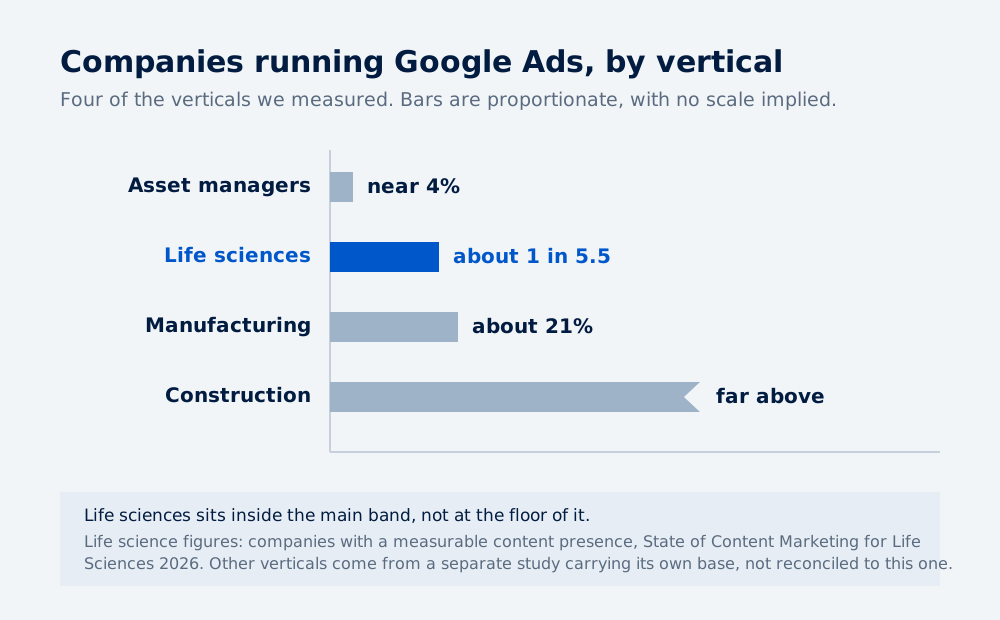
Life sciences sits mid-pack rather than bottom. Across the verticals we have measured, most fall between roughly 4% and 21%, with asset managers near 4% and manufacturing at about 21%. Construction sits far above all of them. Life sciences is inside that main band, not at the floor of it.
The sector-level number also hides a wide internal spread. In our separate pharma work, about 4% of pharma companies run any active Google Ads campaign, which is roughly a quarter of the life-science-wide rate. Pharma is inside life sciences and sits at the low end of it, so treat one in five and a half as a sector average covering very different businesses rather than a description of your own.
Where the rest of the budget goes
The other channels each have their own page, so this is a map rather than a tour. The question of which of them deserves the money first is a general one, covered in how to prioritise demand generation channels and budget allocation. Whether those channels run independently of each other or share data between them is a separate decision, set out in multichannel and omnichannel marketing in life sciences.
- Email remains the durable nurture channel, covered in life science email marketing.
- Account-based programmes are covered in ABM for life sciences.
- The website itself, including what buyers say they want on it, is covered in inbound marketing for life sciences and how to market a life science product.
- Budget and attribution sit in life science marketing budget and ROI.
- Answer engines are covered in how AI is changing top-of-funnel demand generation, and in the sector view in life science marketing trends for 2026.
One outside reference point on where the wider market puts its money. In Gartner's 2025 CMO Spend Survey of 402 marketing leaders across North America, the UK and Europe, "paid search is the leading digital channel" by share of digital budget.
That is self-reported budget allocation from a broad marketing panel, not a life-science measurement. It tells you where marketing money concentrates in general, and nothing about how many companies advertise.
Is staying out of the search auction a mistake?
Most writing on this topic assumes the answer is yes and moves on to tactics. The evidence is genuinely mixed, and the case for restraint deserves a hearing first.
The case that staying out is rational
Technical categories cost more per lead than average. In WordStream and LocaliQ's 2025 benchmark study of 16,446 US search campaigns running between April 2024 and March 2025, the Industrial and Commercial category recorded a median cost per lead of $85.63 and Business Services $103.54, against an all-industry median of $70.11.
Two caveats matter more than the numbers. LocaliQ is an advertising platform reporting on its own client base, and that base skews to smaller and local-services businesses rather than biotech instruments or contract manufacturing. No cost-per-lead dataset for life sciences exists, so treat this as directional evidence that technical categories run above average, not as a life science figure.
A "lead" here also means any tracked in-platform conversion, counted before anyone checks whether it was real, which is why how you capture and qualify a lead decides what that number is worth.
Switching is procedural, not persuasive. Capturing someone's search intent assumes they can act on it. Where a supplier is already specified into a protocol, the buyer often cannot.
Two anonymous commenters in a lab-research forum thread about why reagent prices vary between vendors described the mechanics. One asked, "Do you know how much effort it is to get a new vendor onto the approved list?"
Another described how specifications work in practice: "The catalog numbers you put in there are mostly going to be treated as holy writ."
These are unverified public posts rather than research, and we use them as illustration, not evidence.
If the catalogue number is already written into a protocol and the supplier is already on an approved list, winning the click does not win the order. Search spend that would convert in another sector can land on a buyer with no authority to switch. That is the constraint we worked around at Westlab, a life science manufacturer selling to laboratories, where the lever that moved was educating lab managers before the vendor conversation rather than bidding for the moment of intent.
Practitioners describe the channel differently. An anonymous commenter in a marketing forum thread put it at "97% top of funnel. 3% search traffic looking to buy on the spot."
That is one person's characterisation on an unverified public post, not a measurement, and we have not been able to check it against data. It is worth hearing only because it matches the procurement picture above, and because a channel weighted that far to the top of the funnel has to be judged on what the rest of the funnel does with it.
Regulation genuinely binds some companies. Promotional rules apply in full to prescription products and regulated devices, and far more lightly to research-use reagents and contract services. Our pages on what life science marketing is and pharma marketing strategy cover which rules apply to whom.
The case that staying out is a mistake
The auction is uncontested, which is not the same as cheap. We priced twenty life science search terms in August 2026 using Google's own planner estimates. Sixteen returned data, with a median cost per click of $16.10, running as high as $118.04 for antibody production services.
Those are expensive clicks. The argument for entering is not that the traffic is cheap, it is that very few competitors in this sector are bidding for it. Anyone promising easy wins here is selling something.
Companies in this sector do buy search when they decide to. Mid-market pharma companies running Google Ads typically spend between $15,000 and $45,000 a month, a directional estimate from our pharma report.
That matters because it undercuts the idea that regulation makes search impossible. Companies under the strictest promotional rules in the sector run meaningful search budgets. Most of the rest are choosing not to.
Buying a competitor's brand term is not by itself infringement. The Second Circuit held in 1-800 Contacts v. JAND that "the mere act of purchasing a search engine keyword that is a competitor's trademark does not alone, in the context of keyword search advertising, constitute trademark infringement".
Using the competitor's name in your ad copy or landing page is a different matter. That is one circuit ruling on one element of a claim, and it is general advertising law rather than anything life-science specific.
So which is it
It depends on what you sell and whether anyone searches for it.
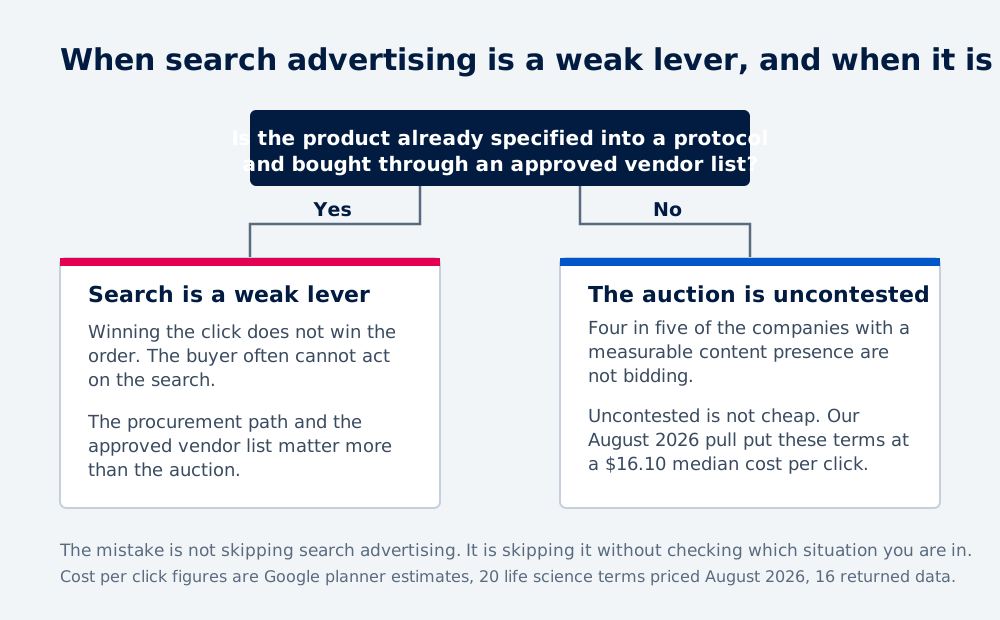
If your product is specified into a protocol and bought through an approved vendor list, the search auction is a weak lever and the procurement path matters more. If your buyer can act on a search, for a catalogue product, an instrument, a service enquiry, or a trial, then four in five of the companies with a measurable content presence are not bidding, and the clicks cost what they cost.
The mistake is not skipping paid search. The mistake is skipping it without ever having checked which of those two situations you are in. We run that check in full, with the click prices, the budget floor, and the four conditions worth testing first, in our buyer's guide to paid ads in life sciences.
Checking it is a measurement exercise, not a strategy exercise. Price your own terms, look at who is already bidding, and read the answer against how your buyer actually places an order. If the numbers say stay out, that is a finding worth having in writing. Our life sciences pages set out how we run that check, and life science marketing budget and ROI covers what you can honestly claim once the spend starts.
Find out whether the auction is worth entering for what you sell
We map your category's search demand, what it costs, and who is already bidding, then tell you plainly if the answer is no.
Frequently Asked Questions
About the Author

Founder & CEO, Content RevOps
Stefan Kalpachev is the founder and CEO of Content RevOps, where he helps B2B SaaS companies transform their content into predictable pipeline. With a background in content marketing and revenue operations, Stefan has developed a unique methodology that bridges the gap between content creation and revenue generation.
Connect on LinkedIn