Life sciences marketing consultant, what they do and when to hire one
Five different businesses sell themselves under one word. Which gap are you actually filling?
Book a CallSearch for a life sciences marketing consultant and you will be shown at least five different businesses under one word, plus a page of job listings. Before you brief any of them, it helps to know what you are actually buying, which is the same question we start with when we scope content marketing as revenue infrastructure.
Part of Content marketing for life sciences, the complete guide.
A strategy consultancy that will not touch execution. A part-time marketing leader. A solo specialist who runs one channel. An agency's front door, where the diagnosis leads to a retainer. And a commercialisation firm that advises on market access and pricing, which is a different profession entirely.
None of them will tell you which one you need. They will tell you what they sell.
So the first job is not picking a consultant. It is naming the gap you are filling, then working out which of the five fills it. This guide covers what each type actually does, what one costs, when a consultant beats an agency or a hire, how to check one before you sign, and what none of them can fix.
What does a life sciences marketing consultant do?
A life sciences marketing consultant gives a company senior marketing judgment without putting a permanent executive on the payroll. What that means in practice splits five ways, and the five are not substitutes for each other. If the underlying question is what the function covers in the first place, we have written separately on what life science marketing is.
The five things sold under one title
Type | What you get | What you do not get | Best when |
Strategy consultancy | Positioning, category and brand work, delivered as a recommendation | Anyone to build it | You know how to execute and cannot agree on what to say |
Fractional marketing leader | Someone running your marketing function two or three days a week | A permanent hire, or much hands-on production | Nobody senior owns marketing and you are not ready to hire |
Specialist practitioner | One channel run properly, hands on the keys | Coverage of anything outside that channel | One channel is broken and the rest works |
Agency strategy arm | A diagnosis, usually free or cheap | Independence from the retainer it recommends | You already suspect you want the agency |
Commercialisation and market access consulting | Payer strategy, pricing, launch sequencing, reimbursement | Demand generation of any kind | Your problem is getting paid for a product, not getting found |
The general, non-vertical version of that first row is covered in what a content marketing consultant does, and the symptoms that point to one are in the five signs you need a content strategy consultant.
Why the title tells you nothing
Nobody certifies any of this. A market research firm's report on the fractional CMO market notes that the market has no common licensing body and no uniform qualification framework, and that the spread of fractional titles has made it harder for buyers to work out whether someone has actually carried senior responsibility for budgets, teams, and board reporting.
The title is a self-description. Treat it that way.
What does a life sciences marketing consultant cost?
Between roughly $200 an hour and roughly $22,000 a month, depending on which of the five you are buying and how much of your marketing you are handing over. The wide range is the honest answer, and the useful part is what moves the number.
The engagement shapes
Five shapes cover almost everything you will be offered.
- Diagnostic or audit. A fixed fee for an assessment. Priced on scope, useful for deciding what to do next, and no use if you already know.
- Fixed-scope project. A defined deliverable, such as a positioning rebuild or a launch plan. Priced on the deliverable, and bad at anything that turns out to need iteration.
- Monthly retainer. Ongoing time. Priced on days per month, and the shape most likely to keep running after it has stopped being useful.
- Day rate. Time bought as you need it. Priced on availability, and expensive if you need a lot.
- Standing advisory. A few hours a month for judgment calls. Cheap, and worthless if nobody inside acts on it.
Retainers are the common arrangement. In the 2026 Fractional Work Report, which surveyed more than 1,700 fractional professionals and analysed over 40,000 profiles, about 46% of fractional executives said they bill primarily on a monthly retainer rather than by the hour. That report comes from a fractional hiring marketplace, which commissioned the research out to a third party.
What the rates look like
The same report puts the average charge-out rate for fractional executives at VP level and above at $223 an hour, with marketing specifically at $209. It also finds that a ten-hour-a-week engagement runs roughly half the fully loaded cost of a full-time hire.
Monthly retainers cluster by company size. The market research report cited above estimates $5,000 to $15,000 a month for companies between $5M and $50M in revenue, rising to $8,000 to $22,000 at mid-market.
That answers the question most people are really asking, which is whether $100 an hour is a good rate. It is roughly half the market, and the reason rates look high next to salaries is arithmetic.
The US Bureau of Labor Statistics puts the median wage for employed management analysts at $101,190 a year, with the top tenth above $174,140. Those wage figures cover employed analysts and exclude the self-employed, who are exactly the people you hire as consultants.
An independent consultant's hourly rate has to cover non-billable time, business overhead, benefits, and tax. A salary already covers all four. Comparing the two directly makes an independent look expensive when they are not.
What the in-house alternative costs in life sciences
This is the comparison that actually decides most engagements, and life sciences pays well for marketing.
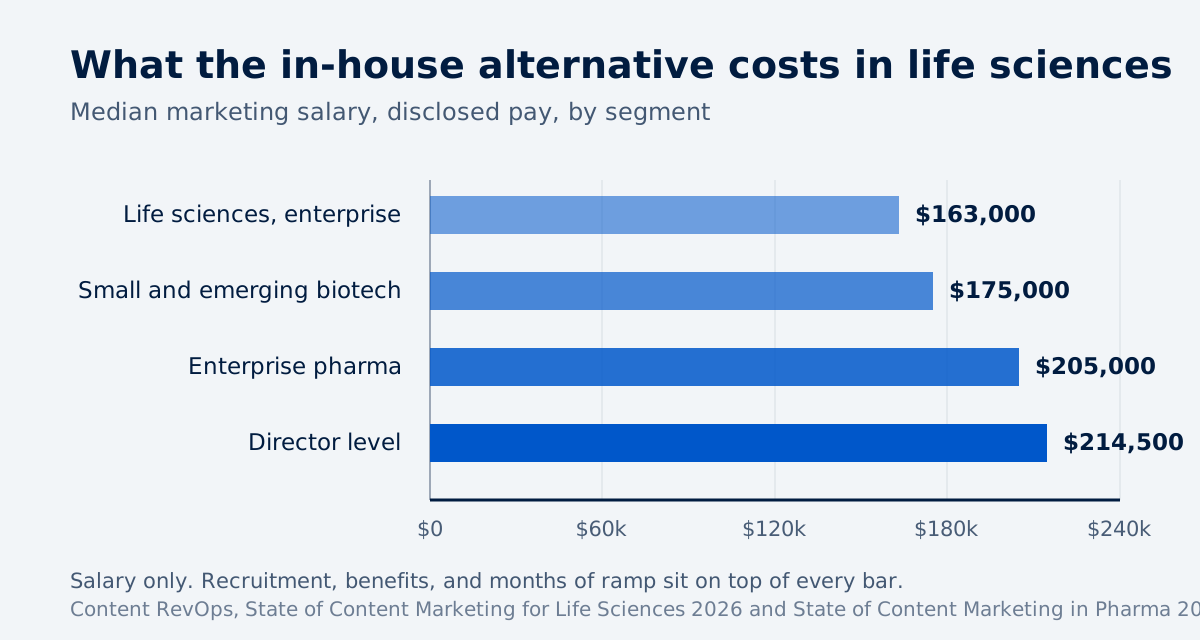
In our study of pharma and biotech marketing hiring, the median for small and emerging biotech sits around $175,000, and small biotechs pay close to large-pharma rates because they are competing for the same pre-launch commercial talent. Director-level median sits around $214,500, and enterprise pharma around $205,000. Across life sciences more broadly, the enterprise US median lands near $163,000.
Those are salaries. Add recruitment, benefits, and the months before a new hire is useful, and one director-level marketer costs more in a year than most consulting engagements cost in two. If you are sizing a team rather than a single hire, our breakdown of demand generation team structure and costs prices the whole shape.
What sits around the number
Size an engagement against what you already spend, not against zero.
Our life sciences research puts typical monthly digital spend at $5,000 to $15,000 for early-stage companies, $25,000 to $75,000 at growth stage, and $100,000 to $500,000 and up at late stage. How companies in the sector justify that spend internally, and what they measure it against, is covered in how life science companies justify and measure marketing spend.
An early-stage biotech spending $10,000 a month and considering a $10,000 retainer is proposing to double its marketing cost. A growth-stage company spending $50,000 is proposing a 20% increase. Same retainer, completely different decision.
When should a life science company hire a consultant instead of an agency or a marketer?
There is a published rule for this, and it has nothing to do with budget.
The rule for what stays inside
Three economists tested a theory of the firm against nine different agency activities across 79 companies and published the result in Marketing Science. A company should keep work in-house when two things are true. The expertise it needs is specific to that company rather than to the function. And the work needs frequent modification.
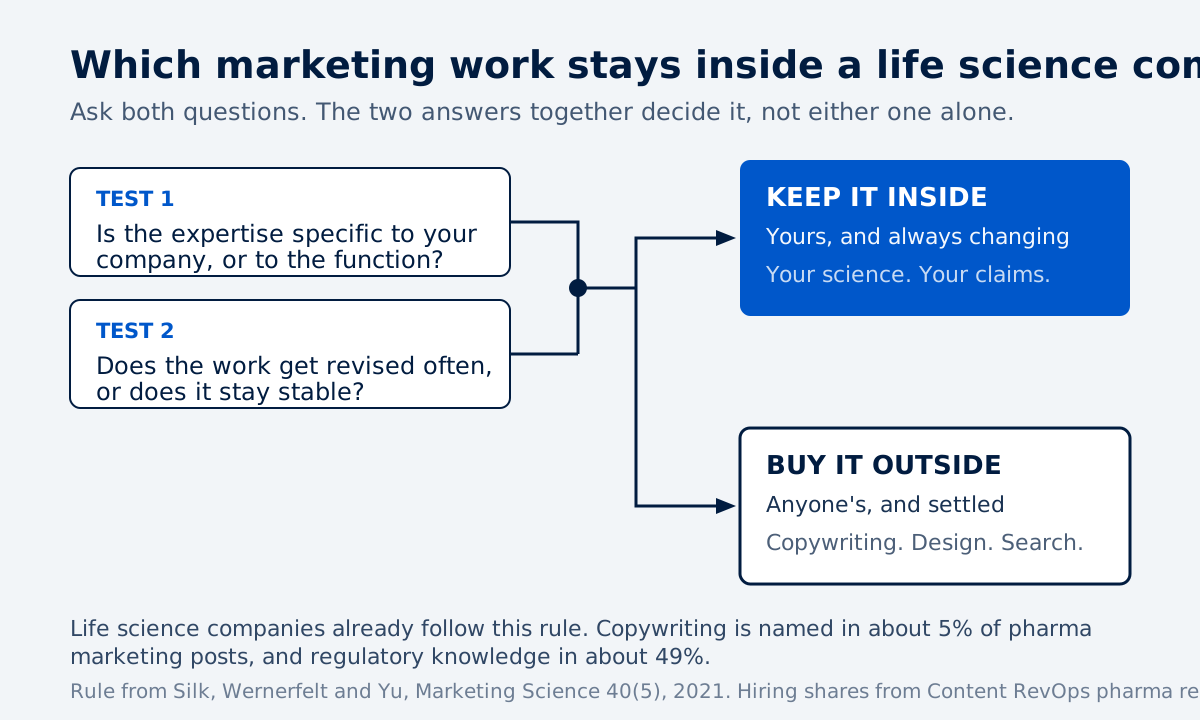
Turn that around and you get a buying rule. Work that any competent specialist could do, and that does not change much month to month, should go outside. Work that only makes sense inside your company, and that you keep revising, should stay in.
Life science companies already follow this rule. They just do not call it that.
What your in-house life sciences marketer already covers
The sector hires scientists who can market, and hires them senior. In our life sciences hiring analysis, scientific or therapeutic knowledge appears in about 70% of marketing postings. Regulatory fluency is close behind, with FDA, EMA, or MLR knowledge named in about 49% of pharma marketing posts.
The most-hired-for skill in pharma marketing is not a marketing skill at all. Cross-functional collaboration appears in about 78% of posts, which makes the role a connector first and an executor second. Across life sciences generally, cross-functional orchestration shows up in about 56%. We took that apart in more depth in what life science companies hire marketers to do.
So the person you already employ is a scientifically credible, regulation-literate coordinator. The gap is almost never "we need someone to think about marketing." It is capacity, or one specific capability nobody in the building has.
What life science companies already buy outside
The craft. Our pharma hiring data shows copywriting named in about 5% of marketing posts, and across life sciences design or creative appears in about 17%. Production gets bought, not built.
The seniority shape says the same thing. About 46% of pharma marketing titles contain Director, VP, Head of, or Chief, while only about 1% are explicitly entry-level. There is almost no junior pipeline, which means the tactical layer sits with agencies and freelancers by default.
That is the Marketing Science rule already operating. Scientific claims and regulatory positioning are firm-specific and get revised constantly, so they stay inside. Copywriting and design are function-specific and stable, so they go out.
How much you can hand over before it backfires
More outsourcing helps, up to a point, and then it starts to hurt.
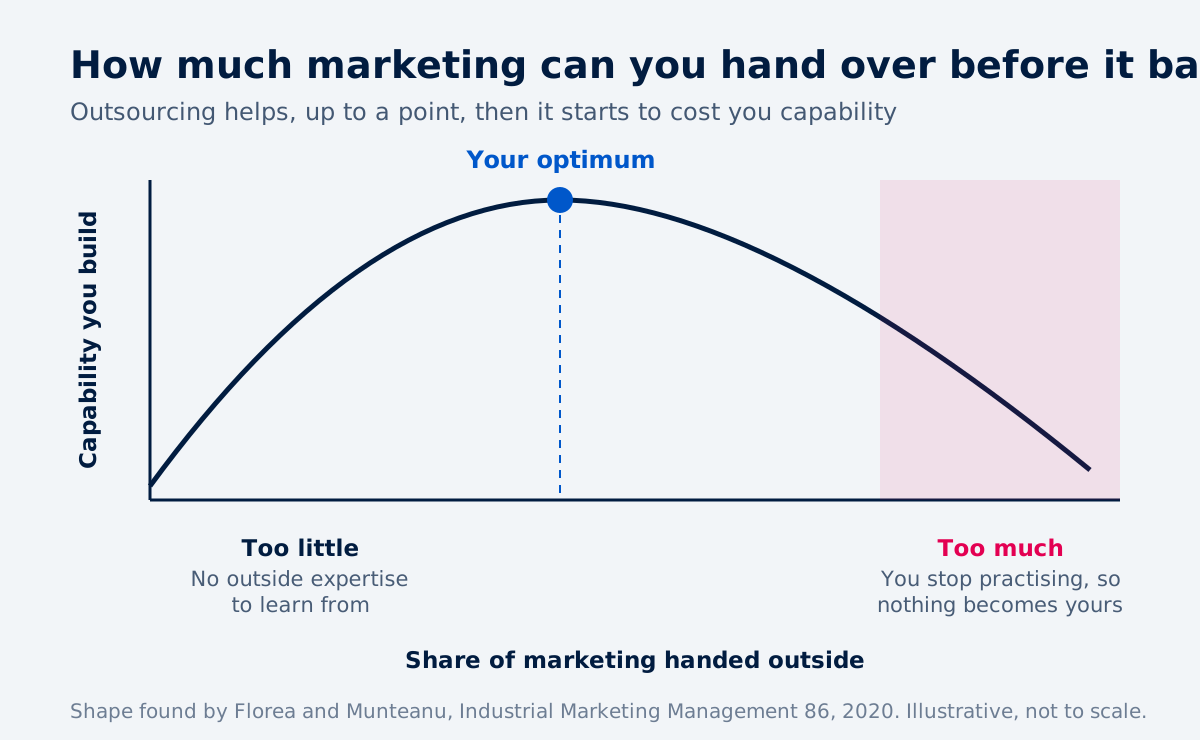
Researchers publishing in Industrial Marketing Management found that the relationship between marketing outsourcing and a company's ability to build new marketing capability follows an inverted U curve. Outsource a bit and you learn from a more expert partner. Outsource nearly everything and you stop practising, so you never convert what you learned into capability you own.
Two things push that turning point further out, letting a company safely outsource more. How skilled it already is in the function it is outsourcing, and how good it is at absorbing new knowledge.
The authors put it plainly. Fully outsourcing a marketing function is never a good idea for organisational learning, and being a good buyer requires being a good maker.
A second study reached the same place by a different route. Researchers interviewed both small and mid-size companies and the digital marketing providers serving them, and published in the Australasian Marketing Journal. They found that a baseline level of in-house capability is what stops the relationship turning conflicted, because the underlying problem is the buyer not knowing enough to judge what they are being told.
If you have nobody inside who can evaluate the work, you will not get a better outcome by buying more of it.
The case for keeping it all in-house
There is a real argument against hiring outside at all, and it is stronger in life sciences than in most sectors.
An analysis of 69 industries, published in the Review of Marketing Science using data from 1991 and 1999, found that about half of advertisers of every size ran some form of in-house agency, far more than anyone assumed at the time. Across industries, the likelihood of keeping the work inside fell as advertising budgets grew, and rose as an industry's technological intensity rose.
Life sciences is about as technologically intense as industries get. The prediction is that companies like yours in-house more than average, and they do.
That does not settle the question, and it points where the Marketing Science rule already pointed. Technically intense companies keep the technical work inside because it is firm-specific and constantly revised.
In life sciences that means the science and the regulatory claims. It does not mean the demand engine, the search visibility, or the nurture system, which are function-specific, stable, and staffed internally by almost nobody in the sector. Which channels the sector actually runs, and which it skips, is measured in digital marketing for life sciences.
What a small retainer actually buys
Buyers argue about whether a small retainer buys anything, and the disagreement is worth knowing before you negotiate.
One side says agency economics cap it. At a low monthly fee, whoever is assigned to you carries many other accounts, so promises of dedicated attention are not credible. Agency operators push back that a $5,000 to $10,000 fee delivers real value for the right company, and that most companies only move in-house once fees pass roughly $20,000 to $25,000 a month.
The reframe that settles it is about what the money buys. At a small retainer you are not buying undivided attention. You are buying playbooks already built across other accounts, which is worth something as long as you know that is the trade.
For the general, non-vertical version of this decision, we have covered when to hire a demand generation agency, when to hire demand generation consultants, how demand generation consulting actually works, and in-house versus outsourced demand generation in more depth.
How do you check a life sciences marketing consultant before you sign?
Four checks, and two of them come from buyers rather than from anyone selling. The same discipline applied to firms rather than individuals is in how to choose a demand generation agency.
Questions that get a straight answer
Ask who does the work, and how many other clients that person carries right now. Most providers will not answer directly, and the evasion is the signal.
Then ask them to walk you through the last engagement they improved. Not a case study. What the account or the program looked like before, what they thought was wrong, what they changed, and what happened.
People who have done the work answer this with specifics and recall the numbers without hesitating. People who have not deflect into decks.
That test comes from two separate places, which is why it is worth trusting. Buyers on marketing forums independently name it as the question that separates real practitioners from plausible ones.
A four-time CMO who says he has hired more than 25 CMOs publishes the same test for senior marketing hires. His tells are giving specifics rather than generalisations, recalling numbers quickly, and walking through the before and after rather than just the win.
Whether the experience is actually life sciences
The pool of fractional marketing leaders skews hard toward technology.
Revelio Labs, a workforce data firm, found that almost half of fractional executives have prior experience in the tech sector, with 29% coming from finance and 24% from consulting. Chief Marketing Officer appears in 14.3% of fractional leaders' self-descriptions, second only to Chief Financial Officer.
Tech is the sector whose marketing playbooks fit life sciences worst. Fast iteration, self-serve conversion, and public pricing all break against scientific buyers, long capital cycles, and regulated claims. The constraints that actually bind are set out in the six biggest life sciences marketing challenges.
So ask what they have shipped through a review cycle, whether they can read a paper, and whether they know which of your buyers is the scientist, which is procurement, and which is the payer.
Whether the model fits a company like yours
Fractional leadership is real, growing fast, and almost entirely a small and mid-size company arrangement.
Lightcast, which analyses labour market data, counted at least 34,000 US workers with "fractional" in their job title in 2025, up 265% on 2019. Job postings for fractional roles reached 677 in 2025 and nearly 1,000 in the first seven months of 2026 alone.
The composition matters more than the growth. About 97% of those 2026 postings came from small and mid-size companies, and only 3% from Fortune 1000 firms. Finance accounts for 46% of fractional postings, with marketing and PR at about 10%.
If you are a 40-person diagnostics company, this model was built for you. If you are a division inside a global pharma, almost nobody in your weight class is buying it, and that is worth knowing before you propose it internally.
Who owns the shortlist
The most comprehensive "best life science marketing agencies" list on the web is written by one of the agencies on it, and six of its ten entries belong to the same private equity backed platform.
BioStrata publishes The 10 Best Life Science Marketing Agencies in 2026. Six of those ten are portfolio companies of Supreme Group, which is backed by Trinity Hunt Partners and which owns BioStrata itself. The six are Supreme Optimization, Supreme Communications, Curator24, Clarity Quest, Pivot Design, and BioStrata.
Supreme Group formed after Trinity Hunt took a majority stake in Supreme Optimization in March 2023, and its own announcement of the Pivot Design deal in August 2025 called it the platform's ninth acquisition in 18 months. MM+M, the trade publication, reported the same deal and described the company as threading the needle between a holding company and a loose collection of agencies.
The relationship is disclosed. It sits under a short heading near the foot of a roughly 4,000-word article, after the recommendations.
None of that makes the agencies on the list bad. It means the list is a marketing asset rather than independent research, and the check takes two minutes. Look up who owns each firm on your shortlist before you treat a ranking as a recommendation.
What can a life sciences marketing consultant not fix?
Three things, and all three sit inside your company.
The plumbing has to exist
A consultant cannot connect content to pipeline at a company with nowhere to connect it.
In our analysis of pharma and biotech websites, fewer than 9% run a detectable CRM and fewer than 10% run marketing automation. Even at $500M or more in revenue, CRM adoption reaches only about 29%. Across life sciences generally, marketing automation and CRM adoption both run low, which means captured leads go cold with nobody noticing. What that layer is for, and what it costs to run, is set out in life science marketing automation.
If that describes you, the first engagement worth paying for is the one that fixes the plumbing. Anything else produces activity you cannot measure and leads you cannot nurture.
The review queue stays inside
Promotional review is a capacity problem in your building, and no outside partner can shorten it.
A survey of 35 US pharmaceutical companies, published in Therapeutic Innovation and Regulatory Science, found that Medical Information teams contribute to the medical review of 51% of promotional materials aimed at healthcare providers. The people doing that work spend a median of about 16 hours a week reviewing materials before review meetings, plus about 6 hours in the meetings themselves.
The striking finding is that roughly 70% of those companies have no benchmark at all for how much staffing medical review needs. The bottleneck is real, it is measured in the hours of people who have other jobs, and most companies are not tracking it.
The delay shows up at the other end. A 2025 benchmark of promotional review puts average job duration at 14.8 days, with an average of 1.5 circulations.
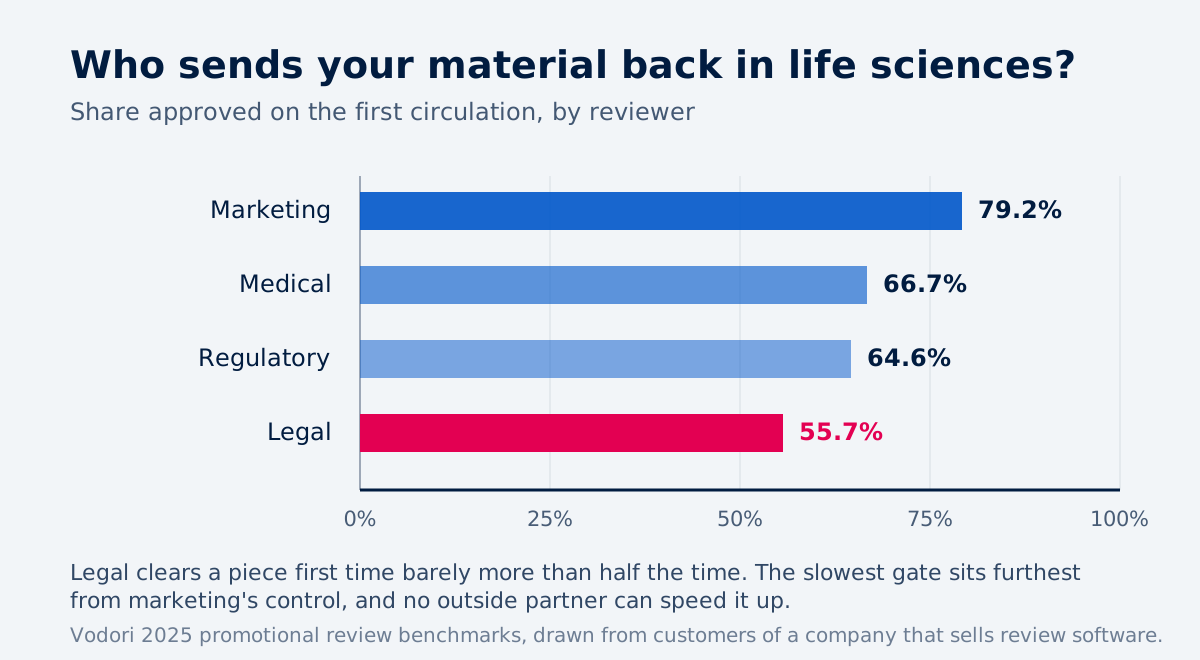
First-circulation approval rates split by reviewer, at 79.2% for marketing, 66.7% for medical, 64.6% for regulatory, and 55.7% for legal. Those figures come from customers of a company that sells review software, so they describe teams already running a purpose-built process.
Legal approves first time barely more than half the time. The slowest gate is the one furthest from marketing's control, which is why "we will move faster" is the promise to test hardest.
Sometimes marketing is not the problem
A fractional CMO working in healthcare put this better than we could. When she gets called in about growth, marketing can usually be improved, and it is often not the root cause. Companies frequently set marketing up to fail by under-resourcing it and positioning it to react to requests rather than to own an outcome.
If your offer is unclear, your pricing is wrong, or your sales team and your marketing team disagree about who you sell to, a consultant will produce excellent work against a broken premise. The decisions that have to be settled before any of it matters are in life science marketing strategy, the five decisions that make one.
Will AI replace the life sciences marketing consultant?
No, and the question is more interesting than the answer, because AI has already changed what a life sciences marketing consultant is for.
What AI changed for life science buyers
Your buyers now get answered before they get to you.
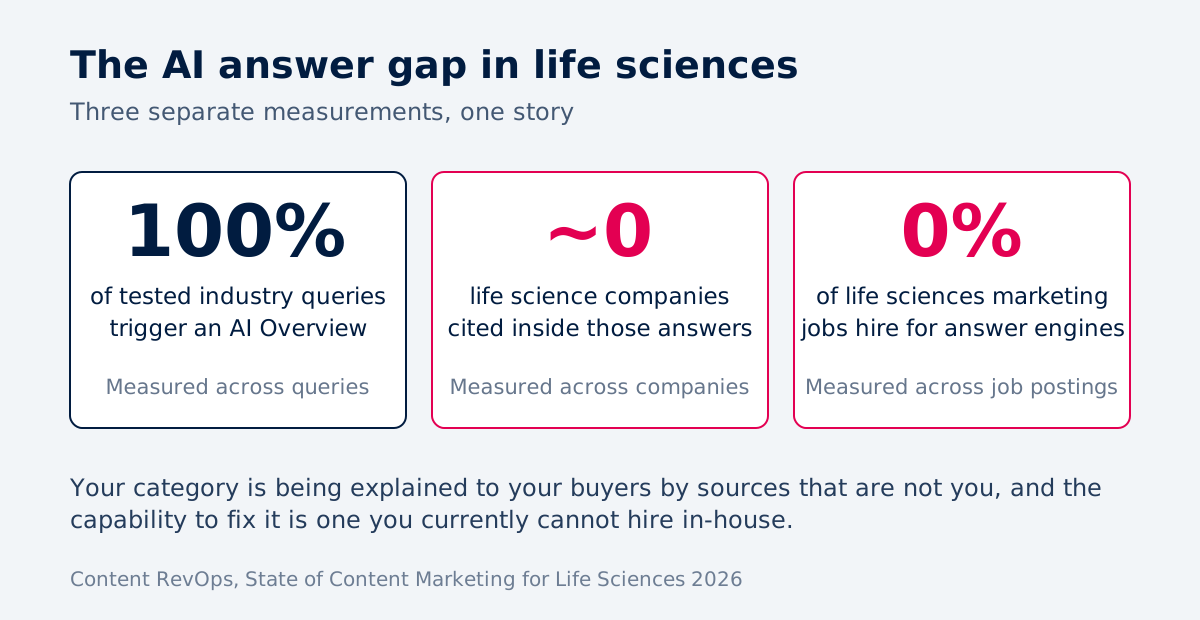
In our life sciences research, AI Overviews triggered on 100% of the industry queries we tested, meaning the answer box sits above the results on every one. Across the companies we analysed, the number cited in those AI answers came out close to zero.
Those are two different measurements. One counts how often the answer box appears. The other counts how often life science companies appear inside it. Put together, they say your category is being explained to your buyers by sources that are not you. Why some brands get pulled into those answers and others do not is the subject of our analysis of 5,761 AI citations.
Nobody in life sciences is hiring for it
The capability you would hire a consultant for is one you currently cannot hire in-house.
Answer engine optimisation appears in 0% of life sciences marketing job postings, and AI search optimisation in about 0.5% of pharma marketing posts. AI or machine learning of any kind is named in under 9% of life sciences postings, while automation and workflow skills appear in about 21%, so teams want operational efficiency more than frontier tools. That direction of travel is measured in life science marketing trends for 2026.
The role barely exists in the market. You cannot post for it and expect a shortlist, which is a straightforward argument for buying the capability rather than building it, at least until the market catches up.
Where the judgment stays human
The work divides along a clean line, and we run our own practice on it.
AI reads volume, organises it, and drafts against structure a person has already set. Humans decide what the argument is, what the evidence supports, and what gets said. In our own method we do the manual reading first and use AI afterwards for organising rather than concluding, and we draft topic titles by hand, because AI-first titles come out neat, plausible, and edgeless.
A consultant who runs entirely on AI produces the same edgeless output your competitors produce. A consultant who refuses to use it produces less work at a higher price. The useful version does the judgment itself and lets the machine carry the operational load. How we handle the search side of that is set out in how we help you show up in AI search.
How we work with life science companies
We work with life science companies as an operating partner rather than a supplier, and three things about the engagement are worth knowing before you talk to anyone, including us.
We price the gap before we scope anything
The first engagement is a content revenue audit that turns each gap into a money figure, with the assumptions printed next to it.
Striking-distance keywords, competitor demand you are not capturing, weak calls to action on commercial pages, content decay, and absence from AI answers all get converted into an annual revenue leakage number using a stated conversion model. You can argue with the inputs, which is the point. A number you cannot inspect is a sales tool. The benchmarks it reads against are the ones we published in life science marketing statistics 2026.
We take the expertise out of your scientists
The knowledge that would make your content credible sits in people who do not write.
We run structured extraction sessions with your subject matter experts to pull out the problem as they see it, the view they hold that the market misses, the framework they use, the proof, and the objections they hear. Then we turn that into assets your company owns. The mechanics of those sessions are documented in how we work with SMEs.
This is the firm-specific knowledge the Marketing Science rule says belongs inside. Our job is to get it out of people's heads and into your assets, which is the opposite of a retainer that keeps the knowledge with the vendor.
What that produced for a life sciences manufacturer
Westlab, a life science manufacturer selling into labs, grew through manual research, cold calling, conferences, and lab visits. It worked, and it was expensive, slow, and entirely dependent on reps.
Their real differentiator was that their sales team acted as a discovery and consulting partner to lab managers. That expertise was locked inside the sales team, so it only reached one lab at a time.
We shipped 40 educational pieces in two months through a human-plus-AI pipeline, packaged as an education program rather than a blog.
Inside three months the system produced 241 inbound leads in a market that had run on cold outbound, influenced $120,000 in quotes, lifted website traffic 205%, and returned 869% on the content investment. Engagement signals from the hub told sales which leads were serious, so reps stopped guessing.
You own what gets installed
The system stays with you. That is not a nicety, it is the finding from the outsourcing research applied to how we contract. The point of the engagement is that your capability goes up, not that your dependence does.
So, should you hire a life sciences marketing consultant?
Four answers, and the right one depends on the gap you named at the start.
Hire a consultant when you need a decision or a diagnosis rather than ongoing production. Positioning is unclear, one channel is broken, a launch needs a plan, or nobody senior owns marketing and you are not ready to hire. You have someone inside who can act on the answer.
Hire an agency when you need sustained execution across more than one lane, your direction is already settled, and your internal team cannot keep it all running. You are buying capacity and process, not judgment. If that is where you land and the product is a drug, how to choose a pharma marketing agency sets out the selection method.
Hire in-house when the work is specific to your company and you keep revising it. Scientific claims, regulatory positioning, and anything that needs a person in the room when the data changes.
Do none of it yet when the plumbing is missing. No CRM, no automation, no way to see what content produced. Fix that first, or you will pay someone to generate demand you cannot catch.
If you want a look at where your content is leaking revenue before you commit to anything, that is the conversation we are happy to have. Book a call and we will walk through your estate and show you the math.
See where your content is leaking revenue before you hire anyone.
Get a Content RevOps audit, your content operation benchmarked against the life sciences 2026 data, with every gap priced in pipeline terms and the assumptions printed next to the number.
Frequently Asked Questions
About the Author

Founder & CEO, Content RevOps
Stefan Kalpachev is the founder and CEO of Content RevOps, where he helps B2B SaaS companies transform their content into predictable pipeline. With a background in content marketing and revenue operations, Stefan has developed a unique methodology that bridges the gap between content creation and revenue generation.
Connect on LinkedInRelated Articles

A Go-to-Market Strategy for Construction Firms
Oct 10, 2026

Why Construction Brands Almost Never Show Up in AI Answers
Oct 9, 2026
How to Turn Before-and-After Construction Project Photos Into a Marketing Strategy
Oct 8, 2026