Can You Build a Content Marketing Strategy in One Week? Yes — If You Stop Guessing and Start Collecting Competitor Data
Are you building content from evidence - or still guessing what the market needs?
Book a CallMost content strategies are slow because they start with internal opinions. The fast ones start with external evidence.
Why content strategies usually take too long
Ask three people on a marketing team what the content strategy should be and you will get three confident answers - and a month of meetings to reconcile them. The team brainstorms topics, skims a handful of competitor sites, asks an AI tool for ideas, and assembles a calendar that feels plausible.
Plausible is the problem. A calendar built on assumptions looks finished but rarely survives contact with the market.
The bottleneck is almost never a shortage of ideas. It is a shortage of structured market intelligence - the kind that tells you what buyers are already being shown, what claims are saturated, and where the genuine gaps are.
When you stop guessing and start collecting competitor data, strategy gets faster and sharper at the same time. Those two usually trade off against each other. Here, they don’t.
AI doesn’t create strategy - data does
Most teams reach for AI too early. They treat it as a standalone fix instead of one input within a broader digital marketing approach, and the machine does exactly what you’d expect: it returns the average of the internet.
That is where recommendations like “publish thought leadership,” “create educational content,” “post consistently,” and “invest in SEO” come from. None of it is wrong. None of it is differentiating either.
AI becomes genuinely useful the moment you stop asking it to invent and start asking it to interpret. Fed a large, relevant body of market signals, it is exceptional at finding patterns a human would take weeks to surface manually. With real market context, it can also help conduct keyword research and generate content ideas.
Those signals are more accessible than most teams realise. They include:
Competitor websites and how they frame value
High-performing organic pages and the topics that help search engines connect them to stronger search results and more organic traffic
Paid ad messaging
Social media posts and the reactions they provoke
A youtube channel, webinars, and other content formats such as blog posts, video content, or audio content
Review sites and customer feedback
Industry publications and trade commentary
Search-visibility signals across the category
The strategic quality of anything AI produces is capped by the quality of what you feed it. Better inputs, better output - it is that direct. This is the same principle behind why content marketing and demand generation succeed or fail on evidence, not enthusiasm.
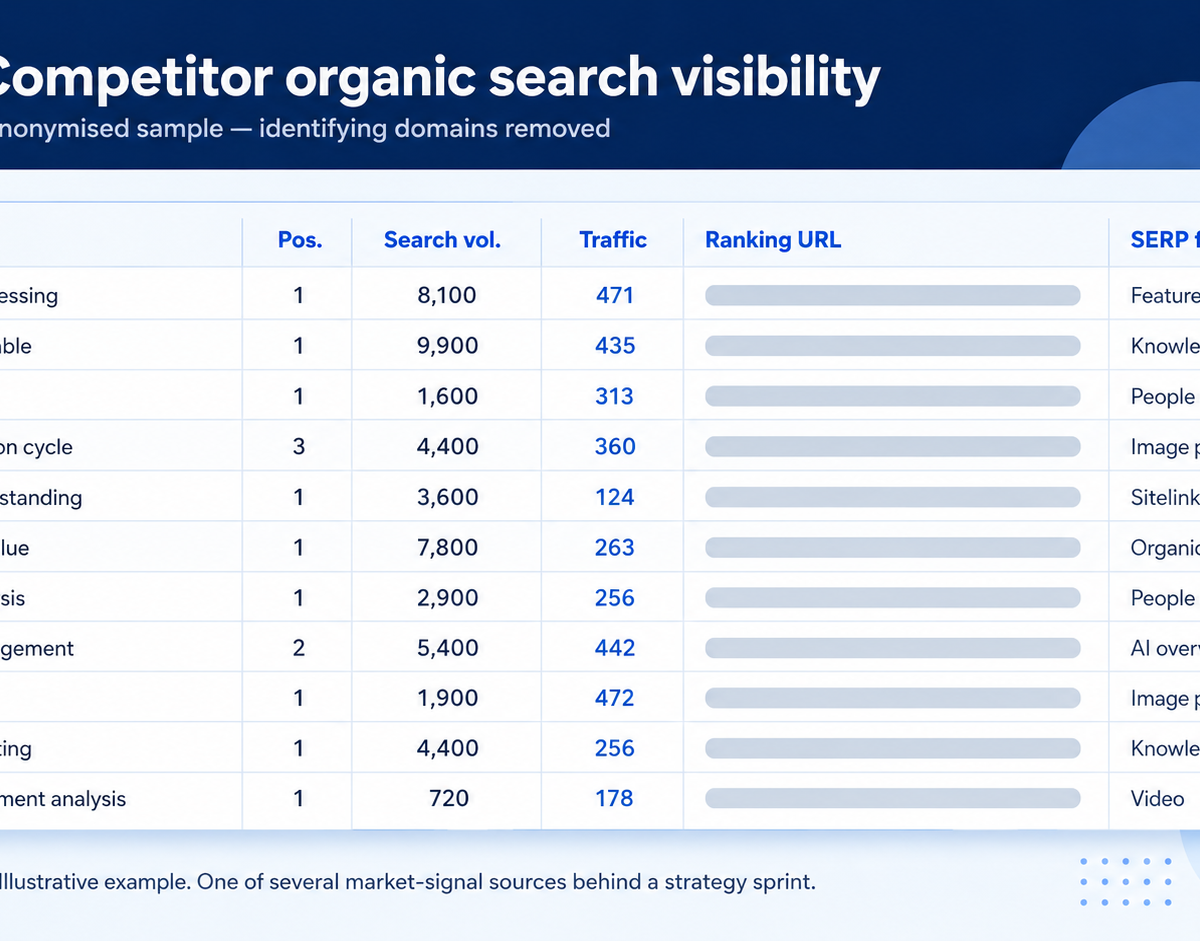
An anonymised sample of the structured competitor data behind a strategy sprint - here, organic search visibility. Identifying domains are redacted.
What makes a one-week strategy possible?
A one-week strategy is not a corner-cutting exercise. It is a disciplined sprint defined by the questions it has to answer, not by a day-by-day checklist.
A focused week should be able to answer enough to create a content marketing plan:
Who is the target audience?
What does that audience already see in the market?
What messages, topics, and formats are competitors using on the social media platforms that audience actually uses?
Where are the gaps?
Which content opportunities should be prioritised first?
Which social media channels are most likely to create traction?
How should content move people through the marketing funnel based on their place in the buyer's journey?
Speed comes from focus. When the goal is to collect the right signals and make decisions - rather than to invent ideas from a blank page - a week is enough to reach a strong, evidence-backed direction.
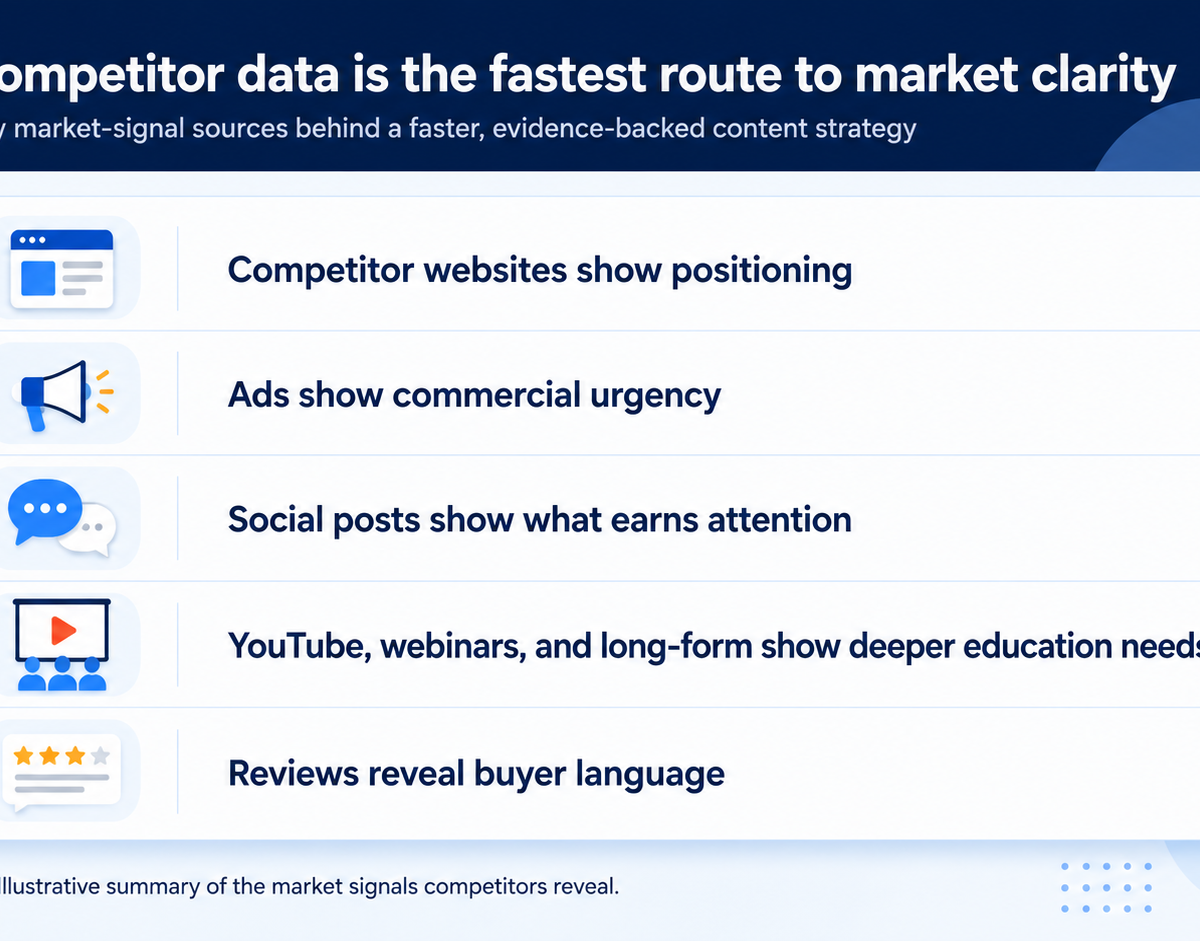
Competitor data is the fastest route to market clarity
Let’s be clear about intent: this is not about copying. Studying competitor data is about understanding the market conversation your buyers are already inside.
Competitors collectively reveal what buyers are being taught, which claims are overused to the point of invisibility, which pain points are loud, and which parts of the buyer journey nobody is serving well. Each channel tells you something different.
Competitor websites show positioning
A website is a company’s most deliberate self-description. It shows how they frame the customer’s problem, structure their offers, and stake a claim to value. Read enough of them in a category and the consensus narrative - and its blind spots - become obvious. Competitor websites also show how brands use valuable content and relevant content to establish brand authority, since quality content establishes a business as a reliable expert and helps position it as an industry leader.
Ads show commercial urgency
Paid ads are messages a company is willing to spend money to promote. That makes them a high-signal view of what competitors believe actually converts, stripped of the hedging you find elsewhere.
Social posts show what earns attention
Social content reveals the opinions, emotional hooks, and pain points that resonate in real time. The comments and reactions matter as much as the posts, because social media engagement shows which ideas the audience rewards or ignores across platforms, and 73% of marketers use organic social media for content promotion. Surveys and interviews can then validate those signals with real data about the audience's preferences.
YouTube, webinars, and long-form show deeper education needs
Long form videos and audio content surface the more mature, complex questions buyers ask later in their journey. They expose the education gaps that short social posts and ad copy never reach.
These formats are also effective for reaching a younger audience, and they can show what a niche youtube channel teaches buyers in later-stage research; video marketing is used by 91% of companies for promotion, while podcasts tend to keep listeners with high retention.
Reviews reveal buyer language
Reviews are where customers describe value and frustration in their own words. They show which promises are landing, which are being broken, and the exact phrasing your future buyers use to describe the problem.
The point of all of this is not imitation. The point is to find the gaps your competitors leave behind.
From data points to strategic patterns
Collecting signals is the easy half. The value is created when scattered data points resolve into patterns. This stage works like a content audit within a broader content plan, helping teams evaluate existing content performance.
A strong analysis should make several things visible at once:
Repeated competitor messages and overused claims
Underserved pain points and unanswered buyer objections
Weak or generic positioning that’s open to challenge
High-performing content themes worth competing for with engaging content and the content quality needed to solve real problems
Channel opportunities others are ignoring, including ways to repurpose content across multiple channels
Content gaps across the funnel
Areas where your company can credibly differentiate
This is where content strategy stops being topic planning and becomes something bigger. It becomes the process of deciding what your company should be known for, where it should show up, and how it should earn trust.
A strong strategy doesn’t get invented. It emerges, once the market’s patterns become visible.
Fast strategy still starts with a precise audience
None of this works against a fuzzy audience. Competitor data only becomes decisive when you know exactly whose attention you are trying to win. That precision only pays off when it is paired with clear, measurable goals. Teams should use SMART goals tied to business goals so they can track measurable outcomes by audience segment.
A strategy for “B2B buyers” or “marketing teams” is too broad to act on. It sharpens the moment you identify the segment with the clearest need, the highest value, the strongest urgency, and the most reachable online behaviour.
The narrower the audience, the more decisive the research becomes - because every signal can be judged against a specific person’s reality rather than a generic average. It’s also what separates content that drives demand generation from content that simply adds to the publishing pile.
What AI is actually useful for
Used well, AI is a research and synthesis engine, not a strategist. It is very good at compressing weeks of manual pattern-finding into hours - identifying messaging patterns, topic clusters, emotional language, content gaps, channel trends, recurring buyer concerns, and candidate content pillars.
What it cannot do is decide what matters. It has no view on what is commercially valuable, what is genuinely differentiated, or what your brand can credibly own.
Those are human calls. AI finds the patterns; strategists turn those patterns into choices - and the choices are where the advantage lives. AI can support the content creation process, but teams still need a documented workflow to create content consistently, improve quality control, and protect brand identity.
What a one-week content strategy should produce
The output of a focused week is not a 40-page theory deck. It is a documented content marketing strategy.
A working strategy should deliver:
A clear audience focus
A sharper positioning direction
Priority content pillars and key messaging themes
The competitor gaps worth attacking
Channel priorities
A practical funnel logic
Initial content opportunities, a content creation process, and a content calendar roadmap for execution
Documented strategies correlate with higher content marketing success, and even a simple Google Sheets calendar with publication dates and content details is enough to operationalize the plan.
In other words, it tells you what to create, where to publish, and how to deliver content so buyers keep moving forward. The result is not just a successful content marketing strategy - it is a decision-making system. Pairing it with the right distribution channels is what turns that system into pipeline.
“Can this really be done in one week?”
Yes - with an honest definition of “strategy.”
A week is enough to create a content marketing strategy with a measurable starting point: a strong working direction grounded in evidence around audience priorities, positioning gaps, content opportunities, and channel focus. It is not a finished system, and it is not enough to replace long-term learning, sales feedback, performance data, or ongoing optimisation. After the sprint, use google analytics and other analytics tools to measure website traffic and organic traffic. Any agency that claims otherwise is overselling.
One week is enough to stop guessing. It is not enough to stop learning.
That distinction is the whole point. The sprint gives you a defensible starting position fast; the optimisation that follows is where it compounds. With 70% of marketers actively investing in content marketing, the edge comes from better lead generation through improved lead quality, lower customer acquisition costs over time because it typically costs less than traditional advertising, and a smoother handoff to the sales team since 62% of B2B buyers read 3-7 pieces of content before making contact.
Stop prompting, start feeding the machine better data
Companies will not win with AI because they wrote a cleverer prompt. They will win because they brought better inputs - competitor intelligence, customer language, market signals, and a clear strategic lens to interpret them through.
That is the shift: from treating content strategy as a brainstorm to running it as a research-backed operating system. One that ties the key elements of audience insight, positioning, search engine optimization, content creation, distribution, and measurement into a single marketing plan. It also sharpens content ideas and content marketing campaigns that can generate leads across multiple channels.
It is the same philosophy we apply whether the category is fintech, pharma, or biotech: collect the market’s signals, find the gaps, and build from evidence.
Effective content marketing examples often combine blog posts, infographics, email marketing, and user generated content to improve online visibility and customer loyalty; blog posts generate the biggest ROI for 16% of marketers, and infographics present complex data in a clear format. Getting that format right has its own rules, which we set out in what to do and what not to do with infographics.
Want to see what your competitors’ content is really telling the market? Content RevOps turns competitor data into research-backed content strategy - so your team can stop guessing and start building with evidence.
Could your next content strategy be built in one week?
Get a Content RevOps-style competitor intelligence sprint that turns market signals, buyer language, and content gaps into an evidence-backed strategy your team can act on fast.
Frequently Asked Questions
About the Author

Founder & CEO, Content RevOps
Stefan Kalpachev is the founder and CEO of Content RevOps, where he helps B2B SaaS companies transform their content into predictable pipeline. With a background in content marketing and revenue operations, Stefan has developed a unique methodology that bridges the gap between content creation and revenue generation.
Connect on LinkedIn