What Do Content Marketing Experts Actually Do & Should You Hire One?
Want content that shows up in your CRM—not just your blog? Let’s map your revenue gaps and build the system.
Book a CallMost B2B SaaS and professional services companies are “doing content”: a few blog posts, some founder LinkedIn thoughts, maybe an ebook when a launch needs air cover. Yet in the same breath, they can’t answer a simple question: what revenue did any of this influence? The result is a familiar set of symptoms: traffic that never turns into pipeline, great insights trapped in a founder’s head, and a sales team asking (again) for assets that never ship.
That disconnect is why the title content marketing expert is so misunderstood. Many people hear it and think “writer,” “SEO person,” or “brand storyteller.” In high-performing teams, it’s closer to a hybrid of strategist, operator, and revenue owner, someone who treats content the way RevOps treats the funnel: staged, measurable, and continuously improved.
This article breaks down how top experts partner with founders and GTM teams to turn content into a revenue system, using four lenses as the backbone:
Content as a process
Content as a team function
Content as a system of tools
Content as a business function
Then we’ll get practical about the real hiring question: how seriously do you want content to drive revenue, and are you ready to run it that way?
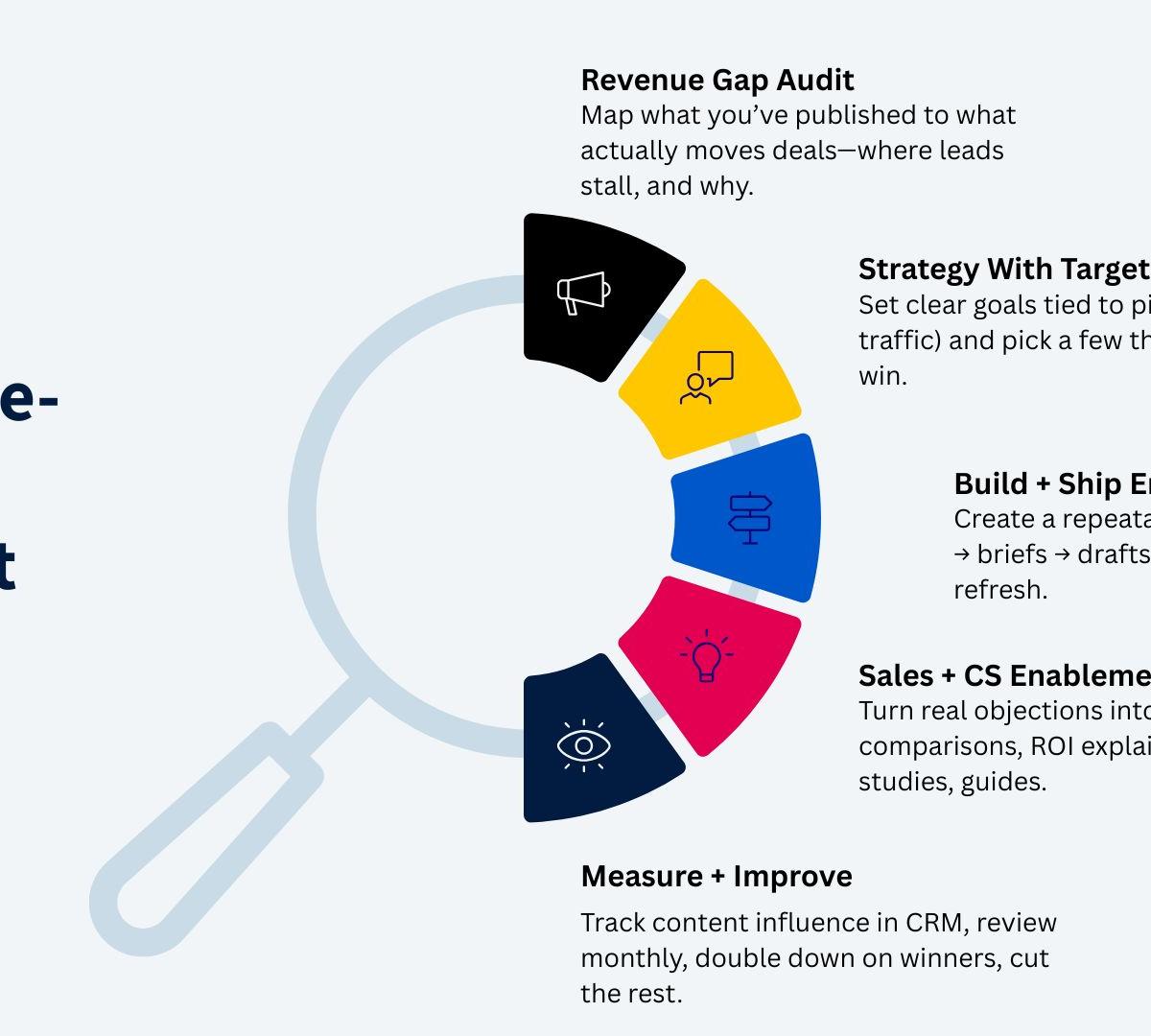
Diagnose content–market fit and revenue gaps
A real content marketing expert starts by figuring out where content is supposed to help revenue, but currently doesn’t. They audit what you’ve published against pipeline reality: which assets drive qualified meetings, where leads stall, and which objections keep resurfacing in calls. That kind of audit usually combines analytics with CRM and marketing automation data so you can see which pieces actually show up on closed-won paths, not just high-traffic pages.
That requires cross-functional input. They’ll interview sales and CS (and sometimes customers) to surface the buying questions your content fails to answer, then compare that to how prospects actually search and evaluate alternatives, often using search-intent and query analysis to see what real buyers ask before they ever talk to sales. They also look for “invisibility gaps”: places competitors show up (organic or paid) where you don’t, especially around high-intent comparison and solution keywords.
Typical outputs:
A shortlist of deal-stalling objections and missing assets by stage
A content inventory mapped to ICP, persona, and funnel stage
A prioritized list of high-intent pages/topics tied to pipeline, not vanity traffic
Design a revenue-aligned content strategy
Next, they turn insights into a strategy with S.M.A.R.T. goals that a RevOps team would respect (for example, content-assisted SQLs, win-rate lift, or cycle-time reduction). Traffic may be a leading indicator, but it’s not the goal. Research consistently shows that marketers with a documented, business-linked content strategy outperform those without one on almost every effectiveness measure, so this step is not optional. It’s where content stops being “blog posts” and becomes a commercial plan.
They choose a few revenue themes where you have a real edge, where paid acquisition is pricey or volatile, and where buyers are actively researching. Then they map content to the decision journey (problem framing → solution exploration → comparison → validation → onboarding/expansion) so your content helps buyers “end the search,” not keep browsing. That journey mapping usually pulls from both qualitative inputs (sales calls, win–loss interviews) and quantitative signals (search data, behavioral analytics) to make sure every stage is covered with the depth buyers now expect.
Build and run a repeatable content engine
Day to day, experts build process, not just posts. They create a pipeline-like operating cadence: a research backlog, clear workflows (briefs → drafts → SME review), distribution plans, and ongoing optimization sprints that refresh winners and retire laggards. High-performing teams run this as an ongoing loop (research → create → distribute → optimize) rather than a sequence of disconnected campaigns.
They also define stage gates: what counts as a content-assisted MQL, SQL, or sales-qualified engagement, so content has measurable handoffs. That usually means agreeing on shared definitions and scoring rules with RevOps, then instrumenting content in your CRM and analytics stack so you can see which assets move people from “interested” to “in a real opportunity.”
Enable sales and customer-facing teams
A big part of the job is converting founder/SME expertise into assets sales can actually use: comparison pages, objection handling, ROI explainers, and implementation guides. Award-winning B2B programs consistently treat these as core assets, not afterthoughts; a good expert builds them straight from patterns in discovery calls, proposals, and renewal conversations.
Then they embed those assets into the sales motion (playbooks, sequences, talk tracks) and collaborate with CS on onboarding/adoption content that reduces tickets and churn. The best teams track asset usage in their enablement or CRM tools so they can see, for example, which case studies reliably show up in late-stage wins or which implementation guides correlate with higher product adoption.
Own measurement and learning loops
Finally, they wire content to the CRM and analytics so reporting is about revenue impact: content-assisted pipeline, win-rate lift, and cycle-time changes. That means going beyond pageviews to implement content scoring, influence reporting, and multi-touch views that reflect the real, messy B2B journey.
Then they run monthly reviews and adjust like an ops function, because content only compounds when the feedback loop is permanent. In practice, that looks like a recurring cadence where marketing, sales, and RevOps review which assets helped create or accelerate opportunities, decide what to double down on, and sunset activity that isn’t earning its keep.
Lens 1: Content as a Process – From Idea to Revenue
A content marketing expert brings process discipline to what’s usually a messy mix of “blog ideas” and one-off launches. In B2B SaaS and professional services, the job isn’t to publish more. It’s to build an operating cadence that turns buyer questions into pipeline, then learns from what happens in the funnel.
The four-stage content process
Most high-performing programs run on a simple loop:
Research → Creation → Distribution → Optimization
This mirrors the kind of “content engine” that’s been shown to drive revenue in practice, not just traffic or impressions.
Research starts with commercial reality, not editorial taste. Experts prioritize topics by combining search intent with internal revenue signals: customer interviews, win/loss patterns, sales call friction, and where competitors are clearly investing. That often means blending classic keyword tools with insights from call recordings and CRM, rather than relying on search data alone. That combination is also how you find content ideas before a topic is already saturated, because revenue signals surface questions the keyword tools have not caught up with.
Creation is built to “end the search.” That means decision-grade assets: comparisons, ROI explainers, implementation guides, and pages that reduce uncertainty, not thin posts written to chase keywords or trends. Assets are judged on whether they resolve the buyer’s job-to-be-done and measurably move opportunities forward, a standard echoed in most serious content marketing frameworks.
Distribution treats SEO as one channel among many. Experts plan repeatable routes through email, sales touchpoints, communities, partner co-marketing, and customer education so one asset can earn attention multiple ways. In stronger programs, distribution is treated as its own ongoing process (“create once, distribute forever”) rather than a single launch moment.
Optimization is continuous. They refresh stats, expand sections that win, tighten CTAs, consolidate overlapping pieces, and retire content that creates noise or cannibalizes performance. Mature teams also look at how specific assets influence opportunity creation, win rates, and deal cycle time, not just rankings or pageviews.
How experts apply RevOps thinking to the process
They run content like a funnel with shared definitions:
Stage definitions: tag assets by lifecycle stage (awareness, consideration, evaluation, decision, onboarding, expansion), aligned to how the revenue team actually defines each stage.
Exit criteria: define what “progress” looks like (pricing/comparison views, demo completion, implementation guide downloads), so content can be tied to real funnel movement instead of vanity engagement.
Metrics that matter:
Leading: qualified organic sessions to high-intent pages, CTA click-through, sales sequence replies when content is included
Lagging: content-assisted SQLs, opportunity creation, win-rate lift, deal cycle time
This kind of measurement approach matches how advanced B2B teams increasingly treat content as part of their revenue infrastructure, not just their brand footprint.
What this looks like inside a B2B org
A typical workflow is tight and collaborative: monthly intake from Sales/CS on the top objections, 2–3 content plays designed to remove them, coordinated distribution across outbound and lifecycle channels, then a 60–90 day review to see what changed in conversion, velocity, or objection frequency. Over time, this builds a repeatable loop where sales insights, performance data, and search intent all feed the same prioritized backlog instead of competing for attention.
Why process matters more than volume
Without feedback loops you get content sprawl: lots of assets, little impact. With a defined process, fewer pieces do more work, because the team keeps improving what already performs, and the value compounds over time. In most B2B environments, that shift from “more output” to “better operating model” is the difference between content as a cost center and content as a measurable revenue function.
Lens 2: Content as a Team Function (so everyone rows toward revenue)
A content marketing expert makes content a shared GTM responsibility, not “marketing’s blog.” They bring Sales Ops and RevOps discipline (clear handoffs, feedback loops, and definitions) so content maps to pipeline realities: objections, stalled stages, and what actually changes buyer behavior. In high-performing B2B teams, this often looks like a documented revenue-focused content strategy rather than ad hoc publishing, which aligns closely with how leading practitioners describe effective content programs being run.
How they align the team:
Sales: capture live objections, pull deal stories, and test new assets inside sequences (so content proves itself in the field). When sales and marketing collaborate this way, organizations are far more likely to report content marketing success and see meaningful impact on pipeline.
Product marketing: keep positioning, category language, and feature narratives consistent across pages and enablement, mirroring the kind of message discipline seen in companies that treat content as part of their core go-to-market strategy rather than a side channel.
Customer success: identify adoption friction and churn risks, then turn them into onboarding and expansion content that reduces support load and protects revenue, an approach that aligns with research showing that well-structured customer education content can increase retention and account growth.
RevOps/Marketing ops: ensure tracking, routing, and reporting are accurate enough to trust decisions. Without this, most teams fall into the trap of vanity metrics instead of the revenue-linked KPIs that advanced content programs rely on.
Practices experts introduce:
A monthly “pipeline content” review where GTM leads look at deal data + content performance and agree on the next content plays. This echoes how mature teams use shared dashboards and integrated analytics to connect content touchpoints to opportunities and closed-won revenue.
Editorial intake tied to revenue themes (top objections, competitor comparisons, implementation fears), not random brainstorms. That intake is often informed by ongoing call intelligence and search behavior, so topics reflect what buyers are actually asking in the moments that matter.
Sales feedback SLAs so reps actually report which assets moved opportunities forward, and which didn’t. Teams that build this feedback loop into their process are far better positioned to double down on “content that ends the search” for buyers and cut assets that only generate superficial engagement.
Turning Founders and SMEs into Force Multipliers
In B2B SaaS and services, the sharpest insights often live in founders and senior ICs. Experts extract that proprietary POV through structured interviews, then package it into repeatable narrative assets: signature frameworks, talk tracks, playbooks, and proof-heavy guides. This mirrors how many high-performing content organizations turn internal expertise into serialized content properties that can be reused across channels and sales cycles.
The result: prospects don’t need a founder call to get clarity. Sales doesn’t rely on “that one rep who can explain it.” Your best thinking becomes scalable, and over time it can function like a niche media property that consistently attracts, educates, and qualifies the right accounts.
Lens 3: Content as a System of Tools (so content connects to revenue)
Experts design content operations around a revenue source of truth (typically CRM + marketing automation), then connect analytics, search insights, and call intelligence to understand what buyers do and how they talk. This kind of integrated stack is what lets teams move beyond pageviews and email opens to questions like “Which assets show up most often in won deals?” and “What content patterns correlate with faster sales cycles?”
They also build a content inventory with taxonomy (topic, persona, stage, product, use case) so teams can reuse and improve assets instead of duplicating them. Structured inventories and taxonomies are a hallmark of “intelligent content” practices, where assets are tagged and modeled so they can be found, recombined, and personalized at scale.
Governance they standardize:
UTM and naming conventions that reveal which assets influence opportunities, enabling content scoring models and multi-touch attribution instead of guesswork.
URL/metadata rules that improve SEO, internal search, and AI discovery, supporting both demand capture in high-intent search moments and findability for sales and success teams.
Refresh schedules for high-value assets, managed like key accounts, so top-performing guides, case studies, and comparison pages stay accurate and competitive rather than decaying quietly in the archive.
Why This Matters in B2B SaaS and Services
Buying journeys are long and multi-threaded. No single post “wins” a deal. When teams and tools align, patterns emerge: which content clusters consistently show up in closed-won, where deals stall without proof, and what to double down on to compound pipeline over time. Organizations that get to this stage treat content as a true business function (with documented strategy, cross-functional ownership, and revenue-linked KPIs) rather than as a set of isolated campaigns.
Lens 4: Content as a Business Function – And When to Hire an Expert
Content as a business function, not brand decoration
In B2B SaaS and professional services, content shouldn’t exist to “keep the website fresh.” A content marketing expert treats content like a revenue-owning function with a scoreboard that lives in your CRM, not in social likes. Leading teams increasingly describe content as a core growth engine rather than a brand accessory, reflecting research that links documented, revenue-aligned content strategies to higher overall marketing effectiveness.
They build a business case for content using outcomes leadership and RevOps care about:
Pipeline created: net-new opportunities sourced or initiated by content
Win-rate lift: higher close rates when specific assets show up in deals
Cycle-time reduction: fewer calls needed because buyers can self-educate
Expansion and retention: onboarding, adoption, and upsell content that reduces churn risk
These are the same dimensions many high-performing marketing organizations use to evaluate content initiatives against revenue and customer value, not just awareness.
Practically, they manage each asset like a mini product: it has a defined “job” (handle a common objection, qualify intent, support pricing, enable onboarding), an expected lifespan, a refresh plan, and unit economics such as cost per qualified visit or cost per SQL. This mirrors how sophisticated teams design content programs with S.M.A.R.T. goals and treat content as an asset with expected return, not a sunk cost.
Signs you’re ready to hire a content marketing expert
Hire when you want content to function like infrastructure across the go-to-market motion, not a side project. If the answer is an outside team rather than a seat on your own payroll, we reviewed more than 90 agencies that market to content leaders and kept the ones that treat content as pipeline infrastructure, in our list of demand generation agencies for heads of content.
Common readiness signals:
You’ve tried content, but can’t tie it to pipeline or revenue (reports are mostly vanity metrics). This is common in orgs where analytics are available but not connected to business decisions or RevOps reporting.
Traffic is up, but sales feedback sounds like: “These aren’t better leads.” That gap usually points to missing intent, journey mapping, and content-to-funnel alignment, not just “more content.”
Your growth engine is fragile or expensive, leaning on paid with rising CAC and unpredictable performance, exactly the pattern that pushes many teams to rebalance into owned, content-led acquisition.
Your basics are in place: clear ICP, validated offer, real point of view, plus workable RevOps foundations (CRM, funnel stages, at least directional attribution) so content performance can be traced to opportunities and revenue rather than clicks alone.
Signs you should wait (or start smaller)
If you’re still validating what you sell and to whom, a full content hire can turn into productive-looking noise.
Wait or narrow scope when:
You’re pre-product or still proving the business model, where learning and direct customer conversations matter more than scaling content.
You don’t have a differentiated POV or consistent messaging, making it hard for any content leader to build a coherent narrative system.
There’s no shared definition of qualified, no clear stages, and no reliable sales process, all symptoms that measurement and content attribution will be guesswork rather than an operating discipline.
In that case, prioritize customer understanding, positioning, and product clarity first, then layer in a content expert to operationalize and scale.
What a strong expert can change in 90–180 days
A good expert doesn’t just publish more. They install an operating model:
A documented, revenue-aligned strategy and editorial roadmap tied to revenue themes instead of disconnected topics
Dashboards connected to CRM metrics, with clear success definitions and handoffs, so leadership can see how specific assets influence opportunities, velocity, and deal size
Governance: taxonomy, routing, refresh cycles, QA, and distribution discipline that reduce “random acts of content” and tool sprawl
Early traction from intent-rich clusters and sales/CS assets teams actually use, plus initial signals of lower CAC via organic and content-assisted deals as content begins to “end the search” for key buyer questions
Connecting to our philosophy
This is the shift from content as support to content as operating system: content treated as decision infrastructure that educates, qualifies, accelerates pipeline, and compounds over time. When content is instrumented against pipeline metrics, supported by an integrated content–tech stack, and governed like any other GTM process, it behaves like the business function it is meant to be. If content doesn’t influence revenue, it’s noise.
Conclusion: Should You Hire a Content Marketing Expert?
A real content marketing expert doesn’t just ship more assets. They design and run a content system that behaves like a revenue function. Using four lenses (process, team function, tools system, and business function), they turn content from ornament into infrastructure: mapped to the buyer journey, connected to your CRM, and optimized to create and move pipeline, in line with how high-performing teams now treat content operations and measurement. If you are weighing that as a hire or an engagement, what a content marketing consultant actually does sets out the same work at a practical level.
The hiring decision is simpler than it sounds:
Hire an expert if content is mostly activity and aesthetics (heavy on output, light on pipeline impact) or if you’re over-reliant on expensive, unpredictable paid channels. When you already have product-market fit and a clear point of view, an experienced operator can translate that into a compounding content engine that behaves more like a go-to-market system than a publishing calendar, and that consistently supports acquisition and sales efficiency rather than just brand metrics. If that operator turns out to be an agency rather than a person, our list of B2B content marketing agencies gives each one a plain label for the job it does best.
Wait if you’re pre-product, unclear on who you serve, or can’t articulate why you win. In that phase, scaling content operations just scales confusion, especially when you don’t yet have the audience clarity, narrative, or revenue model that structured content programs are built around.
This is the philosophy behind Content RevOps: treat content as a disciplined go-to-market operating layer that educates buyers, triggers intent, supports sales, and earns its place by changing revenue outcomes, whether you build that capability in-house or with outside help. If outside help is the route, our review of demand generation agencies for professional services firms narrows 98 down to the 14 that show their work. For a legal practice, the same checks produced a separate shortlist of demand generation agencies for law firms.
Is your “content marketing expert” role driving revenue—or just producing output?
Install Content RevOps: a measurable content operating system that qualifies demand, enables sales, and compounds pipeline over time.
Frequently Asked Questions
About the Author

Founder & CEO, Content RevOps
Stefan Kalpachev is the founder and CEO of Content RevOps, where he helps B2B SaaS companies transform their content into predictable pipeline. With a background in content marketing and revenue operations, Stefan has developed a unique methodology that bridges the gap between content creation and revenue generation.
Connect on LinkedIn