The best demand generation agencies for when awareness is not converting in 2026
Plenty of B2B companies are not short on attention. They publish, post, run events, and buy ads, and traffic and engagement show up. Then sales asks where the pipeline is, and nobody has a clean answer. Awareness is working. The system that should turn it into pipeline is not. Many agencies promise to fix this, but most sell more awareness, or one tactic dressed up as a system. We reviewed demand generation agencies that work with B2B companies in exactly this spot and kept the ones that tie their work to pipeline and can prove it. Below we explain each one in plain words, so you can pick the right fit.

How we chose this list
We ran the same checks on every agency, including our own. Here is what earns a spot and how we ordered them.
Who makes the list
Every agency runs real demand generation and has a working content presence of its own. We left out lead-list sellers, appointment-setters, and ads-only shops.
How we rank them, in order
- Whether the work is tied to pipeline, not just awareness
- Whether they run marketing for themselves, and it works
- Review proof, counting how many reviews back the score
- Whether they show prices and name their team
- Fit to your stage, size, and situation
What we promise on every entry
Every claim can be traced to a source. Ratings always show how many reviews they come from. Prices are shown, or marked not shown. We do not give any agency a made-up score, and we hold our own entry to the same checks. Ranking below the top spot is directional, not exact.
The shortlist at a glance
All 15 entries, ranked by the criteria above. Full detail in the cards below.
| # | Name | Pros | Cons | Best for | Pricing |
|---|---|---|---|---|---|
| 1 | Content RevOps |
|
| B2B teams that already have traffic, brand, or ad spend working but cannot turn that attention into booked pipeline, and want one connected system instead of five disconnected campaigns. | From $4,100/mo |
| 2 | Ironpaper |
|
| Mid-market and enterprise B2B teams that have traffic and activity but a disconnect between marketing and sales, and want demand, content, and enablement run as one measured system. | Not disclosed |
| 3 | The Marketing Practice |
|
| Enterprise B2B technology brands that have strong awareness but need brand and demand run as a single, measured programme across regions. | Not disclosed |
| 4 | strategicabm |
|
| Enterprise and mid-market B2B tech teams that want to convert awareness into named-account pipeline through account-based marketing, with ROI they can show. | Not disclosed |
| 5 | Walker Sands |
|
| Mid-market and enterprise B2B teams with strong brand or PR that is not translating into pipeline, and that want strategy, demand, and RevOps under one roof. | Not disclosed |
| 6 | The Pedowitz Group |
|
| Mid-market and enterprise marketing teams whose awareness stalls because the martech, data, and sales handoffs are broken, and who want revenue-marketing strategy and HubSpot or Marketo operations fixed. | Not disclosed |
| 7 | BOL Agency |
|
| B2B SaaS, tech, and services teams that have brand and demand running as separate efforts and want one team to join awareness, demand, and performance into a single funnel. | Not disclosed |
| 8 | Closed Loop |
|
| Mid-market and enterprise SaaS teams spending seriously on paid media who get clicks and awareness but not pipeline, and want media, creative, and measurement in one team. | Not disclosed |
| 9 | Matter Made |
|
| Funded, growth-stage B2B SaaS teams whose paid awareness has grown expensive and inefficient, and who want demand measured on pipeline and CAC instead of impressions. | Not disclosed |
| 10 | 42DM |
|
| B2B tech and SaaS teams that want one full-service partner to own strategy, demand, ABM, content, and AI search, rather than coordinating several specialist vendors. | Not disclosed |
| 11 | Discovered Labs |
|
| Series A and later B2B SaaS teams whose buyers rely on AI assistants and search, and who need to be found and cited there, reported against pipeline. | Not disclosed |
| 12 | Marsden Marketing |
|
| Mid-market and enterprise B2B teams, often in manufacturing or tech, that want demand generation, HubSpot operations, and PR from one integrated partner. | Not disclosed |
| 13 | Activate Marketing Services |
|
| Established B2B tech marketing teams drowning in low-quality MQLs who want higher-quality, sales-ready demand instead of more volume. | Not disclosed |
| 14 | Twogether |
|
| Enterprise and mid-market technology vendors, especially those selling through partners, that need demand, ABM, and channel marketing joined up globally. | Not disclosed |
| 15 | Skalegrow |
|
| Smaller B2B SaaS and industrial teams on a lean budget that have some awareness but no system to convert it, and want a hands-on, lower-cost partner. | Not disclosed |
The list
What they doContent RevOps is a content marketing and demand generation firm for B2B companies that have attention but not pipeline. We work with SaaS, fintech, education, and industrial teams, from lean marketing groups to companies where content, the CRM, and sales sit in separate lanes. The problem we fix is specific. Most companies stuck here are not short on awareness. They post, publish, run events, and buy ads, and they get traffic and engagement, but sales still asks where the pipeline is. We treat content as revenue infrastructure, not as campaigns. You already own content, it just has no job, and we give it one. We map the buying committee and the real sales motion, then build the decision-stage material most teams never publish, the proof and answers a buyer needs before booking a call. We place it where those buyers actually look, including AI answers, not only on a blog. Then we wire it into the CRM, with nurture and sales enablement, so interest is captured and moved instead of leaking. Everything is tracked back to pipeline and revenue, so you can see what each piece returns. Our method and our prices are published, and we hold named case studies across education, fintech, manufacturing, and life sciences.
Best forB2B teams that already have traffic, brand, or ad spend working but cannot turn that attention into booked pipeline, and want one connected system instead of five disconnected campaigns.
Pros
- Built for the exact gap you have: attention that does not convert. Content is wired to capture, nurture, and the CRM, so interest turns into pipeline instead of leaking.
- Runs content, data, and automation as one connected system, not five campaigns that do not talk to each other. how we work ↗
- Publishes its method and its prices. Every other agency on this list hides pricing. our pricing ↗
- Has named, numbers-backed case studies for this exact situation, including rebuilding inbound demand after a rebrand wiped out most of a company's organic traffic. case studies ↗
- Focuses on organic search and AI answers, so demand keeps flowing when you stop paying, which matters most when ad-driven awareness is not converting.
Cons
- Young and small, founded in 2024, so it fits building a content-led system better than running very large paid-ad budgets.
- Its public review count is small next to the long-established firms on this list, even though the scores are perfect.
What they doIronpaper is a B2B-only growth agency in New York, running since 2002. Its whole pitch speaks to this problem: growth stalls when marketing and sales work as separate systems, so awareness never becomes pipeline. It runs demand generation, content, ABM, websites, and sales enablement as one measured engine built for long, complex sales cycles. It is one of the few agencies that publishes its own survey research, including a study of more than 350 B2B leaders, and it ranks organically for the category it sells, sitting near the top of search for the term demand generation agency. It is a HubSpot Diamond partner, names its senior team, and attaches results to its case studies. The team is mid-sized, so it fits mid-market and enterprise buyers more than very small teams.
Best forMid-market and enterprise B2B teams that have traffic and activity but a disconnect between marketing and sales, and want demand, content, and enablement run as one measured system.
Pros
- Built around the exact failure here: marketing and sales running as separate systems, so leads stall.
- Publishes its own B2B research and ranks organically for the demand generation category it sells.
- Names its senior team and documents its method, with results-based case studies.
- HubSpot Diamond certified partner.
Cons
- Does not publish pricing.
- Mid-market and enterprise focus, so a small startup may find it more than they need.
What they doThe Marketing Practice, which now trades as tmp, is a global B2B agency built on the idea of running brand and demand as one programme rather than separate lanes. That is the direct fix when awareness is high but it is not converting. It works with enterprise technology brands and runs strategy, creative, media, and ABM at scale across the US, UK, and APAC. It grew by acquiring specialists, including the US ABM firm Campaign Stars and the APAC demand and media shop Rombii, and it publishes original research plus the How to Grow a CMO podcast and a benchmarking tool. B2B Marketing ranked it among the top agencies in the US, placing it in the top five for both brand and demand generation. It is an enterprise-scale partner, so it is a heavy lift for a small team.
Best forEnterprise B2B technology brands that have strong awareness but need brand and demand run as a single, measured programme across regions.
Pros
- Runs brand and demand as one programme, the direct answer when awareness is not converting.
- Global scale across the US, UK, and APAC, with ABM and media depth added through acquisitions.
- Publishes original research, a benchmarking tool, and a CMO podcast.
- Ranked among the top US B2B agencies for both brand and demand generation.
Cons
- Does not publish pricing.
- Built for enterprise programmes, so it is oversized for small or early-stage teams.
What they dostrategicabm is a specialist account-based marketing agency in the UK that works only with B2B technology brands. ABM is one of the clearest fixes for awareness that is not converting, because it concentrates effort on the specific accounts you want and ties the work to revenue. It runs a documented six-step Modern ABM Journey and has an award record to back it: the AVEVA programme it delivered won Forrester's 2025 B2B Program of the Year, and its site names SAP and Cloudflare among its programmes. It also dogfoods well, ranking in search for ABM terms it sells, and it publishes an Insights hub, the DashDot magazine, two podcast series, and an ABM glossary. Because it is ABM-only, it is a narrow fit if you also need broad, top-of-funnel demand.
Best forEnterprise and mid-market B2B tech teams that want to convert awareness into named-account pipeline through account-based marketing, with ROI they can show.
Pros
- Specialist ABM, which focuses spend on the accounts you actually want instead of broad awareness.
- Its AVEVA programme won Forrester's 2025 B2B Program of the Year.
- Names SAP and Cloudflare among its programmes and ranks for the ABM terms it sells.
- Documented six-step method, an insights hub, and two podcasts.
Cons
- Does not publish pricing.
- ABM-only, so it is a narrow fit if you also need broad top-of-funnel demand.
What they doWalker Sands is a large, integrated B2B agency in Chicago that runs brand, demand, PR, digital, and data as one connected model it calls Outcome-based Marketing, outcomes before channels. That framing fits teams whose awareness and PR are strong but do not move pipeline. In 2026 it acquired RevPartners to add RevOps and go-to-market engineering, so it can also build the CRM and data layer that captures demand. It publishes original research, including a B2B AI search visibility benchmark, and names clients such as Paylocity, Semrush, John Deere, and AspenTech. It carries real third-party review proof, which is rare here: 4.8 on G2 from 32 reviews and 4.8 on Clutch from 9. At a few hundred people it is a serious partner, not a boutique.
Best forMid-market and enterprise B2B teams with strong brand or PR that is not translating into pipeline, and that want strategy, demand, and RevOps under one roof.
Pros
- Runs brand, demand, PR, and RevOps as one outcome-based model, so awareness is tied to pipeline.
- Added RevOps and CRM engineering by acquiring RevPartners in 2026.
- Rare, verified review proof: 4.8 on G2 from 32 reviews and 4.8 on Clutch from 9.
- Publishes original research and names clients like Paylocity, Semrush, John Deere, and AspenTech.
Cons
- Does not publish pricing.
- A large agency, so it suits mid-market and enterprise budgets more than small teams.
What they doThe Pedowitz Group is a revenue marketing consultancy in Georgia, running since 2007. It helped popularise the idea of turning marketing into a revenue engine, which is the mindset behind fixing awareness that does not convert. Its work is strategy, creative, and martech operations built on a framework it calls RM6, with deep HubSpot, Marketo, and Eloqua expertise. That matters here, because awareness often fails to convert when the martech and the handoffs between marketing and sales are broken, not when there is too little content. Founder Jeff Pedowitz is a published author and runs a revenue marketing podcast, and the firm keeps a large glossary and thought-leadership library that ranks for revenue and martech terms. It leans more consultative than a done-for-you content shop, so you need some internal team to execute alongside it.
Best forMid-market and enterprise marketing teams whose awareness stalls because the martech, data, and sales handoffs are broken, and who want revenue-marketing strategy and HubSpot or Marketo operations fixed.
Pros
- Focuses on the plumbing that usually blocks conversion: martech, operations, and the marketing-to-sales handoff.
- Deep HubSpot, Marketo, and Eloqua expertise, built on a documented RM6 framework.
- Long track record since 2007, with a published founder and an active podcast.
- Ranks organically for the revenue and martech terms it teaches.
Cons
- Does not publish pricing.
- More consultative than done-for-you, so you need an internal team to execute.
What they doBOL is a B2B digital marketing agency in San Diego that pitches a single full-funnel model joining brand, demand, and performance. Splitting those three across separate vendors is a common reason awareness never converts, so one team owning all three is the point. It is a strong dogfooder: it ranks number one in search for the term business to business marketing agency, and its blog ranks for topics like awareness, consideration, and conversion, and account based marketing platforms, which shows it practises the funnel thinking it sells. It positions on data-driven, ROI-focused lead generation across multiple channels. The site calls itself award-winning but does not name the awards, and it does not publish pricing, so you will need a scoping call to understand cost and fit.
Best forB2B SaaS, tech, and services teams that have brand and demand running as separate efforts and want one team to join awareness, demand, and performance into a single funnel.
Pros
- Joins brand, demand, and performance in one full-funnel model, so awareness is not stranded.
- Ranks number one in search for its own category term, a sign it practises what it sells.
- Blog ranks for funnel-stage topics like awareness, consideration, and conversion.
- Multi-channel and data-driven, focused on ROI.
Cons
- Does not publish pricing.
- Calls itself award-winning without naming the awards, so take that claim lightly.
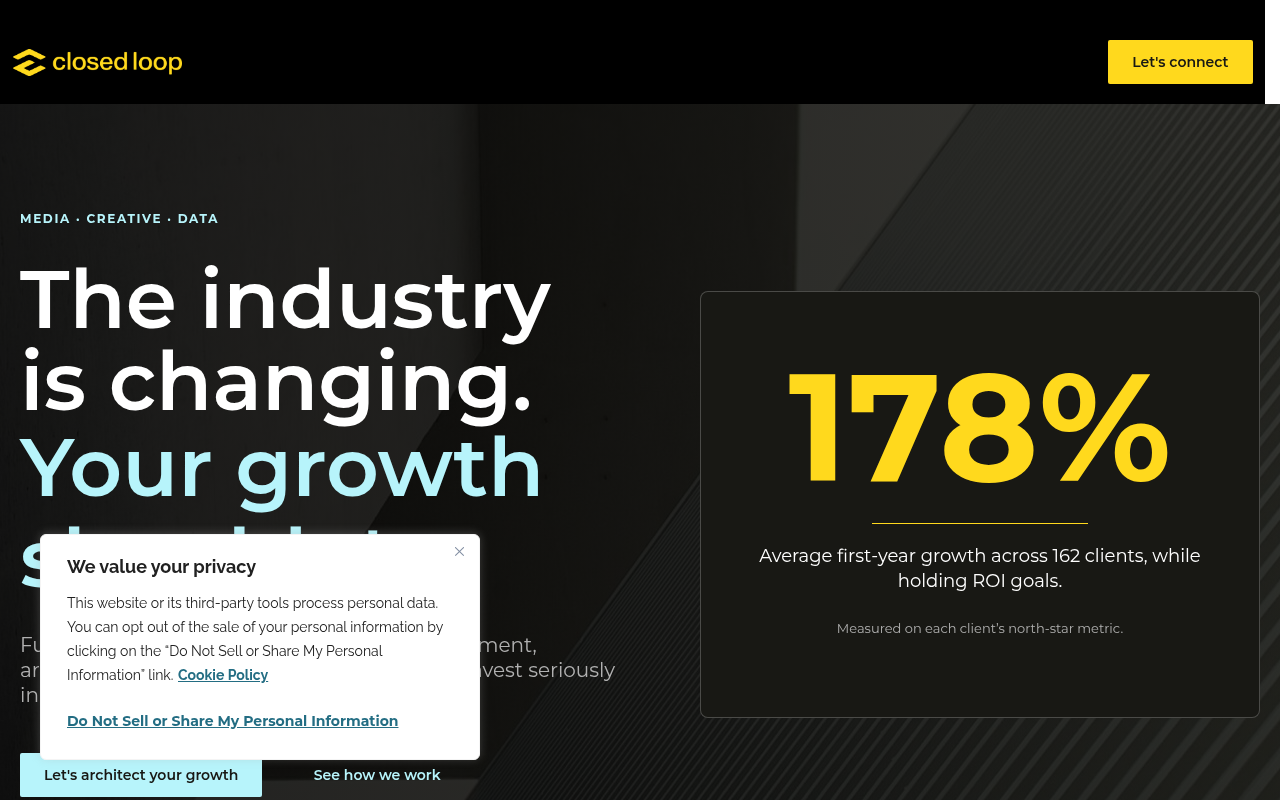
What they doClosed Loop is a full-funnel paid media agency for B2B and SaaS, founded in 2001. It is the right call for a specific version of this problem: you are spending real money on ads and getting clicks and awareness, but not pipeline. It pairs media buying with creative and data strategy, and its team averages more than a decade in paid media. It dogfoods unusually well for a paid-media shop, earning organic rankings for educational terms like conquesting and competitive targeting rather than just its brand name, which shows it can build demand and not only buy it. It has a wall of recognition, including seven straight Ad Age Best Places to Work awards and a Search Engine Land award for AI in search marketing. It does not focus on organic content, so it fits paid-led teams best.
Best forMid-market and enterprise SaaS teams spending seriously on paid media who get clicks and awareness but not pipeline, and want media, creative, and measurement in one team.
Pros
- Built for paid awareness that does not convert: media, creative, and data in one senior team.
- Team averages more than a decade in paid media.
- Dogfoods well, ranking organically for educational paid-media terms, not just its brand.
- Heavily recognised, including seven straight Ad Age Best Places to Work awards.
Cons
- Does not publish pricing.
- Centred on paid media, so it is not the pick if you want an organic, content-led engine.
What they doMatter Made is a growth agency for B2B SaaS, founded in 2016, that sells efficiency rather than volume. Its whole measure is pipeline and CAC, not impressions, which fits teams generating plenty of awareness at a cost that no longer converts. It runs performance-priced paid media paired with a sister design studio, and it names serious SaaS logos it has worked with, including Dropbox, Oracle, G2, and Loom. Its own blog earns demand on-category, ranking for terms like speed to lead and creating demand, so roughly half its organic traffic is non-branded. It does not name senior staff on the site and does not publish pricing. It is aimed at companies scaling toward 100 million dollars in ARR, so it is a fit for funded, growth-stage SaaS more than small teams.
Best forFunded, growth-stage B2B SaaS teams whose paid awareness has grown expensive and inefficient, and who want demand measured on pipeline and CAC instead of impressions.
Pros
- Measured on pipeline and CAC, not impressions, which is the right lens when awareness is costly.
- Names strong SaaS clients, including Dropbox, Oracle, G2, and Loom.
- Performance-priced paid media paired with an in-house design studio.
- Its own blog ranks on-category for demand terms, not just its brand.
Cons
- Does not publish pricing and does not name its senior team on the site.
- Aimed at companies scaling toward $100M ARR, so it is a stretch for small teams.
What they do42DM is a full-service B2B growth agency for technology companies, giving each client a dedicated integrated team across strategy, demand generation, ABM, content, SEO, and the newer area of generative engine optimization, which is getting found inside AI answers. For a team with awareness that does not convert, the draw is one partner owning the whole funnel instead of stitching vendors together. It has one of the best own-search footprints in its peer set, ranking for account based marketing agency and marketing technology agency, and it publishes an AI Visibility Benchmark report. It names clients including Payoneer, with 87 sales-qualified leads in pipeline, plus Reface and Roland Berger. The risk is breadth: it does a lot, so make sure the specific service you need is a real strength and not a line on a long list.
Best forB2B tech and SaaS teams that want one full-service partner to own strategy, demand, ABM, content, and AI search, rather than coordinating several specialist vendors.
Pros
- One integrated team across the full funnel, including AI search visibility.
- Strong own-search footprint, ranking for ABM and marketing technology terms.
- Publishes an AI Visibility Benchmark and names clients like Payoneer and Roland Berger.
- Named authors and active webinars.
Cons
- Does not publish pricing.
- Very broad service list, so check the specific service you need is a genuine strength.
What they doDiscovered Labs is an SEO and answer engine optimization agency for B2B SaaS, built by an ex-Stanford AI researcher with senior demand-gen marketers. It targets a modern version of this problem: buyers now ask AI assistants for recommendations, and if you are invisible there, awareness never reaches you. It works to win Google and AI answers at the same time, and reports on pipeline rather than rankings. It is the strongest dogfooder on this list, ranking in the top ten for the exact AI-search terms it sells, almost always through its own blog and research pages. It publishes original studies of millions of AI citations that it says HubSpot and Semrush have cited, and names clients including incident.io, Instantly, and Granola. It is newer and narrower than the full-service firms here, so it pairs best with a broader demand effort.
Best forSeries A and later B2B SaaS teams whose buyers rely on AI assistants and search, and who need to be found and cited there, reported against pipeline.
Pros
- Targets the newest conversion gap: being invisible when buyers ask AI assistants.
- The strongest dogfooder here, ranking top ten for the AI-search terms it sells.
- Publishes original AI-citation research it says HubSpot and Semrush have cited.
- Names clients including incident.io, Instantly, and Granola, and reports on pipeline.
Cons
- Does not publish pricing.
- Narrow and newer, focused on search and AI answers, so pair it with a broader demand effort.
What they doMarsden Marketing is an Atlanta B2B agency whose tagline, Marketing That Sells, is aimed squarely at awareness that does not convert. It runs demand generation, HubSpot operations, and, since a 2024 merger with Trevelino Keller, public relations as well, so content and outreach can work together. It is a HubSpot Platinum partner, which signals real inbound and CRM practice, the layer where awareness usually leaks. It names manufacturing and B2B tech clients such as COX2M, and reports results like a pipeline lift of several hundred percent. Its own search footprint is modest but genuine, and it publishes a demand generation guide and a content series. It does not publish pricing, and its own rankings now blend with the parent PR brand, so ask what sits under Marsden specifically.
Best forMid-market and enterprise B2B teams, often in manufacturing or tech, that want demand generation, HubSpot operations, and PR from one integrated partner.
Pros
- Combines demand generation, HubSpot operations, and PR after a 2024 merger.
- HubSpot Platinum partner, which points to real inbound and CRM practice.
- Names manufacturing and tech clients and reports strong pipeline results.
- Publishes a demand generation guide and ongoing content.
Cons
- Does not publish pricing.
- Since the 2024 merger its brand blends with its PR parent, so confirm what the Marsden team itself delivers.
What they doActivate Marketing Services is a pure-play demand generation shop for B2B tech, with a plain promise: pipeline for B2B tech marketers is all it does. Its pitch is aimed at this exact problem, selling higher-quality, sales-ready demand rather than raw MQL volume that looks like awareness but never converts. It runs demand strategy, content, webinars, email, and ABM, and names enterprise clients including ServiceNow, NVIDIA, and Egnyte through on-site testimonials. It brings genuine thought leadership, publishing a long-running State of Demand Gen research report and hosting quarterly marketer meet-ups. The gap is its own search footprint, which is almost entirely branded, so it does not rank for the demand generation terms it sells. It does not publish pricing. It fits established B2B tech teams that want quality over volume.
Best forEstablished B2B tech marketing teams drowning in low-quality MQLs who want higher-quality, sales-ready demand instead of more volume.
Pros
- Pure-play demand gen focused on quality and conversion, not MQL volume.
- Names enterprise clients including ServiceNow, NVIDIA, and Egnyte.
- Publishes a long-running State of Demand Gen report and runs marketer meet-ups.
- Clear, single focus on pipeline for B2B tech.
Cons
- Does not publish pricing.
- Its own search footprint is almost entirely branded, so it does not rank for the demand gen terms it sells.

What they doTwogether is a London agency that works only in B2B technology, running integrated demand, ABM, and channel or partner campaigns across global programmes. Its channel focus is a useful angle on this problem for vendors who sell through partners, where awareness often stalls because the partner layer is not activated. It built its own partner-performance tool, PartnerView, which is unusual and shows depth in that lane. Its rankings, though small, are earned on-category rather than on its brand, for terms like B2B sales enablement, and it runs a podcast that pulls in search traffic. It self-reports awards like B2B Marketing Agency of the Year, which are recognitions rather than review scores. It does not name senior staff or publish pricing, so a scoping call is needed to judge fit.
Best forEnterprise and mid-market technology vendors, especially those selling through partners, that need demand, ABM, and channel marketing joined up globally.
Pros
- Technology-only focus with real channel and partner depth, including its own PartnerView tool.
- Earns on-category search rankings, not just brand terms.
- Runs global integrated demand, ABM, and channel programmes.
- Active podcast and content presence.
Cons
- Does not publish pricing and does not name its senior team.
- Its awards are self-reported recognitions, not third-party review scores.
What they doSkalegrow is a small, integrated B2B marketing agency based in Bengaluru that works with SaaS and industrial companies worldwide. It is the lean, lower-cost option on this list, a fit for smaller teams that have some awareness but no system to convert it and cannot carry a large retainer. Despite its size it dogfoods honestly, ranking on-category through its own knowledge hub for niche terms like robotics marketing and B2B content marketing tools rather than its brand name, which is a good sign a small shop can actually do the work. It names senior staff and documents its method. The trade-offs are scale and proof: the team is tiny, its search volume is small, and it has no third-party review score, so it suits a focused engagement more than a broad, high-volume programme.
Best forSmaller B2B SaaS and industrial teams on a lean budget that have some awareness but no system to convert it, and want a hands-on, lower-cost partner.
Pros
- The lean, lower-cost option for smaller teams without a big retainer.
- Dogfoods honestly, ranking on-category for niche terms through its own knowledge hub.
- Names its senior team and documents its method.
- Works with niche B2B and manufacturing companies globally.
Cons
- Does not publish pricing and has no third-party review score.
- A very small team, so it suits a focused engagement more than a broad, high-volume programme.
Is your awareness turning into pipeline?
Get a free Content RevOps audit. We show where attention leaks before it becomes pipeline, and what a connected system would change.
Frequently asked questions
Why is our awareness not turning into pipeline?
Usually the gap is not more content or more reach. It is the system underneath: no clear path from a piece of content to a captured lead, weak nurture, a messy CRM, and handoffs between marketing and sales that drop people. Demand generation fixes that path so attention becomes booked pipeline instead of leaking.
What is the difference between demand generation and lead generation here?
Demand generation creates and shapes interest early. Lead generation captures and qualifies it once a buyer is ready. When awareness is not converting, the problem sits between the two: demand exists but nothing captures and moves it. The agencies here are chosen because they connect both rather than selling one in isolation.
How did we choose and rank these agencies?
We reviewed more than 150 agencies that work with B2B companies in this situation, then kept the ones that tie their work to pipeline. We ranked them on that, on whether they run marketing for themselves, on review proof, on transparency, and on fit. The same checks apply to our own entry, and ranking below the top is directional.