The best demand generation agencies for bootstrapped companies in 2026
Bootstrapped companies fund growth from revenue, not a raise. Every marketing dollar is one you earned, so waste hurts more. The team is usually small, the founder is often still the head of marketing, and the B2B sale still needs several people to trust you first. You need pipeline that keeps working after you pay for it, not spend that stops the day you do. Plenty of agencies chase funded startups with big retainers. Fewer fit a company paying out of cashflow. We reviewed demand generation agencies that work with bootstrapped, self-funded B2B companies and kept the ones with clear pricing, lean or fractional models, and proof they market themselves. Below, each one in plain words.

How we chose this list
We used the same checks on every agency, including our own. Here is what earns a spot and how we ordered them.
Who makes the list
Every agency runs real demand generation and markets itself. We left out lead-list sellers, appointment-setters, and ads-only shops.
How we rank them, in order
- Fit for a budget funded by revenue, not a raise
- Whether they run marketing for themselves, and it works
- Clear pricing and a lean or fractional model
- Review proof, counting how many reviews back the score
- A named team and a method you can check
What we promise on every entry
Every claim can be traced to a source. Ratings always show how many reviews they come from. Prices are shown, or marked not shown. We do not give any agency a made-up score, and we hold our own entry to the same checks. Below the top few spots, the order is a guide, not a hard ranking.
The shortlist at a glance
All 12 entries, ranked by the criteria above. Full detail in the cards below.
| # | Name | Pros | Cons | Best for | Pricing |
|---|---|---|---|---|---|
| 1 | Content RevOps |
|
| Bootstrapped and small self-funded B2B companies that want an owned, content-led system instead of a rented channel, and need it to fit cashflow rather than a big retainer. | From $2,000/mo |
| 2 | Scaled Consulting |
|
| Bootstrapped B2B founders who want strategy and delivery together, especially if they are building toward an exit or a raise. | From £2,000/mo |
| 3 | Colony Spark |
|
| Bootstrapped companies selling to manufacturers or distributors that want one team and one predictable monthly price. | $4,000/mo flat |
| 4 | theorytwenty7 |
|
| Bootstrapped B2B SaaS founders who want a full outsourced marketing team priced in clear monthly tiers. | From $4,428/mo |
| 5 | Peakflow |
|
| Bootstrapped B2B companies with some traction and higher-value deals that want one team running content, ads, and outbound together. | From $4,500/mo |
| 6 | 100Signals |
|
| Bootstrapped software development firms that want a focused, productized program with clear pricing. | From $4,500/mo |
| 7 | SalesPlaybook |
|
| Self-funded B2B software companies in German-speaking Europe that want a fractional revenue team instead of new hires. | From CHF 4,000/mo |
| 8 | Catalyst |
|
| Bootstrapped founders and solopreneurs who want AI tools with light human support at the lowest possible starting price. | From $199/mo |
| 9 | STOICA |
|
| Bootstrapped B2B tech companies whose positioning and website are holding back an otherwise strong product. | Not disclosed |
| 10 | Influential B2B |
|
| Bootstrapped technical or deep-tech consulting firms that need to explain and own a new category. | $7,500 category sprint |
| 11 | 7 Eagles |
|
| Bootstrapped SaaS companies that want to outsource the whole growth function at a lower cost than local hiring. | Not disclosed |
| 12 | The Demand Generation Team |
|
| Bootstrapped UK B2B companies that want a focused partner to join sales and marketing into one funnel. | Not disclosed |
The list

What they doContent RevOps is a content marketing and demand generation firm built for small, self-funded B2B companies. We work with bootstrapped founders, lean teams, and expert-led firms, the kind where the founder is still the head of marketing and there is no budget to hire a full department. Most of these companies already own content, a blog, a few guides, some decks, but it has no job. We give it one. We treat content as revenue infrastructure, run like a sales operation and wired into your CRM, with AI agents doing the daily work so a real marketing function is affordable at ten people. The method is the same each time. We map the buying committee and learn how you actually win deals. We build the decision-stage content a self-funded team rarely has time to make, the comparison pages, the pricing answers, the proof a careful buyer needs. We place it where your buyers look, in search and increasingly in AI answers, which matters more when you cannot outspend funded rivals on ads. Then we wire it to the CRM so every lead is caught, scored, and followed up, and we report in pipeline, not impressions. You own the system, and it keeps producing after you have paid for it.
Best forBootstrapped and small self-funded B2B companies that want an owned, content-led system instead of a rented channel, and need it to fit cashflow rather than a big retainer.
Pros
- Builds one owned system, content wired to your CRM and run by AI agents, so it keeps producing after you pay for it instead of resetting like ads. how we work ↗
- Charges a small-company rate from 2,000 dollars a month, month to month, about half the standard rate, which fits a budget funded by revenue. who we work with ↗
- Builds content to be the answer in search and in AI assistants, which matters more when you cannot outspend funded rivals on ads. our data ↗
- Ranks the firms on this list from its own study of the demand generation agency market, so the comparison rests on data, not opinion. our research ↗
- Has named small-company case studies with public numbers, like Radius cutting cost per lead from about 150 dollars to 45 and Behavior Advantage from around 500 to 10. case studies ↗
- Publishes its full method and its prices, so you can judge the work before you spend a dollar.
Cons
- Young and small, founded in 2024, so it fits building an owned, content-led engine better than running large paid-ad budgets.
- A lean senior-led team, so a company that wants a big bench of specialists on call will find it small.
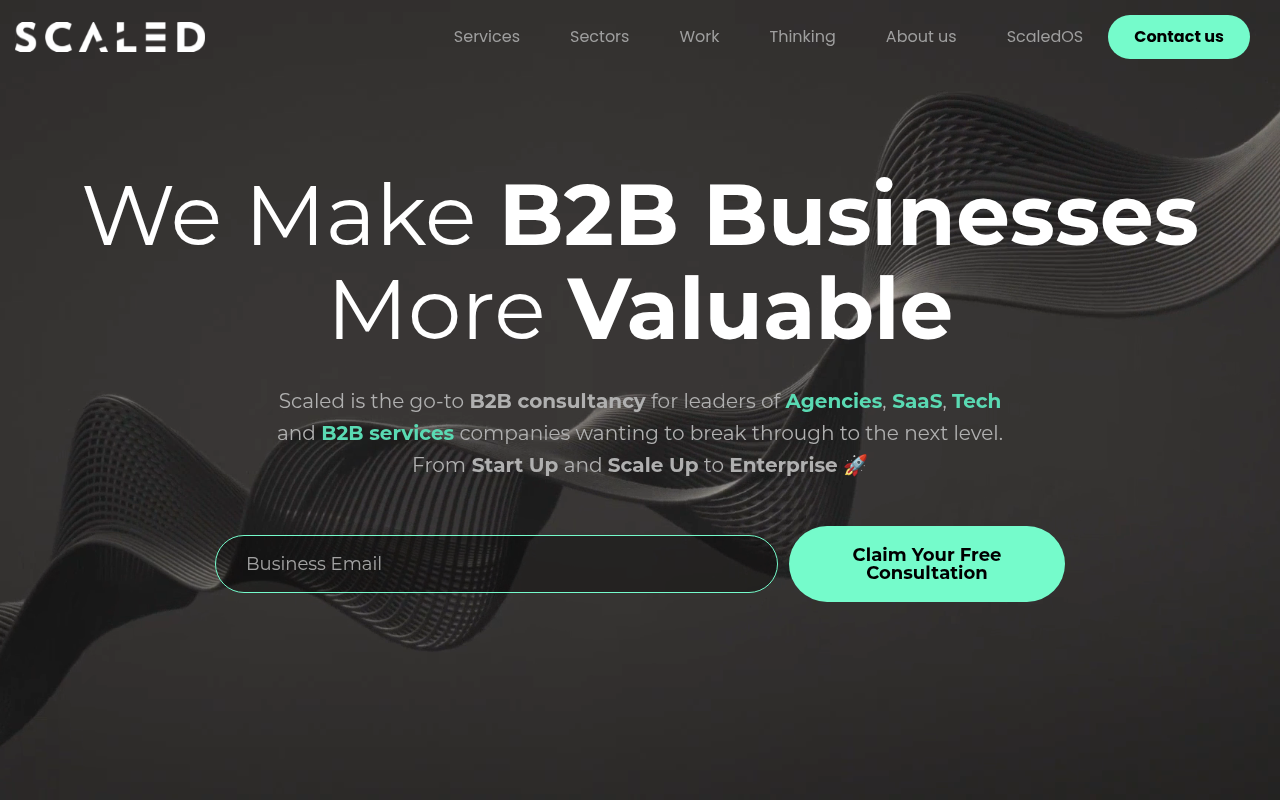
What they doScaled is a UK growth consultancy run by founders who have built and sold their own B2B businesses. The model is advice plus hands-on delivery, not a full retainer agency, so you get go-to-market and demand generation work alongside board-level and non-executive guidance. It fits bootstrapped founders who are growing toward a sale or a raise and need pipeline and operating structure at the same time. The firm practices what it sells: it ranks at the top of UK search for demand generation agency terms on its own service pages. Named clients carry real numbers, including Onelink, which grew top-line revenue 252 percent in a year and added 15 points of net margin, and Kaizen, which trebled its revenue. It also runs its own ScaledOS platform to track enterprise value.
Best forBootstrapped B2B founders who want strategy and delivery together, especially if they are building toward an exit or a raise.
Pros
- Run by founders who have exited their own B2B companies, so the advice comes from operators.
- Publishes pricing, with consulting starting around 2,000 pounds a month.
- Ranks at the top of UK search for its own category, which shows the method works on itself.
- Named clients with verifiable results, like Onelink at 252 percent revenue growth in a year.
Cons
- UK-focused, so a US company may find less local proof.
- The exit and enterprise-value angle fits owners planning a sale more than those who simply want leads.
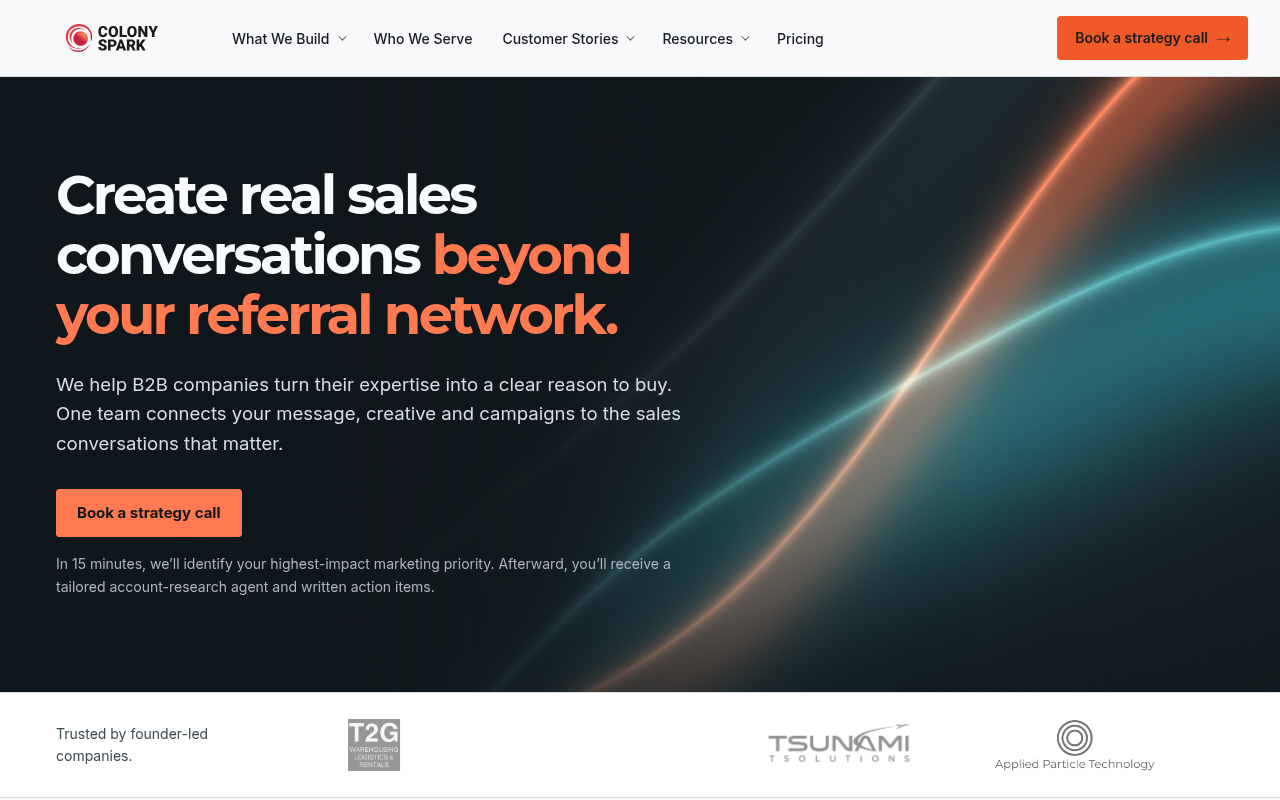
What they doColony Spark runs the full marketing system for founder-led companies that sell into manufacturing, distribution, and industrial markets, think ERP partners, managed service providers, and integrators. One team handles positioning, copy, campaigns, buyer signals, and sales enablement for a flat 4,000 dollars a month, with media spend billed separately. That single, published price is rare and makes budgeting simple for a self-funded company, which is why it ranks high here. The firm earns its own demand too: its blog ranks for terms like google ads alternative and conversion funnel marketing, not just its brand name. Named clients include Nuage, a seven-year relationship, plus Sunsoft ERP, T2G Warehousing, Applied Particle Technology, and Tsunami Tsolutions. Its Revenue Messaging Framework scores how industrial vendors talk about what they sell.
Best forBootstrapped companies selling to manufacturers or distributors that want one team and one predictable monthly price.
Pros
- One flat published price of 4,000 dollars a month, which makes budgeting simple for a self-funded team.
- Ranks for non-brand terms on its own blog, so it markets itself the way it sells.
- Named clients in industrial markets, including a seven-year relationship with Nuage.
Cons
- Built for companies selling into manufacturing and distribution, so a different market is a weaker fit.
- Media spend is billed on top of the flat fee, so the true monthly cost is higher.
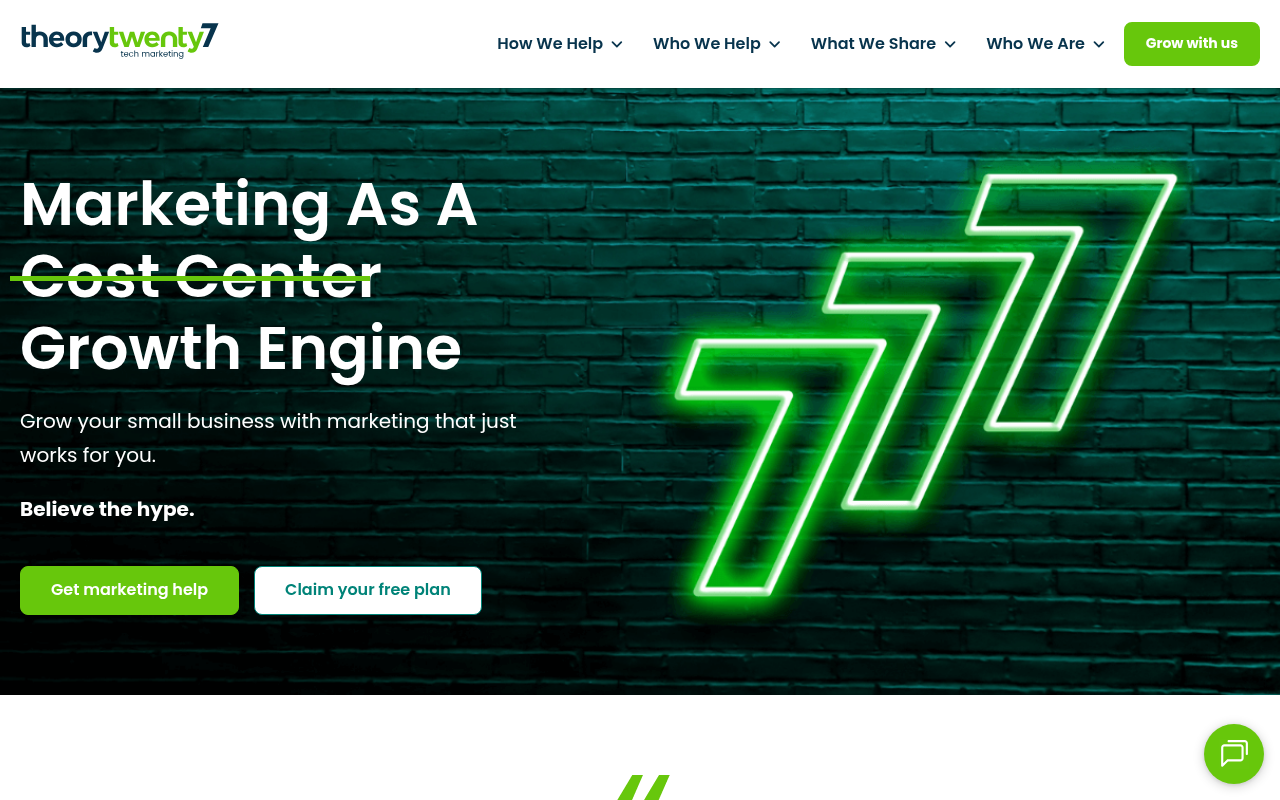
What they dotheorytwenty7 is a subscription marketing agency for B2B SaaS startups, built to act as your outsourced marketing department rather than a single fractional CMO. It organizes its work by company stage, from pre-revenue to startup to small business, so a bootstrapped founder can start where they are. Pricing is published in clear monthly tiers, starting at 4,428 dollars, with a six-month minimum. It is a HubSpot partner and publishes its own templates, blog, and a growth quiz, which is how it earns some non-brand search traffic. Named client stories carry numbers: i-nexus reached 170,000 dollars in monthly recurring revenue over four years with sustained lead growth, and Glide reached 340,000 dollars in monthly recurring revenue. Shell Energy, AQA, and Pluxee round out the client list.
Best forBootstrapped B2B SaaS founders who want a full outsourced marketing team priced in clear monthly tiers.
Pros
- Published monthly pricing and stage-based plans, so an early founder knows the cost up front.
- Focused only on B2B SaaS, with named client results in recurring revenue.
- A HubSpot partner that publishes its own templates and content.
Cons
- A six-month minimum, which is a longer commitment than some self-funded teams want.
- The lowest tier still starts above 4,000 dollars a month, so very early companies may find it steep.
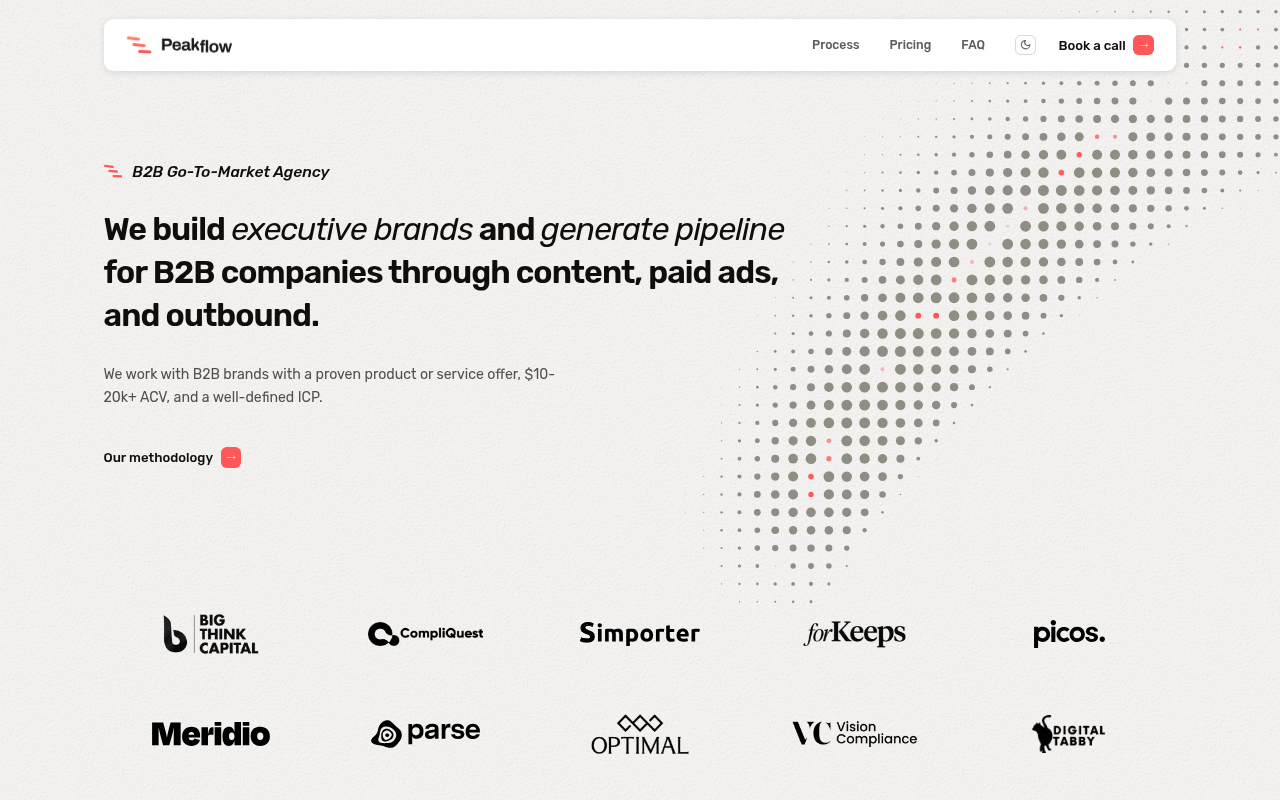
What they doPeakflow is a founder-led go-to-market agency that runs content, paid ads, and personalized outbound as one motion aimed at the same list of target accounts. It is built for founders without an in-house marketing team who want sales and marketing handled together rather than as separate projects. Pricing is published: a done-with-you fractional growth plan starts at 4,500 dollars a month, with larger done-for-you programs above that, on a six-month commitment. The firm works best with companies past about one million dollars in revenue and higher-value deals, so it suits a bootstrapped company that has found traction, not a pre-revenue one. Named clients include CompliQuest, Simporter, Big Think Capital, and Digital Tabby. Founder Antonio Cerneli positions the work around the buyer's research journey rather than cold volume.
Best forBootstrapped B2B companies with some traction and higher-value deals that want one team running content, ads, and outbound together.
Pros
- Runs content, paid, and outbound as one motion, useful when there is no in-house team.
- Publishes its pricing, starting at 4,500 dollars a month for the done-with-you plan.
- Founder-led delivery with named clients like CompliQuest and Simporter.
Cons
- Best fit is companies past about one million dollars in revenue, so pre-revenue founders are out of scope.
- A six-month commitment, which is a bigger step than a month-to-month plan.
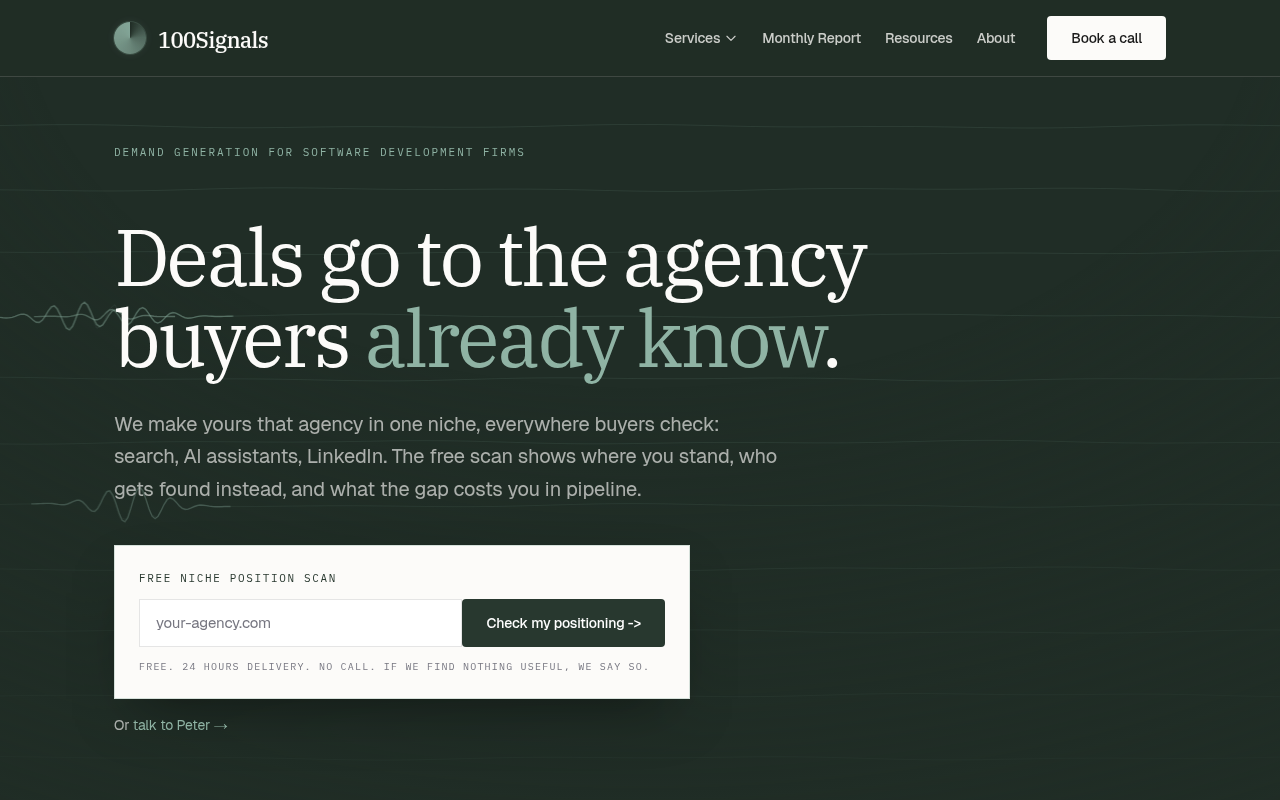
What they do100Signals is a productized demand generation agency built only for software development firms. The core is a 90-day program that combines search, AI-answer visibility, founder LinkedIn, and outbound, with one agency per niche per geography so it does not take competing clients. Pricing is published as a ladder, starting at 4,500 dollars a month for the entry tier and rising for broader programs, and the firm says you own everything it builds. It markets itself the way it sells: it ranks for on-category terms and publishes a proprietary table tracking how often agencies get cited by AI assistants, updated from its own database. Founder Peter Korpak lists a background as a former head of marketing at Brainhub. The clear gap is named proof: fifteen clients are claimed but all are under NDA, so none are shown on the site.
Best forBootstrapped software development firms that want a focused, productized program with clear pricing.
Pros
- Published pricing ladder from 4,500 dollars a month, and you own what it builds.
- Narrow focus on software firms, with one client per niche per geography.
- Markets itself with real on-category rankings and its own AI-citation research.
Cons
- No named clients: all fifteen are under NDA, so you rely on references, not public proof.
- Only fits software development firms, not B2B more broadly.
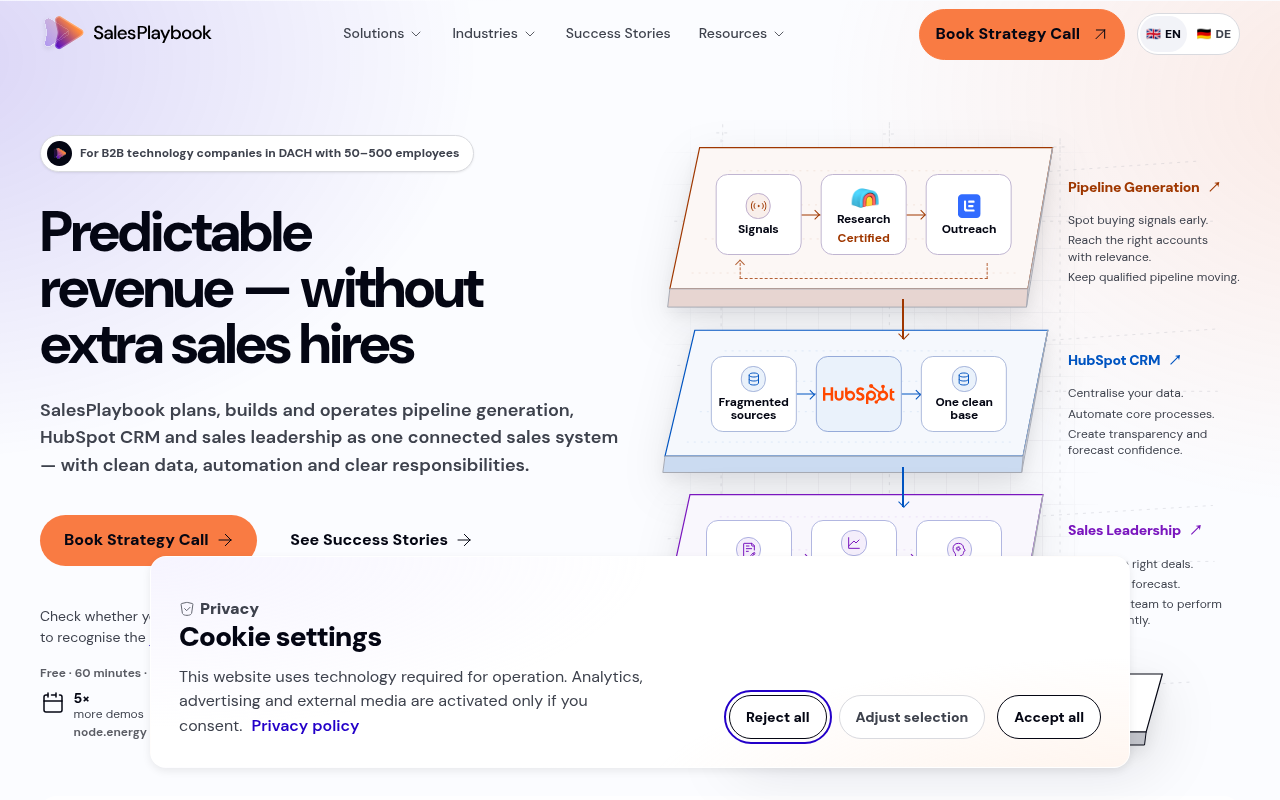
What they doSalesPlaybook builds and runs revenue systems for B2B software companies in German-speaking Europe. It works as a fractional, outsourced team across three levers: pipeline generation, HubSpot CRM, and fractional sales leadership, so you add capability without hiring. It is a verified HubSpot Diamond Partner with a live marketplace listing, which is harder proof than a star rating. Pricing is published in Swiss francs, with pipeline generation from about CHF 4,000 a month. Named clients carry outcomes: Workist saved about 200,000 euros a year, node.energy booked five times more demos, and Pleo hit 210 percent of quota, while the client list also includes Magnolia, Skribble, and the agency group Jung von Matt. Founder Manuel Hartmann wrote a book on scaling B2B buyer trust. The sweet spot is companies with 50 to 500 staff, larger than most bootstrapped firms.
Best forSelf-funded B2B software companies in German-speaking Europe that want a fractional revenue team instead of new hires.
Pros
- Verified HubSpot Diamond Partner with a live marketplace listing, which is checkable proof.
- Published pricing in Swiss francs, from about CHF 4,000 a month.
- Named clients with real outcomes, like Workist saving around 200,000 euros a year.
Cons
- Built for German-speaking Europe, so a company elsewhere is a weaker fit.
- Its sweet spot is 50 to 500 staff, bigger than most bootstrapped teams.
What they doCatalyst is a hybrid platform that pairs AI marketing tools with human support for founders, solopreneurs, and lean teams. You can start self-serve and add group guidance or one-to-one help as you grow, which keeps it affordable for a company with almost no marketing budget. Its published entry plan is 199 dollars a month, the lowest real price on this list, though the done-for-you tiers are quote-only. Named references come through testimonials from small-business leaders, including CNP Staffing, Accounting Frontier, and Predictive Success Systems, and its reviews live on the HubSpot solutions directory. The team is named, led by founder Lucas Hamon, who also runs the full-service sister agency Orange Pegs, and it builds founder support into the offer. It fits a very early, hands-on founder more than a company ready to hand marketing off.
Best forBootstrapped founders and solopreneurs who want AI tools with light human support at the lowest possible starting price.
Pros
- A published entry plan at 199 dollars a month, the most budget-friendly start on this list.
- Built for founders and lean teams, with self-serve and guided options.
- A named team and references from small-business leaders.
Cons
- Only the entry plan shows a price; the done-for-you tiers are quote-only.
- The low tier is mostly do-it-yourself, so a founder who wants it handled will pay more.
What they doSTOICA is a B2B tech agency that starts with positioning and brand strategy, then delivers the website and lead generation that carry the message. It is a good fit for a bootstrapped tech company whose product is strong but whose message and website are not doing it justice. The work spans a marketing accelerator program, conversion-focused websites, audits, and a cancel-anytime digital team subscription. The firm markets itself with a current blog, including early work on how to show up in AI search, which shows it practices the inbound it sells. Named clients include DruidAI, Wirtek, Fort, FieldOS, and RepsMate, with linked case studies and a testimonials page. It does not publish prices, so you need a call to learn the cost, which is the main friction for a founder comparing options quickly.
Best forBootstrapped B2B tech companies whose positioning and website are holding back an otherwise strong product.
Pros
- Starts with positioning, then builds the website and lead generation to match.
- Named B2B tech clients with linked case studies and a testimonials page.
- Publishes current content, including early AI-search work, so it markets itself.
Cons
- No public pricing, so you need a call to learn the cost.
- Positioning-led work takes time to show up as pipeline.
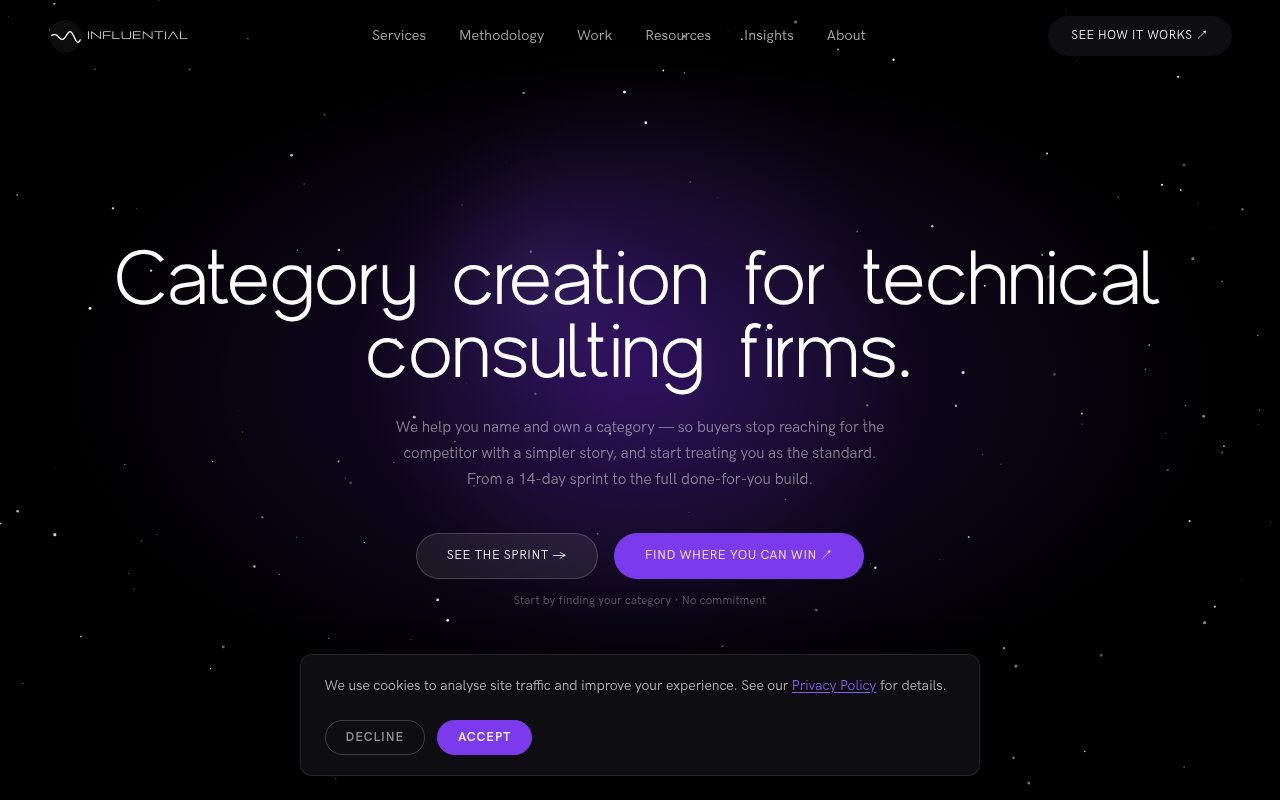
What they doInfluential B2B helps technical and deep-tech consulting firms name and own a category, so buyers stop defaulting to the competitor with the simpler story. The model is productized, not a retainer: a short diagnostic, then a fixed-price category sprint, then an optional longer build, each a defined piece of work. Pricing is published, with the sprint listed at 7,500 dollars and a 2,500 dollar diagnostic, which suits a founder who wants a clear scope and a fixed cost. It runs on its own frameworks, Demand Engineering and the Liminal Window, and names clients with quantified case studies, including AuthenTech AI, Xlera Solutions, and Systalent. The main caveat is youth: the site is new, so its own search footprint is still close to zero, and the public track record is short.
Best forBootstrapped technical or deep-tech consulting firms that need to explain and own a new category.
Pros
- Fixed-price, productized work, so a founder knows the scope and cost up front.
- Published pricing, including a 7,500 dollar category sprint and a 2,500 dollar diagnostic.
- Named clients with quantified case studies in technical markets.
Cons
- New firm with almost no search footprint of its own yet.
- Sprint pricing is a project fee, not a low monthly cost, so it is a real outlay at once.
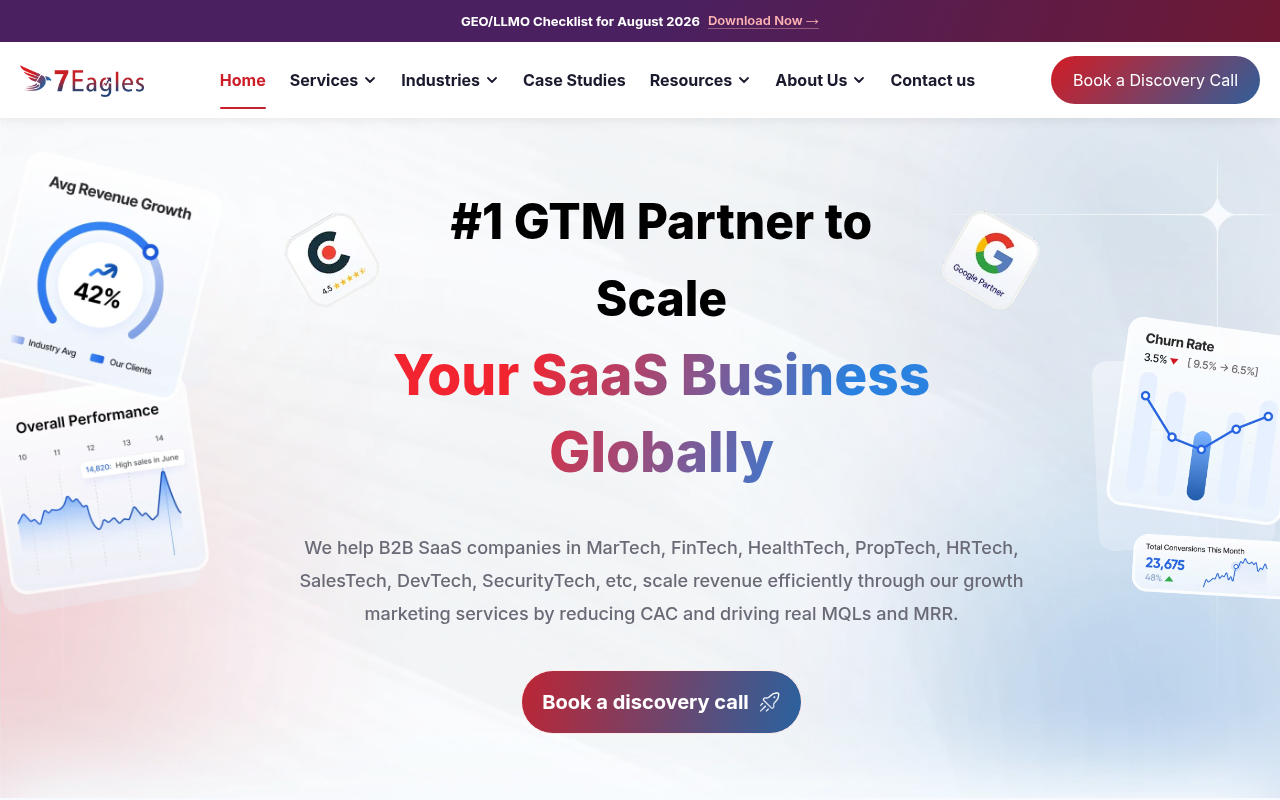
What they do7 Eagles is an outsourced growth marketing team for B2B SaaS startups and scaleups that want to hand off the whole function at a lower cost than hiring locally. It covers SaaS marketing, go-to-market, paid, SEO, demand generation, content, and automation, and frames its work around revenue rather than lead volume. The India-based team shows a large named client wall, including Amadeus, MoEngage, Sprinto, Hexaware, and Acko, with case studies for Beem and Amadeus. Two cautions matter for a careful buyer. First, the 4.9 rating on its site is self-reported, with the Clutch and Google badges shown as plain images and no link to a verified profile or review count, so treat it as unverified. Second, its own top-ranking pages are mostly generic SEO articles rather than on-category terms, so the content proof is thinner than the client wall suggests.
Best forBootstrapped SaaS companies that want to outsource the whole growth function at a lower cost than local hiring.
Pros
- Covers the full growth function, useful for a team with no in-house marketing.
- A large named client wall, including Amadeus, MoEngage, and Sprinto.
- Offshore delivery keeps the cost below a local hire.
Cons
- The 4.9 rating is self-reported, with no verified review count behind it.
- No public pricing, and its own top content ranks for generic terms, not its category.
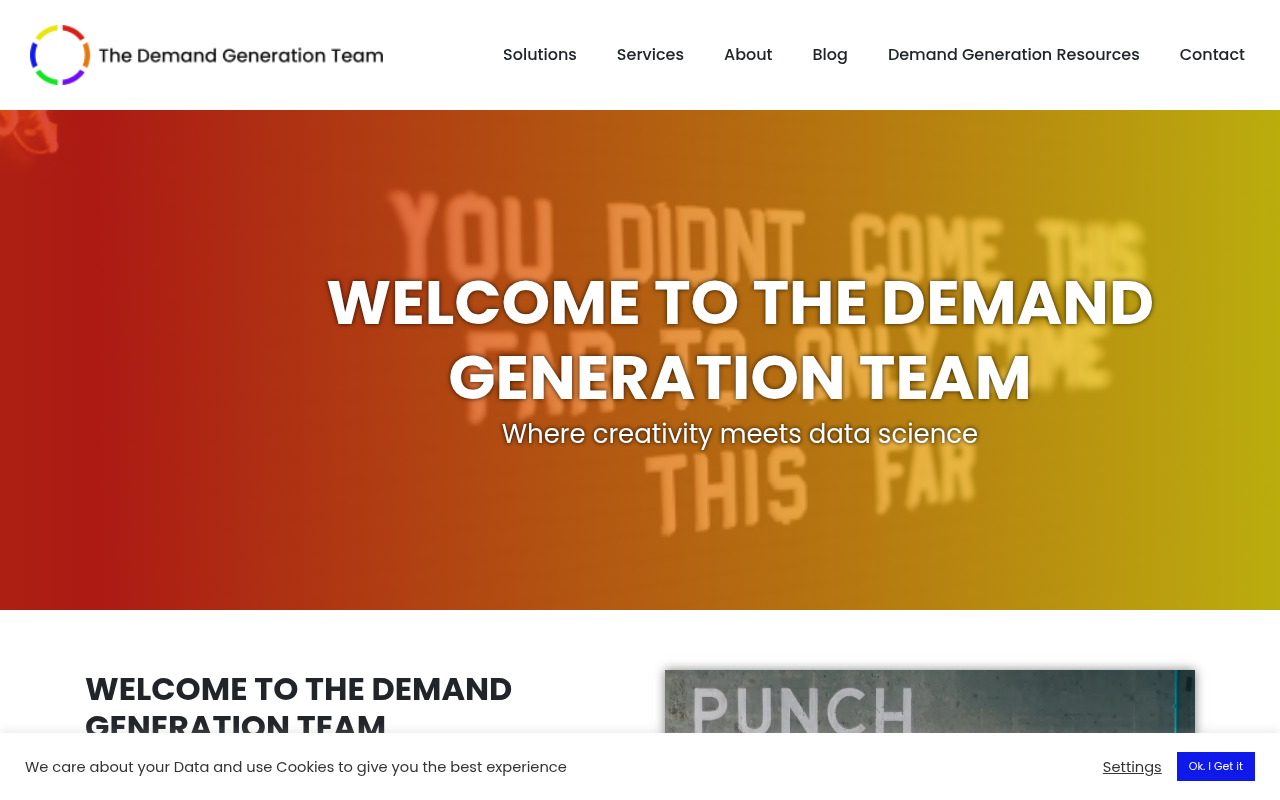
What they doThe Demand Generation Team is a small UK agency, based in Birmingham, that specializes in joining sales and marketing into a single demand funnel for B2B companies. It publishes its own method openly, including a build-your-own-demand-funnel guide and pages that walk through each funnel stage, which is genuinely useful reading for a founder figuring the work out. The services span campaigns, lead generation, content, CRM, automation, and paid search, run as a retainer or project. The honest caveat is freshness: the site looks untouched since 2021, the copyright and assets are old, and the public client proof is thin, limited to a couple of named testimonials rather than a case-study library. It can still suit a bootstrapped UK company that wants a focused, down-to-earth partner, but ask for recent work before you commit.
Best forBootstrapped UK B2B companies that want a focused partner to join sales and marketing into one funnel.
Pros
- Publishes a clear demand funnel method that is useful even before you hire.
- Focused specifically on demand generation for UK B2B companies.
- Small and down-to-earth, which can suit a self-funded team.
Cons
- The site looks untouched since 2021, so ask for recent work before committing.
- Thin public client proof, with a couple of testimonials rather than case studies.
Is your content funding growth, or just costing money?
Get a free Content RevOps audit. We show where your content leaks revenue and what a connected system would change, at a budget built for a self-funded team.
Frequently asked questions
What should a bootstrapped company look for in a demand generation agency?
Look for a model that fits cashflow, not a big fixed retainer, and work that keeps paying off after the invoice. Clear pricing, a lean or fractional team, and proof the agency markets itself matter more than a long client list. For B2B, you also want content built for buyers who research first and buy as a group.
How much do these agencies charge?
It varies. Some here publish a floor, from about 199 US dollars a month for a self-serve plan, through roughly 4,000 to 7,500 a month for most done-for-you work, up to around 15,000 a month for the largest programs. Others only quote after a call, which we mark as not disclosed. For a bootstrapped budget, the published, lower-commitment options are usually the safer place to start.
How did we choose and rank these agencies?
We reviewed agencies that serve bootstrapped and small self-funded B2B companies, then kept the ones with real proof. We ranked them on budget fit, whether they run marketing for themselves, review evidence, pricing clarity, and a named team. The same checks apply to our own entry, and below the top few the order is directional.