The best demand generation agencies for creating new-category demand in 2026
Some companies are not fighting for demand that already exists. They are trying to create it. The product opens a category the market has no name for yet, so buyers are not searching and do not know they need it. You have to teach a market to want something before you can sell it, and usually convince several people at once. Plenty of agencies say they do demand generation, but most capture demand that already exists. Creating demand is different work: a point of view, research, and a story that changes how buyers think. We reviewed more than 100 agencies that take it on and kept the ones with real proof.

How we chose this list
We used the same checks on every agency, including our own. Here is what earns a spot and how we ordered them.
Who makes the list
Every agency here runs real demand generation and has a working content presence of its own. We left out lead-list sellers, appointment-setters, and ads-only shops, because creating demand takes more than a media budget.
How we rank them, in order
- Real skill at creating demand, not just capturing search that already exists
- Whether they run the play on themselves, and it works
- Original thinking: a point of view, research, or frameworks, not just execution
- Proof, counting reviews and named client results, not logos alone
- Fit to your stage, budget, and how new your category really is
What we promise on every entry
Every claim can be traced to a source. Ratings always show how many reviews they come from. Prices are shown, or marked not shown. We do not give any agency a made-up score, and we hold our own entry to the same checks.
The shortlist at a glance
All 16 entries, ranked by the criteria above. Full detail in the cards below.
| # | Name | Pros | Cons | Best for | Pricing |
|---|---|---|---|---|---|
| 1 | Content RevOps |
|
| B2B teams opening or reframing a category, from early startups to mid-market, that need to create demand across a buying group and want one connected system instead of scattered campaigns. | $4.1-8.5k/mo |
| 2 | PitchKitchen |
|
| Growth-stage B2B founders and CEOs, roughly $5M to $75M, whose product is strong but whose story does not land with buyers, sales, or AI. | $15-45k sprint |
| 3 | The Marketing Practice |
|
| Enterprise technology brands that need brand and demand run as one coherent programme at global scale. | Not disclosed |
| 4 | Hotwire Global |
|
| Enterprise and mid-market technology companies that need to name and land a new category in the market, then turn that into demand. | Not disclosed |
| 5 | strategicabm |
|
| Mid-market and enterprise teams that want to create demand inside a defined set of named accounts through account-based marketing. | Not disclosed |
| 6 | Considered Content |
|
| B2B technology, manufacturing and professional services firms that want to out-think a crowded market with a point of view rather than outspend it. | Not disclosed |
| 7 | New Perspective |
|
| Scaling B2B technology companies in fast-moving, mission-led markets that want brand and demand handled by one experienced team. | Not disclosed |
| 8 | Alder & Co. |
|
| Climate-tech and clean-energy companies that need to build a category-defining brand and create demand in a young, mission-driven market. | Not disclosed |
| 9 | Twogether |
|
| Enterprise technology vendors running global demand, ABM and channel programmes who value hard client proof. | Not disclosed |
| 10 | DORN Group |
|
| Industrial manufacturers and distributors that need demand and channel growth for a new product or category, not just campaign delivery. | Not disclosed |
| 11 | Filament |
|
| B2B technology vendors and SaaS businesses launching products or entering new markets across ANZ and APAC. | Not disclosed |
| 12 | The Rubicon Agency |
|
| Technology companies that want demand generation backed by published points of view and deep vertical hubs. | Not disclosed |
| 13 | 42DM |
|
| B2B technology companies that want one full-service partner across strategy, demand generation, ABM, content and AI search. | Not disclosed |
| 14 | Discovered Labs |
|
| B2B SaaS teams that need to win Google and AI answers at the same time as a new category takes shape. | From €6,995/mo |
| 15 | RevvGrowth |
|
| B2B SaaS companies that want to create demand by educating their market through structured content, SEO and AI search. | Not disclosed |
| 16 | GrowthMode Marketing |
|
| HR technology vendors fighting for recall in a crowded category who want brand-led demand rather than more campaign activity. | Not disclosed |
The list
What they doContent RevOps is a content marketing and demand generation firm built for companies creating demand, not just capturing it. We work with B2B teams launching a new category, a new approach, or a product the market has no word for yet, in SaaS and in trust-led professional services. Most of these companies already own what it takes to lead a market: the founder's point of view, customer patterns, internal data, and expert knowledge. It sits unused while the market stays quiet. We turn that raw material into a system, and we give your content one job, to build and carry demand, instead of five campaigns that do not talk to each other. We map the whole buying group, because a new category has to be explained to several people before anyone signs. We build the point-of-view pieces and original research that make buyers see a problem they were ignoring, then place them where those buyers look, including AI answers, where new categories now get defined first. We wire the motion to your CRM so you see pipeline, not just traffic. Our method and our prices are published, and the model was proven on our own content before we sold it to anyone.
Best forB2B teams opening or reframing a category, from early startups to mid-market, that need to create demand across a buying group and want one connected system instead of scattered campaigns.
Pros
- Builds demand where none exists yet. It leads with a point of view and original research that make buyers see a problem, instead of only capturing search terms people already type.
- Runs the play on itself first. Its own content is a top lead source, so the method is tested in market, not sold as theory.
- Runs one connected system from first touch to closed revenue, so a new category gets explained to the whole buying group, not just one person.
- Publishes its method and its prices, places content across search and AI answers, and wires the motion to your CRM so you track pipeline, not vanity metrics. Most agencies that sell demand creation show neither the method nor the price. how we work ↗
- Has named case studies for exactly this kind of work, including rebuilding inbound demand from near zero and turning one flagship asset into a top pipeline channel, with the numbers shown. case studies ↗
Cons
- Young and small, so it fits building a demand-creation system better than pouring money into a large paid-ad budget.
- Demand creation compounds over months, so it is the wrong pick for a team that needs leads this week.

What they doPitchKitchen is a messaging-first B2B agency, and for a new category the message is often the first problem to solve. Before buyers can want something new, they have to understand it in one read. PitchKitchen rebuilds the company story into a Magnetic Messaging Framework, a 35-section document that becomes the single source of truth for the website, sales deck, and outreach. It then trains an AI Brand Twin, a custom GPT built on that framework, so every rep and every email tells the same story. Founder Greg Rosner wrote StoryCraft for Disruptors, a book on telling the story of an innovation the market does not yet understand. The 90-day sprint is a fixed fee, and the firm says plainly that it does not run your ad spend.
Best forGrowth-stage B2B founders and CEOs, roughly $5M to $75M, whose product is strong but whose story does not land with buyers, sales, or AI.
Pros
- Fixes the story before you spend on demand, which is the right order when the market has no name yet for what you sell.
- Names categories. ScaleSpark's CEO credits the work with naming a new category rather than tightening copy. testimonial ↗
- Shows named results. Trilio's CEO reports pipeline tripled and close rate doubled after the messaging rebuild. testimonial ↗
- Leaves the team with tools it keeps: a written framework and an AI Brand Twin trained on it, so the story holds after the engagement ends. AI Brand Twin ↗
- Publishes its prices: a fixed $15,000 to $45,000 for the 90-day sprint, and $3,500 to $7,500 a month for fractional CMO support. pricing ↗
Cons
- Does not run paid media or ongoing demand programmes, so you need a team or partner to carry the message to market once it is fixed.
- A small senior team, so capacity is limited and the work leans on the founder.
What they doThe Marketing Practice, which trades as tmp, is a large global B2B agency that runs brand and demand as one programme rather than two separate lanes. That matters when you are building a category, because the story and the pipeline have to say the same thing. It works with enterprise technology brands, and the client list is heavy: AWS, ServiceNow, Palo Alto Networks, Splunk, Verizon, Thomson Reuters, T-Mobile and Boeing among them. It publishes its own original research, including the Cost of Chaos Report drawn from 1,000 respondents and more than 50 B2B CMOs, and it ranks organically for terms it sells, not just its own name. It is built for big budgets and long programmes, so it is the wrong size for an early-stage launch.
Best forEnterprise technology brands that need brand and demand run as one coherent programme at global scale.
Pros
- Runs brand and demand as one programme, so the category story and the pipeline stay aligned.
- Deep enterprise proof, with published case studies for AWS, ServiceNow, Palo Alto Networks and more.
- Publishes real first-party research, including the Cost of Chaos Report from 1,000 respondents and 50-plus CMOs.
Cons
- Built for enterprise budgets and long programmes, so it is out of reach for a small or early-stage team.
- Does not publish pricing.
What they doHotwire is a global technology communications firm, and communications is where a lot of category creation actually happens. Before buyers search for a new category, someone has to name it in the press, on stage, and in analyst briefings. Hotwire does that work, then connects it to demand generation. It has run programmes for Palo Alto Networks, Salesforce, Adobe, SAP and Meta, and it publishes original research such as its Agentic Organizations and Frontier Tech reports. Its own site ranks for the sector terms it sells, like cyber security PR, which is a good sign it practises what it sells. The trade-off is that a PR-led firm measures in coverage and awareness first, so you need to hold it to pipeline, and it works at enterprise scale and price.
Best forEnterprise and mid-market technology companies that need to name and land a new category in the market, then turn that into demand.
Pros
- Strong at the communications work that names a category before buyers start searching for it.
- Large enterprise client roster, including Palo Alto Networks, Salesforce, Adobe and SAP.
- Publishes its own sector research and ranks organically for the tech-PR terms it sells.
Cons
- PR-led, so it can drift to coverage and awareness metrics unless you tie it to pipeline.
- Enterprise scale and pricing, a stretch for smaller teams, and pricing is not published.
What they dostrategicabm is a specialist account-based marketing agency, and account-based marketing is one of the clearest ways to create demand rather than wait for it. Instead of capturing people already searching, it builds interest inside named target accounts that are not looking yet. It runs a documented six-step Modern ABM Journey and has built programmes for SAP, Cloudflare and AVEVA, the last of which won Forrester's 2025 B2B Program of the Year. It backs the work with a real publishing operation: the DashDot magazine, two podcasts, and a pillar guide that ranks near the top for the category term abm agency. Because it is discipline-led, its depth is in the ABM method rather than any one industry, and it is a small senior team, so it suits companies that want that focus over a full-service shop.
Best forMid-market and enterprise teams that want to create demand inside a defined set of named accounts through account-based marketing.
Pros
- Account-based marketing builds demand inside named accounts that are not searching yet.
- Documented six-step method and award-winning programmes for SAP, Cloudflare and AVEVA.
- Runs its own magazine and podcasts and ranks near the top for the term abm agency.
Cons
- Depth is in the ABM method, not in any one industry, so vertical nuance is on you.
- Small senior team and no public pricing.
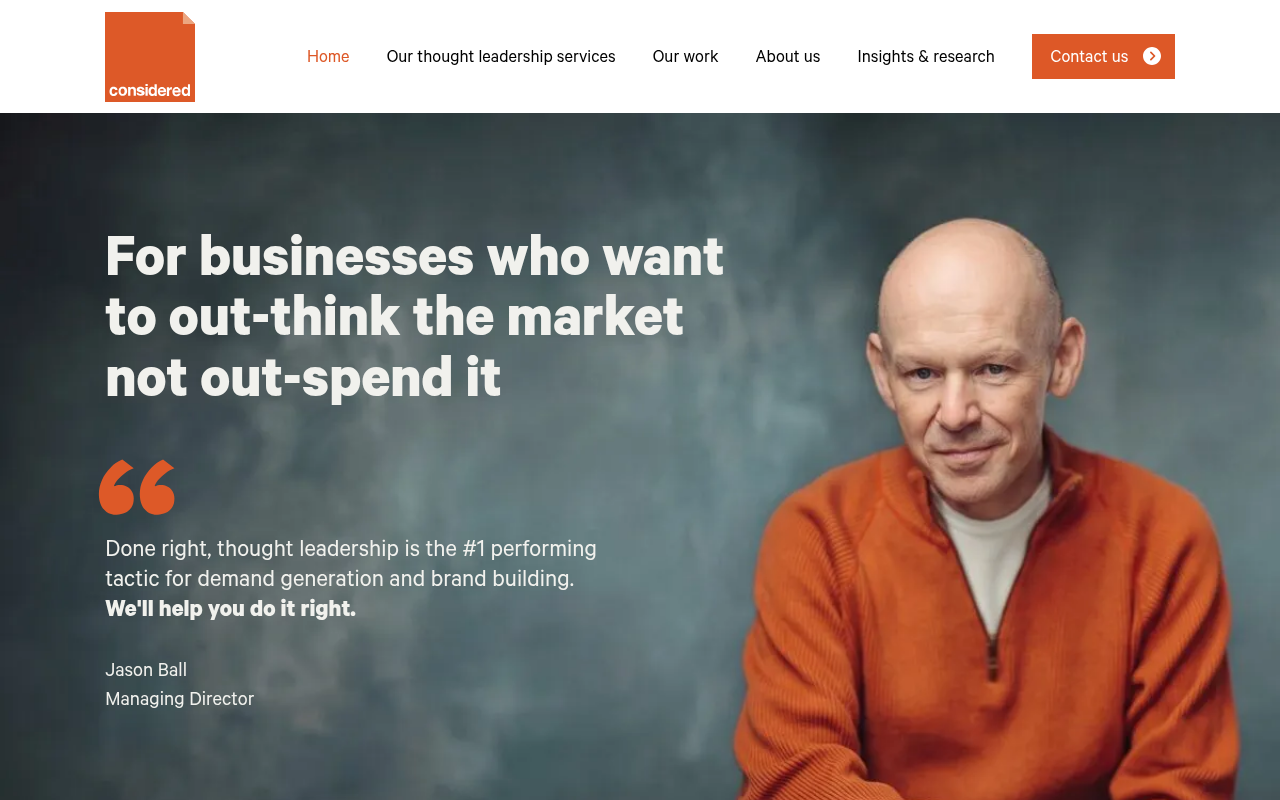
What they doConsidered Content built its whole model around one idea: thought leadership is the demand engine. It starts with a point of view, turns it into research reports and content, then amplifies it, which is exactly how you make a market care about a category it has been ignoring. The firm works with technology, manufacturing and professional services clients including Sony Professional, Munich Re, Acquia and Grant Thornton, and it practises its own pitch: its site ranks first for the term b2b content marketing agency. It is a small UK team, so it is better suited to companies that want senior thinking on a focused programme than to those needing a large, always-on production line, and its client testimonials are kept anonymous to job title and sector.
Best forB2B technology, manufacturing and professional services firms that want to out-think a crowded market with a point of view rather than outspend it.
Pros
- Uses thought leadership as the demand engine, the core skill for making a market care about a new category.
- Named work with Sony Professional, Munich Re, Acquia and Grant Thornton.
- Ranks first for its own category term, b2b content marketing agency, which is real proof it can do the job.
Cons
- Small team, so it fits a focused senior programme better than a large, always-on content line.
- Does not publish pricing, and its client testimonials are anonymised.
What they doNew Perspective is a growth marketing agency for scaling B2B technology companies, and it is one of the few here with a public review score: 4.9 out of 5 on Clutch across 10 reviews. It runs brand and demand together and leans into fast-moving, mission-led markets, with named clients in cleantech and industrial technology such as Carbon Clean, Agrify and CHASM. It practises what it sells, ranking in the top ten for manufacturing marketing agency off its own industry hub, the exact category-plus-vertical term it goes to market on. Founded in 2003, it is an established mid-sized team. The catch is that it is a broad growth agency rather than a category-design specialist, so the sharpest narrative work may need more direction from you.
Best forScaling B2B technology companies in fast-moving, mission-led markets that want brand and demand handled by one experienced team.
Pros
- One of the only agencies here with a public rating: 4.9 out of 5 on Clutch across 10 reviews.
- Runs brand and demand together, with named cleantech and industrial clients like Carbon Clean and Agrify.
- Ranks in the top ten for its own category-plus-vertical term, which shows the approach works.
Cons
- A broad growth agency, not a category-design specialist, so the sharpest narrative work may need your steer.
- Best fit is scaling companies, so a very early startup may find the engagement heavier than it needs, and pricing is not published.
What they doAlder, also known as Alder & Co., is a marketing agency for climate tech and clean energy, and it is a genuine practitioner of demand creation for a new category. Its whole business is helping companies in a young, mission-led market build a brand people believe in and then generate demand for it. It runs a Brand to Scale method that pairs brand building with growth marketing, publishes an original survey of climate-tech marketers, and runs Tofu, a peer community for people doing this exact job. That community and content approach is the work, not decoration. It is content-and-community-led rather than search-led, so its organic footprint is modest, and it is focused on one sector, so it is the right call only if you sit in or near climate and clean energy.
Best forClimate-tech and clean-energy companies that need to build a category-defining brand and create demand in a young, mission-driven market.
Pros
- A true specialist in demand creation for a nascent category, climate and clean energy.
- Pairs brand building with growth marketing through a documented Brand to Scale method.
- Publishes its own climate-marketer research and runs a peer community, Tofu, in the space.
Cons
- Focused on climate and clean energy, so it fits only if you sit in or near that sector.
- Content-and-community-led, so its own search footprint is modest, and it does not publish pricing.

What they doTwogether is a technology-only B2B agency with real depth in ABM and channel marketing, both of which are about creating demand rather than harvesting it. Channel work in particular means building demand through partners for products the end market may not know it needs yet. Its client list is all enterprise technology: Adobe, Dell, Salesforce, Hitachi, Lenovo and AVEVA, and its case studies carry hard numbers, including 128 percent over lead target for Hitachi and a 22 percent revenue lift for Lenovo. It runs the Tech Marketing Podcast and built its own partner tool, PartnerView. The trade-offs are ordinary for a firm this size: it does not name its senior team publicly, it does not publish pricing, and its own organic search footprint is small, so it wins on client proof rather than on marketing itself.
Best forEnterprise technology vendors running global demand, ABM and channel programmes who value hard client proof.
Pros
- Deep in ABM and channel marketing, both ways of creating demand rather than harvesting it.
- All-enterprise-tech roster, with hard numbers like 128 percent over lead target for Hitachi.
- Runs its own podcast and built a purpose-made partner tool, PartnerView.
Cons
- Does not name its senior team or publish pricing.
- Its own search footprint is small, so proof comes from client results rather than from marketing itself.
What they doDORN is a growth partner for B2B manufacturers and distributors that sits between an agency and a consultancy. It pairs market and channel research with hands-on execution, which suits industrial companies trying to create demand for a new product or category in a slow-moving market. It has worked with WD-40, Enerpac, Atkore, Schneider Electric and ITW, and it publishes its own NPI Benchmarking Study, real first-party research rather than repackaged data. Founded in 1976, it earns non-branded search rankings in its own sector, which most agencies in this set do not. The limits are clear: it is built for industrial manufacturing and distribution specifically, its content engine is modest next to its strong brand demand, and it does not publish pricing.
Best forIndustrial manufacturers and distributors that need demand and channel growth for a new product or category, not just campaign delivery.
Pros
- Sits between agency and consultancy, pairing market and channel research with hands-on execution.
- Named industrial clients including WD-40, Enerpac, Atkore and Schneider Electric.
- Publishes its own NPI Benchmarking Study and earns non-branded rankings in its sector.
Cons
- Built specifically for industrial manufacturing and distribution, so a poor fit outside it.
- Its content engine is modest next to its brand demand, and it does not publish pricing.

What they doFilament is a go-to-market and channel marketing agency for B2B technology, based in Australia and focused on ANZ and APAC. Its sweet spot is launches and entering new markets, which is demand creation in its rawest form: making people want a product in a place or category where nobody is asking for it yet. It also helps vendors unlock partner funding to pay for that demand, a practical detail most agencies skip. It has worked with AUCloud, GlobalSign, Veeam and FujiFilm, and its own site ranks for editorial terms like what is a tech company rather than just its brand. It is a small team and a regional specialist, so it fits companies launching in or into Asia Pacific more than a US-only programme, and it does not publish pricing.
Best forB2B technology vendors and SaaS businesses launching products or entering new markets across ANZ and APAC.
Pros
- Specialises in launches and new-market entry, demand creation in its rawest form.
- Helps vendors unlock partner funding to pay for demand, a practical detail most skip.
- Ranks for editorial terms off its own resource pages, not just its brand name.
Cons
- A small regional team focused on Asia Pacific, so less suited to a US-only programme.
- Does not publish pricing.
What they doThe Rubicon Agency is a technology-only marketing agency with deep vertical hubs for cybersecurity, SaaS, cloud, AI and engineering. It publishes its own points of view, including frameworks like the CMO investment maturity path and the 4Ms of content, which is the kind of thinking that helps define a category rather than just fill a funnel. Its client work spans large names such as Cisco, Oracle, Trend Micro and SolarWinds, with specific case studies like partner demand for database observability at SolarWinds. It ranks strongly for the tech-marketing terms it sells, though largely through self-authored top-agency lists that place it first, which works but is more promotion than research. It does not name its senior team publicly, and it does not publish pricing.
Best forTechnology companies that want demand generation backed by published points of view and deep vertical hubs.
Pros
- Publishes its own frameworks and points of view, the thinking that helps define a category.
- Deep tech vertical hubs and named work with Cisco, Oracle, Trend Micro and SolarWinds.
- Ranks strongly for the tech-marketing terms it sells.
Cons
- Ranks partly through self-authored top-agency lists that place it first, which is promotion more than research.
- Does not name its senior team, and its pricing is not published.
What they do42DM is a full-service growth agency for B2B technology companies, covering strategy, demand generation, ABM, content, and the newer work of getting found in AI answers. It publishes an original AI Visibility benchmark, which is useful because AI answers are where many new categories now get defined and won. It gives each client a dedicated integrated team and has worked with names like Payoneer and Roland Berger. It ranks organically for the exact services it sells, including account based marketing agency and GEO agency, which is a healthy sign. The honest limit is breadth: 42DM is a generalist across all of B2B tech with no single-vertical depth, so if your category sits in a specialised field you may want a specialist alongside it.
Best forB2B technology companies that want one full-service partner across strategy, demand generation, ABM, content and AI search.
Pros
- Covers the newer work of getting found in AI answers, where many new categories now get defined.
- Publishes an original AI Visibility benchmark and ranks for the services it sells.
- Gives each client a dedicated integrated team, with clients like Payoneer and Roland Berger.
Cons
- A generalist across all of B2B tech with no single-vertical depth.
- Does not publish pricing.
What they doDiscovered Labs runs search and answer engine optimisation as one engine, led by an ex-Stanford AI researcher. Its focus is winning both Google and AI answers at the same time, which matters for category creation because AI answers are increasingly where buyers first learn a new category even exists. It works only with B2B SaaS and shows its results: named case studies for incident.io, Gladia and Sova Assessment with real lifts in demos and AI visibility. It practises its own pitch better than anyone here, ranking for a dozen AI-search terms it sells and publishing AI-citation research that HubSpot and Semrush cite. It also publishes full retainer pricing on its site, which is rare here. It is young, though, and a specialist in getting found rather than in building the wider category narrative.
Best forB2B SaaS teams that need to win Google and AI answers at the same time as a new category takes shape.
Pros
- Wins AI answers, increasingly where buyers first learn a new category exists.
- Named SaaS case studies for incident.io, Gladia and Sova Assessment with real lifts.
- The strongest own-marketing proof on this list, with original AI-citation research cited by HubSpot and Semrush.
- Publishes full retainer pricing openly on its site, which almost no one else here does.
Cons
- Young, and a specialist in getting found rather than in building the wider category story.
- Works only with B2B SaaS, so a poor fit outside software.
What they doRevvGrowth is a B2B SaaS demand agency built around content, SEO, and the newer answer engine optimisation. Its argument for this list is that educating a market is how you create demand for it, and RevvGrowth builds structured SaaS content hubs rather than scattered blog posts. Every service is SaaS-scoped, and its case studies name real clients with numbers: Everstage grown from 20 to more than 400 ranking pages, Vymo credited with 21 million dollars in pipeline, Docsumo lifting conversion from under 1 percent to 2.5 percent. It ranks for the SaaS SEO and AEO terms it sells, and its founder is named with 20 years in the field. It leans toward capturing and shaping search demand more than inventing a brand-new category from nothing, and it does not publish pricing.
Best forB2B SaaS companies that want to create demand by educating their market through structured content, SEO and AI search.
Pros
- Builds structured SaaS content hubs to educate a market, a real way to create demand.
- Named case studies with numbers: Everstage, Vymo credited with 21 million dollars in pipeline, Docsumo.
- Ranks for the SaaS SEO and AEO terms it sells, and names its experienced founder.
Cons
- Leans toward capturing and shaping search demand more than inventing a brand-new category.
- Does not publish pricing.
What they doGrowthMode is a demand generation agency that works only with HR technology companies, a crowded category where standing out is the whole battle. Its Demand Gen 2.0 approach puts differentiation and brand-led demand ahead of more campaign activity, which is the right instinct when a market is noisy and buyers cannot tell vendors apart. It ranks organically for the terms it sells, off real service and resource pages rather than its brand name. The weakness is proof: the site leans on its framework and an HR Tech Outlook award but names few clients and shows few case studies, so you are trusting the method more than a track record. It is a small team in one narrow vertical, so it fits HR tech vendors and few others.
Best forHR technology vendors fighting for recall in a crowded category who want brand-led demand rather than more campaign activity.
Pros
- Puts differentiation and brand-led demand first, the right instinct in a crowded category.
- Ranks organically for the terms it sells, off real service and resource pages, not its brand name.
- A true single-vertical specialist in HR technology, with an HR Tech Outlook award.
Cons
- Names few clients and shows few case studies, so you are trusting the method more than a track record.
- A small team serving only HR tech, so a poor fit outside that category, and pricing is not published.
Are you creating demand, or just capturing the little that exists?
Get a free Content RevOps audit. We show where your content could be building a category and pipeline, and what a connected system would change.
Frequently asked questions
What does creating demand mean, and how is it different from capturing it?
Capturing demand means reaching people who are already looking, through ads on existing intent or search terms buyers already type. Creating demand means making a market want something it was not asking for, by naming a problem, taking a point of view, and publishing research and content that change how buyers think. New categories need the second kind of work, because there is little existing demand to capture.
How much do these agencies charge?
Most do not publish prices. Where a floor is public it tends to run from about 1,000 to 25,000 US dollars a month, depending on scope and team size. We mark pricing as not disclosed when an agency does not share it on its own site.
How did we choose and rank these agencies?
We reviewed more than 100 agencies that work on creating and shaping demand rather than only capturing it, then kept the ones with real proof. We ranked them on demand-creation skill, whether they run the play on themselves, original thinking, client proof, and fit. The same checks apply to our own entry.