The best demand generation agencies for financial services companies in 2026
In financial services, nobody buys alone. A decision usually needs marketing, compliance, risk and whoever holds the budget to agree, and that takes months. Those people research on their own first, so by the time they contact you they have already formed a view from your website, your case studies and whatever an AI assistant said about you. Plenty of agencies say they do this work. Most name one or two finance logos and move on. Our audit of more than 1,600 firms found 7 in 10 publish no client proof, which is the gap a good agency should close. We reviewed more than 230 agencies serving banks, lenders, insurers and asset managers, and kept the 13 with real proof. If you sell software into those institutions rather than being one, the fintech list is the closer match.

How we chose this list
We used the same checks on every agency, including our own. Here is what earns a spot and how we ordered them.
Who makes the list
Every agency runs real demand generation, names at least one financial services client on its own website, and has a working content presence of its own. We left out lead-list sellers, appointment-setters with no marketing practice, and shops whose finance claim rests on a logo wall alone.
How we rank them, in order
- Real depth in financial services, backed by named clients and published work
- Whether they run marketing for themselves, and it works
- Review proof, counting how many reviews back the score
- Whether they show prices and name their senior team
- Fit to your stage, size, and situation
What we promise on every entry
Every claim can be traced to something on the agency's own site or to a named data source. Ratings always show how many reviews they come from, and in this sector those counts are small, so treat them as a signal and not a score. Prices are shown, or marked not shown. We do not give any agency a made-up score, and we hold our own entry to the same checks. Below the top spot, the order is directional rather than an exact ranking.
The shortlist at a glance
All 13 entries, ranked by the criteria above. Full detail in the cards below.
| # | Name | Pros | Cons | Best for | Pricing |
|---|---|---|---|---|---|
| 1 | Content RevOps |
|
| Financial services teams, from a lean marketing team inside a wealth or asset manager to a mid-market lender or insurer, that face long committee-led sales and want one connected system instead of scattered campaigns. | $1-5k/mo |
| 2 | Hinge |
|
| Wealth managers, advisory firms, banks and credit unions that grow on reputation and want research to lead the marketing. | Not disclosed |
| 3 | Verndale |
|
| Banks and asset managers rebuilding a website or content platform who want the marketing layer built with it. | Not disclosed |
| 4 | FullFunnel |
|
| Wealth platforms and financial software firms whose marketing and sales teams are not joined up. | Not disclosed |
| 5 | LAIRE |
|
| Advisory firms, credit unions and mid-sized financial businesses that want to know the price before the first call. | From $5,250/mo |
| 6 | Arketi Group |
|
| Payments and banking technology firms that need press coverage and demand generation run together. | Not disclosed |
| 7 | Air Marketing |
|
| UK financial and fintech firms that need an outsourced sales team booking real meetings, not just more traffic. | Not disclosed |
| 8 | TSM Thinksmart Marketing |
|
| Global financial and technology brands that need a marketing partner inside the Asia-Pacific region. | Not disclosed |
| 9 | 7DOTS |
|
| Financial firms whose website looks fine but does not move a considered buyer from interest to a decision. | Not disclosed |
| 10 | Creative Business Company |
|
| Large finance and data brands that need positioning fixed before demand work can pay off. | $50k+ |
| 11 | Thirdflow |
|
| Insurance and financial firms that want an audience and a community built around them, not just a lead campaign. | Not disclosed |
| 12 | Earworm |
|
| Finance brands that want a senior-led video podcast run properly and cut up for every other channel. | From GBP 1,500/mo |
| 13 | Move Digital Group |
|
| Regional banks, advisers and financial firms that want a hands-on local partner rather than a national agency. | Not disclosed |
The list
What they doContent RevOps is a content marketing and demand generation firm built for financial services. We work with banks, credit unions, lenders, insurers, wealth and asset managers, and the software firms that sell into them, usually alongside a small in-house team or one marketing lead doing this on their own. Most of those firms already own plenty of content. Reports, decks, webinar recordings, adviser notes. It sits there without a job. We give it one, and run it as revenue infrastructure rather than a publishing habit. In practice that means we map who actually has to say yes, then build what that group is missing, which in this sector is almost always the decision stage: comparisons, pricing logic, the business case a champion carries into a committee, and named client proof. We place it where these buyers look, which now includes AI answers as much as search, because paid search in financial services is barely contested and organic is wide open. Then we wire the whole thing into your CRM, so you can see which content moved which deal, and which pages a committee read before it said yes. Our method is published and so is our price, which in this sector is unusual enough to be worth saying out loud.
Best forFinancial services teams, from a lean marketing team inside a wealth or asset manager to a mid-market lender or insurer, that face long committee-led sales and want one connected system instead of scattered campaigns.
Pros
- Runs one connected system, from first search to closed revenue, rather than five campaigns that do not talk to each other. how we work ↗
- Publishes original research on this exact market, an audit of more than 1,600 financial services firms plus a 500-firm benchmark. our research ↗
- Knows what the sector actually publishes. Three in five firms run a digital brochure and only about 1 in 28 run a real content system. our data ↗
- Builds the decision-stage material that 62 percent of publishing firms have none of, which is where a committee decision is won or lost. our data ↗
- Named finance proof with numbers. Banking Crowded went from about 15 inbound leads a month to 120-150, cost per lead fell from $180-220 to under $15, and content influenced $3-4M in pipeline. case study ↗
- Aims at the terms that signal a buyer. In this sector 45.8 percent of ranked keywords are just the firm's own name, and under 4 percent carry buying intent. our data ↗
- You can score yourself against the same 1,628-firm dataset before you speak to anyone, free. free tool ↗
- Publishes its prices and its method. Ten of the twelve other agencies here publish neither.
Cons
- Young and small, founded in 2024, so it fits building a content-led system better than running large paid-ad budgets.
- No public review score yet, so you are judging it on published work rather than on a rating.

What they doHinge is a full retainer agency that has worked on professional services marketing since 2002, and accounting and finance is one of its six named practice areas with a hub of its own. It suits firms that have grown on referrals and now need to be found by people who have never met them, because its starting point is research rather than campaigns. Every year it runs the High Growth Study and publishes it under named experts, then turns those findings into branding, website and demand work. The finance client list is the longest on this page: Morgan Stanley Smith Barney, Wells Fargo Advisors, Congressional Federal Credit Union, Bill.com, Cornerstone Advisors, the International Finance Corporation and Paychex, plus a set of independent wealth advisers.
Best forWealth managers, advisory firms, banks and credit unions that grow on reputation and want research to lead the marketing.
Pros
- Runs an annual original research programme, the High Growth Study, which very few agencies attempt.
- The strongest own marketing on this page. It ranks in the top three for terms like brand building and holds more than 1,500 organic keywords.
- A dedicated accounting and finance practice with 15 named clients, including two national wealth brands and a credit union.
Cons
- Does not publish prices anywhere on its site.
- Its Clutch score of 5.0 rests on only 2 reviews, so it is thin evidence either way.
- Brand and research led, so if you need paid media run at scale it is not the natural fit.

What they doVerndale is a large build shop rather than a campaign agency, which is the real distinction to understand before you brief it. Founded in 1998, it now runs about 300 people across Boston, Philadelphia, Los Angeles, Montreal and Quito, and works on the platform underneath the marketing: Sitecore, Optimizely, Salesforce and composable stacks, with Sitecore Platinum and Optimizely Premier Platinum partner status to match. It fits a firm whose real problem is an ageing site or a content platform nobody can update, not a firm that simply wants more leads next quarter. Financial services is one of ten named industry hubs, backed by published work with Acadian Asset Management and Johnson Financial Group.
Best forBanks and asset managers rebuilding a website or content platform who want the marketing layer built with it.
Pros
- Nearly thirty years old with about 300 people, so it can carry a large, multi-year programme.
- A dedicated financial services hub backed by named work with an asset manager and a bank.
- Ranks organically on non-branded technical terms, so its own content earns traffic rather than buying it.
Cons
- Does not publish prices, and enterprise platform work is expensive.
- No public review score with a review count, so you are relying on its own case studies.
- Platform and experience led, so ongoing demand generation is a smaller part of what it does.
What they doFullFunnel is an outsourced revenue team rather than a marketing agency, and that difference is the point. It supplies marketing, sales development and the systems underneath as one function, so it fits a firm where leads exist but nobody can say what happened to them, or where the handoff between marketing and sales keeps breaking. It has been running since 2015 and went fully remote in 2020. Two of its seven industry hubs are financial services and private equity, and it names the firms behind them: Stratton, Alliant, AssetMark, Adhesion Wealth, Voyant and InvestNext, with named testimonials from Adhesion Wealth and InvestiQuant. Its own guides rank first for full funnel, so the method shows up in its own numbers too.
Best forWealth platforms and financial software firms whose marketing and sales teams are not joined up.
Pros
- Joins marketing, sales development and the systems underneath, which is the usual break point in finance.
- Six named financial services clients plus two named client testimonials, on a dedicated hub.
- Ranks organically for the RevOps and demand terms it sells, so its own marketing works.
Cons
- Publishes no office address anywhere on its site, which some buyers will want.
- No published pricing and no public review score with a count.
- Fully remote and mid-sized, so it suits a working partnership more than a hands-off retainer.

What they doLAIRE is a family-founded retainer agency, started in Charlotte in 2006 by Todd and Laura Laire, with a second office in Charleston and HubSpot Diamond partner status. It runs inbound marketing, websites and HubSpot implementation, so it suits a mid-sized firm that wants one team to own the whole inbound motion rather than a specialist for each channel. What sets it apart here is that it publishes the price. Retainers start at 5,250 dollars a month, HubSpot migrations at 10,000, custom builds at 20,000, all on the site. Financial services is one of four named verticals, evidenced by LPL Financial, the planning firm Spaugh Dameron Tenny and The Dental CFO.
Best forAdvisory firms, credit unions and mid-sized financial businesses that want to know the price before the first call.
Pros
- Publishes a full price list, the most detailed of any agency here.
- Named financial services clients including LPL Financial, with a client testimonial attached.
- Twenty years in business and a HubSpot Diamond partner, so the delivery side is well proven.
Cons
- Most of its own search traffic comes from general brand-archetype articles rather than finance topics, so the content engine is not aimed where you would want it aimed.
- No public review score with a review count, only unscored testimonials.
- Regional and mid-sized, so a global programme would stretch it.

What they doArketi is a combined PR and demand shop, running from Atlanta since 2003, and the combination is why firms hire it. If your buyers judge you partly on where you have been written about, one team handling both coverage and campaigns saves a lot of translation. Financial technology is its densest client cluster, with published case studies for Fiserv, FLEETCOR, Fintwist, DefenseStorm, Xerox Mortgage Services and Cantaloupe, alongside Equifax, NCR Voyix and Wolters Kluwer. It also runs its own research: an annual CMO Signals survey of more than 110 marketing leaders including 60 sitting chief marketing officers, plus a Tech CMO Roundtable. Twenty-five named clients sit behind that, which is a deep bench for a team of this size.
Best forPayments and banking technology firms that need press coverage and demand generation run together.
Pros
- Six named financial and payments case studies, the most specific finance proof on this page.
- Runs its own annual research survey of marketing leaders rather than only publishing opinion.
- Joins PR and demand generation, which suits a category where third-party credibility matters.
Cons
- Sells demand generation but ranks organically for almost nothing it sells, so its own inbound is weak.
- Its Clutch score of 4.8 rests on only 2 reviews.
- Does not publish prices or a founding year on its own site.

What they doAir Marketing sells people, not plans. It is an outsourced sales team you rent: telemarketers, callers, appointment setters and inbound handlers working your list from Exeter, running since 2016. That makes it the right call when the pipeline problem is conversations rather than awareness, and the wrong one if you want an owned content engine built. Its team page is the fullest on this page, naming more than twenty people with titles, from founder Owen Richards down. Financial services shows up through Funding Circle, the small business lender, and sixteen published case studies carry real numbers, including 28 million pounds of pipeline in six months for Johnson Controls and 500,000 pounds of revenue in six months for Colossyan.
Best forUK financial and fintech firms that need an outsourced sales team booking real meetings, not just more traffic.
Pros
- Names its full senior team with titles, which is rare on this list.
- Sixteen published case studies with real numbers rather than a logo wall.
- Ranks in the top three organically for the outsourced telesales terms it sells, so its own marketing works.
Cons
- Does not publish prices.
- Sells outbound sales more than content, so it is a weaker fit if you want an owned content engine built.
- UK-centred, so less useful if your buyers are mostly in North America.
What they doTSM is a small integrated agency, founded in Sydney in 2014, that runs brand and demand together for enterprise clients across Asia-Pacific. Its real value is regional: if you sell into Australia, New Zealand or Singapore and keep briefing an agency in another time zone, this is a local team that already knows the market. Its financial services work is unusually specific for its size, with named projects for Iress, Cuscal Payments, Identitii, the Australian Financial Crimes Exchange, Nikko Asset Management and State Street. It also publishes a free Brand Relevance Score tool, and the wider client wall runs to Adobe, Dell, AWS, KPMG and Deloitte. For a team this small, that is an unusual amount of enterprise trust.
Best forGlobal financial and technology brands that need a marketing partner inside the Asia-Pacific region.
Pros
- Names real financial services clients, including a custody bank, an asset manager and two payments firms.
- Runs its own data asset, a free Brand Relevance Score tool.
- One of the few agencies here with genuine Asia-Pacific coverage.
Cons
- Small team, so capacity is limited compared with the larger agencies here.
- Only its founder is named publicly, so you cannot see who else would run your account.
- Does not publish prices.
What they do7DOTS is a project shop working on the experience layer, so it takes on strategy, design and the website itself rather than a monthly campaign retainer. It frames the work around what it calls the Confidence Gap, the point where a considered buyer stops moving, which makes it a good fit if your traffic is fine and your enquiry rate is not. It runs a dedicated financial services page and names the work behind it, including Miller Insurance and the corporate finance advisory firm Clearwater International. Its chief executive Sam Page and several senior people are named publicly, and it built a free cookie compliance checker that pulls in search traffic on its own.
Best forFinancial firms whose website looks fine but does not move a considered buyer from interest to a decision.
Pros
- A dedicated financial services page backed by named client work, not just a logo.
- Names its chief executive and senior people publicly.
- Built a free compliance tool that ranks on its own, which shows it can make assets that attract buyers.
Cons
- Does not publish prices, a founding year or team size, so it is hard to size up before a call.
- Strongest on website and experience work, so you may still need a separate partner for ongoing demand generation.
- Its search footprint is small, so most of its own visibility comes from referral and reputation.

What they doCreative Business Company is a brand and positioning consultancy, not a delivery agency, and its published 50,000 dollar minimum project size tells you where it sits. You hire it when the problem is that nobody can say what you are for, and campaigns keep underperforming as a result. Its finance work is with data and research brands: Morningstar and PitchBook are both named on the site with quotes from senior people there, including PitchBook's chief marketing officer. It names its whole leadership team under founder Faisal Siddiqui, and its Schneider Electric case study reports a 232 percent rise in marketing qualified leads and 22 million dollars of revenue won in under six months. A newsletter and knowledge hub sit behind all of it.
Best forLarge finance and data brands that need positioning fixed before demand work can pay off.
Pros
- Named senior finance clients with quotes from real people, including Morningstar and PitchBook.
- Names its whole leadership team, with roles.
- Publishes case studies with specific commercial numbers rather than adjectives.
Cons
- A 50,000 dollar minimum project size puts it out of reach for smaller teams.
- Brand and strategy led, so it is a weaker fit if you need a running demand engine rather than a repositioning.
- Publishes a lot but earns almost no search traffic from it, so its own content is not yet a demand channel.

What they doThirdflow is a media-first agency, which in practice means it builds you an audience, a community and events rather than running lead campaigns into a form. That suits a firm selling something new or complicated where buyers need to hear from peers before they will hear from you. Insurance is its deepest lane by a distance: named work with Marsh, the world's largest insurance broker, and with WTW, plus Insurtech Insights, which it reports drew 13,000 attendees, and the Open and Embedded Insurance Observatory. On the payments side it names Vitesse and reports 30 enterprise opportunities. Both founders, Lucas Salvatore and Kyryl Tokolov, are named on the homepage, and the testimonial wall reaches Generali and Google.
Best forInsurance and financial firms that want an audience and a community built around them, not just a lead campaign.
Pros
- The strongest named insurance and insurtech client list on this page.
- Both founders are named, so you know who you are hiring.
- Builds owned audiences and events, which fits a market where trust is earned slowly.
Cons
- Very small team, so it suits focused programmes rather than broad, multi-market delivery.
- Does not publish prices or a founding year.
- Almost no search footprint of its own, so there is no evidence it can win organic search for you.
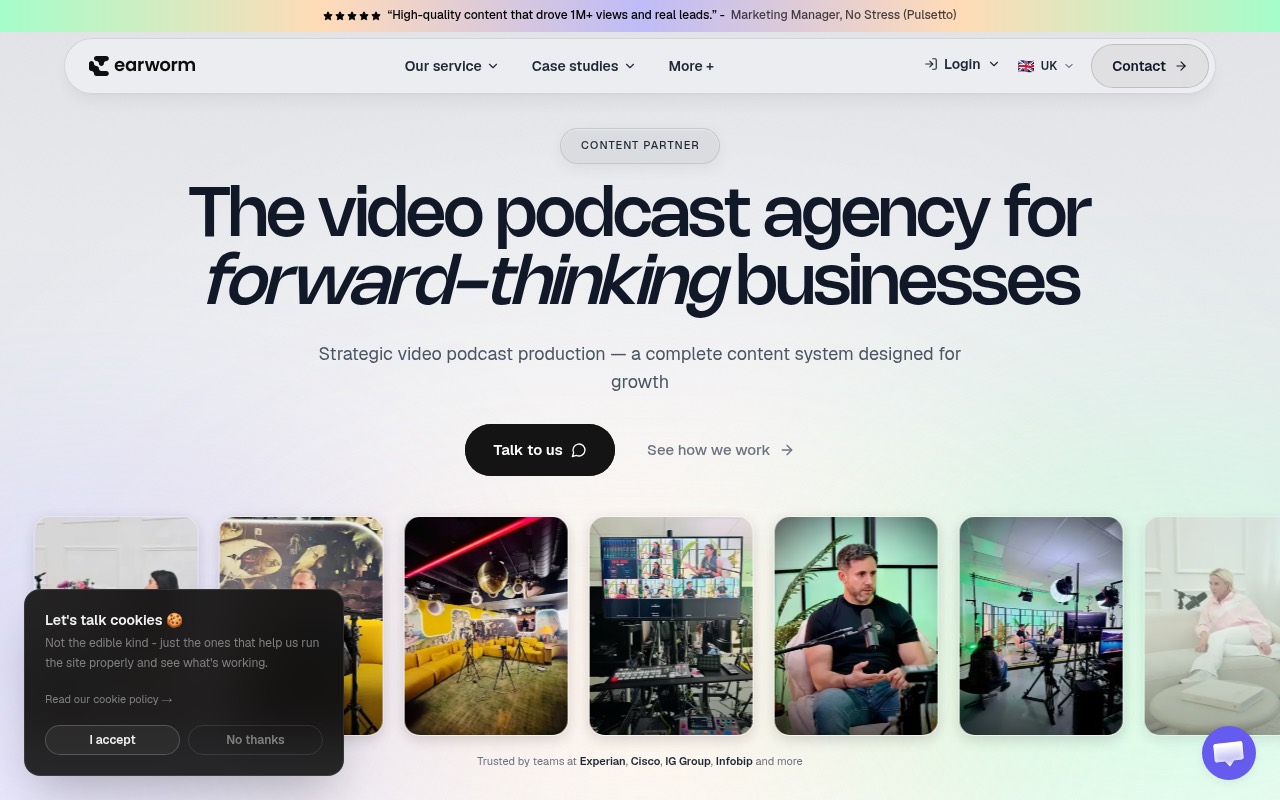
What they doEarworm is a format specialist, and that is the honest way to read it. It does fully managed B2B video podcasts and nothing else: format design, filming at partner studios, clips, distribution and reporting, run out of Bristol by founder Ben Farley. Hire it when you have a credible executive and no way to get them in front of the market repeatedly, not when you need a pipeline built. Its finance work is named and published, including The CFO Playbook for the spend management fintech Soldo, plus IG Group, Experian and the law firm Collyer Bristow. Its plans start at 1,500 pounds a month, and it publishes the wider UK market range next to that figure.
Best forFinance brands that want a senior-led video podcast run properly and cut up for every other channel.
Pros
- Publishes a real starting price and the market range around it, which almost nobody else here does.
- Named finance clients with published shows, including Soldo and IG Group.
- Ranks organically for the podcast production terms it sells, so its own marketing works.
Cons
- It is a format specialist, not a demand generation agency, so it covers one channel rather than a pipeline.
- Only the founder is named, so the wider team is not visible.
- Small and UK-based, so global or multi-language programmes are a stretch.
What they doMove Digital Group is a small regional retainer agency, running from Huntsville, Alabama since 2013 around a documented process it calls the Move Method. It is the closest thing on this page to a local partner you can actually get on the phone, which matters more than it sounds if you are a community bank or a two-adviser practice. It runs five dedicated industry pages, one of them financial services, each with a matching case study, and the financial one reports more than 100 new leads from a webinar programme. Its whole team is named with roles under president Laurie Heard, and it publishes a free marketing budget calculator so you can size the spend before you call anyone.
Best forRegional banks, advisers and financial firms that want a hands-on local partner rather than a national agency.
Pros
- Runs a real financial services page with a matching case study, not just a claim.
- Names its whole team, including its president and finance lead.
- Publishes a free budget calculator, a genuine self-serve tool for buyers.
Cons
- Its financial services case study does not name the client, so you cannot verify the work.
- Most of its own search traffic comes from old social media how-to posts rather than the services it sells.
- Small regional agency, so it is a weaker fit for national or multi-market programmes.
Is your financial services content bringing in pipeline?
Get a free Content RevOps audit. We show where your content leaks revenue and what a connected system would change, benchmarked against our 2026 financial services data.
Frequently asked questions
What does a demand generation agency do for a financial services firm?
It helps the right buyers find you and trust you before they talk to sales. In financial services that means content that survives compliance review, answers the questions a committee asks, carries real proof of past work, and shows up in search and in AI answers, then ties back to your pipeline.
How much do financial services marketing agencies charge?
Most do not publish prices. Of the 13 agencies here, only three publish a real figure, and those start between about 1,500 and 5,250 a month. Larger firms quote per project, sometimes from 50,000 dollars up. We mark pricing as not disclosed when an agency does not share it.
Why does content matter so much in financial services?
Because trust is the product and the buyer does most of their research alone. Our 2026 analysis of more than 1,600 financial firms found that 3 in 5 run a digital brochure, only about 1 in 28 run a real content system, 7 in 10 publish no client proof of any kind, and the median firm draws around 214 organic visits a month. AI answers in the sector are dominated by five household names, so the ground is wide open for everyone else.
How did we choose and rank these agencies?
We reviewed more than 230 agencies that serve financial services, then kept the ones with real proof. We ranked them on depth in the sector, whether they run marketing for themselves, review evidence, transparency, and fit. The same checks apply to our own entry.