The best demand generation agencies for growth leads in 2026
A growth lead owns one number: pipeline that becomes revenue. You answer for it across the whole funnel, not a single channel, usually with a small team and a budget that has to show a return. Your buyers research on their own for months, often as a group, before they talk to sales, so demand has to be built before the form fill, and it has to be measurable. Many agencies say they drive growth. Most run one channel, name a few logos, and report clicks. We reviewed more than 120 demand generation agencies that serve growth and revenue teams, and kept the ones with real proof. Below we explain each one in plain words.

How we chose this list
We used the same checks on every agency, including our own. Here is what earns a spot and how we ordered them.
Who makes the list
Every agency runs real demand generation and markets itself with its own content. We left out lead-list sellers, appointment-setters, and pure ad shops with no footprint of their own.
How we rank them, in order
- How well they fit a growth lead who owns the full-funnel number
- Whether they run marketing for themselves, and it works
- Review proof, counting how many reviews back the score
- Whether they show prices and name their team
- Fit to your stage, size, and situation
What we promise on every entry
Every claim can be traced to a source. Ratings always show how many reviews they come from. Prices are shown, or marked not shown. We do not give any agency a made-up score, and we hold our own entry to the same checks.
The shortlist at a glance
All 15 entries, ranked by the criteria above. Full detail in the cards below.
| # | Name | Pros | Cons | Best for | Pricing |
|---|---|---|---|---|---|
| 1 | Content RevOps |
|
| Growth leads at B2B software and services companies who own a full-funnel pipeline number, often with a lean team and long sales cycles, and want one connected system instead of scattered campaigns. | $4.1k-8.5k/mo |
| 2 | Directive |
|
| Funded mid-market and enterprise growth teams that want full-funnel performance tied to revenue. | Not disclosed |
| 3 | Gripped |
|
| SaaS and tech growth leads who want a focused outsourced team with clear, published pricing. | From £3,500/mo |
| 4 | New Perspective |
|
| Growth leads at industrial, manufacturing, and SaaS companies who need marketing tied to revenue. | Not disclosed |
| 5 | Walker Sands |
|
| Funded mid-market and enterprise growth leads who want brand, demand, and RevOps in one place. | Not disclosed |
| 6 | 42 Agency |
|
| Growth leads at scaling B2B SaaS who want demand gen and RevOps run as one revenue engine. | Not disclosed |
| 7 | Matter Made |
|
| Growth leads at scaling SaaS companies focused on lower CAC and faster ARR. | Not disclosed |
| 8 | WITHIN |
|
| Growth leads who want brand and performance run as one compounding system. | Not disclosed |
| 9 | Level Agency |
|
| Growth leads who value disciplined experimentation for long, high-consideration sales cycles. | Not disclosed |
| 10 | Closed Loop |
|
| Growth leads who run meaningful paid budgets and want senior media and creative in one team. | Not disclosed |
| 11 | Omni Lab |
|
| SaaS growth leads who want transparent, spend-based pricing and pipeline-tied reporting. | From $4,800/mo |
| 12 | Inverta |
|
| Growth leads who want strategy, ABM, and martech fixed, not just more leads. | Not disclosed |
| 13 | farsiight |
|
| Growth leads who want award-level performance work backed by deep review proof. | Not disclosed |
| 14 | RevvGrowth |
|
| SaaS growth leads at earlier-stage companies who want a focused, content-led engine. | Not disclosed |
| 15 | Avid Demand |
|
| Growth leads who want a low-risk, measurable first engagement with a long-tenured team. | Not disclosed |
The list
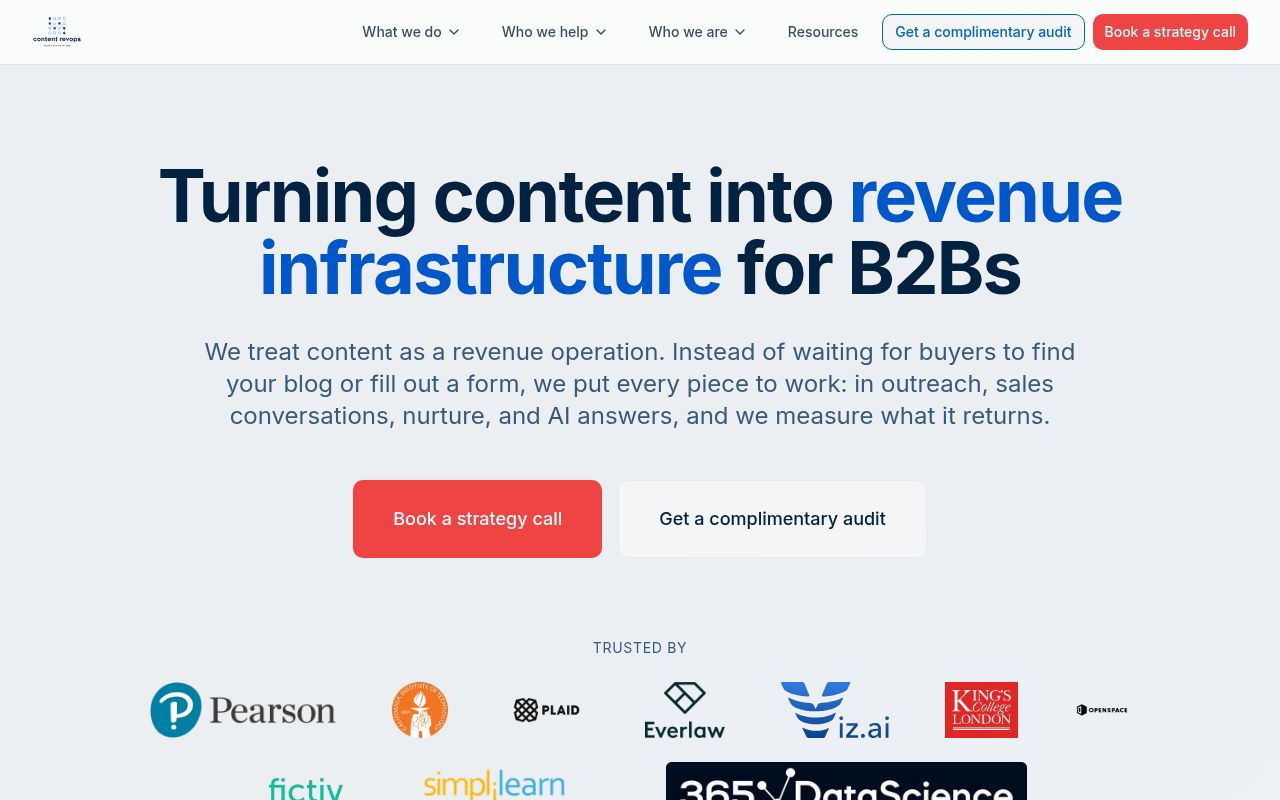
What they doContent RevOps is a content marketing and demand generation firm built for growth leads who own the pipeline number across the whole funnel. We work with B2B software, data, and services companies, from lean teams where one person owns growth to scale-ups with a small marketing bench, especially those with long, committee-led sales. Most growth leads already have content and some demand. The problem is that the content has no job. It was made to publish, not to produce pipeline, so it sits in a blog while paid spend carries the number and CAC climbs. We give that content a job. We treat it as revenue infrastructure, not a campaign calendar. We map the buying committee, then build the decision-stage and middle-funnel material the company never made, the comparison pages, proof, and answers that move a deal. We place it where buyers look now, including AI answers, not just Google. We wire it to the CRM so leads are captured, scored, and nurtured, and so you can see which content creates pipeline. The result compounds, so demand keeps coming when you stop paying for it. Our method and our prices are published, from a consulting tier to a done-for-you system.
Best forGrowth leads at B2B software and services companies who own a full-funnel pipeline number, often with a lean team and long sales cycles, and want one connected system instead of scattered campaigns.
Pros
- Runs your content as one connected system, from the first search a buyer makes to closed revenue, instead of separate campaigns that do not add up. how we work ↗
- Wires content to the CRM so you can see which pieces create pipeline, and the demand compounds, which lowers CAC over time.
- Backs the method with original research across about 14,000 B2B websites, which found most companies publish content but never build the decision layer that converts. our research ↗
- Builds for AI answers and organic search, where most B2B companies are still absent, so you get found as buyers move to AI tools.
- Has named case studies for growth and revenue teams, with results like lead costs falling to about 10 dollars and content becoming a top pipeline source. case studies ↗
Cons
- Young and small. Founded in 2024 with a lean team, so it is built to build and run a content-led system, not to manage very large paid-ad budgets.
- Newer than the decades-old firms here, so it has fewer years of track record, even though the case-study results are strong.
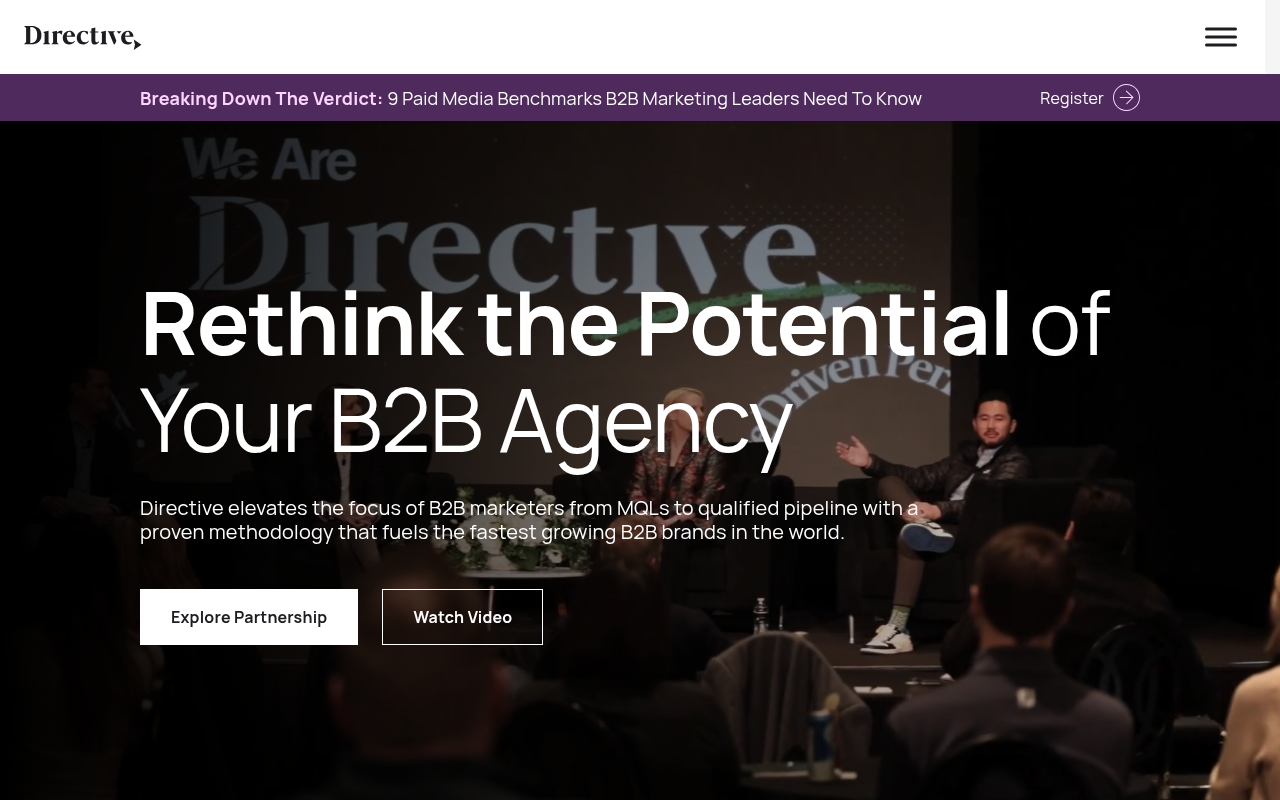
What they doDirective is a performance agency that works on retainer and sells one idea: move marketing from MQLs to qualified pipeline. For a growth lead that is the right altitude, because Directive plans across the full buying journey instead of optimizing one channel on its own. It runs paid media, SEO, and creative under a named method it calls Customer Generation, and reports on revenue rather than clicks. The firm says it has served more than 420 B2B brands and influenced over 1 billion dollars in revenue, and it markets itself well, with a large library of marketing glossary and how-to content that ranks strongly. It is a bigger, pricier shop, so it fits funded teams that can feed a full program, less so a solo operator on a tight budget.
Best forFunded mid-market and enterprise growth teams that want full-funnel performance tied to revenue.
Pros
- Plans across the full funnel and reports on pipeline and revenue, not vanity metrics.
- Strong, high-rated proof: 4.8 on Clutch from 56 reviews.
- Markets itself well, ranking strongly off a large glossary and how-to content library.
Cons
- Does not publish pricing, and it is a higher-cost agency better suited to funded teams.
- Much of its ranking traffic is broad glossary content rather than buying-intent terms.
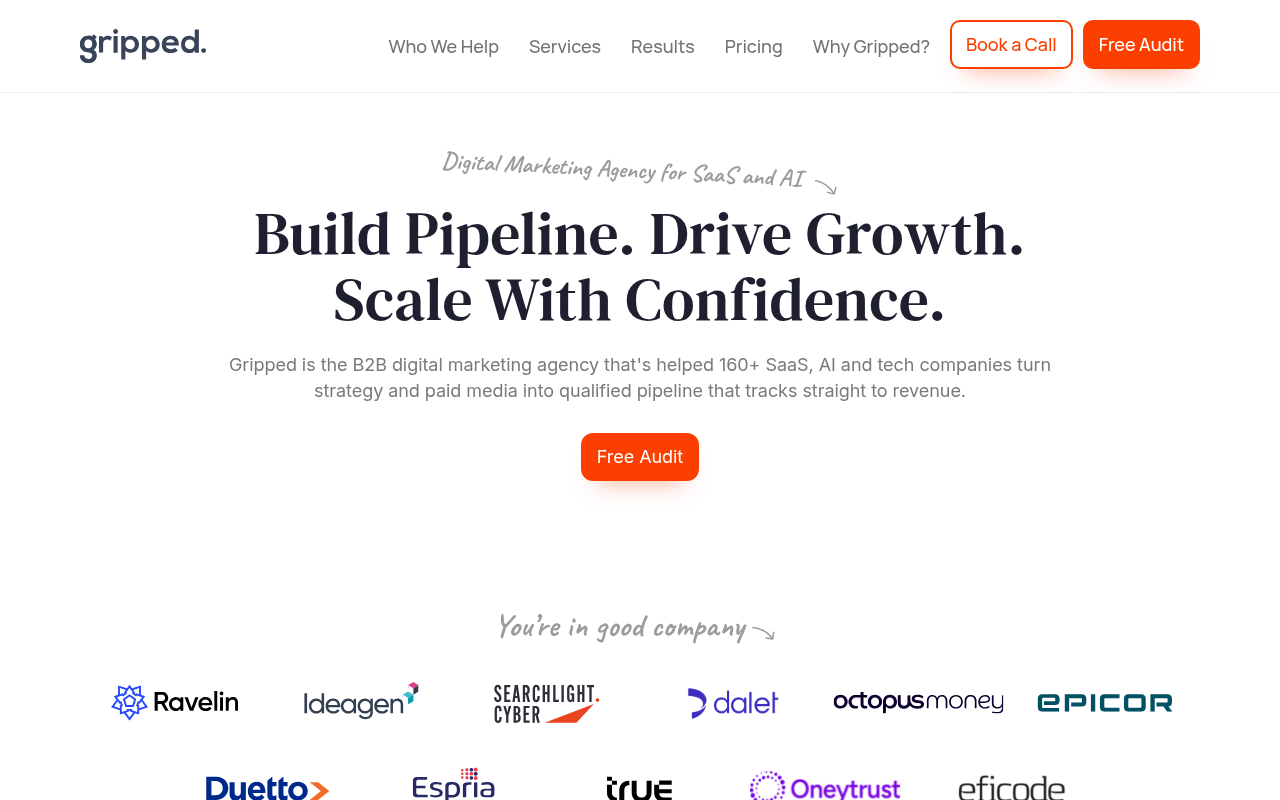
What they doGripped is a UK agency that works only with SaaS and tech companies, and it runs as your outsourced marketing team on a monthly retainer. For a growth lead, the appeal is focus and clarity. Gripped ties every plan to pipeline and revenue, not vanity metrics, and it is one of the few agencies here that publishes its prices, with tiers from advisory up to a full demand generation engine. It says it has helped more than 160 SaaS, AI, and tech firms, running paid media, SEO, and content in 30-day sprints against 90-day goals. Named clients include Ideagen, Epicor, and Searchlight Cyber. It is a smaller team and UK based, so time zones and scale can matter for large US programs.
Best forSaaS and tech growth leads who want a focused outsourced team with clear, published pricing.
Pros
- Publishes clear, tiered pricing, which most agencies here do not.
- SaaS and tech only, and ties every plan to pipeline and revenue.
- Strong proof: 4.9 on Clutch from 32 reviews, with no red flags found.
Cons
- Smaller UK-based team, so large US programs may hit time-zone and scale limits.
- Paid media budgets sit on top of the retainer, so total spend runs higher than the headline.
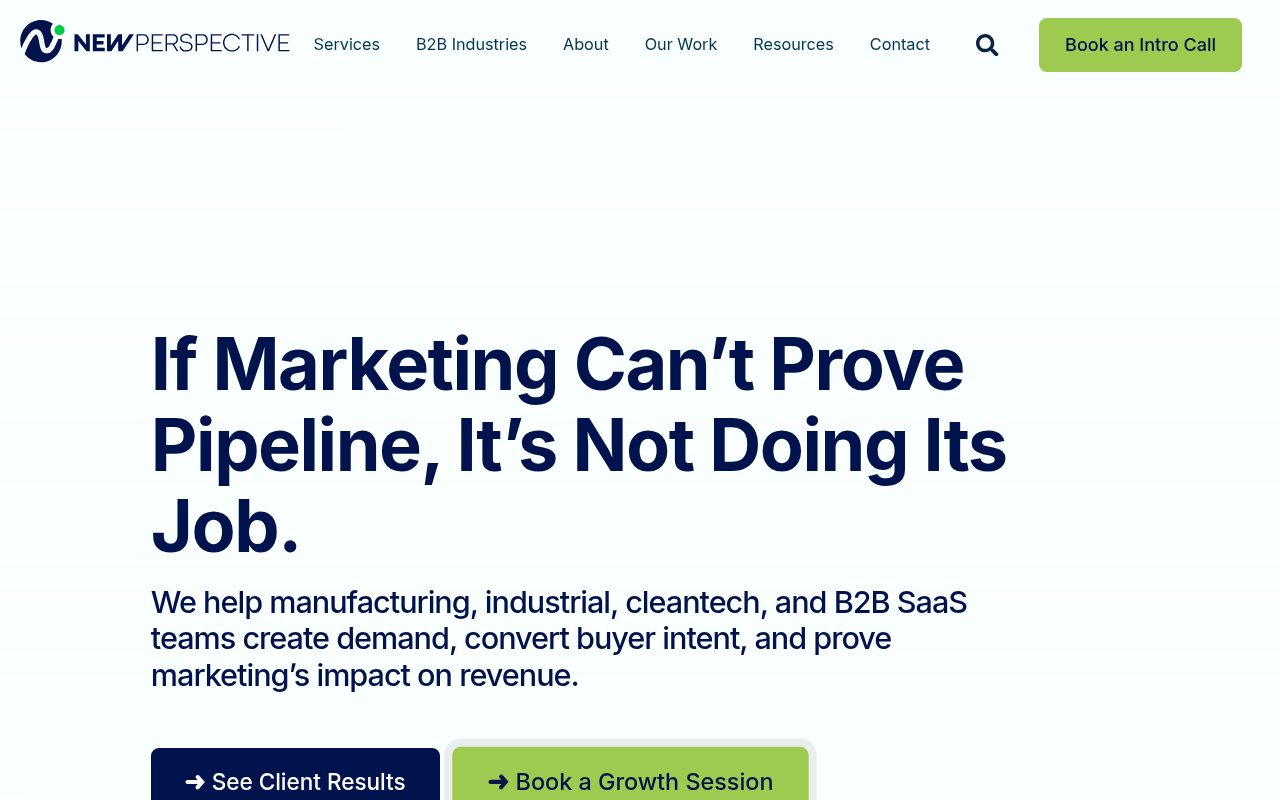
What they doNew Perspective is a B2B growth marketing agency that has run since 2003, and its pitch is squarely aimed at a growth lead: marketing that shows up in the revenue meeting. It helps industrial, manufacturing, cleantech, and SaaS companies turn website traffic into qualified pipeline and prove the link between marketing and revenue. The model is a full retainer across strategy, content, SEO, paid, and conversion, built on HubSpot. It ranks for its own category terms, including manufacturing marketing agency, which is a good sign it can do the same for a client. Its Clutch score is high at 4.9, though from a smaller base of 10 reviews. It is a mid-sized team, so very large enterprise programs may want more bench.
Best forGrowth leads at industrial, manufacturing, and SaaS companies who need marketing tied to revenue.
Pros
- Built around proving the link between marketing and revenue, with 20-plus years of track record.
- Ranks for its own category terms, a good sign it can rank a client too.
- High Clutch score at 4.9, and no red flags found.
Cons
- The 4.9 score rests on a smaller base of 10 reviews.
- Does not publish pricing on its site.

What they doWalker Sands is a larger, established B2B agency that joins brand, demand, PR, and data under one model it calls outcome-based marketing. For a growth lead who has to connect awareness to pipeline, the useful part is that Walker Sands added a RevOps and go-to-market engineering practice in 2026 by acquiring RevPartners, so CRM architecture, HubSpot, and Clay sit next to the campaigns. It serves well-known names such as Paylocity, Semrush, commercetools, and John Deere, publishes original research like its B2B AI search report, and carries a 4.8 rating from 32 G2 reviews. The trade-off is size and price: this is a full-service firm for funded teams, not a lean, single-owner budget, and PR remains a large part of the story.
Best forFunded mid-market and enterprise growth leads who want brand, demand, and RevOps in one place.
Pros
- Joins brand, demand, PR, and RevOps, with CRM and go-to-market engineering added in 2026.
- Deep, named client proof and its own original research.
- Rated 4.8 from 32 reviews on G2, verified on more than one platform.
Cons
- Large, full-service, and does not publish pricing, so it suits funded teams only.
- PR is a big part of the mix, so a pure demand-gen buyer pays for breadth they may not use.

What they do42 Agency calls itself plug-and-play demand generation for scaling B2B SaaS, and it works like an outsourced revenue team rather than a single-channel vendor. For a growth lead, that breadth fits: paid media, performance creative, SEO, and revenue operations under one roof, priced to beat a stack of full-time hires. What sets it apart is its own data. The firm publishes paid media, email, and LinkedIn benchmarks drawn from dozens of client accounts and more than 5 million dollars in managed spend, then runs programs off that data, which is the kind of measurement a growth lead wants. It is a small, senior team based in Canada. It does not publish pricing or surface a third-party review score, so you will need a call to judge fit.
Best forGrowth leads at scaling B2B SaaS who want demand gen and RevOps run as one revenue engine.
Pros
- Combines demand gen and revenue operations, priced to replace a set of full-time hires.
- Publishes its own benchmarks from real client spend, so decisions rest on data.
- Senior team focused on scaling SaaS.
Cons
- Does not publish pricing or surface a public review score.
- Small team, so a very large always-on program may stretch it.

What they doMatter Made is a growth agency for B2B SaaS that measures itself on the two numbers a growth lead cares about most: lower CAC and higher ARR. It runs performance-priced paid media paired with a sister design studio, so strategy, media, and creative move together. It positions as the outcomes agency and points to a Silicon Valley track record, with clients such as Dropbox, Oracle, G2, Loom, and Productboard, and it says it helps companies reach 100 million dollars in ARR faster. Most of its own ranking traffic comes from a working blog on growth topics rather than brand terms, a modest but real sign it practices demand generation. It does not publish pricing, show a public review score, or name a senior team, so vetting takes a call.
Best forGrowth leads at scaling SaaS companies focused on lower CAC and faster ARR.
Pros
- Measures its work on CAC and ARR, the numbers a growth lead reports.
- Strong Silicon Valley client roster, with media and creative under one roof.
Cons
- Does not publish pricing, a review score, or a named senior team.
- Paid-media led, so content and organic are a smaller part of the mix.

What they doWITHIN calls itself a performance branding agency, and its model unites brand and performance so that awareness and acquisition compound instead of running as separate budgets. For a growth lead chasing efficient, compounding growth, that framing is the draw: marketing systems where each investment builds on the last rather than resetting every quarter. WITHIN has a large own-marketing footprint and ranks for its category terms, which shows the model works on itself. Named clients include The North Face, Ruggable, Foot Locker, and Parachute, so its proof leans toward modern consumer brands as much as B2B. It does not publish pricing, surface a review score, or name a senior team, so a B2B growth lead should probe the B2B track record directly.
Best forGrowth leads who want brand and performance run as one compounding system.
Pros
- Unites brand and performance so spend compounds instead of resetting.
- Ranks for its own category terms off a large owned-content library, a sign the model works.
Cons
- Named proof leans toward consumer brands, so check the B2B track record.
- No public pricing, review score, or named senior team.

What they doLevel Agency is a performance agency built around a repeatable test-and-learn system it runs as an embedded growth team. Its method, four steps it labels Interrogate, Ideate, Implement, and Iterate, is tuned for high-consideration purchases with long sales cycles, which is the exact terrain a growth lead works in. Strategy, creative, media, and analytics sit in one loop aimed at compounding results rather than one-off campaigns. It is a larger team, around 200 to 500 people, with a real content engine behind it. The honest caveat is that a chunk of its ranking content is broad and informational rather than on its core category, and it publishes neither pricing nor a third-party review score. For a growth lead who values disciplined experimentation over a fixed playbook, it is worth a look.
Best forGrowth leads who value disciplined experimentation for long, high-consideration sales cycles.
Pros
- A repeatable test-and-learn system built for long, high-consideration cycles.
- Works as an embedded growth team across strategy, creative, media, and analytics.
Cons
- Some ranking content is broad and off-category rather than core demand gen.
- Does not publish pricing or a third-party review score.
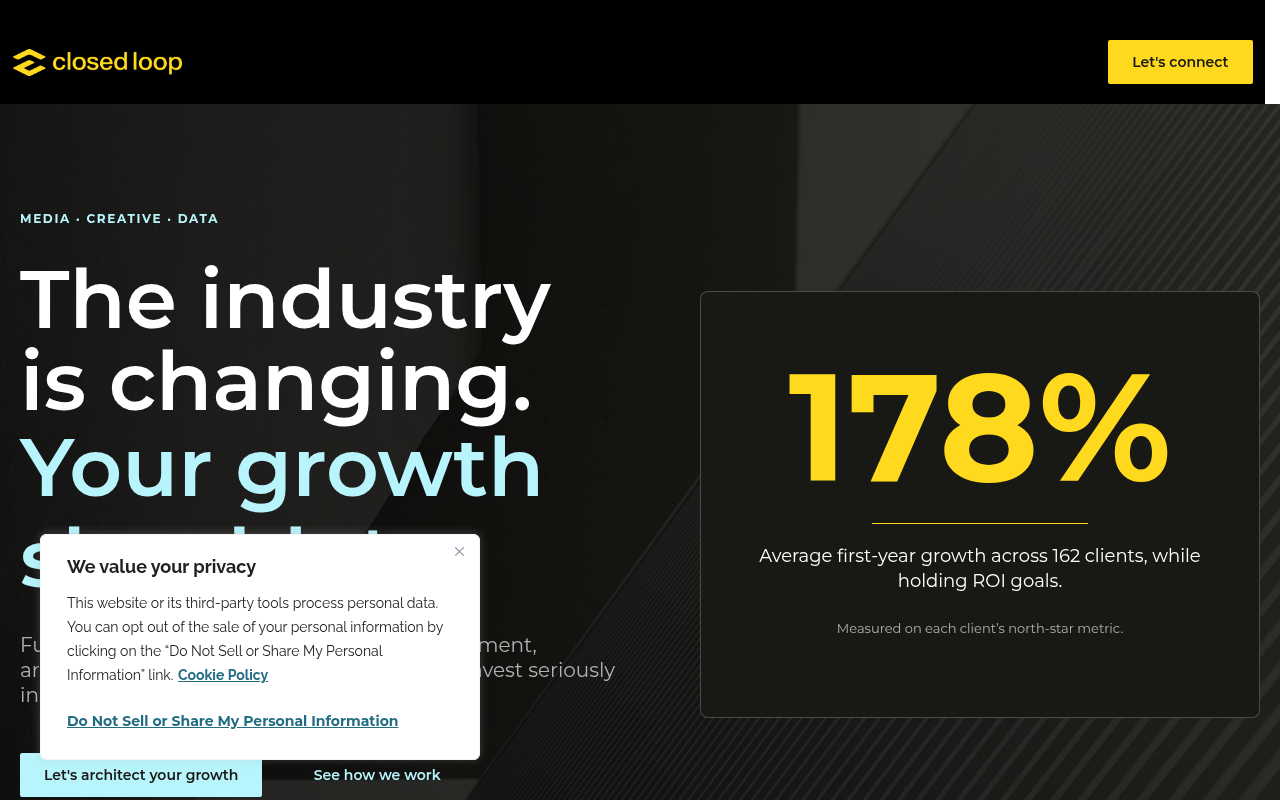
What they doClosed Loop is a paid media agency that joins full-funnel media buying to in-house creative production and data strategy. For a growth lead who leans on paid to hit the number, the pitch is senior hands: the firm says its practitioners average twelve years of experience, and it has won awards for work with well-known B2B SaaS brands. It markets itself well, ranking for educational terms like conquesting and competitive targeting off its own blog rather than brand searches alone. Recognition comes as industry awards, including seven straight Ad Age Best Places to Work honors, rather than a public review score. The limits for a growth lead: it is paid-media first, so content and organic are a smaller part of the mix, and it does not publish pricing or name its senior team on the site.
Best forGrowth leads who run meaningful paid budgets and want senior media and creative in one team.
Pros
- Senior paid-media team with in-house creative and data strategy.
- Markets itself well, ranking on educational terms rather than brand alone.
Cons
- Paid-media first, so content and organic are a smaller part of the mix.
- No public pricing or named senior team, and proof is awards rather than reviews.
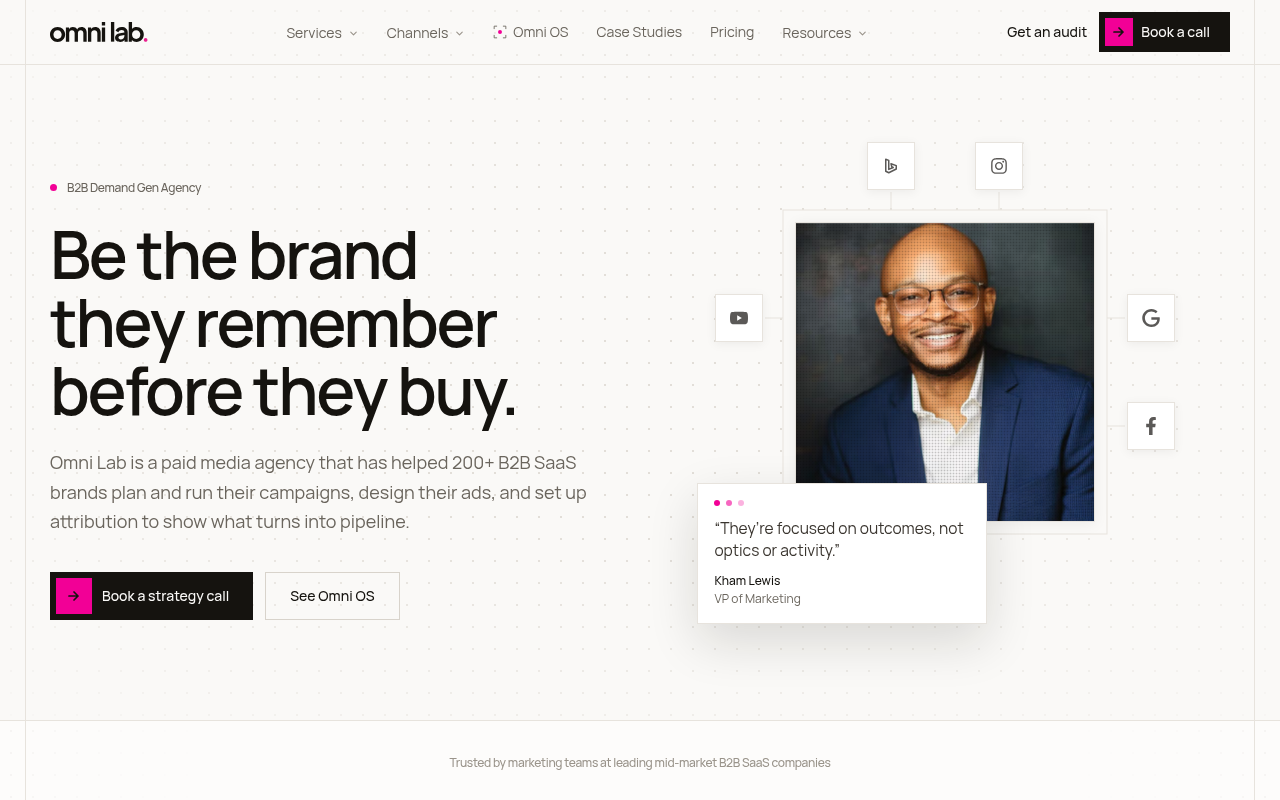
What they doOmni Lab is a demand generation and paid media agency for B2B SaaS, and it is one of the few here that publishes its prices, with retainers that start at 4,800 dollars a month and scale with your ad spend. For a growth lead, the model is attractive because it is built to both create and capture demand, and it ties reporting to pipeline and revenue through a proprietary platform called Omni OS that connects to HubSpot or Salesforce. It runs across Google, LinkedIn, Meta, and more, and names clients such as Shipwell, Cocoon, and Synthace. The caveat is thin third-party proof: it carries only a single public Clutch review, so lean on its case studies and references rather than a score.
Best forSaaS growth leads who want transparent, spend-based pricing and pipeline-tied reporting.
Pros
- Publishes clear, spend-based pricing from 4,800 dollars a month.
- Built to create and capture demand, with reporting tied to pipeline and revenue.
Cons
- Only one public review, so proof rests on case studies rather than a score.
- Paid-media led, so organic and content are a smaller part of the program.

What they doInverta is a B2B growth marketing agency that pairs CMO-level strategists with hands-on execution, and its focus is fixing how go-to-market actually operates: ABM, demand generation, martech, and AI adoption from strategy through delivery. For a growth lead inheriting a messy stack or a stalled motion, that consulting-plus-execution model fits better than a pure campaign shop. Inverta is a senior, boutique team that ranks for the exact services it sells, including demand gen consultant and account-based marketing company, which signals it can do the same for clients. It names its senior people and documents its methods. It does not publish pricing or surface a third-party review score, and it is a small team, so a large, always-on execution program may stretch it.
Best forGrowth leads who want strategy, ABM, and martech fixed, not just more leads.
Pros
- Pairs senior strategy with execution across ABM, demand gen, and martech.
- Names its senior team and ranks for the services it sells.
Cons
- No public pricing or third-party review score.
- Small, senior team, so large always-on execution may stretch it.

What they dofarsiight is a growth agency out of Australia that blends media, creative, strategy, and data, and it frames its work around removing growth blockers and driving long-term, profitable results rather than chasing vanity metrics. For a growth lead, the standout is proof: farsiight holds a 5.0 rating from 78 Clutch reviews, the highest review count on this list, and it backs its performance claims with a resources hub that ranks for its own category terms and a State of B2B Paid Media piece built on its own data. The model is performance-led across paid search and paid social, with creative in house. The main caveat for a North American or European growth lead is location: farsiight is APAC based, so time zones and some market nuance can need managing on larger programs.
Best forGrowth leads who want award-level performance work backed by deep review proof.
Pros
- The highest review count on this list: 5.0 on Clutch from 78 reviews.
- Backs its claims with its own data and a resources hub that ranks for its category.
Cons
- APAC based, so time zones can need managing for North American or European teams.
- Performance-led, and it does not publish pricing.
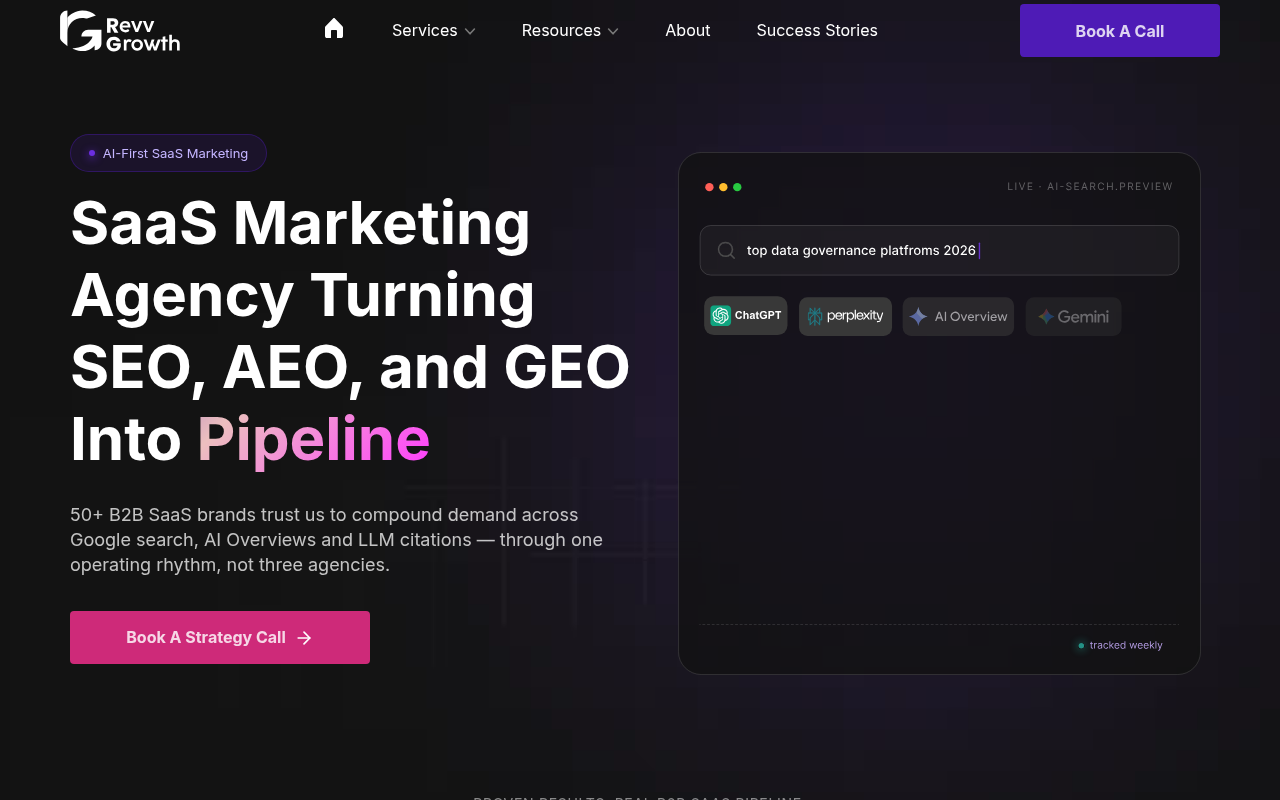
What they doRevvGrowth is a SaaS marketing agency that runs SEO, content, PPC, and ABM aimed at qualified pipeline and revenue. For a growth lead at a software company, the fit is its focus and its own proof. RevvGrowth has the cleanest dogfooding in this group, ranking on structured service hubs it built for topics like answer-engine optimization and account-based marketing rather than scattered blog posts, which shows it can build a real content engine. It names its senior team and documents its methods, and it points to SaaS client results. The caveats are youth and reach: the firm was founded in 2023, it is India based, and it does not publish pricing or surface a third-party review score, so for a larger program lean on references and a clear scope rather than years of track record.
Best forSaaS growth leads at earlier-stage companies who want a focused, content-led engine.
Pros
- Clean dogfooding, ranking on structured hubs it built for its own services.
- Names its senior team and documents its methods.
Cons
- Young firm, founded in 2023, with a shorter track record.
- India based with no public pricing or review score, so lean on references.
What they doAvid Demand is a full-funnel B2B demand generation agency that has run since 1999, pairing SEO, paid media, content, and conversion work for companies with complex sales. Two things make it a sensible pick for a growth lead. First, it reports through a custom ROI dashboard, so the link between spend and pipeline stays visible. Second, it offers a 90-day trial instead of a long lock-in contract, which lowers the risk of a first engagement. It markets itself on its own category, ranking first for b2b seo agency off its site, a fair sign it can rank a client too. It is a small, long-tenured team in Boulder, Colorado. It does not publish pricing, surface a public review score, or name a senior team on the site, so references will do more than a rating here.
Best forGrowth leads who want a low-risk, measurable first engagement with a long-tenured team.
Pros
- Reports through a custom ROI dashboard, keeping spend-to-pipeline visible.
- Offers a 90-day trial instead of a long lock-in, lowering first-engagement risk.
- Long-tenured since 1999, and ranks first for its own category term.
Cons
- Does not publish pricing, a review score, or a named senior team.
- Small team, so a large multi-market program may want more bench.
Is your content producing pipeline, or just traffic?
Get a free Content RevOps audit. We show where your content leaks revenue and what a connected system would change, benchmarked against our 2026 B2B data.
Frequently asked questions
What does a demand generation agency do for a growth lead?
It helps the right buyers find you and trust you before they talk to sales, then ties that work to pipeline. For a growth lead that means content and campaigns built for the full funnel, placed in search and AI answers, wired to the CRM so you can see what creates revenue, not just clicks.
How much do these agencies charge?
Most do not publish prices. A few on this list do: Gripped starts around 3,500 pounds a month, Omni Lab from about 4,800 US dollars a month, and Content RevOps from 4,100 US dollars a month. Where an agency does not share a price, we mark it not disclosed rather than guess.
How did we choose and rank these agencies?
We reviewed more than 120 agencies that serve growth and revenue teams, then kept the ones with real proof. We ranked them on fit for a growth lead, whether they market themselves well, review evidence, transparency, and fit to your stage and situation. The same checks apply to our own entry.