The best demand generation agencies for law firms in 2026
Law firms grow on trust and referrals. When a firm looks for outside help, the choice rarely rests with one person. Managing partners, a marketing lead, and practice heads all weigh in, and they move carefully. Prospective clients research the same way, reading and comparing and asking AI tools about a firm long before they call. Plenty of agencies say they market law firms. Most name one or two clients and stop. We reviewed demand generation agencies that work with law firms and legal teams, checked each claim against their live sites, and kept the ones that hold up. Below we explain each in plain words, with real ratings, pricing where it is published, and honest trade-offs.

How we chose this list
We ran the same checks on every agency, including our own. Here is what earns a spot and how we ordered them.
Who makes the list
Every agency runs real demand generation and has a working content presence of its own. We left out lead-list sellers, appointment-setters, and ads-only shops.
How we rank them, in order
- Real depth with law firms and legal teams, not one or two named logos
- Whether they run marketing for themselves, and it works
- Review proof, counting how many reviews back the score
- Whether they show prices and name their team
- Fit to your firm's size and situation
What we promise on every entry
Every claim can be traced to a live source. Ratings always show how many reviews they come from. Prices are shown only where the agency publishes them on its own site, and marked not disclosed otherwise. We hold our own entry to the same checks, and the order below the top spot is a guide, not a hard science.
The shortlist at a glance
All 12 entries, ranked by the criteria above. Full detail in the cards below.
| # | Name | Pros | Cons | Best for | Pricing |
|---|---|---|---|---|---|
| 1 | Content RevOps |
|
| Law firms and legal teams, from solo practices to mid-size firms, that rely on referrals and want a predictable, content-led source of new enquiries instead of scattered marketing. | $4.1-8.5k/mo |
| 2 | Hinge |
|
| Mid-size and larger firms that want research-led brand, positioning, and demand from one team. | Not disclosed |
| 3 | Saffron Edge |
|
| Small and mid-size firms that want search, paid, and automation from one full-funnel partner. | Not disclosed |
| 4 | MLT Digital |
|
| UK law firms that want an agency working only in the legal sector. | Not disclosed |
| 5 | Point Source Marketing |
|
| Solo and small firms that want measurable local and organic growth from a hands-on team. | Not disclosed |
| 6 | Move Digital Group |
|
| Regional firms that want a clear plan before any spend on tactics. | Not disclosed |
| 7 | Verndale |
|
| Large firms rebuilding a website or digital experience at enterprise scale. | Not disclosed |
| 8 | Enlimited |
|
| Smaller firms that want clear, packaged pricing and a named legal service. | From $1,050/mo |
| 9 | Kraftvertising |
|
| Mid-size and European firms that want paid channels run well, with pricing shown up front. | From EUR 8,000/mo |
| 10 | Creative Business Company |
|
| Large firms that want brand and demand rebuilt together at enterprise scale. | Not disclosed |
| 11 | Fractional Demand |
|
| Legal tech companies, or firms wanting an embedded operator rather than a hands-off agency. | Not disclosed |
| 12 | Thirdflow |
|
| Brands that want an audience and a presence at events, not just leads. | Not disclosed |
The list
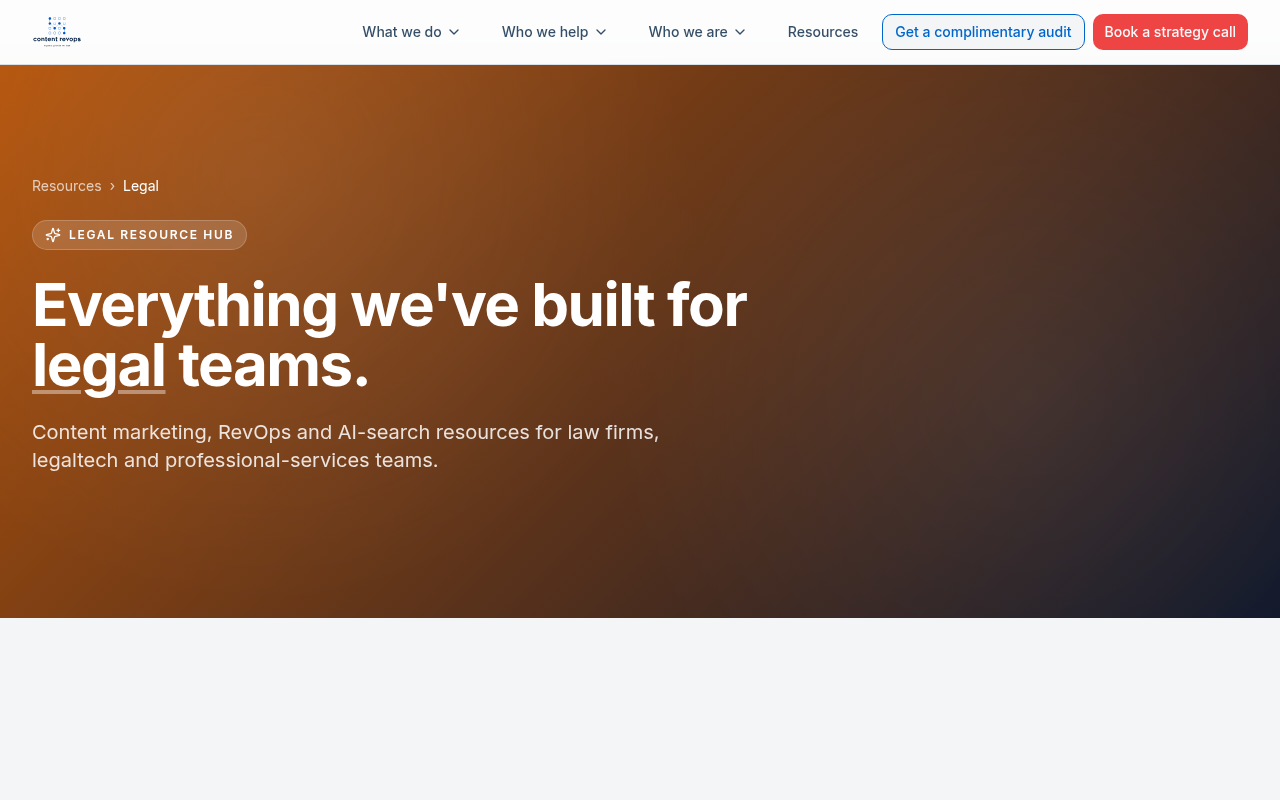
What they doContent RevOps is a content marketing and demand generation firm built for trust-led B2B, and now for law firms and legal teams. We work with solo and small firms, mid-size practices, and the marketing leads inside larger firms, the places where new business still leans on referrals and where several partners have to agree before anyone signs. The problem we fix is not a lack of content. Most firms already have a blog, some guides, and practice pages. The problem is that this content has no job. It sits there and brings in nothing. We give it one. We treat content as revenue infrastructure, not decoration. We map how your firm actually wins clients and where prospects drop off, then build the decision-stage material most firms never publish, the comparison pages, plain answers, and proof a careful buyer needs before they call. We place it where legal buyers now look, including Google and AI answer tools, because that is where research starts. Then we wire it to your CRM so enquiries are captured, followed up, and measured, instead of leaking. Our method and our prices are published, and you work directly with the founder in the early stages.
Best forLaw firms and legal teams, from solo practices to mid-size firms, that rely on referrals and want a predictable, content-led source of new enquiries instead of scattered marketing.
Pros
- Runs one connected system, from the first search to a signed client, instead of separate campaigns that do not talk to each other.
- Publishes its full method and its prices, so you know what you are buying before you commit. how we work ↗
- Built on original research into how B2B content actually converts, across close to 14,000 company sites. our research ↗
- Backs the model with named case studies carrying real revenue and pipeline numbers, from education to fintech to manufacturing. case studies ↗
- Runs a dedicated legal resource hub and focuses on organic search and AI answers, which matter more as legal buyers research on their own before they call. our legal hub ↗
Cons
- Its named case studies are in adjacent long-cycle fields like education, fintech, and manufacturing, not yet a named law firm.
- Young and small, so it fits building a content-led engine better than running large paid-ad budgets.
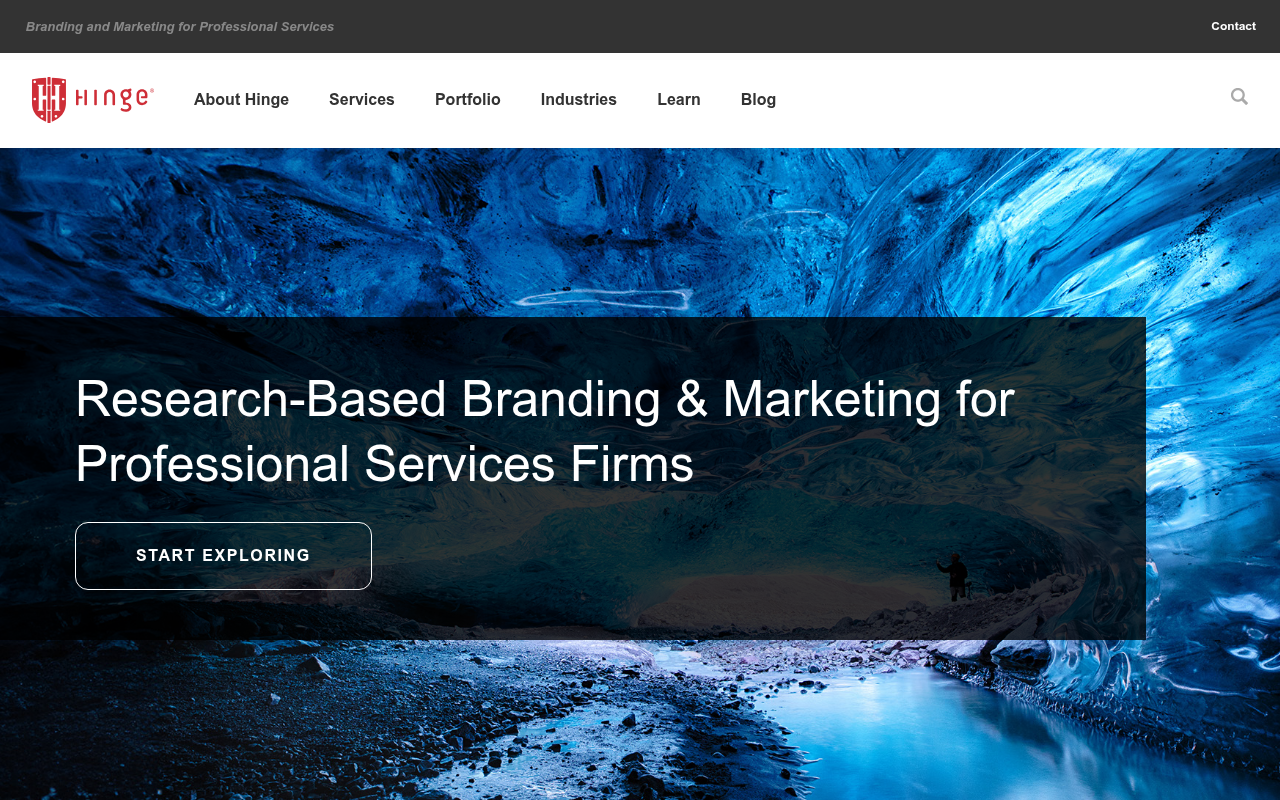
What they doHinge is a retainer branding and marketing agency built only for professional services firms, and law firms are one of its six named markets. It is best known for research. Its Hinge Research Institute has studied tens of thousands of firms and buyers, and its annual High Growth Study shapes how many professional firms think about growth. That research feeds programs like The Visible Firm, which turn a firm's expertise into visibility and referrals. Named legal clients include the global firm Nishith Desai Associates and the Chicago firm Pilgrim Christakis. Hinge suits mid-size and larger firms that want brand, positioning, and demand handled by one experienced team, rather than a quick lead push.
Best forMid-size and larger firms that want research-led brand, positioning, and demand from one team.
Pros
- Runs its own research programme, the High Growth Study, and ranks well for the terms it sells.
- Deep, named work with professional services and law firms, backed by two decades of sector data.
- Names its senior experts and publishes its methodology.
Cons
- Does not publish prices on its site.
- Law firms are one slice of its work, so it is a professional-services generalist first.

What they doSaffron Edge is a full-funnel B2B growth agency that runs SEO, AI search, paid media, and marketing automation as one engine, so a firm does not have to hire three separate vendors. It has a dedicated legal marketing service, including a family-law page, and names the law firm Radow Law among its clients. Its own site ranks organically for terms it sells, which is a good sign it can do the same for a firm. An unusual point is its build-operate-transfer model: it can run your marketing, then hand a working team back to you. It has more third-party reviews than almost any agency here, which gives a buyer more to check before signing.
Best forSmall and mid-size firms that want search, paid, and automation from one full-funnel partner.
Pros
- The strongest review record on this list, a 4.8 score from 83 reviews.
- Covers search, paid, and automation under one roof, with a dedicated legal service.
- Ranks organically for the services it sells, a sign the model works.
Cons
- Does not publish prices on its site.
- Legal is one of many industries it serves, so it is a broad B2B agency rather than a legal specialist.
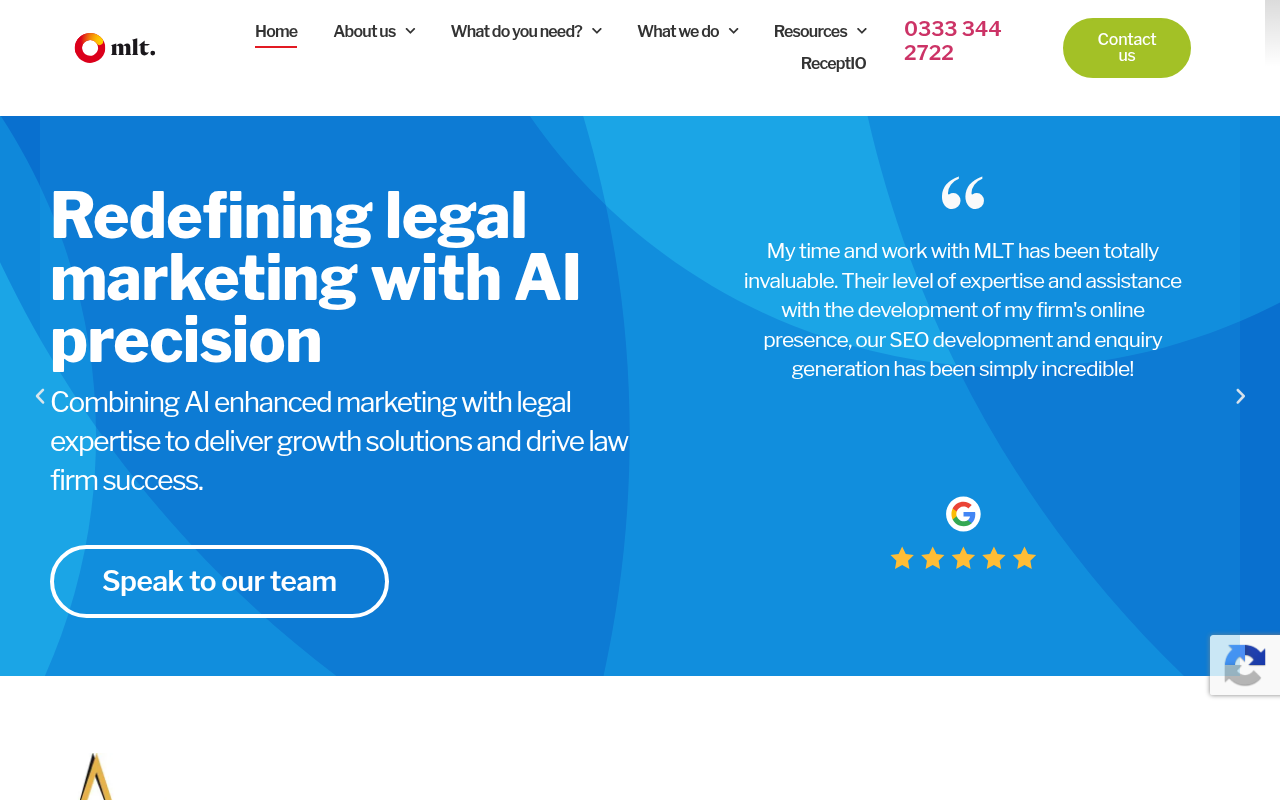
What they doMLT Digital is the purest law-firm specialist on this list. Its whole site is built for one buyer: its tagline is that it helps law firms make money from the internet, and every service page is scoped to firms, from law firm SEO to law firm PPC to law firm web design. Founder Stephen Moore hosts a podcast, Your Law Firm Success, and the agency claims 20 years in legal-sector marketing. It was a finalist at the Scottish Legal Awards 2024. The main gap is proof a buyer can check: its testimonials are strong but anonymised by role, such as Partner or Marketing Manager, with no named firms and no numbers attached to the results.
Best forUK law firms that want an agency working only in the legal sector.
Pros
- A true law-firm specialist, with every service built for legal buyers.
- Runs its own law-firm podcast and claims two decades in the sector.
- Carries a 4.6 Google rating from 23 reviews, the kind of proof clients leave.
Cons
- Testimonials are anonymised by role, with no named firms or numbers to verify.
- Does not publish prices, and works mainly with UK firms.
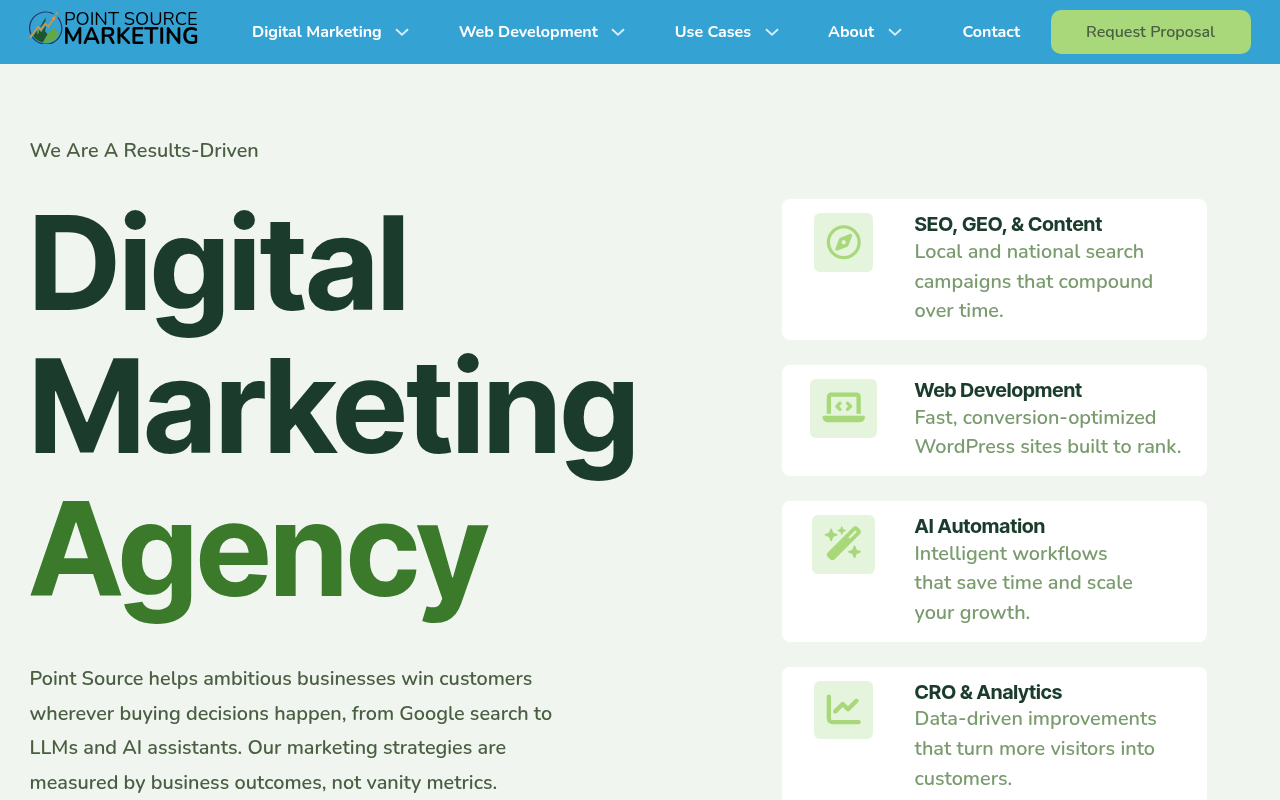
What they doPoint Source Marketing is a small performance agency that offers several ways to work together, from a monthly retainer to agency-of-record to priced-to-scope projects. Its clearest law-firm proof is a case study for The Military Defense Firm, a military law practice, where SEO and related work drove roughly a 1,000% increase in traffic and steady month-over-month lead growth. The founding attorney left a named review confirming it. The firm rebranded from SEO Succor in early 2026 and is young, founded in 2022, with a small team. Because it ranks for genuine SEO topics itself, its search claims are believable. It fits a solo or small firm that wants measurable local and organic growth.
Best forSolo and small firms that want measurable local and organic growth from a hands-on team.
Pros
- A named law-firm case study with a real result, roughly 1,000% more traffic, confirmed by the client.
- Ranks for the SEO topics it sells, so its search claims hold up.
- Offers flexible ways to engage, from retainer to project.
Cons
- Young and small, founded in 2022, with only two public reviews.
- Does not publish prices, and legal is one of several industries it serves.
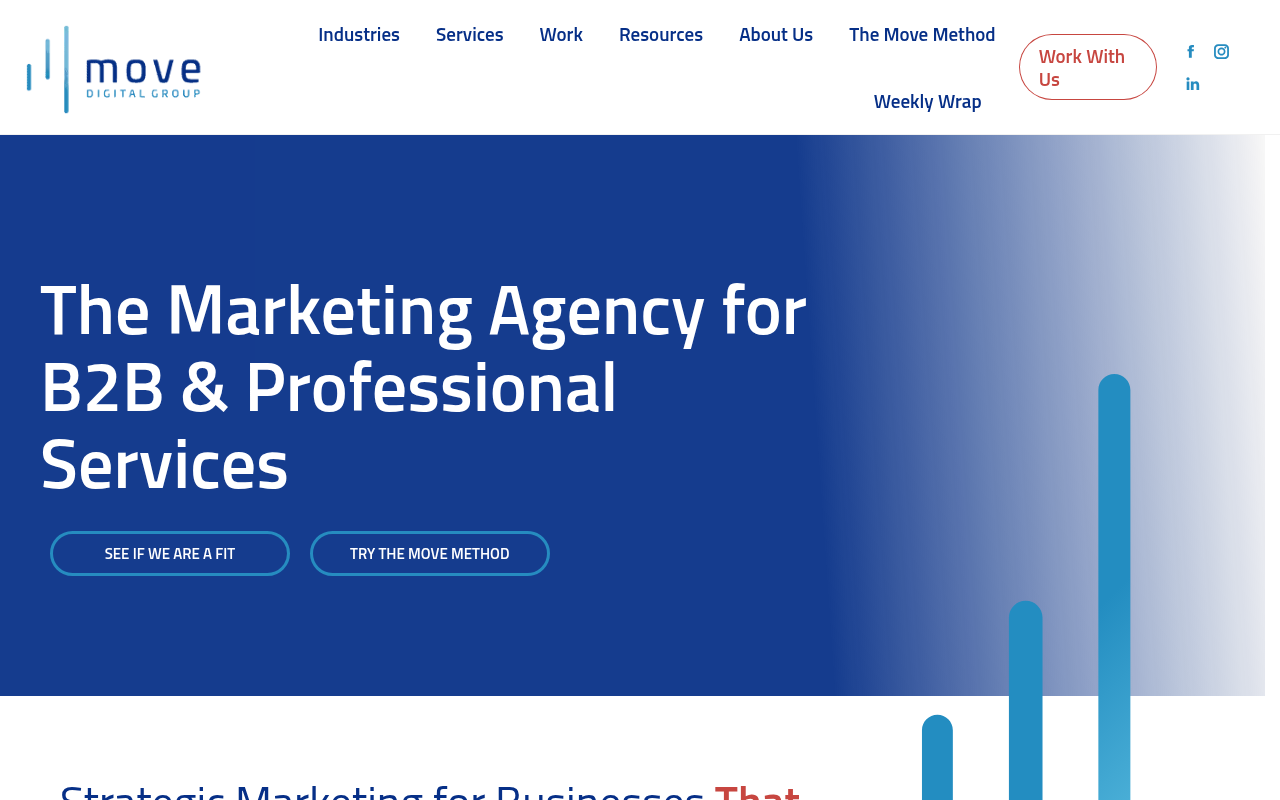
What they doMove Digital Group is a strategy-first agency in Huntsville, Alabama that serves law firms as one of five named industries. It has a dedicated law firm marketing page and a matching case study: it increased website traffic by more than 600% for Timberlake and League, a local personal injury firm. It also names Fuqua Partners and Associates among its legal clients. Its signature is the Move Method, a 90-day planning process that sets strategy before spend. The clients are mostly regional businesses rather than national brands, and it has no verified third-party review score yet, so a buyer has the case studies to go on but less outside proof. It fits a regional firm that wants a plan before tactics.
Best forRegional firms that want a clear plan before any spend on tactics.
Pros
- A named law-firm case study, over 600% more website traffic for a local firm.
- Starts with a 90-day plan, so strategy comes before spend.
- Has a dedicated law firm service and more than one named legal client.
Cons
- No verified third-party review score yet.
- Does not publish prices, and its clients are mostly regional rather than national.

What they doVerndale is an enterprise digital experience agency, founded in 1998, with a team in the hundreds and a partnership at the top tier of platforms like Sitecore and Optimizely. It has a dedicated law firm page and names the major firm WilmerHale as a success story, with LexisNexis as a partner. Its work is framed around building and running large websites and digital platforms, with data, design, and marketing on top, rather than quick lead generation. That makes it a fit for a large firm replatforming its site or rebuilding its digital experience, and less of a fit for a small firm that just wants more enquiries. It has no verified agency review score, so judge it on its named enterprise work.
Best forLarge firms rebuilding a website or digital experience at enterprise scale.
Pros
- Genuine enterprise credentials, including named work with a major law firm, WilmerHale.
- Top-tier platform partner for large website and digital-experience builds.
- Deep team, founded in 1998, able to handle complex enterprise projects.
Cons
- Built for enterprise replatforming, not quick lead generation for a small firm.
- Does not publish prices and has no verified agency review score.
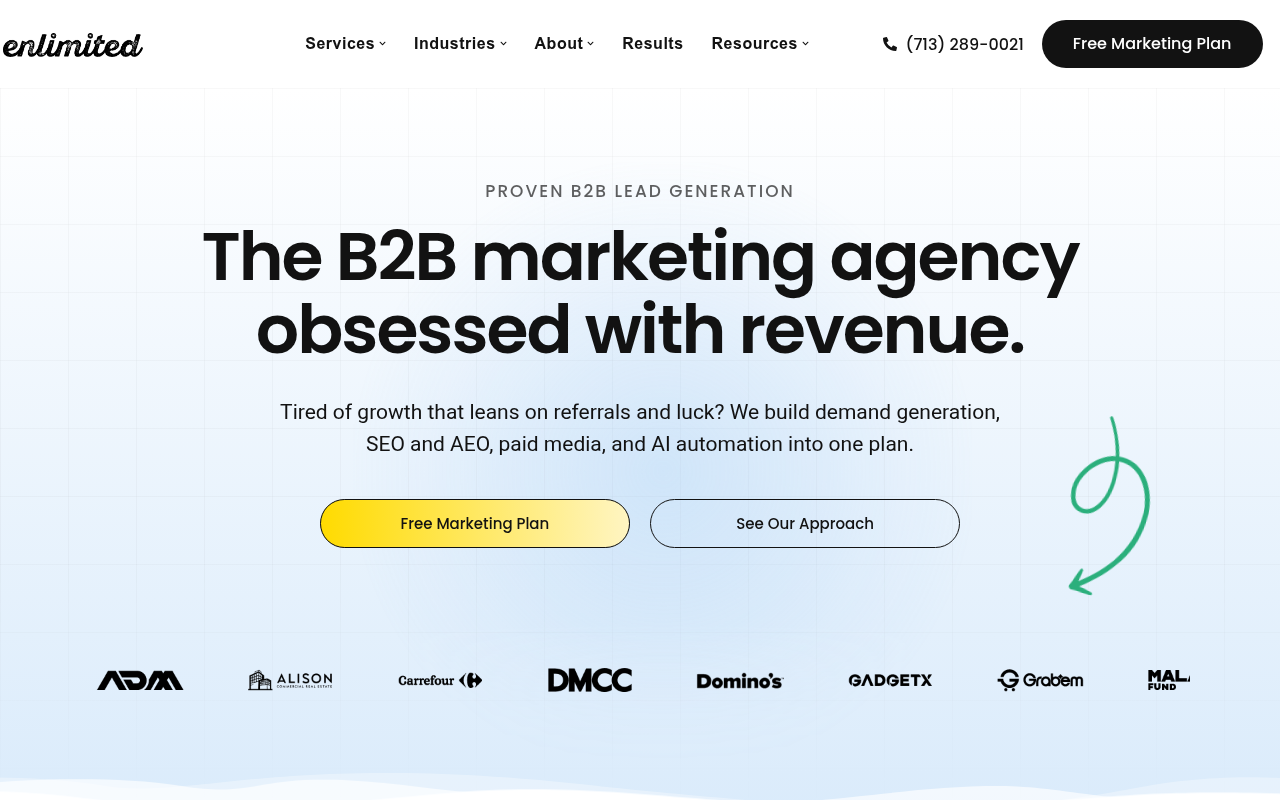
What they doEnlimited is a growth marketing agency that positions itself for SaaS, fintech, and law firms, and it runs month to month. It has a dedicated law firm marketing page, names Sullivan Legal Solutions as a client, and shows a law firm case study, a Houston personal injury firm with roughly 300% more conversions. One thing sets it apart here: it publishes its SEO package prices openly, starting at $1,050 a month, so a buyer can compare before a call. Founder Mohsin Ali is named. The catch is thin outside proof: its Clutch profile carries a single review, so the 5.0 score rests on one client. It suits a smaller firm that wants clear, packaged pricing and a named legal service.
Best forSmaller firms that want clear, packaged pricing and a named legal service.
Pros
- Publishes its package prices openly, starting at $1,050 a month.
- Has a dedicated law firm service, a named legal client, and a law firm case study.
- Names its founder and works month to month.
Cons
- Its 5.0 Clutch score rests on a single review.
- Runs many services across several industries, so it is not a legal specialist.
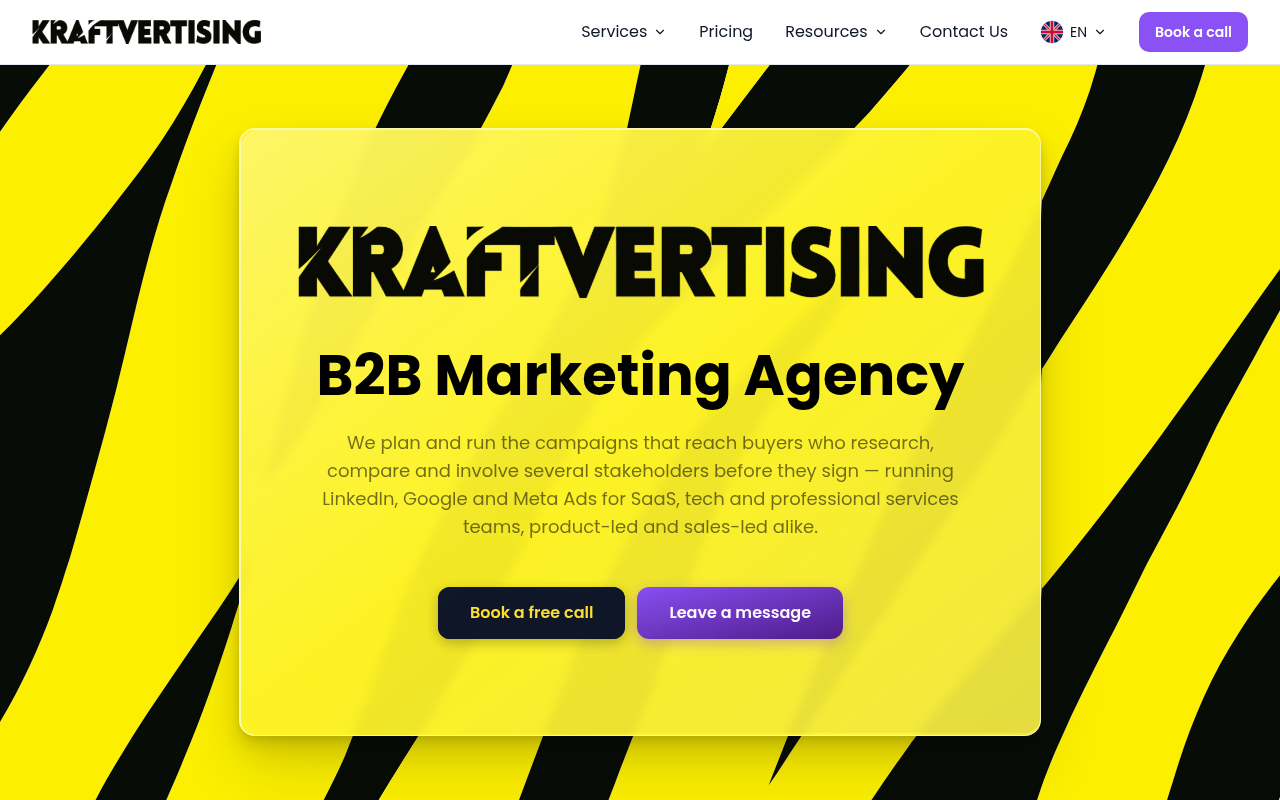
What they doKraftvertising is a European B2B paid media agency, based across Prague, Vienna, and Bratislava, that runs paid search and LinkedIn as one strategy. It is unusually open about money: it publishes its retainer tiers on its homepage, all starting from 8,000 euros a month, and even sells fixed-price ad audits at 450 euros. Its client list includes real law firms, among them the global firm Eversheds Sutherland, plus Mathison Legal and a firm called endors whose CEO credits it with growth. It does not run a dedicated legal practice, so law firms are strong clients rather than a named specialism. It fits a mid-size or European firm that wants paid channels run well, with pricing it can see up front.
Best forMid-size and European firms that want paid channels run well, with pricing shown up front.
Pros
- Publishes its retainer prices openly, starting from 8,000 euros a month.
- Names real law firm clients, including the global firm Eversheds Sutherland.
- Focuses paid search and LinkedIn into one strategy.
Cons
- Paid media only, so it will not build your organic search or content on its own.
- No dedicated legal practice, and only a single third-party review to check.

What they doCreative Business Company, or CBC, is an enterprise brand and demand consultancy that treats brand and demand as one job. It works with large B2B organisations and has the awards and named results to match, including a Schneider Electric campaign it says drove a 232% rise in qualified leads and 22 million dollars in revenue in under six months. Its legal-sector proof is Consilio, a legal services and ediscovery provider that serves law firms and legal departments, rather than a law firm itself. So CBC is the enterprise option here for a large firm that wants brand and demand rebuilt together, not a legal specialist. It does not publish prices and has no client reviews on its Clutch profile yet.
Best forLarge firms that want brand and demand rebuilt together at enterprise scale.
Pros
- Strong enterprise results, including a 232% lift in qualified leads for Schneider Electric.
- Handles brand and demand together, useful for a firm repositioning itself.
- Award-winning work across large B2B organisations.
Cons
- Its legal proof is one legal-services client, Consilio, not a law firm.
- Does not publish prices and has no reviews on its Clutch profile yet.

What they doFractional Demand places senior operators inside your business to run demand generation and revenue operations, positioned as an alternative to both a traditional agency and a full-time hire. It runs on a named system it calls Fractional DemandOS, split into build, run, and scale. Its legal work is on the technology side: it built paid media from scratch for Hona, a legal tech company, reporting 122 qualified opportunities and 1.6 times return on ad spend. Other named results include 1.3 million dollars in paid pipeline for Venteur. It does not serve law firms directly and has no third-party review score, so this is a fit for a legal tech company, or a firm that wants an embedded operator rather than a hands-off agency.
Best forLegal tech companies, or firms wanting an embedded operator rather than a hands-off agency.
Pros
- Embeds senior operators, so you get pipeline ownership without a full-time hire.
- Runs paid media and RevOps together on a documented system.
- Named legal tech result: 122 qualified opportunities for Hona.
Cons
- Serves legal tech companies, not law firms directly.
- Does not publish prices and has no third-party review score.

What they doThirdflow is a media and community-first B2B agency that builds audiences and events, not just campaigns. Its legal work is community-side: it grew LegalTechTalk into what it calls the most engaged legal tech community on LinkedIn in twelve months, and it names a client called Zaven legal. It has also built large industry events, including an insurtech community with 13,000 attendees, and it names clients like Marsh and Willis Towers Watson. This is a different model from the rest of the list. Rather than run your search or ads, it helps a brand build a following and a presence at events. It serves legal tech and events rather than law firms, and it publishes no pricing and has no third-party review score.
Best forBrands that want an audience and a presence at events, not just leads.
Pros
- Builds real audiences and communities, including a leading legal tech community.
- Strong track record with large industry events and named enterprise clients.
- A genuinely different model for firms that want presence, not just leads.
Cons
- Serves legal tech and events, not law firms directly.
- Does not publish prices and has no third-party review score.
Is your firm's content bringing in clients?
Get a free Content RevOps audit. We show where your content leaks revenue and what a connected system would change, from search to signed clients.
Frequently asked questions
What does a demand generation agency do for a law firm?
It helps the right clients find your firm and trust it before they call. For law firms that means content and search built for how people actually choose a lawyer, placed in Google and AI answer tools, then tied back to enquiries and matters so you can see what works.
How much do these agencies charge?
Most do not publish prices. Where a firm does, the floor on this list runs from about 1,000 US dollars a month for packaged SEO up to 8,000 euros a month for a full paid-media retainer, and bespoke work can run higher. We mark pricing as not disclosed when an agency does not share it.
How did we choose and rank these agencies?
We reviewed more than 60 agencies that work with law firms and legal teams, checked each claim against their live sites, and kept the ones with real proof. We ranked them on legal depth, whether they market themselves well, review evidence, transparency, and fit. The same checks apply to our own entry, and the order below the top spot is a guide.