The best demand generation agencies for mid-market companies in 2026
A mid-market company, roughly $10M to $1B in revenue, already has a marketing team, a CRM, and a sales team that wants better leads. Its buyers decide in committees, take months, and do most of their research alone, increasingly by asking an AI assistant before they ask a vendor. An agency at this level is not a missing department. It is a layer that has to fit a system that already exists. Hundreds of agencies say they serve the mid-market. Most show a logo wall and little else. We reviewed more than 450 that state they work with mid-market companies and kept the 16 that can prove it: named clients with numbers, a visible senior bench, and a demand engine they run for themselves.

How we chose this list
We used the same checks on every agency, including our own. Here is what earns a spot and how we ordered them.
Who makes the list
Every agency here runs real demand generation for mid-market B2B companies and has a working content presence of its own. We left out lead-list sellers, appointment-setters, pure web or design shops, and agencies whose sites could not show a single named client.
How we rank them, in order
- A model built for a company with an existing marketing team: senior people, integration with your CRM and sales, not a one-size retainer
- Whether they run marketing for themselves, and it works
- Review proof, counting how many reviews back the score
- Whether they show prices and name their team
- Fit to committee-led, months-long B2B sales rather than quick transactional funnels
What we promise on every entry
Every claim can be traced to a source, and we re-checked ratings and prices against the live pages before publishing. Ratings always show how many reviews they come from. Prices are shown, or marked not disclosed. We hold our own entry to the same checks.
The shortlist at a glance
All 16 entries, ranked by the criteria above. Full detail in the cards below.
| # | Name | Pros | Cons | Best for | Pricing |
|---|---|---|---|---|---|
| 1 | Content RevOps |
|
| Mid-market B2B companies with an established marketing team whose content, CRM, and sales enablement run separately, and who want that estate turned into one measured revenue system. | $1-5k/mo |
| 2 | Walker Sands |
|
| Mid-market and enterprise B2B teams that want strategy, PR, demand generation, and RevOps run by one accountable partner instead of several vendors. | Not disclosed |
| 3 | Directive |
|
| Mid-market SaaS and technology companies with meaningful budget that want paid, search, and content run together and measured in pipeline. | Not disclosed |
| 4 | Ironpaper |
|
| Mid-market B2B companies with six to eighteen month sales cycles that want demand generation, content, and sales enablement run as one measured HubSpot system. | Not disclosed |
| 5 | Obility |
|
| Mid-market technology companies that want organic search, AI search, and paid media run by a B2B-only team with published prices that demonstrably ranks for what it sells. | From $6,500/mo |
| 6 | Blend |
|
| Mid-market B2B companies on HubSpot, or moving to it, whose website is the weak link between traffic and pipeline. | From $8,000/mo |
| 7 | The Marketing Practice |
|
| Larger mid-market and enterprise technology companies running global brand, demand, and ABM programs that need one agency with proven enterprise references. | Not disclosed |
| 8 | Gripped |
|
| Mid-market SaaS and technology companies, especially in the UK and Europe, that want a transparent growth partner with published prices and a named team. | From £3,500/mo |
| 9 | strategicabm |
|
| Mid-market and enterprise technology companies that need to win, grow, and retain a defined set of named accounts and want a specialist rather than a generalist. | From $20,000/mo |
| 10 | Kuno Creative |
|
| Mid-market medtech, industrial, and software companies that want demand generation tied to sales enablement and RevOps by a stable, employee-owned team. | Not disclosed |
| 11 | Inverta |
|
| Mid-market B2B technology marketing leaders launching or rebuilding ABM and demand generation who want senior strategy, execution, and martech setup from one partner. | Not disclosed |
| 12 | CS2 |
|
| Mid-market SaaS and AI companies whose demand generation is blocked by the revenue systems behind it: routing, attribution, and marketing automation. | From $16,500/mo |
| 13 | Hotwire |
|
| Mid-market technology companies going international that need earned media, thought leadership, and third-party authority feeding demand across several markets. | Not disclosed |
| 14 | Twogether |
|
| Mid-market technology vendors that sell through partners and want ABM and channel marketing from a team that only does technology. | Not disclosed |
| 15 | The Rubicon Agency |
|
| Mid-market technology companies taking a new or disruptive proposition to market that want an agency with enterprise tech references and published thinking. | Not disclosed |
| 16 | BOL Agency |
|
| Mid-market B2B companies with several disconnected vendors that want brand, demand, and performance consolidated with one partner whose own search engine plainly works. | Not disclosed |
The list
What they doContent RevOps is a content marketing and demand generation firm built for B2B companies that sell on trust: long cycles, several decision makers, and buyers who research alone before they ever fill in a form. We work with SaaS and service companies from about $1M to $100M and beyond in revenue, across education, life sciences, manufacturing, construction, finance, and professional services. In the mid-market we usually plug in as a systems layer, because content, the CRM, and sales enablement tend to run in three separate lanes that never meet. What we do is give content a job again. A mid-market company has usually invested in content for years. AI removed the barrier to producing more of it, markets flooded, and most of that estate now earns nothing. We treat it as revenue infrastructure, the way a sales team treats its CRM, not as a stream of projects. How it works: we map everyone in your buying committee and what each person needs to say yes. We build the decision-stage material your market never publishes, the comparisons, ROI models, and proof, because that is where deals are won. We place it where your buyers look, which now means AI assistants as much as Google. Then we wire every piece into your CRM so each asset is measured in pipeline. Our method and pricing are published, and every case study is named and linked.
Best forMid-market B2B companies with an established marketing team whose content, CRM, and sales enablement run separately, and who want that estate turned into one measured revenue system.
Pros
- Built for committee-led, trust-driven B2B sales: the system is designed around buying groups and months-long cycles, and it plugs into an existing team rather than replacing it. how we work ↗
- Strong, named case studies with revenue numbers in higher education, fintech, manufacturing, and construction, including King's College London, Lucid, GRC, and Heliogen. case studies ↗
- Builds for AI answers as well as Google, and backs the method with published research across seven B2B industries and close to 14,000 company websites. our research ↗
Cons
- A young firm with a small senior team, so it fits a company that wants a hands-on system built and run, not a large-agency bench or a big paid-media budget managed.
- Only for B2B considered sales. A transactional or ecommerce business is not a fit, and neither is a team that mainly wants brand campaigns or events produced.
What they doWalker Sands is a large retainer agency, founded in 2001 with offices in Chicago, Boston, Seattle, and San Francisco, that runs brand, PR, demand generation, digital, and data as one program it calls outcome-based marketing. In 2026 it acquired RevPartners, which added revenue operations and go-to-market engineering: CRM architecture, HubSpot, and Clay workflows. That matters for a mid-market team, because the usual failure is that the content agency, the CRM consultant, and the sales team never meet, and this firm now covers all three lanes under one roof. Named clients include John Deere, KUKA, and AspenTech in manufacturing, Paylocity, Semrush, and commercetools in technology, and Korn Ferry and West Monroe in professional services. It publishes original research, including a B2B AI Search Visibility Benchmark, names its senior team, and holds a 4.8 on Clutch, though from only 9 reviews.
Best forMid-market and enterprise B2B teams that want strategy, PR, demand generation, and RevOps run by one accountable partner instead of several vendors.
Pros
- Brand, demand, PR, and now revenue operations under one roof, after the 2026 RevPartners acquisition.
- Named mid-market and enterprise clients on dedicated industry pages, including John Deere, Paylocity, and Korn Ferry.
- Publishes original research, including a B2B AI Search Visibility Benchmark, and ranks for the categories it sells.
Cons
- Does not publish pricing, and an agency of this size carries a cost base to match.
- Review proof is thin for its size: a 4.8 on Clutch from 9 reviews.
What they doDirective is a performance-led B2B agency with more than 100 strategists that runs paid media, SEO, content, and PR as one program for software and technology companies. It organises the work around a named method, Customer Generation, and reports results in pipeline rather than leads. Named clients include Adobe, Calendly, ZoomInfo, Gong, and Wiz, and Clutch ranked it first among B2B marketing service providers. Its own marketing engine is the largest on this list: roughly 3,300 ranked keywords and an estimated 22,000 organic visits a month, mostly from a glossary of marketing terms, top-of-funnel traffic rather than buying intent, but unmistakably self-built. It holds a 4.8 on Clutch across 56 reviews and names its leadership. It publishes a price only for a startup package. Expect a process-driven, multi-channel shop for a team with real budget, not a boutique that goes deep in one industry.
Best forMid-market SaaS and technology companies with meaningful budget that want paid, search, and content run together and measured in pipeline.
Pros
- 4.8 on Clutch across 56 reviews, among the most public proof on this list.
- A documented method, named leadership, and results reported in pipeline rather than leads.
- Its own organic engine is the largest here, proof it can build one.
Cons
- Publishes no pricing for mid-market engagements, only a startup package.
- Organised by motion rather than industry, so little deep vertical content for a buyer in one niche.
What they doIronpaper is a B2B-only growth agency in New York, about 70 people, that has spent two decades on one problem: companies with long, complex sales where marketing and sales run as separate systems. It works as a retainer partner covering demand generation, content, and sales enablement, usually on HubSpot, where it is a Diamond partner. The proof that it knows the play is its own site: it ranks third in US search for demand generation agency and fifth for B2B marketing agency, from its own service and glossary pages. It also publishes original survey research, including a 358-respondent study of B2B leaders on CRM. Named clients include Steelcase, Solartis, Mobilewalla, and Sparks Group. The founder and four vice presidents are named with photos. It has no reviews on Clutch and publishes no price, so references matter.
Best forMid-market B2B companies with six to eighteen month sales cycles that want demand generation, content, and sales enablement run as one measured HubSpot system.
Pros
- Ranks third in the US for demand generation agency, the clearest dogfooding on this list.
- Publishes its own survey research rather than borrowing benchmarks.
- Names its senior team and works sales enablement alongside demand generation.
Cons
- No Clutch or G2 reviews to check claims against.
- Does not publish pricing.
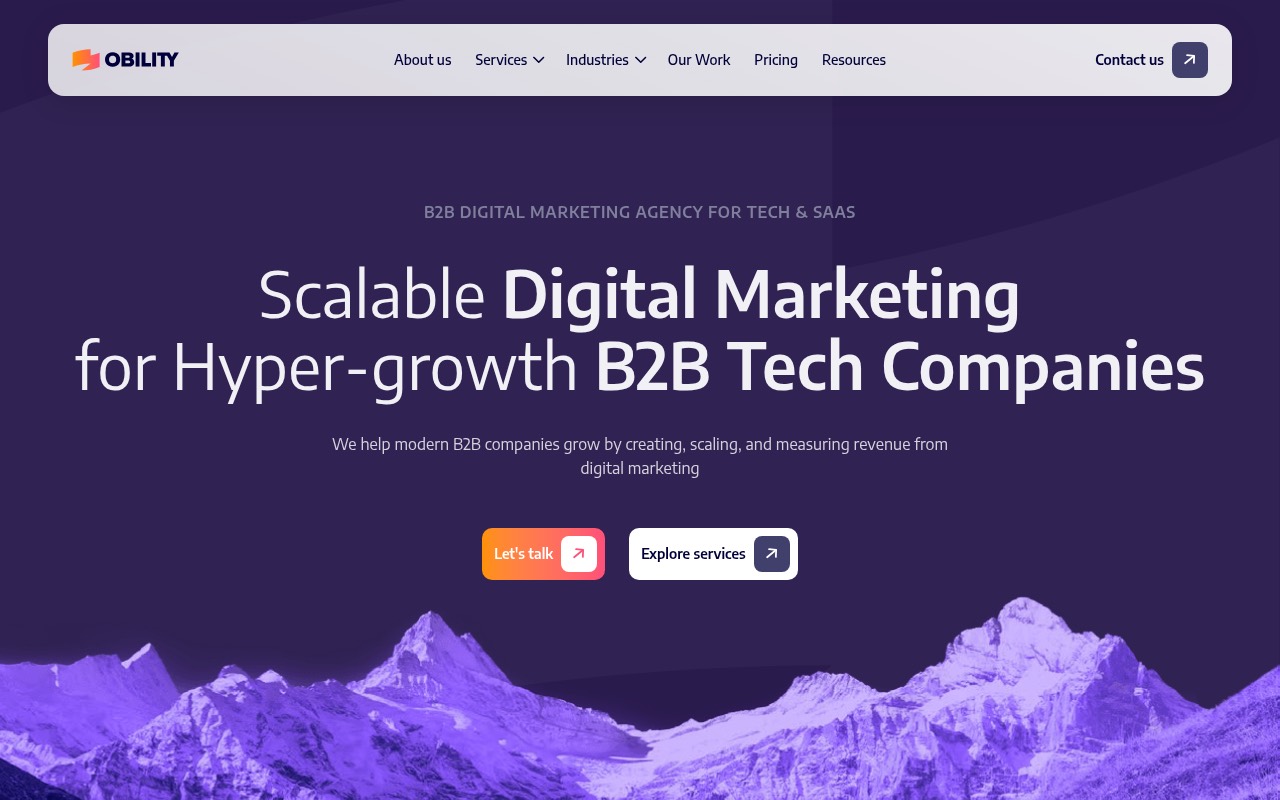
What they doObility is a B2B-only agency of about 24 named people that runs paid search, paid social, SEO, AI search optimisation, and content for technology companies from Series A to public enterprises. It sits this high on focus and candour. It sells B2B SEO and owns the term: first in US search for B2B SEO services and B2B SEO company. It publishes its prices, from $1,850 a month for a guided plan to $6,500 a month for its core Ascent tier, plus priced add-ons for content, Reddit visibility, and brand mentions. The site carries eight industry hubs written for specific buyers, from SaaS and cybersecurity to construction. Named clients include Snowflake, Fastly, Hitachi Vantara, and Autodesk, and it holds a 4.8 on Clutch across 27 reviews. The founder and every director are named. The limit is scale: a small team suits a focused search and paid program, not a global one.
Best forMid-market technology companies that want organic search, AI search, and paid media run by a B2B-only team with published prices that demonstrably ranks for what it sells.
Pros
- Ranks first for B2B SEO services and B2B SEO company, the categories it sells.
- Publishes its prices and names its whole team, both rare on this list.
- 4.8 on Clutch across 27 reviews, with eight buyer-specific industry hubs.
Cons
- A team of about 24, so a large global or multi-channel program will stretch it.
- No original research behind the industry hubs.
What they doBlend is a HubSpot Diamond partner with more than 50 in-house specialists across Reading and Atlanta that builds websites on HubSpot CMS and then runs demand generation and AI search work on top of them, for B2B technology companies. The angle is that the website itself should generate pipeline, and its own numbers back it: close to 800 ranked keywords and an estimated 3,800 organic visits a month. It publishes its prices, with demand generation retainers from $8,000 a month, AI search optimisation from $7,500, and bespoke websites from $45,000. It has won eight HubSpot Impact Awards and holds a 5.0 across 107 reviews on the HubSpot Solutions Marketplace. Named clients include Skyscanner, Allica Bank, Datel, and Inshur, with 800% ROI reported for Datel. Leadership is named. It is website-first and HubSpot-only, so a team with a strong site on another stack will use less of it.
Best forMid-market B2B companies on HubSpot, or moving to it, whose website is the weak link between traffic and pipeline.
Pros
- 5.0 across 107 HubSpot Marketplace reviews and eight HubSpot Impact Awards.
- Publishes its prices: demand generation retainers from $8,000 a month.
- Named clients with numbered results, including 800% ROI for Datel.
Cons
- Website-led and HubSpot-only, so less value if your site and stack are already settled.
- Its reviews live on HubSpot's marketplace rather than an independent platform like Clutch or G2.
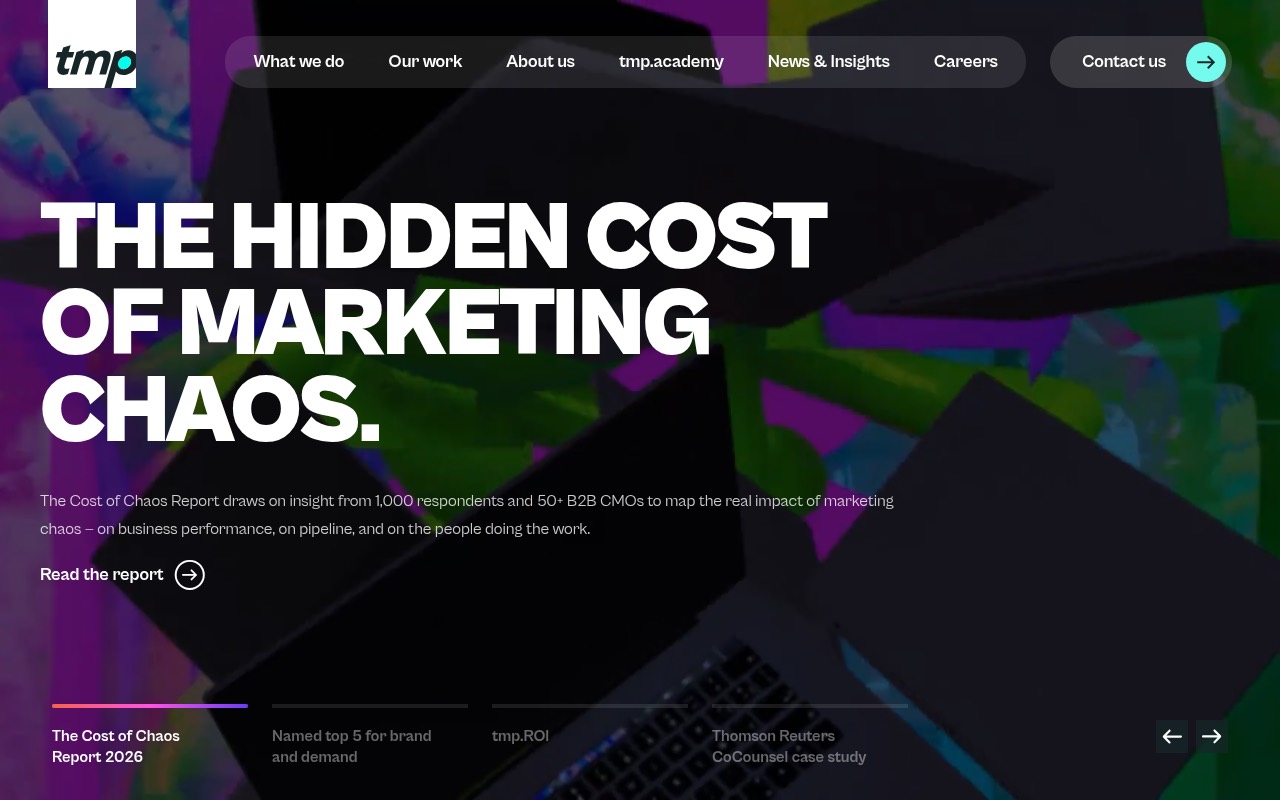
What they doThe Marketing Practice is a global B2B technology agency of several hundred people, formed by combining specialists including the Denver demand agency 90octane, the ABM firm Campaign Stars, and the brand agency Omobono. It runs brand and demand as one program for technology companies, with account-based marketing as a core practice. The client list is the deepest on this page: named case studies for AWS, ServiceNow, Palo Alto Networks, Splunk, and T-Mobile, including $13 million of pipeline generated for Thomson Reuters CoCounsel. It publishes genuine first-party research, the Cost of Chaos Report 2026, built on 1,000 respondents and more than 50 B2B CMOs, and its C-suite is named with photos. For a mid-market company this is the upper end of the list: a firm built for large, global programs, with the fees that implies. No third-party review score and no published price.
Best forLarger mid-market and enterprise technology companies running global brand, demand, and ABM programs that need one agency with proven enterprise references.
Pros
- Named enterprise case studies including AWS, ServiceNow, and $13M of pipeline for Thomson Reuters.
- First-party research at scale: the Cost of Chaos Report draws on 1,000 respondents.
- Brand, demand, and ABM run as one program, with a dedicated ABM practice.
Cons
- Built for enterprise-scale programs, so smaller mid-market budgets will not be a fit.
- No public review score and no published pricing.
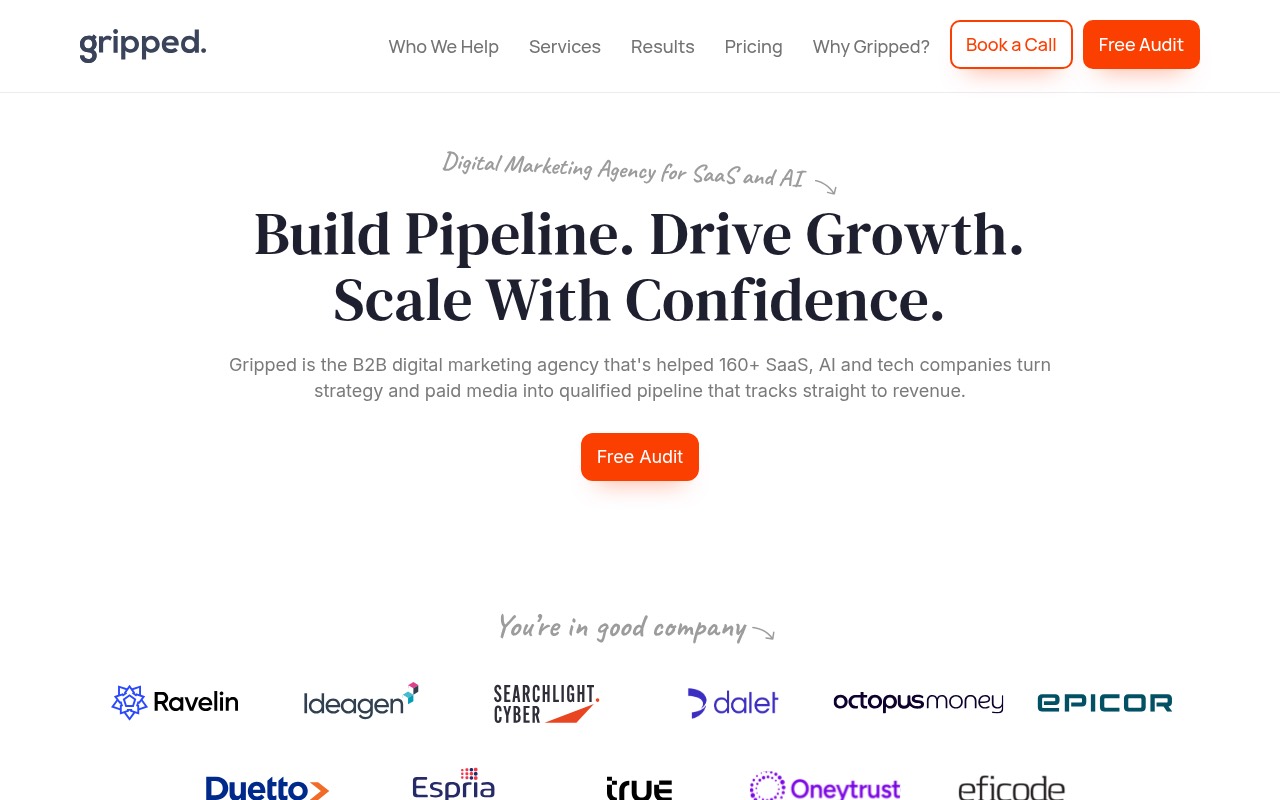
What they doGripped is a London agency of about 25 that works only with B2B SaaS, AI, and technology companies, and says it has helped more than 160 of them. It runs strategy, paid media, SEO, content, and ABM as a retainer, tracked through to revenue. Three things set it apart for a mid-market buyer. It publishes its pricing in full: advisory from 3,500 pounds a month, performance retainers from 7,500, scale programs from 15,000. It names its founders. And its own marketing works: its B2B marketing and B2B SEO hubs rank for UK agency and SEO consultant terms. Named clients include Ideagen, Epicor, Ravelin, and Crownpeak, with 1.3 million pounds of new pipeline in one quarter reported for Crownpeak, and it holds a 4.9 on Clutch across 32 reviews. The caveat is scope: a UK-centred team with no original research behind its hubs, better suited to a transparent, senior partnership than a global program.
Best forMid-market SaaS and technology companies, especially in the UK and Europe, that want a transparent growth partner with published prices and a named team.
Pros
- Publishes full pricing tiers and names its founders, both rare on this list.
- 4.9 on Clutch across 32 reviews.
- Its own B2B marketing and SEO hubs rank, so it runs the play it sells.
Cons
- UK-centred team of about 25, so limited depth for large US or global programs.
- No original research behind its content hubs.
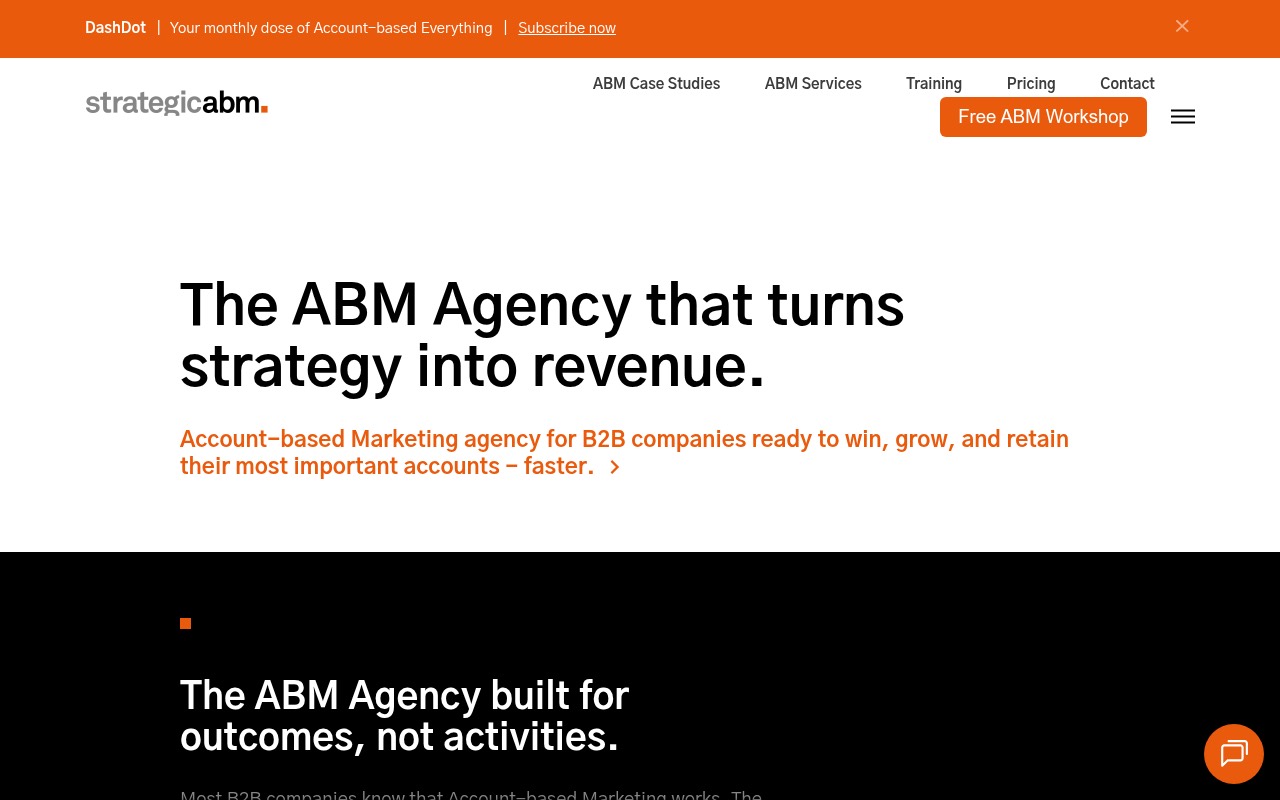
What they dostrategicabm does one thing: account-based marketing for B2B technology brands. For a mid-market company that already generates leads but cannot land the forty accounts that matter, that focus is the point. It runs a documented six-step method, the Modern ABM Journey, and delivers the programs itself, from account selection to sales alignment. It publishes its prices: an ABM readiness program at $10,000 and full engagements from $20,000 a month, clearly mid-market and up. The proof is concrete. Its AVEVA program won the Forrester 2025 B2B Program of the Year, Acxiom reports $2 million of pipeline in 120 days, and named clients include SAP, Cloudflare, and GlobalSign. It runs a real publishing operation, with an insights hub, the DashDot magazine, and two podcasts. Two cautions: no senior team is named on the site, and its G2 score rests on a single review. It is a specialist, best paired with a team that already covers inbound.
Best forMid-market and enterprise technology companies that need to win, grow, and retain a defined set of named accounts and want a specialist rather than a generalist.
Pros
- Forrester 2025 B2B Program of the Year for its AVEVA program.
- Publishes its prices, with full ABM engagements from $20,000 a month.
- Named enterprise clients including SAP and Cloudflare, with a documented six-step method.
Cons
- ABM only. You will still need a partner for inbound and wider demand generation.
- No senior team named on the site, and no meaningful third-party review record.

What they doKuno Creative is an employee-owned agency founded in 2000 that joins brand, demand generation, sales enablement, and revenue operations into one program, mostly on HubSpot, where it is a Diamond partner. It goes deep in three markets where mid-market buying is technical and slow: medtech, industrial manufacturing, and B2B software. Each has a case-study track with a number, including a 1,373% increase in organic contacts for a medtech company, an 1,800% rise in quote requests for a manufacturer, and $1.6M influenced across 61 deals for a software company. Named clients include BASF, Aramark, Samsung, and Transonic, and about 33 staff are named with photos. One caution on proof: the homepage claims 156 verified reviews at 5.0, but the independent platforms we could check show a 5.0 from 2 reviews on Clutch and one review on G2, so we report the verified figure. It does not publish prices.
Best forMid-market medtech, industrial, and software companies that want demand generation tied to sales enablement and RevOps by a stable, employee-owned team.
Pros
- Real depth in medtech, industrial, and SaaS, each with numbered case studies.
- Employee-owned with a named senior team, so the people who pitch tend to stay.
- HubSpot Diamond partner joining demand generation to sales enablement and RevOps.
Cons
- Independently verifiable reviews are thin: 2 on Clutch, despite a larger figure claimed on its homepage.
- Does not publish pricing, and is HubSpot-centred.
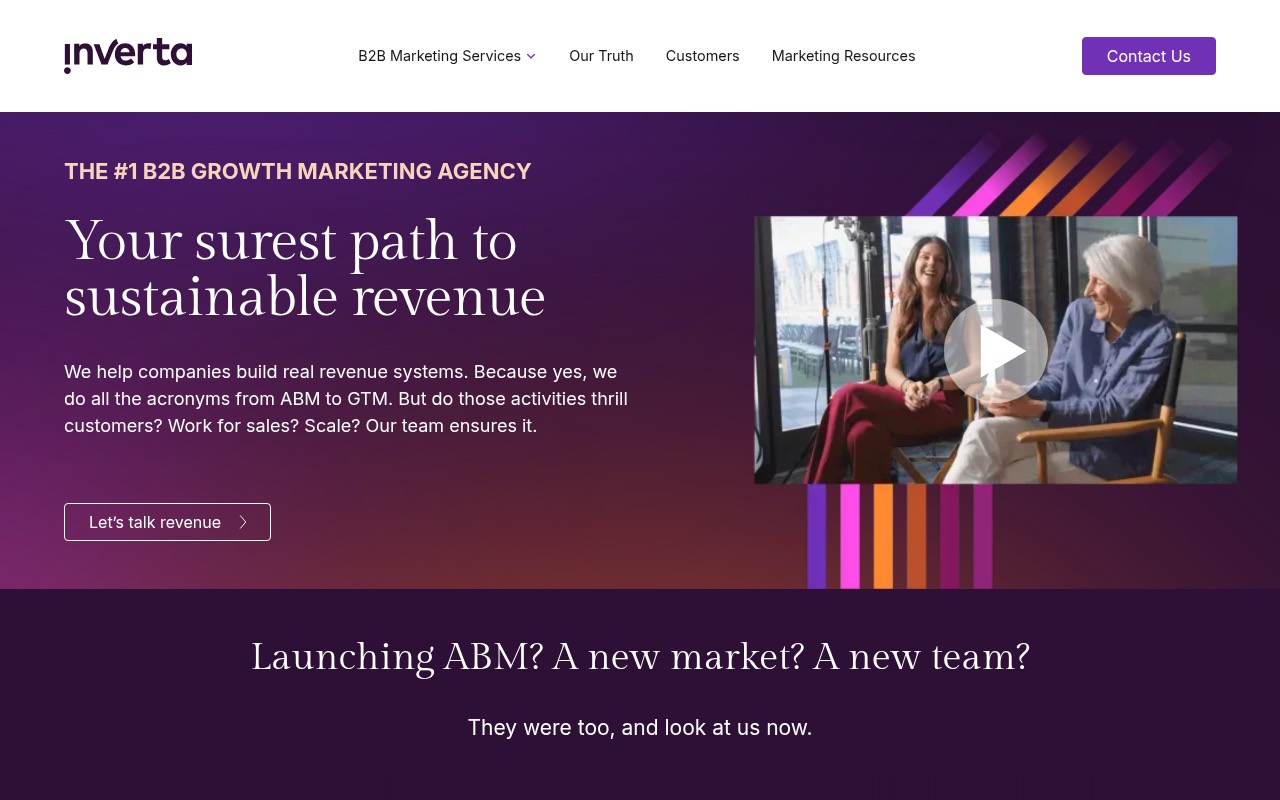
What they doInverta calls itself the original account-based marketing agency and works as a consultancy that also executes: CMO-level strategists paired with hands-on delivery and marketing technology implementation. It segments by growth stage, emerging, mid-market, and enterprise, rather than by industry, which suits a company whose problem is building or rebuilding the ABM and demand function itself. Client results are specific and quantified. Procore drove 75% of its outbound pipeline from ABM, Sysdig raised marketing-sourced contract sizes 36%, and Actian reorganised its marketing team around the program. Its own site ranks third in the US for account based marketing vendor and fourth for demand gen consultant, on its service pages rather than its brand name, and every consultant is named with a bio. A resource library and the RevRoom podcast back the work. It has no reviews on Clutch or G2 and prints no price.
Best forMid-market B2B technology marketing leaders launching or rebuilding ABM and demand generation who want senior strategy, execution, and martech setup from one partner.
Pros
- Quantified ABM outcomes at named clients, including 75% of outbound pipeline at Procore.
- Every consultant named with a bio, so you know who does the work.
- Ranks for account based marketing vendor and demand gen consultant on its own service pages.
Cons
- No third-party reviews to check against.
- Does not publish pricing.
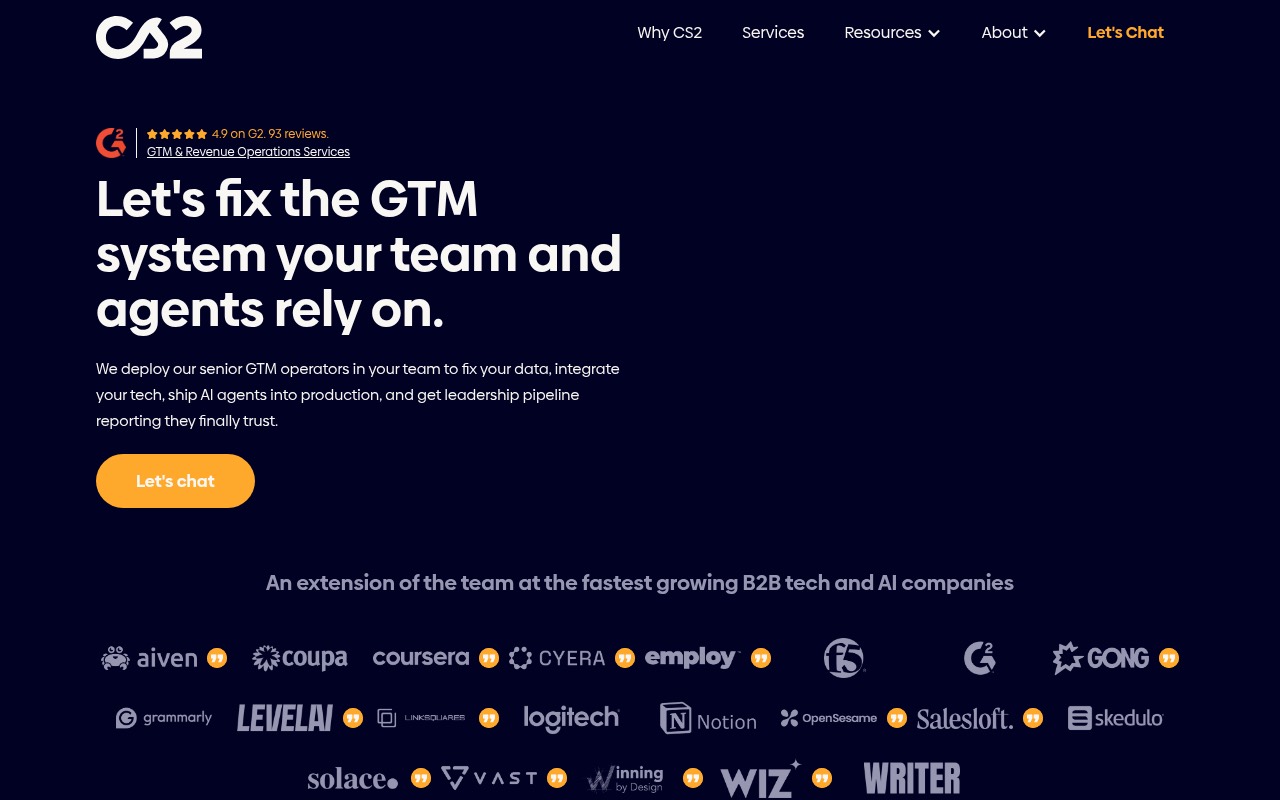
What they doCS2 is a go-to-market operations consultancy rather than a campaign agency, and that is why it is here. Many mid-market demand problems are really systems problems: lead routing that drops hand-raisers, attribution nobody trusts, marketing and sales working from different definitions. CS2 fixes that layer, running marketing automation, CRM, and pipeline operations through a documented Unified GTM Pipeline Model it says has run at more than 30 B2B technology companies since 2015. The client roster is unusually strong and verifiable from attributed testimonials: Gong, Notion, Grammarly, Wiz, Coupa, Coursera, Logitech, and Salesloft. It holds a 4.9 on G2 across 93 reviews, and the founders, Charlie and Crissy Saunders, plus 16 staff are named on the site. Its search footprint is tiny after a recent domain move, so it wins business through its podcast, newsletter, and network. It publishes its prices: tiers from $16,500 a month on a six-month minimum.
Best forMid-market SaaS and AI companies whose demand generation is blocked by the revenue systems behind it: routing, attribution, and marketing automation.
Pros
- 4.9 on G2 across 93 reviews, strong public proof for a consultancy.
- Named clients including Gong, Notion, and Wiz, with founders and staff named.
- A documented operating model for the marketing-to-sales handoff.
Cons
- Operations, not content or campaigns. It fixes the plumbing, not the demand itself.
- Starts at $16,500 a month on a six-month minimum, and its own organic footprint is small.
What they doHotwire is a global technology communications consultancy, more than 400 people across 15 offices in 11 countries, that joins PR, social, content, and digital marketing for technology brands. It belongs on a demand generation list because earned authority is now part of the engine: the review sites, trade press, and reference pages that AI assistants cite are exactly what a PR firm moves. For a mid-market company expanding into Europe or Asia, its footprint is hard to match. Named clients include Palo Alto Networks, Salesforce, Adobe, SAP, Qualcomm, and Honeywell, and it publishes original research, including the 2026 Agentic Organizations report. Its leadership team is named with photos. The limits are clear: it is communications-led, not a pipeline shop, its minimum sits around $10,000 to $25,000 a month, and it has no reviews on Clutch and no published price.
Best forMid-market technology companies going international that need earned media, thought leadership, and third-party authority feeding demand across several markets.
Pros
- Fifteen offices in eleven countries, rare reach for a multi-market launch.
- Publishes original research and names its leadership.
- Named enterprise references across technology and fintech.
Cons
- Communications-led, so pipeline and CRM work need another partner.
- Minimum around $10,000 to $25,000 a month, with no published pricing or public reviews.

What they doTwogether is a UK agency of well over 50 people that works only with technology companies, with particular depth in account-based marketing and channel programs, the marketing a vendor runs with and through its partners. That channel layer is where many mid-market technology companies sell most of their revenue and where generic agencies have nothing to say. Twogether built its own partner-performance tool, PartnerView, around it. Every logo is B2B technology, including Adobe, Dell, Hitachi, Lenovo, Juniper, and Salesforce, and the case studies carry hard numbers: 128% over lead target for Hitachi, a 22% year-on-year revenue increase for Lenovo, and a 1 to 127 pipeline return on Hitachi's global ABM program. Its own search footprint is small and we found no named leadership page, so it wins on references rather than visibility. No reviews on Clutch and no published price.
Best forMid-market technology vendors that sell through partners and want ABM and channel marketing from a team that only does technology.
Pros
- Channel and partner marketing depth, with its own PartnerView tool.
- Numbered enterprise results, including a 1 to 127 pipeline return on Hitachi global ABM.
- Technology only, so the team already speaks the buyer's language.
Cons
- No named leadership we could find on the site, and a very small own search footprint.
- No public reviews and no published pricing.
What they doThe Rubicon Agency is a UK technology marketing firm whose specialty is taking a disruptive technology and making it mainstream, which is the problem a mid-market company creating a new category actually has. It runs ABM, content, paid, brand, and web as a retainer, with dedicated hubs for cybersecurity, SaaS, cloud and AI, and infrastructure. The client roster is serious for a firm of under 50: Cisco, Oracle, AT&T, VMware, Trend Micro, SolarWinds, Five9, and Genesys, with specific case studies such as enterprise cyber-risk demand for Trend Micro and partner demand for SolarWinds. It claims 30 years in tech marketing, publishes its own frameworks, including a CMO investment maturity path, and ranks first for marketing agency technology in US search, though mostly through self-authored top-ten lists that place itself first. It names no senior team, has no Clutch or G2 presence, and publishes no price.
Best forMid-market technology companies taking a new or disruptive proposition to market that want an agency with enterprise tech references and published thinking.
Pros
- Enterprise technology references including Cisco, Trend Micro, and SolarWinds.
- Dedicated hubs for cybersecurity, SaaS, cloud, and infrastructure.
- Publishes its own frameworks rather than generic advice.
Cons
- No senior team named, no review presence, and no published pricing.
- Its search rankings come mostly from self-authored agency lists rather than research.
What they doBOL Agency, formerly BusinessOnline, is a San Diego firm founded in 1996 that connects brand, demand, and performance in one full-funnel model for B2B software, technology, industrial, and services companies. It makes the list on the cleanest kind of proof: it ranks first in US search for business to business marketing agency, a 5,400-search-a-month term, and top five for B2B growth marketing agency. An agency that wins its own category in search has shown it can build the machine. The homepage shows only anonymised results, but the case-studies page names real clients with numbers: a 1,300% increase in ROI on an ABM program for Baker Hughes, an 88% rise in sales-accepted leads for Workday, and 79% business volume growth for PayPal, alongside Honeywell and Lincoln Electric. The gaps are transparency ones: a 4.7 on Clutch from just 3 reviews, no leadership page we could find, and no published price.
Best forMid-market B2B companies with several disconnected vendors that want brand, demand, and performance consolidated with one partner whose own search engine plainly works.
Pros
- Ranks first for business to business marketing agency, clear proof it runs the play.
- Named enterprise case studies with numbers, including Baker Hughes, Workday, and PayPal.
- Brand, demand, and performance in one model, built to replace a vendor stack.
Cons
- Review proof is thin: a 4.7 on Clutch from 3 reviews.
- No leadership page we could find, and no published pricing.
What is your existing content worth in pipeline?
Get a free Content RevOps audit. We map what your team already owns, where it leaks revenue, and what a connected system would change, benchmarked against our 2026 research across seven B2B industries.
Frequently asked questions
What does a demand generation agency do for a mid-market company?
It helps the whole buying committee find and trust you before anyone talks to sales, then ties that work to pipeline. At mid-market scale that means working with your existing team, CRM, and sales process rather than replacing them: mapping the accounts and people who matter, building the decision-stage material they need, placing it in search, AI answers, and email, and reporting in revenue rather than clicks.
How much do demand generation agencies charge mid-market companies?
Most do not publish prices. On this list six do: Content RevOps, Obility, Gripped, Blend, strategicabm, and CS2. Published monthly retainers run from about $6,500 at Obility and 7,500 pounds at Gripped to $8,000 at Blend, $16,500 at CS2, and $20,000 at strategicabm, and the large integrated firms sit well above that. We verified every published price against the live page and mark the rest as not disclosed.
How is a mid-market agency different from one built for small businesses?
A small business usually needs a whole marketing department on a budget. A mid-market company already has one, so the agency has to add a capability the team lacks: account-based programs, decision-stage content, revenue operations, or AI search visibility, and it has to plug into HubSpot, Salesforce, or Marketo without breaking what is there. The best firms on this list are judged on that fit, not on headcount.
How did we choose and rank these agencies?
We started from a database of over 1,700 demand generation agencies, kept more than 450 that state they serve mid-market companies, and ranked the shortlist on mid-market fit, whether their own marketing works, review evidence, and transparency. The same checks apply to our own entry, which is pinned first because this is our directory. Positions below the top few are directional, not a precise score.