The best demand generation agencies for PE-backed companies in 2026
When private equity takes a stake, the growth target gets bigger and the clock starts. The board reviews pipeline every month, and the sponsor wants efficient growth before the next raise or sale. Your buyers also research on their own and only talk to sales late, so demand generation has to build pipeline and prove where it came from. Plenty of agencies say they grow portfolio companies. Most run ads or name a couple of logos and call it proof. We reviewed the agencies that work with PE-backed B2B companies and kept the ones with real depth, real results, and clear pricing. Below we explain each one in plain words.

How we chose this list
We used the same checks on every agency, including our own. Here is what earns a spot and how we ordered them.
Who makes the list
Every agency runs real demand generation or go-to-market work and has a working presence of its own. We left out lead-list sellers, appointment-setters, and ads-only shops.
How we rank them, in order
- Real fit for PE-backed, mid-market B2B, not one or two named logos
- Whether they run marketing for themselves, and it works
- Review proof, counting how many reviews back the score
- Whether they show prices and name their team
- Fit to your stage, size, and situation
What we promise on every entry
Every claim can be traced to a source. Ratings always show how many reviews they come from. Prices are shown, or marked not shown. We do not give any agency a made-up score, and we hold our own entry to the same checks.
The shortlist at a glance
All 14 entries, ranked by the criteria above. Full detail in the cards below.
| # | Name | Pros | Cons | Best for | Pricing |
|---|---|---|---|---|---|
| 1 | Content RevOps |
|
| PE-backed and sponsor-owned B2B companies, from lean teams to multi-department orgs, that need pipeline they can trace to revenue on the board's timeline, not another set of campaigns. | From $4,100/mo |
| 2 | Walker Sands |
|
| Mid-market and enterprise portfolio companies that want brand, demand, PR, and RevOps from one experienced team. | Not disclosed |
| 3 | The Pedowitz Group |
|
| Mid-market and enterprise teams that need attribution, martech, and revenue-marketing strategy before more campaigns. | Not disclosed |
| 4 | Inverta |
|
| B2B tech marketing leaders launching or rebuilding ABM and demand gen with senior help. | Not disclosed |
| 5 | Scaled Consulting |
|
| Founder-led B2B companies building toward an exit or a raise that want pipeline and operating structure at once. | From £1,600/mo |
| 6 | Position2 |
|
| Mid-market and enterprise tech brands that want one full-service partner for performance across many channels. | Not disclosed |
| 7 | DORN |
|
| PE-backed manufacturers and distributors that need demand and channel growth, not campaign delivery. | Not disclosed |
| 8 | Marsden Marketing |
|
| HubSpot-standardised mid-market teams that want demand generation and PR from one partner. | Not disclosed |
| 9 | Activate Marketing Services |
|
| B2B tech marketing leaders who want higher-quality, sales-ready demand, not raw MQL volume. | Not disclosed |
| 10 | Knack Collective |
|
| Enterprise and mid-market software firms growing through Microsoft, AWS, or other cloud partners. | Not disclosed |
| 11 | Clarify |
|
| Enterprise technology companies that need to break into large, hard-to-reach accounts via ABM and SDR. | Not disclosed |
| 12 | Abe |
|
| PE-backed companies with real ad budget that want LinkedIn and paid social held to revenue, not MQLs. | Not disclosed |
| 13 | Bailey Brand Consulting |
|
| PE-backed manufacturers and building-products firms that need positioning and a rebrand after a deal. | Not disclosed |
| 14 | Pivot AI Global |
|
| Founder-led BPOs and B2B service firms where the CEO is still the de facto head of marketing. | Not disclosed |
The list
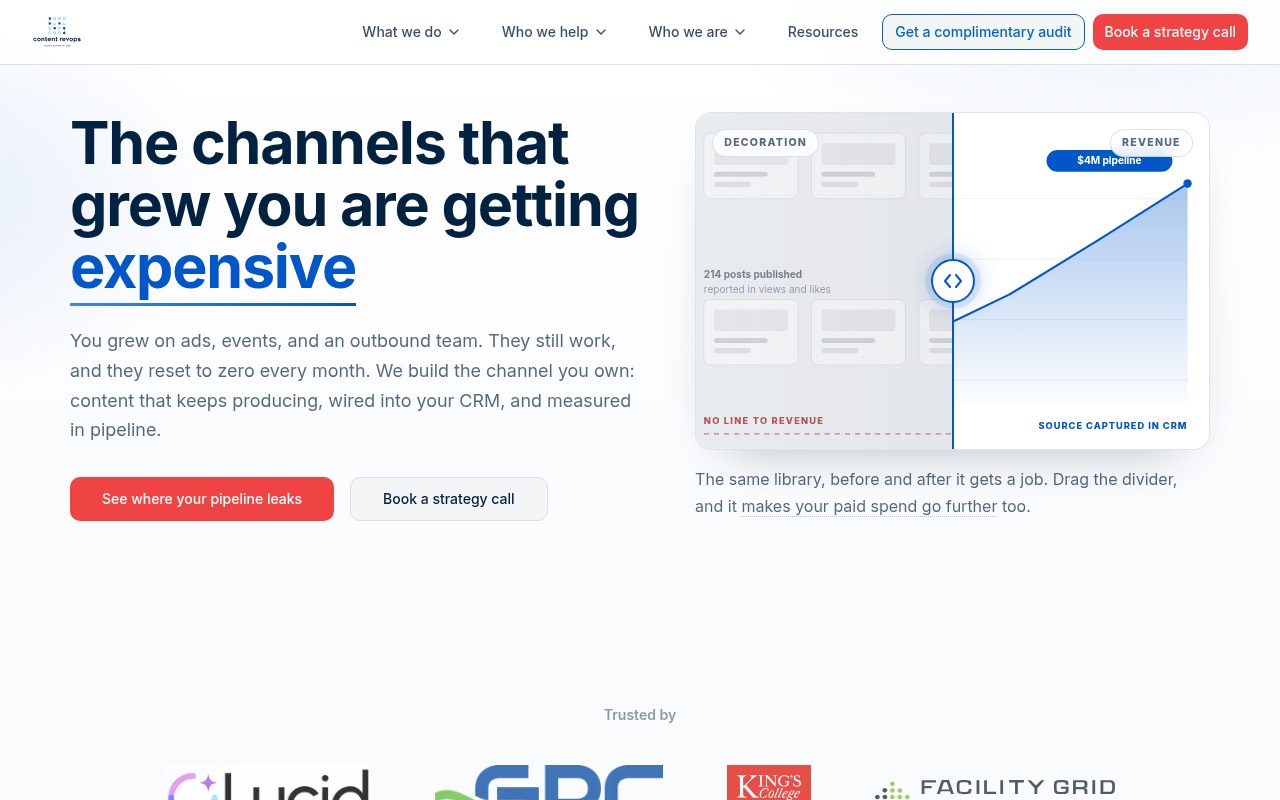
What they doContent RevOps is a content marketing and demand generation firm built for companies under a growth mandate, including PE-backed and sponsor-owned B2B. We work with portfolio companies in SaaS, software, data, and professional services, from lean teams to businesses where marketing, sales, and RevOps run in separate lanes. The common thread is pressure to show revenue, not activity, on the board's timeline. Here is what we do. Most of these companies already spent years making content, and it has no job. We give it one, as revenue infrastructure. Instead of five campaigns that do not talk to each other, we run one connected system, from the first search to closed revenue, working across data, automation, and content together. How it works. We map the buying committee and how you actually sell. We build the decision-stage content most companies skip, the comparisons and proof a careful buyer needs. We place it where those buyers look, including AI answers, not just blue links. Then we wire it into your CRM, with one written definition of a qualified lead and the source captured on every deal, so marketing reports in pipeline the board can trust. Our method and our prices are published, so you know what you are buying before you commit.
Best forPE-backed and sponsor-owned B2B companies, from lean teams to multi-department orgs, that need pipeline they can trace to revenue on the board's timeline, not another set of campaigns.
Pros
- Publishes its method and its prices, so you can see what you are buying before you commit. Most agencies on this list show neither. how we work ↗
- Has named case studies with revenue numbers, from reply rates of 14 to 18% to pipeline in the millions, each written up in full. case studies ↗
- Built for mid-market B2B with long, consultative sales, the shape most portfolio companies are in. who we serve ↗
- Runs one connected system across content, data, and automation, instead of campaigns that stop when you stop paying.
- Reports in pipeline and revenue tied to the CRM, which is the language a PE board and sponsor actually read.
Cons
- Young and small, so it fits building a durable content-led system better than spending a very large paid-ad budget fast.
- Only a handful of public reviews so far, fewer than the long-established firms here.
What they doWalker Sands is a large Chicago agency that has run integrated B2B marketing and PR since 2001. It works as a full-service retainer partner, so one team handles brand, demand generation, PR, content, and now revenue operations after it bought RevPartners in 2026. That RevOps arm matters for a PE-backed company, because it connects campaigns to the CRM and to pipeline the board can see. Named clients include John Deere, Paylocity, Semrush, and Korn Ferry, and it publishes its own research, such as a B2B AI search visibility benchmark. It is built for mid-market and enterprise companies that want strategy through to pipeline under one roof, rather than stitching point vendors together.
Best forMid-market and enterprise portfolio companies that want brand, demand, PR, and RevOps from one experienced team.
Pros
- Full-service team covers brand, demand, PR, and now RevOps after the 2026 RevPartners deal.
- Publishes original research and ranks for its own category, a sign it markets itself the way it would market you.
- Deep client proof across enterprise B2B, from John Deere to Semrush.
Cons
- Does not publish prices, so cost takes a call.
- Large and broad, so a small portfolio company may be a small account here.
What they doThe Pedowitz Group is a revenue marketing consultancy that has worked on marketing operations since 2007. It is a HubSpot partner and runs on a documented framework it calls RM6, pairing strategy with hands-on martech work in HubSpot, Marketo, and Eloqua. For a PE-backed company the draw is attribution: it is built to connect marketing spend to revenue and to fix the reporting a board cares about. Founder Jeff Pedowitz is a published author and hosts a revenue marketing podcast, and the firm runs a large glossary of answer-style content that ranks for martech and RevOps terms. It is a good fit for mid-market and enterprise teams that want revenue-marketing strategy and clean martech more than campaign production.
Best forMid-market and enterprise teams that need attribution, martech, and revenue-marketing strategy before more campaigns.
Pros
- Built around attribution and revenue reporting, which is what a PE board asks for first.
- Deep martech skill across HubSpot, Marketo, and Eloqua, backed by a documented method.
- Ranks for its own category through a large library of answer-style content.
Cons
- Horizontal and generalist, with no single industry it goes deep in.
- Does not publish prices.
What they doInverta calls itself the original account-based marketing agency and has run ABM and demand generation since 2015. The model is a consultancy: it pairs CMO-level strategists with hands-on execution and martech setup, rather than selling campaign hours. That suits a PE-backed company that needs to rebuild go-to-market quickly and target named accounts. Its client results are specific. Procore drove 75% of its outbound pipeline from ABM, and Sysdig raised marketing-sourced contract sizes by 36%. Inverta ranks for the category it sells, with terms like account-based marketing vendor and demand gen consultant landing on its own service pages, and it runs a go-to-market podcast. It fits B2B tech marketing leaders launching or rebuilding ABM across mid-market and enterprise.
Best forB2B tech marketing leaders launching or rebuilding ABM and demand gen with senior help.
Pros
- Strategy and execution from one team, led by senior ABM strategists.
- Specific, named client results, like Procore running 75% of outbound pipeline from ABM.
- Ranks for the ABM and demand-gen terms it sells, not just its brand name.
Cons
- Focused on B2B tech, so less fit outside software.
- Does not publish prices.
What they doScaled Consulting is a UK growth consultancy run by founders who have built and sold B2B businesses. It pairs go-to-market and demand generation delivery with exit, investment, and board-level advisory, which is an unusual match for a PE-backed company working toward its own sale. The team measures progress through its own platform, ScaledOS, which benchmarks enterprise value, not just leads. Client proof is named and quantified: Onelink grew revenue 252% in a year, and Kaizen trebled revenue. Scaled publishes its pricing and names its senior people, and it ranks first in the UK for demand generation agency on purpose-built service pages. The honest limits are size and geography: it is a small, UK-based team, so a large US portfolio company should check capacity.
Best forFounder-led B2B companies building toward an exit or a raise that want pipeline and operating structure at once.
Pros
- Run by operators who have exited B2B companies, with exit and board advisory built in.
- Publishes pricing and names its senior team, rare on this list.
- Named, quantified client growth, like Onelink up 252% in a year.
Cons
- A small team, so a large US portfolio company should check capacity.
- UK-based and UK-focused, with most proof in that market.

What they doPosition2 is a 20-year, full-service growth marketing agency with teams in Santa Clara and Bangalore. It runs paid media, SEO, ABM, automation, CRO, and creative, and it has its own analytics product, Arena Calibrate, that ties spend to results. For a PE-backed company that wants performance at scale across many channels, that breadth and the offshore delivery model can keep costs down. Named clients include AWS, Google Cloud, and Lenovo, which shows it can handle large accounts. The honest caveat is that Position2's own growth engine leans on paid media more than organic. For a 20-year agency its own search footprint is thin and brand-heavy, so it is stronger at running paid performance than at building the compounding organic demand that outlasts spend.
Best forMid-market and enterprise tech brands that want one full-service partner for performance across many channels.
Pros
- Full-service at scale, with paid, SEO, ABM, automation, and CRO under one roof.
- Its own analytics product ties spend to results.
- Large enterprise clients like AWS and Google Cloud.
Cons
- Leans on paid media, so demand can slow when spend stops.
- Does not publish prices.
What they doDORN is a growth partner for industrial manufacturers and distributors, and it has worked in that world for nearly 50 years. It sits between an agency and a consultancy, pairing market and channel research with embedded execution, which fits the many PE-backed industrials that sell through distributors and reps. The vertical depth is real, not claimed. Named clients include WD-40, Enerpac, Schneider Electric, and ITW, with written growth stories for GP PRO and Unirac, and DORN publishes its own research, like an NPI benchmarking study. It even ranks for sector terms such as manufacturer prices off its own articles. The limits: it is a niche, manufacturing-and-distribution shop, so it is the wrong pick for a software or services portfolio company, and it does not publish prices.
Best forPE-backed manufacturers and distributors that need demand and channel growth, not campaign delivery.
Pros
- Nearly 50 years of focus on manufacturers and distributors, with named clients like WD-40 and Schneider Electric.
- Publishes its own sector research and ranks for industrial terms.
- Knows the distributor and channel layer most agencies do not.
Cons
- Niche to manufacturing and distribution, wrong fit for software or services.
- Does not publish prices.
What they doMarsden Marketing is an Atlanta demand generation agency that has run since 2008 and is a HubSpot Platinum partner, so it is strong on HubSpot, Salesforce, and Pardot setups. In 2024 it was acquired by Trevelino/Keller, which added PR to the demand-gen offering, so one team can now handle pipeline and press. For a PE-backed company standardising on HubSpot, that platform depth plus sales-and-marketing alignment work is the draw. A client in connected devices, COX2M, reported that Marsden boosted its sales pipeline by 600% and lead generation by 300% in the first few months. The agency leans toward manufacturing and technology clients. The caveat is that its own organic footprint is modest, and it does not publish prices, so cost takes a call.
Best forHubSpot-standardised mid-market teams that want demand generation and PR from one partner.
Pros
- HubSpot Platinum partner, strong on HubSpot, Salesforce, and Pardot.
- Demand generation plus PR in one team after the 2024 Trevelino/Keller deal.
- Named client result: COX2M reported a 600% pipeline lift.
Cons
- Modest own organic footprint for its age.
- Does not publish prices.
What they doActivate Marketing Services is a pure-play demand generation shop for B2B technology companies. Its line is that pipeline for B2B tech marketers is all it does, so it does not spread into brand or PR. It sells higher-quality, sales-ready demand rather than raw MQL volume, which matters to a PE-backed company tired of leads that never close. The proof is in blue-chip references: ServiceNow, NVIDIA, and Egnyte all appear with named testimonials. Activate also publishes a long-running State of Demand Gen research report and runs regular marketer meet-ups, so it invests in the category. The honest gap is its own search footprint, which is thin and mostly brand terms, so it relies on research and events rather than ranking for the demand-gen terms it sells.
Best forB2B tech marketing leaders who want higher-quality, sales-ready demand, not raw MQL volume.
Pros
- Pure-play demand generation for B2B tech, no spreading into brand or PR.
- Blue-chip named references, including ServiceNow and NVIDIA.
- Publishes a long-running State of Demand Gen report and runs marketer meet-ups.
Cons
- Thin own search footprint, mostly brand terms.
- Does not publish prices.
What they doKnack Collective is a B2B marketing agency for enterprise technology, cybersecurity, and AI companies, and its specialty is partner and co-sell marketing across cloud ecosystems. That is a narrow but valuable skill for a PE-backed software company whose growth runs through Microsoft, AWS, or similar partners. The client proof is strong: it reports 537 million US dollars of pipeline influenced for Avanade and more than 3,600 MQLs with a 13.7% conversion rate for a Microsoft partner program, backed by 24 named enterprise logos. It also publishes a partner-marketing field guide and runs on AI-assisted production across more than 40 markets. The caveats are that its own content hub is young and thin against the terms it should own, it does not name senior leaders, and it does not publish prices.
Best forEnterprise and mid-market software firms growing through Microsoft, AWS, or other cloud partners.
Pros
- Specialist in partner and co-sell marketing across cloud ecosystems.
- Heavy enterprise proof, including 537 million dollars of pipeline influenced for Avanade.
- Publishes a partner-marketing field guide and works across more than 40 markets.
Cons
- Young, thin own content footprint.
- Does not name senior leaders or publish prices.
What they doClarify is a UK and US business development agency that has helped enterprise technology companies reach hard accounts for more than 20 years. The model is outsourced sales development and ABM, backed by data and a sales academy, so it is more about booked meetings in big accounts than inbound content. For a PE-backed company that needs to break into named enterprise targets fast, that outbound muscle is the point. The client roster is blue-chip, with Adobe, SAP, VMware, and Palo Alto Networks. Clarify carries a 4.8 rating on Clutch, from five reviews, solid for a firm that wins work mostly by referral and reputation. The trade-off is a thin own-content footprint: this is a sales-development partner, not an inbound engine, and it does not publish prices on its own site.
Best forEnterprise technology companies that need to break into large, hard-to-reach accounts via ABM and SDR.
Pros
- Two decades of enterprise ABM and outsourced sales development.
- Blue-chip clients, including Adobe, SAP, and Palo Alto Networks.
- Carries a 4.8 rating on Clutch, backed by named reviews.
Cons
- Thin own-content footprint, since it is an outbound, not inbound, shop.
- Does not publish prices on its own site.
What they doAbe is a focused agency that does one thing: B2B paid social, mostly LinkedIn ads. It runs on a documented method it calls Customer Generation, and it holds campaigns to LTV and CAC rather than lead counts, which is the right language for a PE-backed board. Its own homepage headlines more than 120 million US dollars in paid social ad spend under management, with per-lead costs cut by about 45%. Named clients cluster in B2B SaaS, including Arctic Wolf, TigerConnect, and Supermetrics. Because it is a channel specialist, Abe is a strong add-on for a portfolio company with real ad budget that wants LinkedIn run properly, but it is not a full demand-generation system on its own, and it does not publish prices or name its senior team.
Best forPE-backed companies with real ad budget that want LinkedIn and paid social held to revenue, not MQLs.
Pros
- Deep specialist in B2B paid social, with more than $120M in ad spend managed.
- Holds campaigns to LTV and CAC, not lead counts.
- Named SaaS clients, including Arctic Wolf and Supermetrics.
Cons
- A single channel, so not a full demand-generation system on its own.
- Does not publish prices or name senior staff.
What they doBailey Brand Consulting is a brand strategy and creative agency that has worked since 1985, so it is one of the oldest firms on this list. Its strength is positioning, identity, and packaging, carried through to campaigns, more than pipeline mechanics. For a PE-backed company that needs to reposition or rebrand after a deal, that is useful, and Bailey backs each named client with a written case study. Its clients cluster in manufacturing and building products, such as JBT, OPEX, Simonton, and Cornerstone Building Brands, with life sciences names like Boehringer Ingelheim too. Unusually for a brand shop, it earns organic traffic on marketing topics, a sign it practices what it sells. The caveat for this list is clear: Bailey is brand-led, not a demand-generation engine, and it does not publish prices.
Best forPE-backed manufacturers and building-products firms that need positioning and a rebrand after a deal.
Pros
- Four decades of brand strategy and creative, useful for a post-deal reposition.
- Named clients across manufacturing and building products, each with a written case study.
- Earns organic traffic on marketing topics, rare for a brand shop.
Cons
- Brand-led, not a demand-generation engine.
- Does not publish prices.
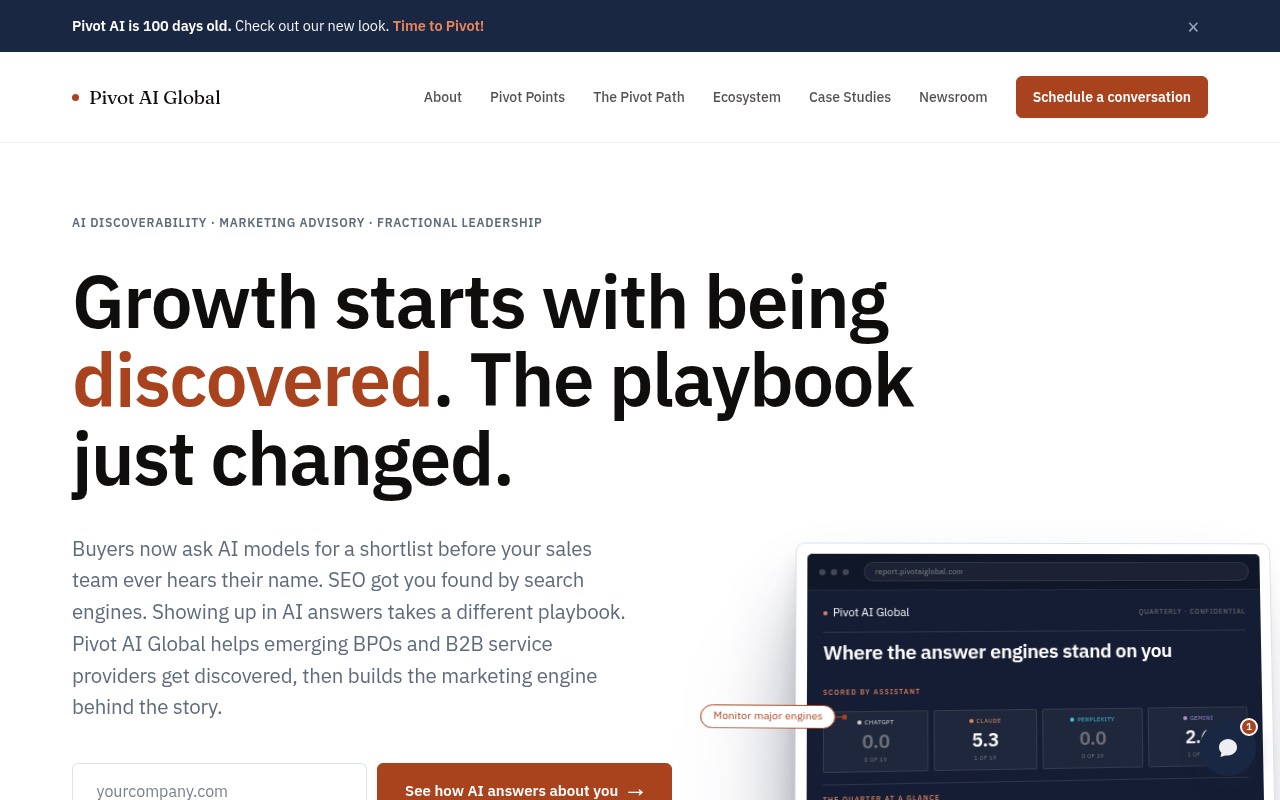
What they doPivot AI Global is a fractional CMO and growth advisory practice for emerging business process outsourcers and B2B service firms, including PE-owned ones, in the 10 to 100 million dollar revenue range. Its bet is on AI discoverability: being the name that comes up when a buyer asks ChatGPT or Perplexity for a shortlist, rather than chasing blue links. It is run by Andrew Kokes, who spent twelve years as a CMO across ten countries, and it publishes original research, including a ranking of 25 emerging BPOs against a stated methodology. For a founder-led portfolio company where the CEO is still the de facto head of marketing, that fractional model fits. The honest limits are real: it is a one-to-ten-person shop with almost no classic search footprint, no client case studies yet, and no public pricing.
Best forFounder-led BPOs and B2B service firms where the CEO is still the de facto head of marketing.
Pros
- Fractional CMO model for founder-led services and BPO firms, including PE-owned.
- Bets on AI discoverability, which is where more B2B research now starts.
- Led by a CMO with 12 years of global experience, and publishes original research.
Cons
- A one-to-ten-person shop with no client case studies published yet.
- Almost no classic search footprint, and no public pricing.
Is your content bringing in pipeline the board can see?
Get a free Content RevOps audit. We show where your content leaks revenue and what a connected system would change, measured in pipeline, not clicks.
Frequently asked questions
What should a PE-backed company want from a demand generation agency?
Pipeline it can trace to revenue, on the board's timeline. That means demand built for your buying committee, placed where buyers research, and wired to the CRM so marketing reports in pipeline and revenue, not clicks and MQLs.
How much do these agencies charge?
Most do not publish prices. Where a floor is public it tends to sit between about 4,000 and 25,000 US dollars a month, depending on scope and team size. We mark pricing as not disclosed when an agency does not share it.
How did we choose and rank these agencies?
We started from agencies that work with PE-backed and mid-market B2B companies, then kept the ones with real proof. We ranked them on fit, whether they run marketing for themselves, review evidence, transparency, and stage fit. The same checks apply to our own entry.