The best demand generation agencies for product-led (PLG) companies in 2026
Product-led companies grow differently. People find the product, try it, and decide for themselves before anyone talks to sales. A developer or an end user starts a free trial, a team spreads it, and a budget holder signs off later. Demand generation here has one job: help the right people discover, trust, and start using the product on their own. Plenty of agencies say they do this for software, but most run ads or name one or two SaaS logos and call it depth. We reviewed the agencies that work with product-led and self-serve companies and kept the ones with real proof. Below we explain each one in plain words, so you can pick the right fit.

How we chose this list
We ran the same checks on every agency, including our own. Here is what earns a spot and how we ordered them.
Who makes the list
Every agency runs real demand generation for software companies and has a working content presence of its own. We left out lead-list sellers, appointment-setters, and ads-only shops with no proof.
How we rank them, in order
- Real fit for product-led and self-serve growth, not just a couple of SaaS logos
- Whether they run marketing for themselves, and it works
- Review proof, counting how many reviews back the score
- Whether they show prices and name their team
- Fit to your stage, size, and motion
What we promise on every entry
Every claim can be traced to a source. Ratings always show how many reviews they come from. Prices are shown, or marked not shown. We ranked the top few on the strongest mix of fit and proof; positions further down are directional, and we hold our own entry to the same checks.
The shortlist at a glance
All 14 entries, ranked by the criteria above. Full detail in the cards below.
| # | Name | Pros | Cons | Best for | Pricing |
|---|---|---|---|---|---|
| 1 | Content RevOps |
|
| Product-led and self-serve software teams, from seed to scale, that want content wired to signups, activation, and expansion, not another pile of awareness posts. | $4.1-8.5k/mo |
| 2 | Gripped |
|
| Funded SaaS and AI companies that want SEO, content, and paid run as one retainer aimed at pipeline, with pricing shown up front. | £3.5-15k/mo |
| 3 | GrowthSpree |
|
| Seed to scale-up SaaS teams that want paid and demand generation run as one pipeline-accountable system on a flat monthly fee. | Not disclosed |
| 4 | Hackmamba |
|
| Developer-tool and technical SaaS companies that grow through self-serve developer adoption and need content that ranks, teaches, and gets cited by AI. | Not disclosed |
| 5 | Discovered Labs |
|
| Series A and later SaaS teams that want to be the answer when buyers ask both Google and an AI assistant for a recommendation. | Not disclosed |
| 6 | Perceptric |
|
| B2B SaaS teams with product-market fit that want an organic content engine built for pipeline and AI answers. | $4k/mo |
| 7 | PipeRocket Digital |
|
| Product-led SaaS teams that want trial-driving SEO, content, and paid built around comparison and alternative pages. | Not disclosed |
| 8 | RevvGrowth |
|
| B2B SaaS teams that want one agency for SEO, AI search, content, and paid, scoped to software. | Not disclosed |
| 9 | 42 Agency |
|
| SaaS teams that want demand generation and marketing operations fixed as one system rather than two vendors. | Not disclosed |
| 10 | Veza Digital |
|
| SaaS teams that grow through a fast, high-converting Webflow site kept visible in search and AI answers. | Not disclosed |
| 11 | Refine Labs |
|
| Funded SaaS companies, roughly Series B and up, that want to create category demand, not just capture it. | From $35k assessment |
| 12 | Directive |
|
| Mid-market and enterprise SaaS teams that want one experienced agency to run acquisition across SEO, paid, and content. | Not disclosed |
| 13 | farsiight |
|
| SaaS and growth teams that need paid media and creative to drive trials, especially in Australia and wider APAC. | Not disclosed |
| 14 | InterTeam |
|
| SaaS teams that need senior-run paid ads to drive trials, plus conversion work on the landing experience. | Not disclosed |
The list
What they doContent RevOps is a content marketing and demand generation firm built for product-led software companies. We work with self-serve and bottom-up SaaS, from seed to scale, where a developer or an end user tries the product first and a budget holder signs off later, and where the growth team is usually small. Most of these companies already publish a lot: docs, release notes, blog posts, help articles. Very little of it has a job. We give it one. We treat content as revenue infrastructure, not a publishing habit. We map the real path people take to a signup, the solo evaluator, the champion who spreads the product inside a team, and the person who approves the paid plan. We build the decision-stage and comparison content product-led buyers read before they start a trial, the material most SaaS sites never publish, and we place it where those buyers look, in search and increasingly in AI answers. Then we wire it to the product and the CRM, so you can see which content drives signups, activation, and expansion, not just traffic. Our method and our prices are published, and you work with a named team.
Best forProduct-led and self-serve software teams, from seed to scale, that want content wired to signups, activation, and expansion, not another pile of awareness posts.
Pros
- Runs content as one connected system, from the first search to signup, activation, and expansion, instead of separate campaigns that do not talk to each other. how we work ↗
- Builds the decision-stage and comparison content product-led buyers read before they start a trial, then places it in search and AI answers where self-serve buyers look.
- Wires content to the product and the CRM, so you can see which pieces drive signups and paid conversions, not just visits.
- Has named case studies for self-serve and content-led software companies, including a self-sustaining inbound engine that cut cost per lead 70 percent at Radius and a 40 percent shorter sales cycle at WinPure. case studies ↗
- Publishes its method and its prices, and backs the approach with its own 2026 research across roughly 14,000 B2B sites. our research ↗
- Named founder and team, not a rotating cast of juniors.
Cons
- Young and small, built to install and run a content-led system, not to manage large paid-ad budgets.
- Best fit for product-led and trust-led software sales, less so for pure high-velocity self-serve with no sales touch at all.
What they doGripped is a B2B marketing agency from London that works only with SaaS, AI, and tech companies. The model is a retainer: a team that plugs in and runs SEO, paid media, content, and conversion work together, rather than selling one channel. For a product-led company that matters, because self-serve growth needs search demand and a site that converts a trial, not just ads. Gripped runs the play on itself, ranking for terms like SEO expert UK and UK marketing agencies off its own hubs. It names enterprise clients including Ideagen, Epicor, Ravelin, and Crownpeak, and publishes results such as 1.3 million pounds in new pipeline in a quarter for Crownpeak. It also publishes its pricing, which most agencies on this list do not.
Best forFunded SaaS and AI companies that want SEO, content, and paid run as one retainer aimed at pipeline, with pricing shown up front.
Pros
- Works only with SaaS, AI, and tech, so the team knows the product-led playbook.
- Runs SEO and content on itself and ranks for competitive category terms, a sign the dogfooding is real.
- Publishes its pricing, from 3,500 pounds a month, which is rare here.
- Strong, named review base at 4.9 from 32 Clutch reviews.
Cons
- A retainer that spans many channels, so it fits companies with budget to fund the full engine, less so a seed team that needs one thing.
- Priced in pounds and UK-based, so US teams should plan for timezone overlap.
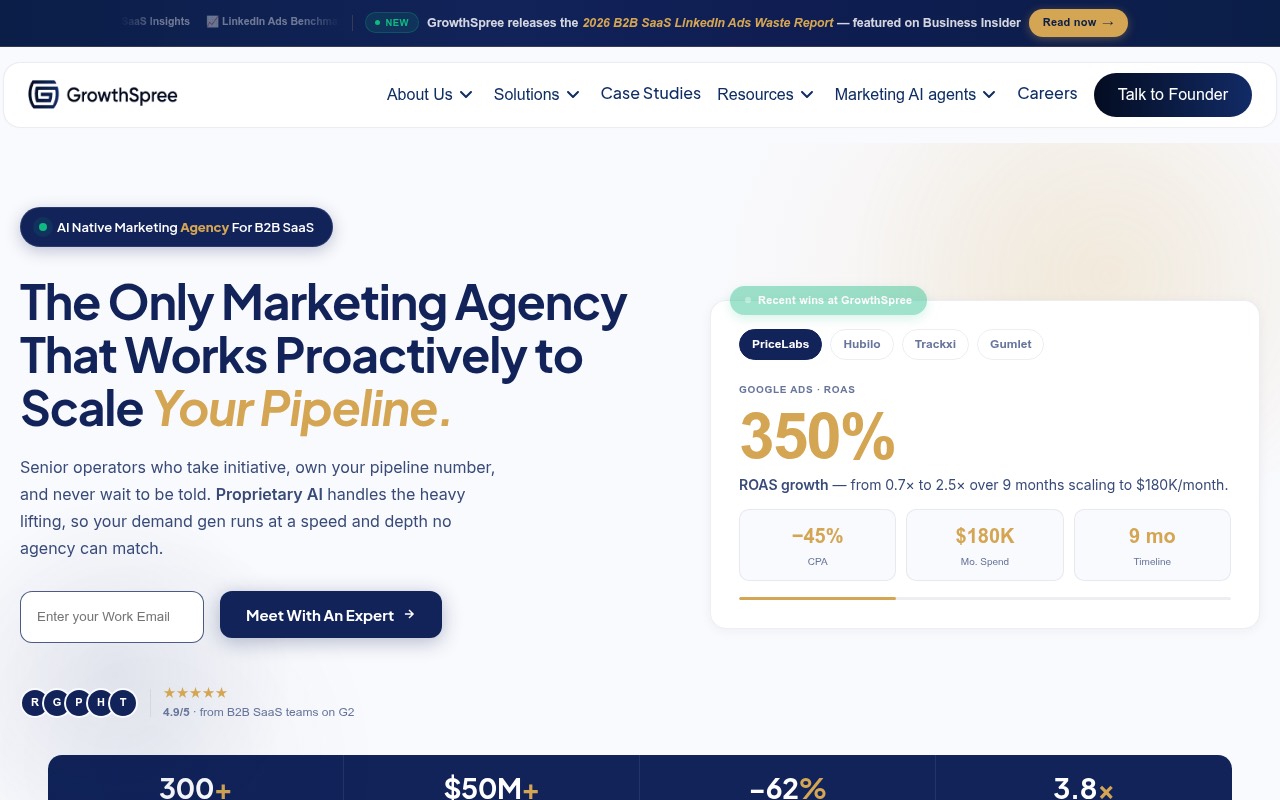
What they doGrowthSpree is a demand generation agency for B2B SaaS, run as a monthly retainer with a flat fee and no long lock-in. It pairs senior operators with its own set of AI tools that push toward pipeline tracked in the CRM, not lead volume. For a product-led company, the useful part is that it treats paid and demand generation as one system feeding signups, and it reports on what reaches the pipeline. It names a clear roster of SaaS clients, including PriceLabs, Hubilo, Rocketlane, Gumlet, and Hasura, and publishes results such as lifting PriceLabs return on ad spend from 0.7 to 2.5 times while scaling spend. It also runs original research, like a LinkedIn Ads waste report picked up by Business Insider, and holds a 4.9 from 49 reviews on G2.
Best forSeed to scale-up SaaS teams that want paid and demand generation run as one pipeline-accountable system on a flat monthly fee.
Pros
- Works only with B2B SaaS and reports on pipeline in the CRM, not lead counts.
- Flat monthly fee with no long contract, which suits a lean team watching cash.
- Named SaaS clients and published results, like PriceLabs return on ad spend from 0.7 to 2.5 times.
- Strong, verified review base at 4.9 from 49 reviews on G2.
Cons
- Paid acquisition is the core, so it leans more to capturing demand than building organic, self-serve discovery.
- Does not publish a price, so you need a call to learn the flat fee.
What they doHackmamba is a content marketing agency built for developer tools and technical software. This is the closest fit on the list for a true product-led motion, where the people who adopt the product are engineers who learn by reading and trying, not by talking to sales. Hackmamba writes technical content, documentation, and SEO built to rank and to get cited by AI answers, and it runs developer community and DevRel work alongside. It has published more than a thousand pieces and names a deep roster of developer-tool clients, including Auth0, Netlify, Replit, Databricks, Sourcegraph, Appwrite, and Cloudinary. One example: 39 technical articles drove 49,139 organic clicks for OpenRouter in three months. For a company whose growth runs through developer adoption, that is the exact skill set.
Best forDeveloper-tool and technical SaaS companies that grow through self-serve developer adoption and need content that ranks, teaches, and gets cited by AI.
Pros
- Specialises in developer and technical content, the hardest kind to get right for product-led tools.
- Builds docs, SEO, and AI-answer visibility together, which is how developers actually find tools.
- Deep roster of named developer-tool clients, from Auth0 to Databricks.
- Ranks for the informational developer terms its clients' buyers search, a sign it runs its own play.
Cons
- No public review score on Clutch or G2 yet, so you lean on its client list and case studies for proof.
- Does not publish a price.
What they doDiscovered Labs is a newer agency that runs SEO and answer engine optimisation as one service, aimed at winning both Google and AI assistants like ChatGPT, Claude, and Perplexity. For a product-led company this matters, because self-serve buyers increasingly ask an AI for a shortlist before they ever search. The team is led by a former Stanford AI researcher alongside senior marketers, and it reports on pipeline rather than rankings. It publishes original studies of how AI engines cite sources, and its own blog and research pages rank for the exact category terms it sells, like answer engine tools and AI citations. Named clients include incident.io, Gladia, Instantly, and Granola. One result: Gladia grew sales-accepted leads sevenfold in four months, with most AI-referred leads coming from LLM search.
Best forSeries A and later SaaS teams that want to be the answer when buyers ask both Google and an AI assistant for a recommendation.
Pros
- Runs SEO and answer engine optimisation together, which maps to how self-serve buyers now research.
- Publishes original research on AI citations and ranks its own content for the terms it sells.
- Names a senior team and reports on pipeline, not just rankings.
- Named SaaS clients with specific results, like Gladia's sevenfold rise in sales-accepted leads.
Cons
- No public review score yet, so proof rests on named client results.
- Does not publish a price, and it is a young firm.
What they doPerceptric is an SEO and GEO agency built for B2B SaaS companies that already have product-market fit and want an inbound engine instead of leaning on outbound or paid. GEO means optimising for AI answers as well as search. The pitch fits a product-led company well: build organic content that captures demand and traces to booked calls through GA4, Search Console, and the CRM. It ranks for competitive terms like B2B content marketing agencies and B2B marketing agency off its own blog, which is the play it sells. Named clients include Katalon, Anduin, ScoutQA, and Momos, and it reports results such as 4 times ARR growth and a large traffic lift for Katalon. It is one of the few here that publishes pricing, with SEO and GEO tiers starting at 4,000 dollars a month.
Best forB2B SaaS teams with product-market fit that want an organic content engine built for pipeline and AI answers.
Pros
- Focused on SaaS SEO and GEO, with content tied to booked calls through analytics and the CRM.
- Publishes pricing, with tiers starting at 4,000 dollars a month.
- Ranks its own blog for competitive category terms, a sign the method works.
- Named clients and reported results, like 4 times ARR growth at Katalon.
Cons
- A young firm, founded in 2024, with no public review score yet.
- Organic SEO and GEO take time to compound, so it is not a quick-pipeline fix.
What they doPipeRocket Digital is a B2B SaaS marketing agency that spells out the product-led versus sales-led split and builds for both. For product-led companies, it builds the bottom-of-funnel content first, comparison and alternative pages that get the right buyers into a free trial, then layers SEO, paid, and answer engine work, plus marketing-ops attribution so you can see what drives signups. Senior operators embed with your team rather than handing work to juniors. It ranks for the terms a SaaS marketing agency should own, like SaaS PPC agency and enterprise SEO agency, off its own comparison and tool pages. Named clients include Storylane, Spendflo, DevRev, and Goldcast, with results such as 2.5 times growth and 82 percent more demos at Storylane. It holds 4.7 from 18 reviews on Clutch and says it has shipped work for more than 70 SaaS brands.
Best forProduct-led SaaS teams that want trial-driving SEO, content, and paid built around comparison and alternative pages.
Pros
- Names the product-led versus sales-led split and builds trial-driving bottom-of-funnel content for it.
- Senior operators embed with your team rather than handing off to juniors.
- Ranks for the SaaS category terms it sells, a sign it runs its own play.
- 4.7 from 18 Clutch reviews and named SaaS clients with results.
Cons
- Does not publish a price.
- A younger, smaller shop, founded in 2023, so it fits scaling teams more than large enterprises.
What they doRevvGrowth is a B2B SaaS agency that covers SEO, AI search, content, PPC, ABM, and marketing automation, with everything scoped to SaaS rather than general marketing. Its service hubs are built around SaaS SEO, SaaS PPC, and SaaS content, and they rank for the terms it sells, like AEO tracker and content pillars, which is a good sign for a product-led company that lives on organic discovery. Founder Karthick Raajha is named with more than twenty years in B2B marketing. It names real SaaS clients with numbers, including 21 million dollars in marketing-sourced pipeline in 90 days for Vymo and a jump from 11 to 47 qualified leads a month for HyperVerge. It is based in India, which can mean a lower cost base and some timezone overlap to plan around.
Best forB2B SaaS teams that want one agency for SEO, AI search, content, and paid, scoped to software.
Pros
- Everything is scoped to B2B SaaS, from SEO to paid to automation.
- Service hubs rank for the SaaS search terms the agency sells.
- Named clients with real numbers, like Vymo's 21 million dollars in sourced pipeline in 90 days.
- Named, experienced founder leading the work.
Cons
- Only one public review so far, so there is little third-party proof of a score.
- Does not publish a price, and the team is based in India, so plan for timezones.
What they do42 Agency is a SaaS demand generation and marketing operations shop from Toronto. Its angle is data: it publishes its own benchmarks for B2B paid media, email, and LinkedIn, drawn from 87 client accounts and more than 5 million dollars in managed spend, then runs demand generation and marketing ops off that data. For a product-led company, the marketing-ops side is the draw, because self-serve growth needs HubSpot or Pardot wired so signups are tracked, scored, and routed. It names recognisable SaaS clients including ProfitWell, Cin7, Teamwork, Float, and Charma, with results such as cost per activation down 76 percent at Charma and cost per qualified lead down 40 percent at ProfitWell. It holds a 5.0 on Clutch, though from only 4 reviews.
Best forSaaS teams that want demand generation and marketing operations fixed as one system rather than two vendors.
Pros
- Runs demand generation and marketing ops together, so signups are tracked and routed properly.
- Publishes its own first-party B2B benchmarks and runs the play on itself.
- Named SaaS clients with hard results, like cost per activation down 76 percent at Charma.
Cons
- Only 4 public reviews, so the perfect score rests on a small sample.
- Does not publish a price, and the senior team is not named on the site.
What they doVeza Digital is a Webflow agency for B2B and SaaS companies that pairs website design and build with SEO, answer engine optimisation, and demand generation. For a product-led company, the website is the product's front door, the page that has to turn a visitor into a trial, so a team that builds fast, high-converting sites and keeps them visible in search and AI answers is a real fit. Veza uses its own method for making sites readable by AI search, and it names SaaS clients including Chili Piper, Grata, Wisedocs, Smartrr, and Kizen. It reports results such as 144 percent organic traffic growth for Concordium, and holds a strong 4.9 from 45 reviews on Clutch.
Best forSaaS teams that grow through a fast, high-converting Webflow site kept visible in search and AI answers.
Pros
- Builds the Webflow site that serves as a product-led company's main conversion surface.
- Pairs the build with SEO and answer engine work, so the site stays visible.
- Named SaaS clients and a strong 4.9 from 45 Clutch reviews.
Cons
- Core strength is web design and build, so a full demand program may need other help.
- Its own homepage is set to hide from Google search, an odd signal from an SEO agency.
- Does not publish a price.
What they doRefine Labs is one of the best-known demand generation agencies in B2B SaaS, built on the idea of creating demand rather than only capturing it. That idea fits product-led growth well, because self-serve companies grow on word of mouth, dark social, and content that builds intent before anyone fills in a form. Refine Labs runs its own content machine, a newsletter, a podcast, and a research library, and ranks at the top for demand generation agency. It names a serious client wall including Clari, Cognism, BeyondTrust, and Showpad, and reports results like a 67 percent lower cost of acquisition at Clari. It serves funded companies, roughly Series B and beyond, and publishes its entry point: a Revenue Performance Assessment starting at 35,000 dollars.
Best forFunded SaaS companies, roughly Series B and up, that want to create category demand, not just capture it.
Pros
- Built around creating demand, which is how product-led companies grow before buyers fill in a form.
- Runs a strong content machine of its own and ranks first for demand generation agency.
- Publishes its starting price and names its senior team, both rare here.
- Serious, named client wall with reported results, like 67 percent lower cost of acquisition at Clari.
Cons
- Built for funded companies with real budgets, so it is a poor fit for early, self-serve teams watching cash.
- Thin public review base: 4.8 from only 4 reviews on G2, and no Clutch reviews.
What they doDirective is a larger, full-service B2B agency for SaaS and tech, running SEO, paid media, content, and conversion work under a method it calls Customer Generation. It is the biggest own-marketing engine on this list, ranking for thousands of terms off its own glossary and guides, though a lot of that traffic sits at the top of the funnel. For a product-led company, Directive fits when you have scaled past the early stage and want one experienced team to run acquisition across channels. It names enterprise clients including Uber Freight, Calendly, Gong, and Adobe, and reports more than 1 billion dollars in revenue influenced across 420 brands. It holds a 4.8 from 56 reviews on Clutch, strong proof from a large sample, though it does not publish a price.
Best forMid-market and enterprise SaaS teams that want one experienced agency to run acquisition across SEO, paid, and content.
Pros
- Full-service across SEO, paid, and content under one documented method.
- Strong, named client wall including Calendly and Gong, and a 4.8 from 56 Clutch reviews.
- Runs a large content engine of its own.
Cons
- Built for mid-market and enterprise, so it is a heavy fit for an early self-serve team.
- A lot of its own ranking content is top-of-funnel glossary traffic, not buying-intent terms.
- Does not publish a price.

What they dofarsiight is an award-winning performance marketing agency from Brisbane that runs paid media, creative, and growth strategy for B2B and modern consumer brands. For a product-led company, farsiight fits the paid side of the motion: getting the right people into a free trial through Google and paid social, backed by creative and data. It also keeps a resources hub that ranks for its own category terms, like Google Ads for SaaS, so the dogfooding is real rather than branded-only. Named clients include Go1 and Simpro, and it reports growing one client's revenue from 2.2 to 8 million dollars in two years. Its review proof is the strongest on this list, a 5.0 from 80 reviews on Clutch. It spans B2B and consumer work, so it is less of a pure SaaS specialist.
Best forSaaS and growth teams that need paid media and creative to drive trials, especially in Australia and wider APAC.
Pros
- Strongest review proof on this list, a 5.0 from 80 Clutch reviews.
- Runs paid media and creative that get buyers into a trial, backed by data.
- Keeps a content hub that ranks for its own category terms.
Cons
- Paid-led, so it covers demand capture more than organic, self-serve discovery.
- Serves consumer brands too, so it is less of a pure SaaS specialist, and it is APAC-based.
- Does not publish a price.
What they doInterTeam is a lean, paid-ads agency from Toronto that runs Google, LinkedIn, Reddit, Meta, and Bing campaigns for B2B SaaS and services. For a product-led company, InterTeam covers one clear job: using paid to get qualified people into a free trial, with conversion-rate work to lift what the trial does with them. It is a small team, so you get senior hands on the account rather than juniors. It runs a working blog that ranks for practitioner terms like Reddit ad specs and LinkedIn ad specs, the exact discipline it sells. Named clients include Coefficient, Rise Vision, and TaskRay, with results such as a 166 percent lift in conversion rate in three months at Coefficient. It holds a 5.0 from 23 reviews on Clutch, strong proof for a young firm.
Best forSaaS teams that need senior-run paid ads to drive trials, plus conversion work on the landing experience.
Pros
- Senior-run paid ads across Google, LinkedIn, Reddit, and more, aimed at qualified trials.
- Runs a practitioner blog that ranks for the ad terms it sells.
- Strong proof for a young firm, a 5.0 from 23 Clutch reviews, with named clients and results.
Cons
- Paid ads are the whole offer, so it covers one slice of a product-led program, not organic or content.
- Small team and does not name its senior staff on the site.
- Does not publish a price.
Is your product-led content driving signups?
Get a free Content RevOps audit. We show where your content leaks revenue and what a connected system would change, benchmarked against our 2026 research across roughly 14,000 B2B sites.
Frequently asked questions
What does a demand generation agency do for a product-led company?
It helps the right people discover and trust your product before they talk to sales. For product-led growth that means content and search built for self-serve buyers, comparison and decision-stage pages that lead to a free trial, visibility in AI answers, and a clear line from content to signups and activation in your CRM.
How much do these agencies charge?
Most do not publish a price. Where a floor is public it ranges widely, from about 4,000 dollars a month for a focused SEO or content program to 35,000 dollars for a fixed assessment, depending on scope and team size. We mark pricing as not disclosed when an agency does not share it.
How did we choose and rank these agencies?
We reviewed the agencies that work with product-led and self-serve software companies, then kept the ones with real proof. We ranked them on fit for product-led growth, whether they run marketing for themselves, review evidence, transparency, and fit to your stage. The same checks apply to our own entry.