The best demand generation agencies for RevOps leads in 2026
RevOps leads own the plumbing that turns marketing and sales into revenue: the CRM, the data, the routing, and the reporting the board reads. When you hire a demand generation agency, you are not buying more campaigns. You are buying pipeline that shows up in the system, attributes cleanly, and holds up when finance asks where it came from. Plenty of agencies say they are revenue-focused. Most still report clicks and leads, then leave your team to reconcile it. We looked for demand generation agencies that work the way a RevOps leader needs, wiring content and campaigns into HubSpot, Marketo, Salesforce, and Pardot, and measuring real pipeline. Below we explain each in plain words, with honest pros and cons.

How we chose this list
We used the same checks on every agency, including our own. Here is what earns a spot and how we ordered them.
Who makes the list
Every agency runs real demand generation and ties it to pipeline. We left out lead-list sellers, appointment-setters, and ads-only shops with no attribution.
How we rank them, in order
- Real revenue and RevOps depth, not just campaign delivery
- Whether they run marketing for themselves, and it works
- Review proof, counting how many reviews back the score
- Whether they show prices and name their team
- Fit to your CRM, your martech, and your team's size
What we promise on every entry
Every claim can be traced to a source. Ratings always show how many reviews they come from. Prices are shown, or marked not shown. We do not give any agency a made-up score, and we hold our own entry to the same checks.
The shortlist at a glance
All 15 entries, ranked by the criteria above. Full detail in the cards below.
| # | Name | Pros | Cons | Best for | Pricing |
|---|---|---|---|---|---|
| 1 | Content RevOps |
|
| Revenue teams and RevOps leads at B2B SaaS and professional services firms that want content wired into the CRM and tied to pipeline, not another campaign to reconcile. | $4.1-8.5k/mo |
| 2 | RevPartners |
|
| Revenue teams that need the HubSpot engine behind demand generation rebuilt and run by an embedded RevOps team. | From $9,850/mo |
| 3 | The Pedowitz Group |
|
| Mid-market and enterprise teams that want a senior consulting partner to connect marketing, martech, and revenue. | Not disclosed |
| 4 | 42 Agency |
|
| Funded B2B SaaS teams that want demand generation and marketing operations fixed together by one partner. | From $6,500/mo |
| 5 | Kuno Creative |
|
| Mid-market and enterprise B2B teams that want brand, demand, and RevOps from one long-term partner. | Not disclosed |
| 6 | Spear Marketing Group |
|
| Revenue teams whose demand generation and martech execution currently sit in separate lanes. | Not disclosed |
| 7 | New Perspective |
|
| Mid-market industrial, cleantech, and tech teams that want demand generation held to a pipeline standard. | Not disclosed |
| 8 | Marsden Marketing |
|
| B2B teams that want demand generation and HubSpot-driven RevOps from one integrated partner. | Not disclosed |
| 9 | SalesPlaybook |
|
| DACH B2B software teams that want pipeline generation, HubSpot CRM, and a single trusted forecast. | From CHF 4,000/mo |
| 10 | Ledger Bennett |
|
| Large, global revenue teams that need demand generation delivery plus embedded martech talent. | Not disclosed |
| 11 | Scaled |
|
| Founder-led B2B teams that want go-to-market strategy and a RevOps practice from one small, senior consultancy. | From GBP 1,000/mo |
| 12 | Gripped |
|
| SaaS, AI, and tech teams that want demand generation wired to attribution and pipeline. | From GBP 3,500/mo |
| 13 | Position2 |
|
| Enterprise teams that want full-service scale plus a marketing analytics and attribution layer. | Not disclosed |
| 14 | Digital Wasabi |
|
| Nordic B2B SaaS teams that spend on ads but cannot attribute pipeline to a channel. | Not disclosed |
| 15 | Fractional Demand |
|
| Lean B2B SaaS teams that need RevOps and demand ownership without hiring a full function. | Not disclosed |
The list
What they doContent RevOps is a content marketing and demand generation firm built for revenue teams. We work with B2B SaaS and professional services companies where marketing, the CRM, and sales enablement each run in their own lane, and nobody can prove what content actually returns. That gap is what a RevOps lead lives with every day. Most companies already own a pile of content. It sits on a blog, earns a few clicks, and never touches the pipeline. We give that content a job. We map your buying committee and your sales motion, then build the decision-stage material your market needs, and place it where those buyers look, including AI answers. Then we wire it into the CRM. Leads are enriched, scored, and segmented, follow-up is automated, and every piece is tied back to pipeline and revenue in HubSpot and Looker, so you can show which content produced which deal. That is the part a RevOps buyer cares about most: not more activity, but a system you can measure and trust. We publish our method and our prices, from 4,100 to 8,500 US dollars a month, so you know what you are buying before the first call.
Best forRevenue teams and RevOps leads at B2B SaaS and professional services firms that want content wired into the CRM and tied to pipeline, not another campaign to reconcile.
Pros
- Runs one connected system from first search to closed revenue, instead of campaigns that never touch the pipeline.
- Wires content into the CRM with enrichment, lead scoring, and attribution, so pipeline is provable rather than guessed. how we work ↗
- Has named case studies with real pipeline numbers, from a fintech resource hub that influenced 3 to 4 million dollars to a webinar system behind a 2 million dollar-plus pipeline. case studies ↗
- Publishes its method and its prices, from 4,100 to 8,500 dollars a month. Most agencies here hide both. how we work ↗
- Built for careful B2B buyers and for AI answers, measured on pipeline and revenue rather than clicks.
Cons
- Young and small, so it fits building a content-led revenue system better than running large enterprise paid-media budgets.
- Newer to the market than the established consultancies on this list.
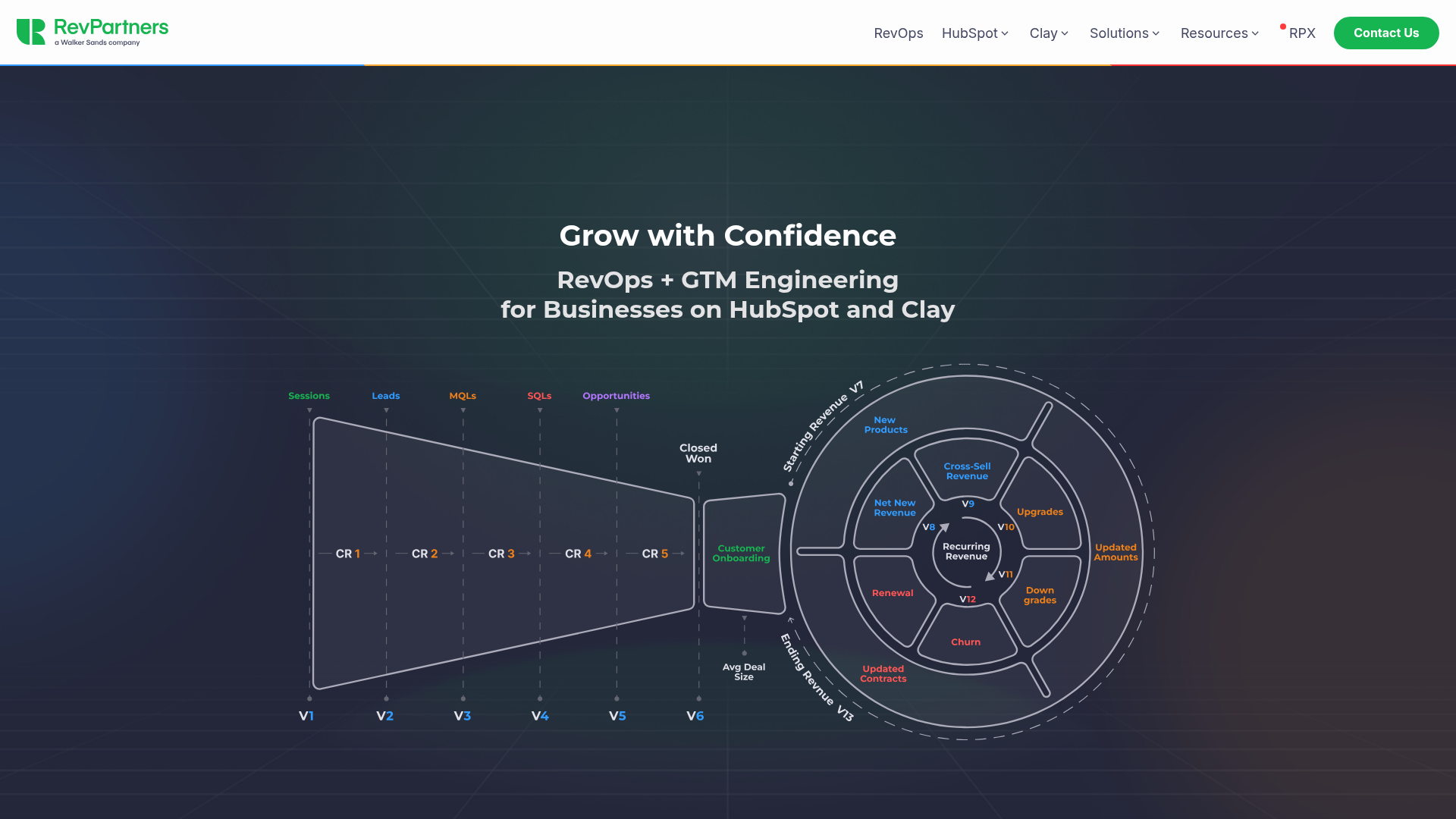
What they doRevPartners is the closest thing on this list to a pure RevOps shop. The model is a fractional revenue team embedded in yours, or an ongoing RevOps-as-a-Service retainer, rather than a campaign agency. They build and run the HubSpot instance behind demand generation: CRM architecture, lead routing, data flows, and a Revenue Performance Model that ties marketing to pipeline, retention, and expansion. They are the only firm holding Elite accreditation with both HubSpot and Clay, and they publish their prices, which start around 9,850 dollars a month. Clients include Eventbrite, Zoom, and GardaWorld. In June 2026 they were acquired by Walker Sands and now operate as a Walker Sands company, so the independent-boutique era is over, but the RevOps engineering is exactly what a RevOps lead is buying.
Best forRevenue teams that need the HubSpot engine behind demand generation rebuilt and run by an embedded RevOps team.
Pros
- Runs as an embedded RevOps team or an ongoing service, not a campaign vendor, so it owns the CRM and pipeline plumbing.
- The only agency holding Elite accreditation with both HubSpot and Clay, with 700+ HubSpot certifications.
- Publishes its prices, starting around 9,850 dollars a month.
- Ties marketing to pipeline, retention, and expansion through a documented Revenue Performance Model.
Cons
- Now a Walker Sands company after a 2026 acquisition, so it is no longer an independent boutique.
- Entry pricing near 9,850 dollars a month puts it out of reach for very small teams.
What they doThe Pedowitz Group is a revenue marketing consultancy, not a campaign agency, and it helped define the category: its team coined the term Revenue Marketing and built the RM6 maturity framework that ties marketing activity to pipeline and revenue. The work is strategy plus martech operations. They architect, integrate, and optimize inside HubSpot, Marketo, Eloqua, and Salesforce, which is precisely the layer a RevOps lead owns. Founded in 2007 and still privately held and founder-led by Jeff Pedowitz, they carry blue-chip clients such as Charles Schwab, Broadridge, Zoetis, and Cisco. A HubSpot Platinum partner with a deep glossary and thought-leadership engine, they fit mid-market and enterprise teams that want a senior consulting partner to connect marketing, martech, and revenue, rather than a vendor to run ads.
Best forMid-market and enterprise teams that want a senior consulting partner to connect marketing, martech, and revenue.
Pros
- A named revenue marketing consultancy that architects HubSpot, Marketo, Eloqua, and Salesforce, the systems a RevOps team owns.
- Helped define revenue marketing and built the RM6 framework linking marketing to pipeline.
- Long, credible client roster including Charles Schwab, Broadridge, and Cisco.
- Independent and founder-led since 2007, so no holding-company churn.
Cons
- Does not publish prices, so budget fit takes a call.
- A strategy and consulting partner, so lighter teams may want more hands-on execution.

What they do42 Agency runs demand generation and marketing operations as one retainer, which is unusual and exactly what a RevOps lead wants. Alongside campaigns, they handle HubSpot and Pardot implementation, marketing automation migrations, CRM work, integrations, and an attribution and reporting layer with dashboards and marketing mix modeling. They publish their own B2B benchmarks built from 87 client accounts and more than 5 million dollars in managed ad spend, then run the play on that data, which is real dogfooding. Named clients include ProfitWell, Cin7, and Charma. Pricing is public, with demand generation starting around 6,500 dollars a month and marketing-ops retainers from 3,800. The main caveat is focus: their ICP is B2B SaaS at Series A and beyond with 5 million dollars or more in revenue, so they fit that profile best.
Best forFunded B2B SaaS teams that want demand generation and marketing operations fixed together by one partner.
Pros
- Runs demand generation and marketing operations, including HubSpot and Pardot builds, as one retainer.
- Ships an attribution and reporting layer with dashboards and marketing mix modeling.
- Publishes first-party benchmarks from 87 accounts and 5 million dollars in managed spend.
- Shows its prices, with demand generation from around 6,500 dollars a month.
Cons
- Focused on B2B SaaS at Series A and up, so it is a narrow fit outside that profile.
- No public third-party review score to point to.

What they doKuno Creative is a full-service, employee-owned agency that has run for more than 25 years and joins brand, demand generation, sales enablement, and a dedicated RevOps practice into one revenue system. For a RevOps lead the draw is the HubSpot depth: Kuno is a HubSpot Diamond partner with CRM implementation, data migration, and solutions-architecture accreditations. Engagements are long retainers, and clients stay an average of three years or more. The client list is heavyweight, including Aramark, BASF, Samsung, and symplr. Kuno reports a 5.0 average across 156 reviews gathered on Google and HubSpot, which is strong proof, though it is a self-published aggregate rather than a single third-party platform score. It fits mid-market and enterprise teams that want pipeline tied back to revenue, not just campaigns shipped.
Best forMid-market and enterprise B2B teams that want brand, demand, and RevOps from one long-term partner.
Pros
- Joins demand generation, sales enablement, and a dedicated RevOps practice in one team.
- HubSpot Diamond partner with CRM implementation and data-migration accreditations.
- Heavyweight clients including Aramark, BASF, and Samsung, and clients stay three years or more.
- Reports a 5.0 average across 156 reviews.
Cons
- The 156-review, 5.0 score is a self-published aggregate of Google and HubSpot, not a single third-party platform rating.
- Does not publish prices.
What they doSpear Marketing Group runs demand generation, creative, and marketing operations as one team, so the campaign and the martech behind it do not sit in separate lanes. That structure is why it lands on a RevOps list: its people are hands-on platform experts across Marketo, HubSpot, Pardot, and Salesforce, building and running the automation, scoring, and reporting under a full-funnel program. The agency has operated for more than 16 years and works with a striking client roster for its size, including Dropbox, Intuit, Amazon, and Lattice. Its ABM work is framed around aligning sales and marketing to move pipeline, another RevOps concern. Spear is independent and led by CEO Matt Randolph and president Howard Sewell. It does not publish pricing, so budget fit takes a conversation.
Best forRevenue teams whose demand generation and martech execution currently sit in separate lanes.
Pros
- Runs demand generation and marketing operations as one team across Marketo, HubSpot, Pardot, and Salesforce.
- Client roster punches above its size, with Dropbox, Intuit, Amazon, and Lattice.
- ABM built around aligning sales and marketing to move pipeline.
Cons
- Does not publish prices or a third-party review score.
- A broad full-funnel shop, so very early teams may not need its depth.
What they doNew Perspective is a growth marketing retainer agency with a RevOps-friendly creed, printed right on its homepage: if marketing cannot prove pipeline, it is not doing its job. In practice that means the demand programs are wired to measurement. As long-standing HubSpot partners, they support the CRM, automation, and reporting infrastructure behind the campaigns, not just the campaigns themselves. The firm has operated for more than 20 years and works with industrial, cleantech, and SaaS companies such as Carbon Clean, Agrify, and QiO Technologies. It carries a verified 4.9 rating from 10 reviews on Clutch. New Perspective fits mid-market B2B teams that want demand generation held to a pipeline standard, though its sweet spot leans toward manufacturing and industrial tech more than pure software.
Best forMid-market industrial, cleantech, and tech teams that want demand generation held to a pipeline standard.
Pros
- Holds demand generation to a pipeline standard and supports the HubSpot CRM, automation, and reporting behind it.
- More than 20 years in business with industrial and cleantech clients like Carbon Clean and Agrify.
- Verified 4.9 rating from 10 reviews on Clutch.
Cons
- Only 10 reviews back the 4.9 score, a thinner sample than some peers here.
- Leans toward manufacturing and industrial tech, so pure-software teams may want a specialist.

What they doMarsden Marketing is an award-winning demand generation retainer agency that markets under the line Marketing That Sells, and it backs that with real RevOps plumbing. It runs dedicated Revenue Operations and Sales and Marketing Alignment practices, powered by HubSpot, Salesforce, and Pardot, and it is a HubSpot Platinum partner, so the pipeline and the martech come from one team. Founded in 2008 in Atlanta, it works with B2B clients such as COX2M, Alithya, and Foundry45, and reports outcomes like a 600 percent lift in a client's sales pipeline. In 2024 the agency was acquired by growth-marketing and PR firm Trevelino/Keller and now operates as a TK company, which added PR to the offering but also folded it into a larger parent. It does not publish pricing.
Best forB2B teams that want demand generation and HubSpot-driven RevOps from one integrated partner.
Pros
- Runs dedicated RevOps and sales-marketing-alignment practices on HubSpot, Salesforce, and Pardot.
- HubSpot Platinum partner with an award-winning demand generation track record since 2008.
- Reports concrete pipeline outcomes, such as a 600 percent lift for client COX2M.
Cons
- Acquired by Trevelino/Keller in 2024, so it now sits inside a larger parent rather than standing alone.
- Does not publish prices or a third-party review score.
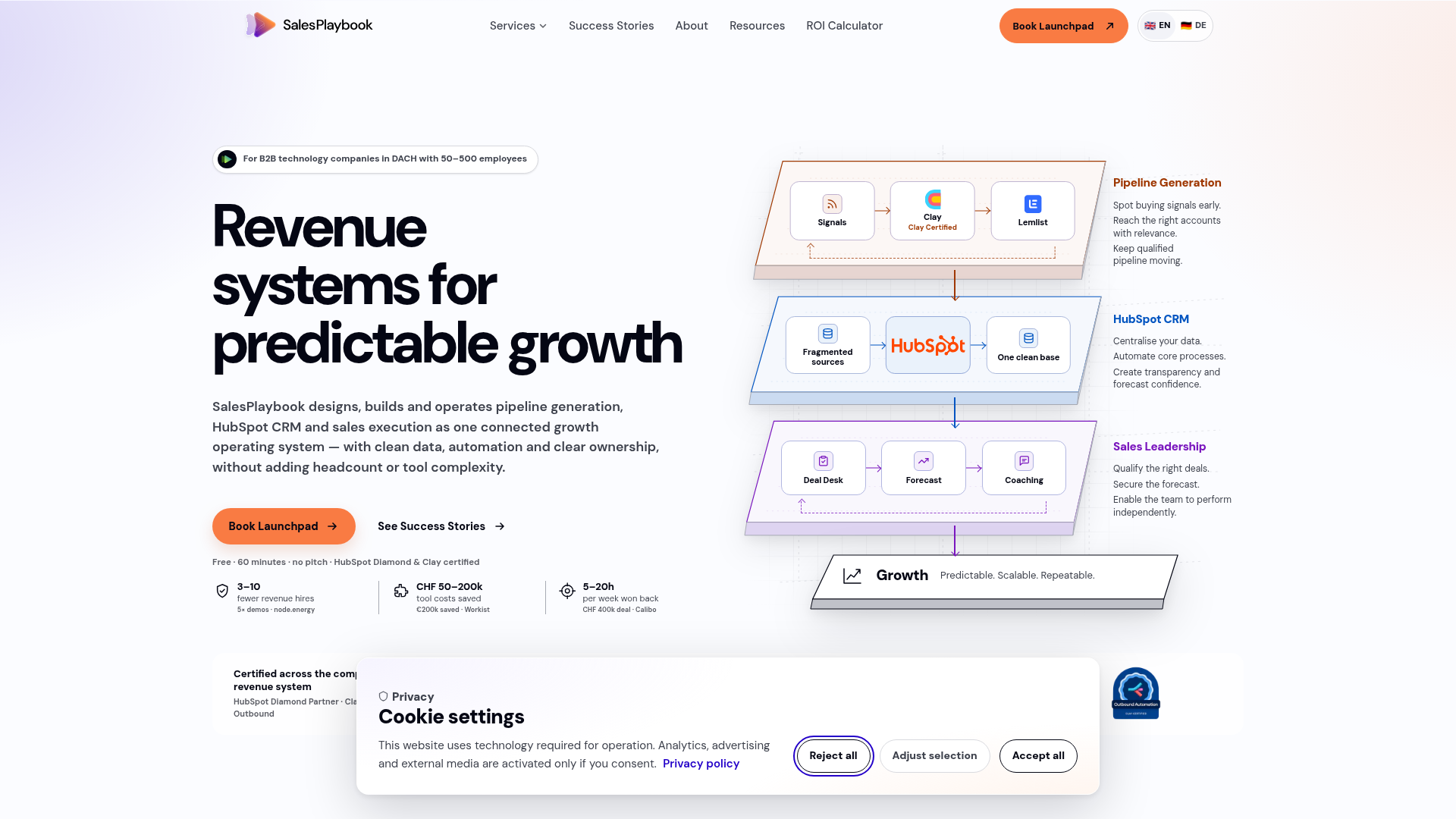
What they doSalesPlaybook is a fractional revenue partner for B2B software companies in the DACH region, and it is one of the most literal RevOps entries here. It designs, builds, and operates pipeline generation, HubSpot CRM, and sales execution as one connected growth operating system, including automation, lead routing, reporting, and a post-launch RevOps operating cadence. It migrates teams off Salesforce, Pipedrive, or fragmented stacks toward one trusted forecast, which is a RevOps lead's exact wish list. A HubSpot Diamond partner, it works with software companies such as Beekeeper, Pleo, FTAPI, and node.energy, and unusually it publishes pricing, with pipeline generation from 4,000 Swiss francs a month. The obvious limit is geography: it is built for the German-speaking market, so it fits DACH software teams far better than firms elsewhere.
Best forDACH B2B software teams that want pipeline generation, HubSpot CRM, and a single trusted forecast.
Pros
- Builds and operates pipeline generation, HubSpot CRM, and reporting as one revenue operating system.
- Migrates messy or Salesforce and Pipedrive stacks toward a single trusted forecast.
- HubSpot Diamond partner that publishes its prices, from 4,000 Swiss francs a month.
Cons
- Built for the DACH market, so it fits German-speaking teams best.
- No third-party review score to point to.
What they doLedger Bennett is a global, full-funnel B2B demand generation agency built for modern revenue teams, and it pairs delivery with an embedded-talent arm called Fluid Talent, so it can either run the program or place operators inside your team. For a RevOps lead the relevant part is its marketing automation practice: a team of HubSpot, Marketo, Pardot, and Eloqua experts offering managed services across the martech stack, alongside demand generation, ABM, and sales enablement. It works with enterprise clients such as GE Digital, GE Vernova, John Crane, and Canon. The agency was acquired by Havas in 2019, which gives it holding-company scale and reach, but also means it is no longer independent, and it does not publish pricing. It fits large, global revenue teams more than lean ones.
Best forLarge, global revenue teams that need demand generation delivery plus embedded martech talent.
Pros
- Full-funnel demand plus a martech-ops team fluent in HubSpot, Marketo, Pardot, and Eloqua.
- Can place embedded operators through its Fluid Talent arm, not just run campaigns.
- Enterprise-grade clients including GE, John Crane, and Canon, with Havas scale behind it.
Cons
- Owned by Havas since 2019, so it is part of a holding company rather than independent.
- No public pricing, and its scale suits large teams more than lean ones.

What they doScaled is a UK B2B growth consultancy built by exited founders, and it runs a genuine RevOps practice inside a broader go-to-market and advisory offering. Its senior partner heads a revenue-services practice covering CRM, martech, and team building, and packages run from top-of-funnel demand down to RevOps, augmented by an external Scaler Network of more than 100 specialists. It is unusually transparent for a consultancy: pricing is public, with a RevOps, sales, and marketing package from about 1,000 pounds a month and consultancy from 1,600. Founded in 2022 by multi-exit operator Simon Penson, it works with B2B and agency clients such as CACI and Kaizen, and runs its own enterprise-value tracking product, ScaledOS. The trade-off is scale: it is a small consultancy pointed at founders and leadership teams heading toward a raise or exit.
Best forFounder-led B2B teams that want go-to-market strategy and a RevOps practice from one small, senior consultancy.
Pros
- Runs a real RevOps practice covering CRM, martech, and team building inside a wider GTM offer.
- Publishes its prices, with a RevOps package from about 1,000 pounds a month.
- Founder-led by a multi-exit operator, with named clients like CACI and Kaizen.
Cons
- A small consultancy, so heavy hands-on execution leans on its external Scaler Network.
- Oriented toward founders heading for a raise or exit, which may not match a pure pipeline brief.
What they doGripped is a B2B digital marketing retainer agency that works only with SaaS, AI, and tech companies, and it leads with pipeline and revenue rather than vanity metrics. The RevOps-relevant part is under the hood: alongside demand generation it sets up attribution, lead scoring, and automation workflows, and integrates your marketing tools with the CRM, then reports against MQLs, SQLs, CAC, LTV, and opportunity value. Founded in 2017, it says it has helped more than 160 SaaS and tech companies and works in 30-day sprint cycles with monthly reporting. Named clients include Ideagen, Epicor, and Ravelin. It carries a verified 4.9 rating from 32 reviews on Clutch and publishes tiered pricing from 3,500 pounds a month. The main limit is focus: it is built for software and tech, not broader B2B.
Best forSaaS, AI, and tech teams that want demand generation wired to attribution and pipeline.
Pros
- Sets up attribution, lead scoring, and CRM integration, then reports on MQLs, SQLs, CAC, and LTV.
- Verified 4.9 rating from 32 reviews on Clutch, a solid sample.
- Publishes tiered pricing from 3,500 pounds a month.
Cons
- Works only with SaaS, AI, and tech, so it is a narrow fit for other B2B sectors.
- Runs in fixed 30-day sprints, which suits ongoing programs more than one-off projects.

What they doPosition2 is a large, full-service growth marketing retainer agency with more than 20 years behind it, 200-plus staff, and four global offices. It runs paid, SEO, ABM, CRO, and marketing automation, but the reason it fits a RevOps list is its measurement layer: dedicated audit, reporting, analytics, and attribution service lines, plus a proprietary analytics product called Arena Calibrate that pulls marketing performance into one dashboard. It publishes on RevOps directly and runs on a Pardot backbone. The client roster is enterprise-heavy, including AWS, Google Cloud, Lenovo, and American Express. The caveats a RevOps buyer should weigh: its own organic footprint is modest for its age and its growth engine leans on paid media, and it does not publish pricing, so it fits enterprise teams that want scale and analytics under one roof.
Best forEnterprise teams that want full-service scale plus a marketing analytics and attribution layer.
Pros
- Dedicated reporting, analytics, and attribution lines, plus its own Arena Calibrate analytics dashboard.
- Enterprise client roster including AWS, Google Cloud, Lenovo, and American Express.
- Full-service scale across paid, SEO, ABM, CRO, and marketing automation.
Cons
- Growth leans on paid media, with a modest own organic footprint for a 20-year agency.
- Does not publish pricing, and its scale suits enterprise more than lean teams.
What they doDigital Wasabi is a small Nordic B2B SaaS agency built around a single RevOps promise: if you are spending on ads but cannot tell the board which ones bring customers, it connects strategy, paid, and HubSpot into one revenue-tracked system. It is a HubSpot Platinum partner with a dedicated HubSpot and RevOps function that owns pipeline and revenue operations, reporting CAC and payback by channel and tracking revenue from first click to closed deal. The model is a single retainer working directly with the specialists, with no account-manager layer. It says it has scaled more than 50 SaaS companies and counts Planday, Dixa, and Pento among its clients. The trade-offs are size and reach: it is a lean, Denmark-based team without a public review score or published pricing.
Best forNordic B2B SaaS teams that spend on ads but cannot attribute pipeline to a channel.
Pros
- Connects paid and HubSpot into one revenue-tracked system, reporting CAC and payback by channel.
- HubSpot Platinum partner with a dedicated RevOps function tracking first click to closed deal.
- Founder built Planday's marketing engine ahead of a 183 million euro exit.
Cons
- A lean, Denmark-based team, so capacity and reach are limited.
- No public review score or published pricing.
What they doFractional Demand embeds senior operators inside your team across two core offerings, paid media and Fractional RevOps, rather than staffing an account team. The RevOps work is squarely on target: its case studies describe CRM enrichment flows, stacks built on HubSpot, Clay, and Outreach, and closed-loop revenue reporting from click to pipeline, run under a documented method it calls DemandOS. Because the operators sit in your Slack and your meetings, it behaves more like a fractional department than an agency, which suits a lean team that needs RevOps and demand ownership without hiring a full function. Clients include Merge, incident.io, and Digioh, with a logo wall spanning Matillion, ClickHouse, and Pluralsight. The limits: it is a small, senior-only team, and it publishes neither pricing nor a third-party review score.
Best forLean B2B SaaS teams that need RevOps and demand ownership without hiring a full function.
Pros
- Fractional RevOps is a core offering, with CRM enrichment and closed-loop revenue reporting from click to pipeline.
- Senior operators embed in your team, working from HubSpot, Clay, and Outreach.
- Runs on a documented method, DemandOS, with clients like Merge and incident.io.
Cons
- A small, senior-only team, so capacity is limited.
- Publishes neither pricing nor a third-party review score.
Can your team prove which content drives pipeline?
Get a free Content RevOps audit. We show where your content leaks revenue and what a connected system, wired to your CRM and tied to pipeline, would change.
Frequently asked questions
What should a RevOps lead look for in a demand generation agency?
Look past campaigns to the plumbing. The right partner ties demand to pipeline, works fluently in your CRM and martech (HubSpot, Marketo, Salesforce, or Pardot), sets up lead scoring and attribution, and aligns sales and marketing. If an agency reports clicks and leads but cannot show influenced pipeline, it will create work for your team, not remove it.
How much do these agencies charge?
Most do not publish prices. Where a floor is public it ranges widely, from about 1,000 US dollars a month for a lean consultancy to 9,850 dollars a month and up for an embedded RevOps team. We mark pricing as not disclosed when an agency does not share it.
How did we choose and rank these agencies?
We reviewed more than 100 agencies that position around revenue and demand generation, then kept the ones that genuinely tie demand to pipeline. We ranked them on RevOps and revenue depth, whether they run marketing for themselves, review evidence, transparency, and fit. The same checks apply to our own entry.