The best demand generation agencies for Series B companies in 2026
You raised a Series B, so growth is now the job. The board wants pipeline it can plan around, not more spend. Usually a VP or CMO owns the number, with the CEO and often RevOps in the room. And your buyers have changed: they read for weeks and ask AI who to trust before they ever talk to sales. Plenty of agencies say they serve funded, scaling companies. Most just run ads, or name one or two logos and call it proof. We reviewed 112 agencies that work with Series B and venture-backed teams and kept the ones that show real depth. Below we explain each one in plain words, so you can pick the right fit.

How we chose this list
We ran the same checks on every agency, including our own. Here is what earns a spot and how we ordered them.
Who makes the list
Every agency runs real demand generation and has a working content presence of its own. We left out lead-list sellers, appointment-setters, and ads-only shops.
How we rank them, in order
- Real fit for funded, scaling companies, not one or two named logos
- Whether they run marketing for themselves, and it works
- Review proof, counting how many reviews back the score
- Whether they show prices and name their team
- Fit to your stage, model, and situation
What we promise on every entry
Every claim can be traced to a source. Ratings always show how many reviews they come from. Prices are shown, or marked not shown. We do not give any agency a made-up score, and we hold our own entry to the same checks.
The shortlist at a glance
All 15 entries, ranked by the criteria above. Full detail in the cards below.
| # | Name | Pros | Cons | Best for | Pricing |
|---|---|---|---|---|---|
| 1 | Content RevOps |
|
| Series B and venture-backed teams, in SaaS or services, that want one connected system turning content into predictable pipeline, instead of five campaigns that do not talk. | $2-4.2k/mo |
| 2 | Discovered Labs |
|
| Growth-stage SaaS teams that want to win Google and AI answers at once and already have traffic to build on. | Not disclosed |
| 3 | Walker Sands |
|
| Series B companies scaling toward mid-market that want strategy, demand, PR, and RevOps from one experienced partner. | Not disclosed |
| 4 | 42 Agency |
|
| Series B SaaS teams that need demand generation and HubSpot or Pardot operations fixed as one system. | Not disclosed |
| 5 | Gripped |
|
| B2B SaaS scaleups that want pipeline from organic search and AI answers, with pricing shown up front. | £5-15k/mo |
| 6 | Matter Made |
|
| B2B SaaS companies scaling toward $100M ARR that want more efficient demand, not more volume. | Not disclosed |
| 7 | Scaled |
|
| Series B founders and leaders building toward a raise or exit who need pipeline and operating structure at once. | From £2,000/mo |
| 8 | RevvGrowth |
|
| Series B SaaS teams that want organic and AI-answer visibility, run toward qualified pipeline. | Not disclosed |
| 9 | Sponge |
|
| Series B teams whose martech stack, routing, and reporting have buckled under fast growth. | Not disclosed |
| 10 | Position2 |
|
| Series B companies scaling paid and performance across many channels that want one established partner. | Not disclosed |
| 11 | CS2 |
|
| Growth-stage B2B tech teams that need marketing, sales, and RevOps aligned so pipeline stops leaking. | Not disclosed |
| 12 | SalesPlaybook |
|
| Series B B2B software companies selling into DACH that are moving from founder-led sales to a repeatable motion. | From CHF 4,000/mo |
| 13 | Veza Digital |
|
| Series B SaaS teams whose website has fallen behind and needs to convert, with ongoing SEO and AEO. | Not disclosed |
| 14 | GrowthSpree |
|
| Series B SaaS teams that want paid and demand run as one pipeline-accountable system on a flat fee. | Not disclosed |
| 15 | Omni Lab |
|
| Series B SaaS teams investing in paid media that want it run toward qualified revenue, not raw leads. | Not disclosed |
The list

What they doContent RevOps is a content marketing and demand generation firm built for funded, scaling companies. We work with Series B and venture-backed B2B teams, in software and in services, that have outgrown founder-led sales and referrals and now need a demand engine the board can count on. Most of these companies already own a pile of content. It just has no job. We give it one. We run content as revenue infrastructure, not as a set of campaigns. That means we map the buying committee at your size, usually a VP or CMO, the CEO, and often RevOps, then build the decision-stage material scaling companies rarely publish, the pages that answer the hard questions a buyer asks before a call. We put that work where your buyers actually look, including the AI assistants they now ask first, and we wire the whole thing into your CRM, so every lead is caught, scored, and traced back to the piece that produced it. AI agents run the daily work, senior people own the judgment. Our method and our prices are public. At Series B the aim is efficient, repeatable pipeline, not more spend, and that is what a connected system delivers.
Best forSeries B and venture-backed teams, in SaaS or services, that want one connected system turning content into predictable pipeline, instead of five campaigns that do not talk.
Pros
- Runs one connected system, from first search to closed revenue, so a scaling team gets predictable pipeline instead of scattered campaigns. how we work ↗
- Builds the decision-stage content scaling companies skip, and engineers it to be the answer AI assistants give, where more buyers now start.
- Names case studies for funded, scaling companies, with the numbers, from cost per lead falling to organic becoming the top lead source. case studies ↗
- Backs the plan with original research on how B2B content converts, so decisions rest on data, not opinion. our research ↗
- Publishes its method and its prices, month to month. Most agencies on this list hide both. our pricing ↗
Cons
- Young and small next to the 20-year agencies on this list, so a team that wants a big-brand name on the masthead may look elsewhere.
- Built for companies that sell considered, trust-led deals. If your growth is pure self-serve volume or paid performance, another shop may fit better.
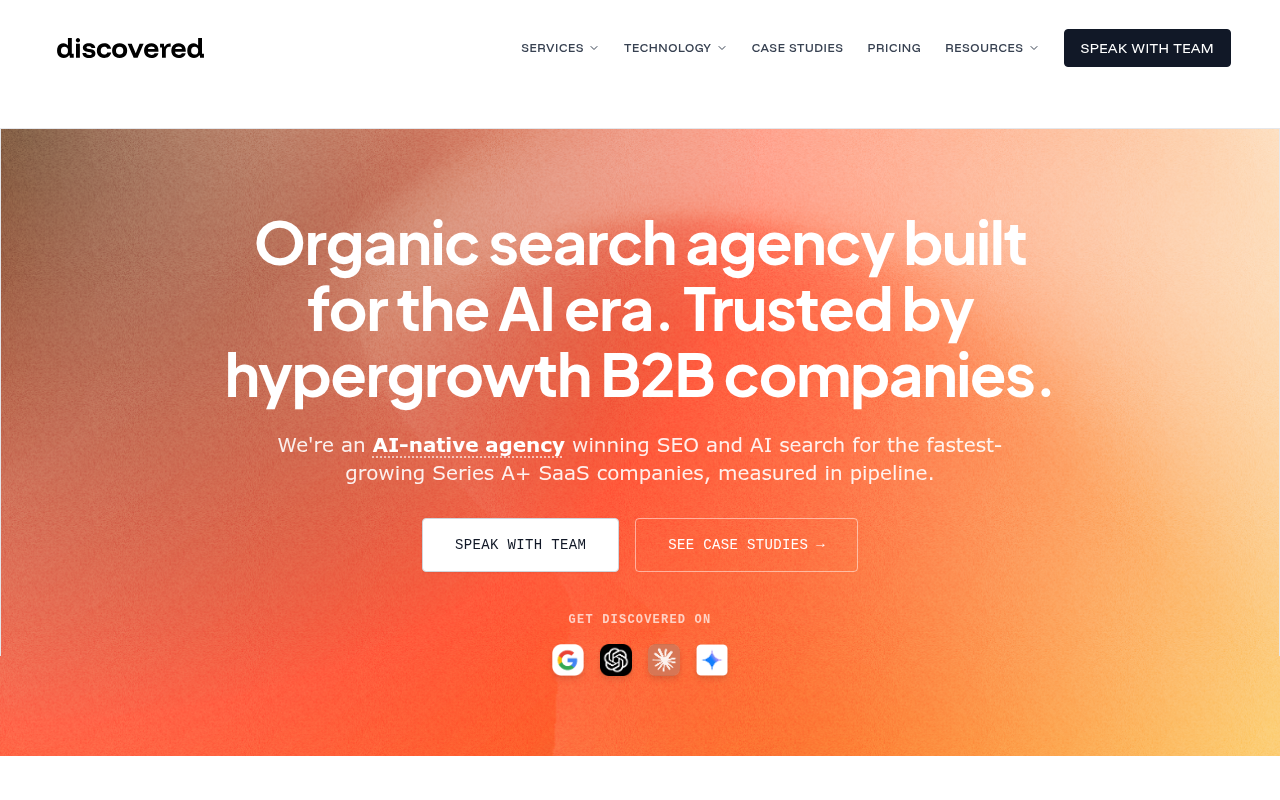
What they doDiscovered Labs is a specialist, not a full-service agency. It does one thing: win organic search and AI answers at the same time, what it calls SEO and answer engine optimization run as one engine. That focus fits a Series B company that already has traffic but needs to show up when buyers ask ChatGPT, Gemini, or Google's AI overviews for a shortlist. The team is led by a former Stanford AI researcher, and it publishes original studies of millions of AI citations that HubSpot and Semrush have cited. Named clients include Instantly, incident.io, Granola, and Gladia, the kind of hypergrowth SaaS names a scaling team recognises. It reports on pipeline, not rankings. If you need brand, paid, and events under one roof, this is not that.
Best forGrowth-stage SaaS teams that want to win Google and AI answers at once and already have traffic to build on.
Pros
- Deep specialist in AI-answer visibility, backed by original research that HubSpot and Semrush have cited.
- Names hypergrowth SaaS clients like Instantly, incident.io, and Granola, and reports on pipeline rather than rankings.
Cons
- Narrow by design. It covers search and AI answers, not paid media, brand, or events, so you still need those elsewhere.
- No public review score, so lean on the named client proof instead.
What they doWalker Sands is a large, established agency, founded in Chicago in 2001 with more than 200 staff. It runs brand, demand, PR, digital, and RevOps as one connected model it calls outcome-based marketing, and in 2026 it acquired RevPartners to add CRM and HubSpot engineering. For a Series B company scaling toward mid-market, that breadth means strategy through to pipeline under one roof, rather than stitching five point vendors together. Its client list includes Semrush, Paylocity, commercetools, AspenTech, and John Deere, and it publishes its own research, like a B2B AI Search Visibility Benchmark, so it runs the play it sells. It holds a 4.8 rating from 32 reviews on G2. The trade-off is size: it does not post prices, and a large integrated agency is usually a bigger commitment than a lean scaleup wants.
Best forSeries B companies scaling toward mid-market that want strategy, demand, PR, and RevOps from one experienced partner.
Pros
- Runs brand, demand, PR, and RevOps as one model, so a scaling team gets strategy to pipeline under one roof.
- Verified proof: 4.8 from 32 reviews on G2, named enterprise clients, and its own published research.
Cons
- Does not publish pricing.
- A large integrated agency, so likely more scope and cost than a lean team needs.
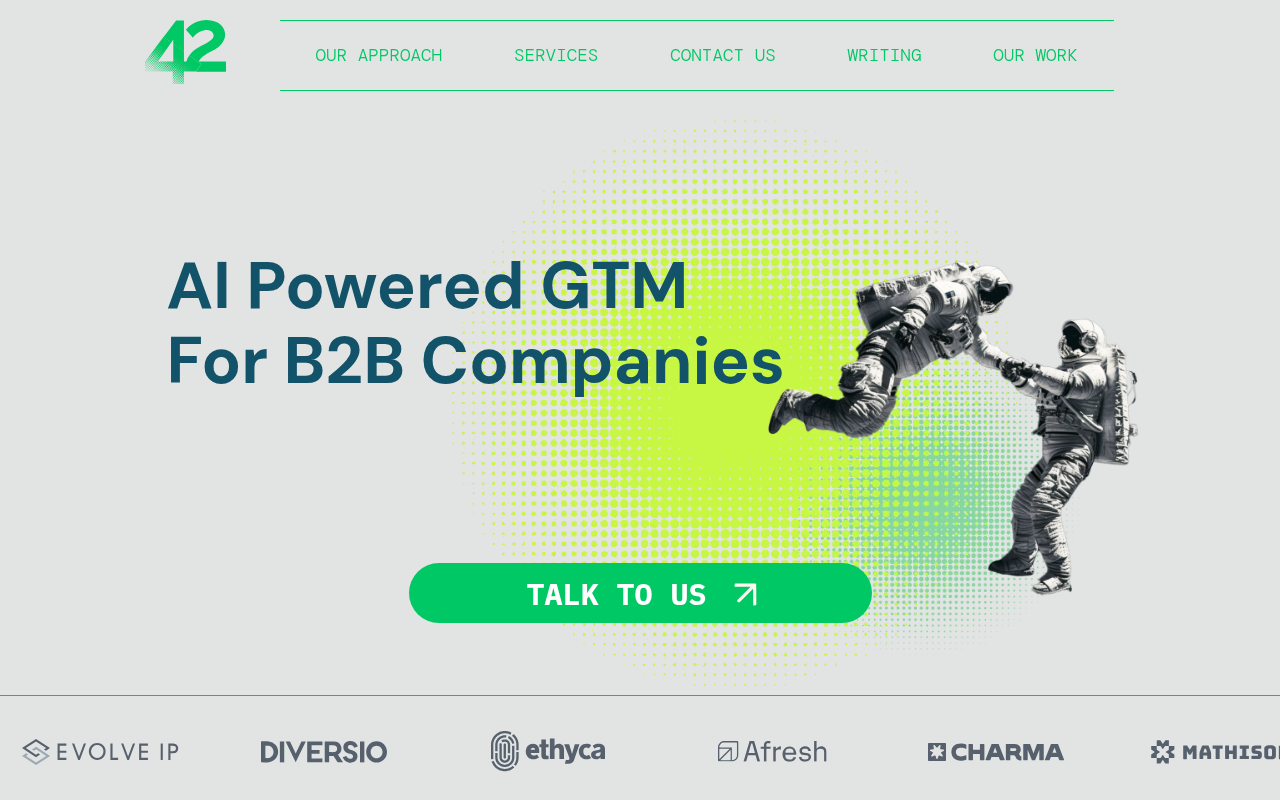
What they do42 Agency, based in Toronto since 2018, sells demand generation and marketing operations as one system rather than as two vendors. For a Series B team that has bought HubSpot or Pardot and now needs pipeline out of it, that combined model is the draw. What sets it apart is data: it publishes its own B2B benchmarks for paid media, email, and LinkedIn, drawn from 87 client accounts and more than 5 million dollars in managed ad spend, then runs campaigns off that evidence. Its research hub ranks for terms like B2B benchmarks and email marketing benchmarks, so it clearly runs the play it sells. The gaps are transparency ones: it does not name its senior team on the site, and it does not publish pricing.
Best forSeries B SaaS teams that need demand generation and HubSpot or Pardot operations fixed as one system.
Pros
- Runs demand and marketing operations as one system, off its own first-party benchmark data from 87 accounts.
- Ranks organically for the benchmark terms it publishes, real evidence it runs its own play.
Cons
- Does not name its senior team publicly.
- No published pricing.
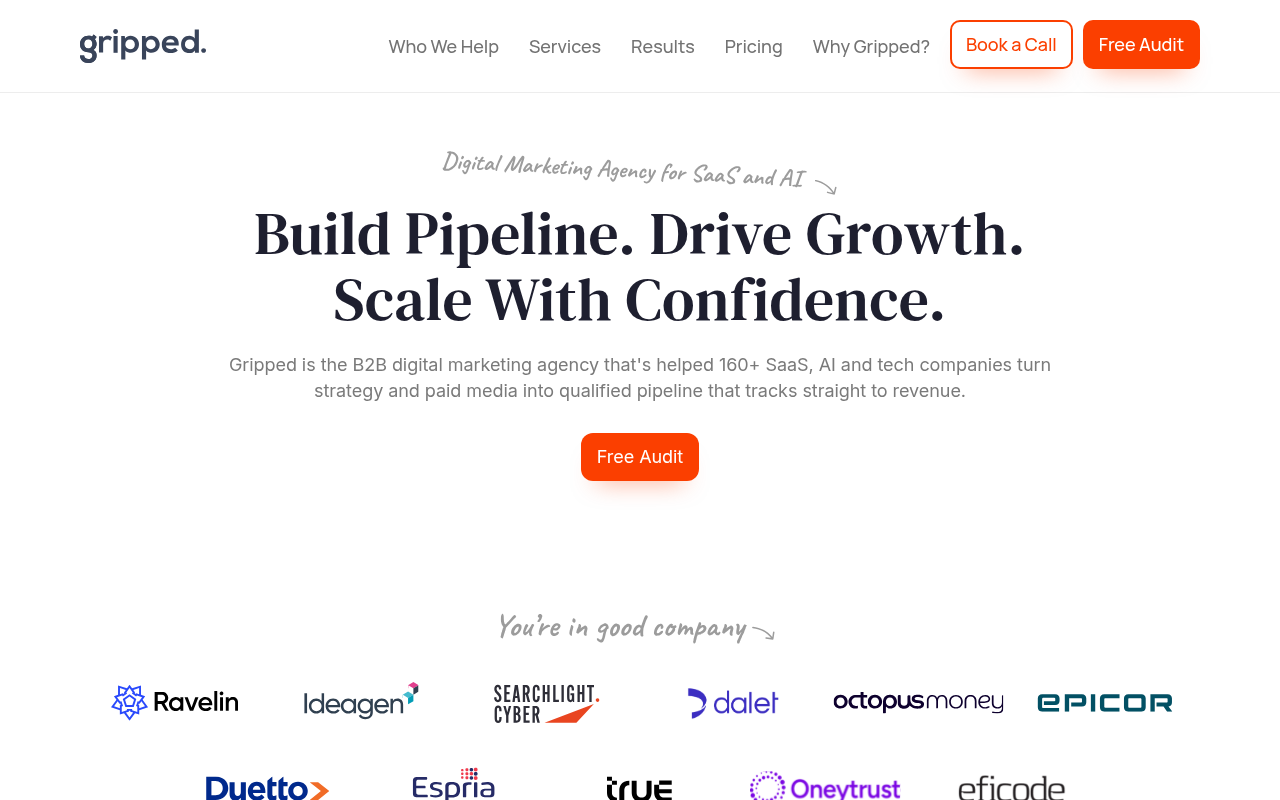
What they doGripped is a London retainer agency that works only with B2B SaaS and AI companies, covering SEO, demand generation, and answer engine optimization together. It is one of the clearest examples on this list of an agency that runs its own play: it ranks organically for competitive terms like London marketing agencies and a cluster of UK SEO queries, off purpose-built service pages rather than its homepage. For a Series B SaaS company that wants pipeline from search and AI answers instead of more ad spend, that track record matters. It names its senior team and, unusually, publishes pricing: retainers start at 5,000 pounds a month, with most clients between 8,000 and 12,000 pounds. The main limit is focus. It is UK-centred and built for SaaS, so a US-heavy or non-software team should check fit.
Best forB2B SaaS scaleups that want pipeline from organic search and AI answers, with pricing shown up front.
Pros
- Genuine dogfooder: ranks for competitive SEO terms off its own service pages, the play it sells.
- Names its senior team and publishes pricing, from 5,000 pounds a month, which most agencies here do not.
Cons
- UK-centred, so a US-based team should confirm coverage and working hours.
- Specialised in SaaS, so a non-software company may not fit.
What they doMatter Made, out of Denver since 2016, focuses on efficient demand for B2B SaaS companies scaling toward 100 million dollars in ARR. Its pitch to a Series B team is not more leads but more efficient ones: it prices paid media on performance and reports on pipeline and customer acquisition cost rather than impressions, and it pairs delivery with a sister design studio for the creative. Its own blog ranks for growth and demand topics like speed to lead and creating demand, so there is genuine content behind the positioning. The clients it names are fast-growing technology companies. Two things to weigh: it does not publish pricing, and it does not name its senior team on the site, so you will want both pinned down before you sign.
Best forB2B SaaS companies scaling toward $100M ARR that want more efficient demand, not more volume.
Pros
- Prices paid media on performance and reports on pipeline and CAC, aimed at efficient growth.
- Its own blog ranks for real demand and growth topics, so there is content behind the pitch.
Cons
- No published pricing.
- Paid-media-led, so less suited if you want to reduce ad dependence.
What they doScaled is a UK consultancy, started in 2022 and run by founders who have built and sold B2B businesses themselves. It pairs go-to-market and demand generation delivery with exit, investment, and non-executive advisory, and tracks progress through its own ScaledOS platform. That mix fits a Series B leadership team thinking about the next raise or an eventual exit, not just this quarter's leads. It is a textbook example of practising what it sells: in the UK it ranks number one for demand gen agency, and on page one for related demand generation terms, on purpose-built pages. Consulting is priced openly from 2,000 pounds a month, and the senior team is named. The caution is scale and geography: it is a small team of under ten and UK-centred, so a large US programme may stretch it.
Best forSeries B founders and leaders building toward a raise or exit who need pipeline and operating structure at once.
Pros
- Ranks number one in the UK for demand gen agency, on a purpose-built page, so it runs its own play.
- Names its senior team, prices consulting openly from 2,000 pounds a month, and is led by exited founders.
Cons
- Small team of under ten.
- UK-centred, so a large US-based programme should confirm capacity.
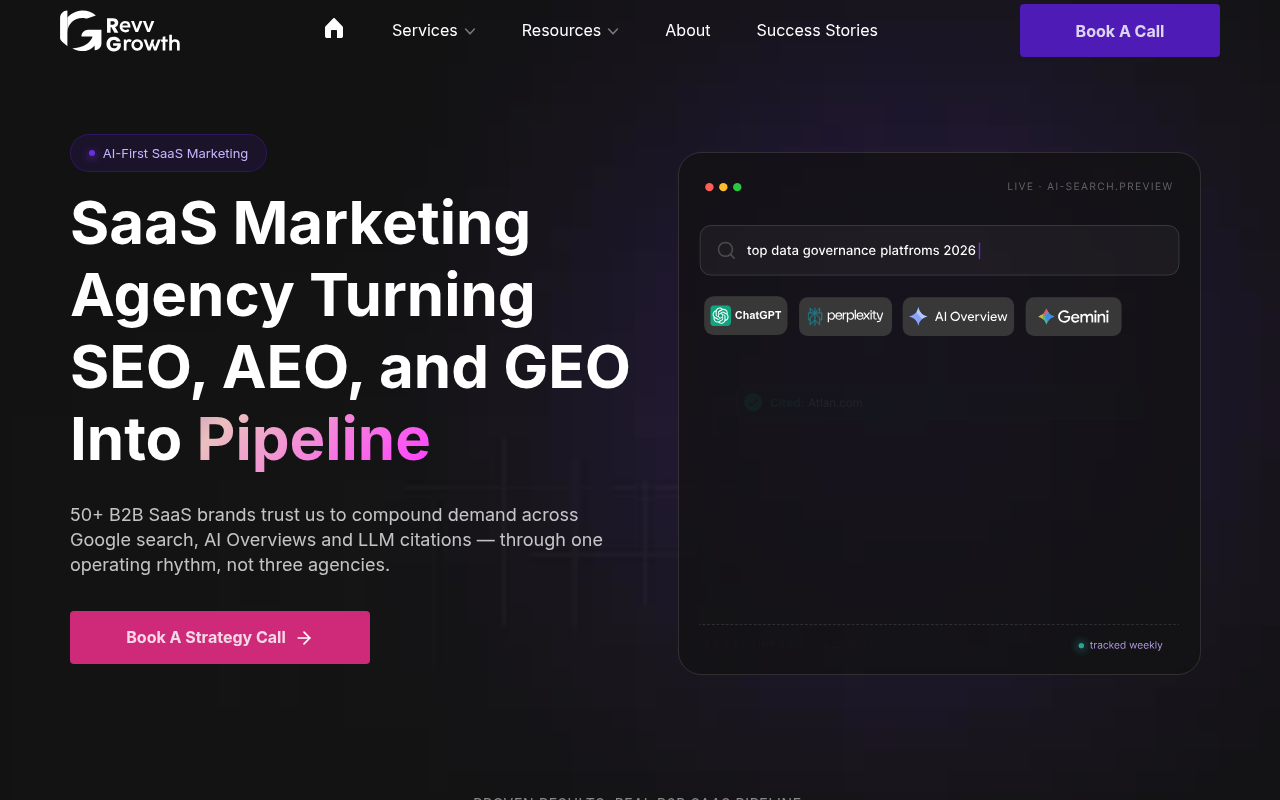
What they doRevvGrowth is a B2B SaaS marketing agency that runs SEO, paid, ABM, and content toward qualified pipeline rather than raw lead volume. Its strongest signal is its own search footprint: it ranks for the categories it sells, on structured service hubs for SaaS SEO, AEO tracking, and ABM, not just generic blog posts. For a Series B SaaS company that wants organic and AI-answer visibility as it scales, that is real evidence the play works. It names its team and documents its method. Two caveats for a buyer: it is a younger firm, founded in 2023, and it does not publish pricing, so scope and cost need confirming on a call. Its delivery team is India-based, which suits some buyers and not others.
Best forSeries B SaaS teams that want organic and AI-answer visibility, run toward qualified pipeline.
Pros
- Ranks for the SaaS SEO and AEO categories it sells, on structured service hubs, not generic posts.
- Names its team and documents its method, aimed at qualified pipeline over lead volume.
Cons
- Younger firm, founded in 2023.
- No published pricing, and delivery is India-based, so confirm fit and timezone.
What they doSponge is a fractional marketing operations agency, not a demand-creation shop, and that is exactly why it belongs on a Series B list. Fast growth tends to leave the marketing stack in a mess: broken lead routing, scoring that no longer works, reporting nobody trusts. Sponge steps in as an embedded ops team, with certified operators across Marketo, HubSpot, Salesforce, and Pardot, to restructure account hierarchies, rebuild lead lifecycles, and clear technical debt so the pipeline you generate actually gets counted. It has run this since 2016 and publishes genuinely useful ops content, one of the stronger own-marketing footprints in its group. What it is not is a source of new demand: it fixes and runs the plumbing, so you still need someone to create the pipeline. It does not publish pricing.
Best forSeries B teams whose martech stack, routing, and reporting have buckled under fast growth.
Pros
- Certified operators across Marketo, HubSpot, Salesforce, and Pardot, embedded as a fractional ops team.
- Fixes routing, scoring, and reporting so the pipeline you generate is actually counted.
Cons
- Operations, not demand creation, so you still need a source of new pipeline.
- No published pricing.

What they doPosition2 is a 20-year-old, 200-plus-person growth marketing agency in Santa Clara that offers the full stack: paid media, SEO, ABM, automation, CRO, and creative, backed by its own products, the Arena Calibrate analytics platform and a StudioX 3D content studio. For a Series B company scaling fast and wanting one partner to handle performance across channels, that breadth and its enterprise client list, which names AWS, Lenovo, Google Cloud, American Express, and Cohere, are the draw. It publishes credible GTM and RevOps thought leadership too. The honest weakness is its own organic footprint: for a two-decade agency, it ranks mostly on branded terms, and the real engine is paid media and enterprise relationships. It does not publish pricing, and its enterprise orientation can be heavy for a lean team.
Best forSeries B companies scaling paid and performance across many channels that want one established partner.
Pros
- Full-funnel across paid, SEO, ABM, and CRO, backed by its own analytics and 3D content products.
- Two decades in market with named enterprise clients like AWS, Lenovo, and Google Cloud.
Cons
- Paid-media-led, with a thin own-organic footprint for its age.
- Enterprise-oriented, so it can be heavy for a lean Series B team, and it shows no pricing.
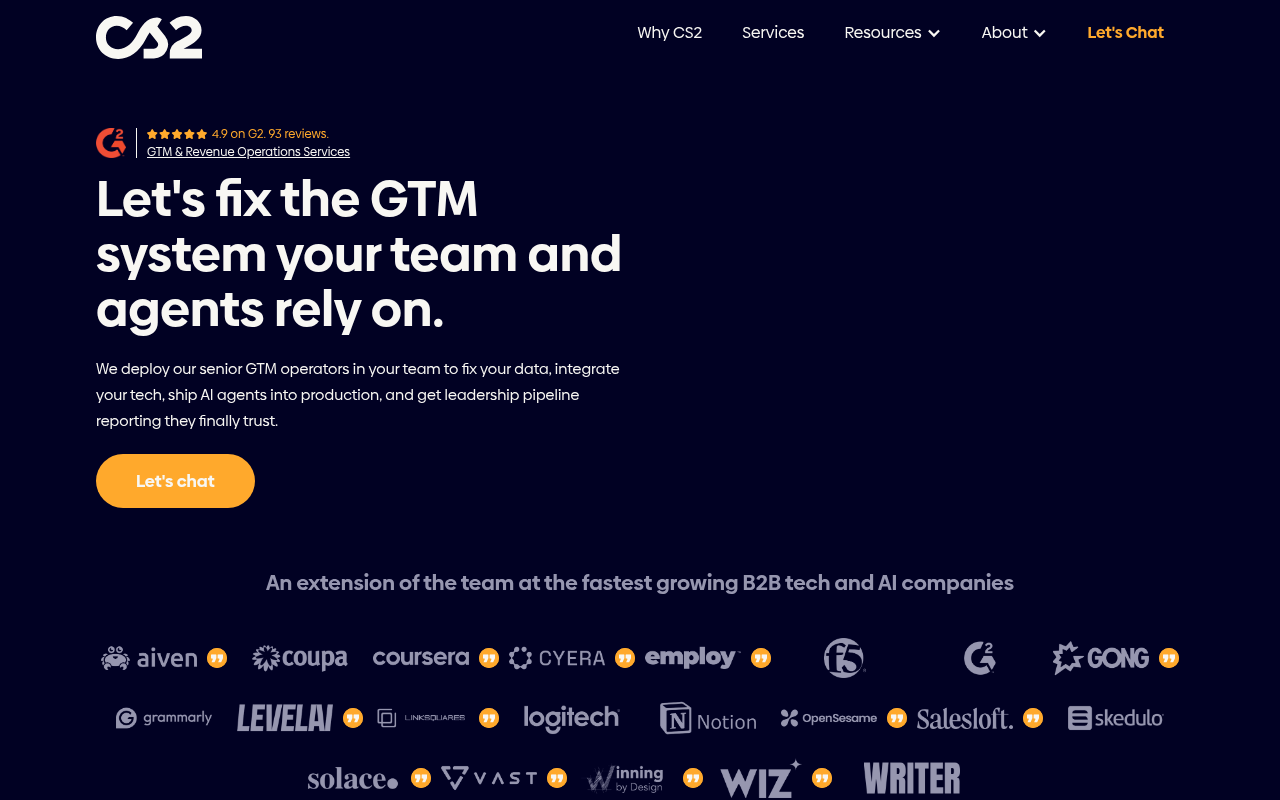
What they doCS2 delivers go-to-market and revenue operations for growth-stage B2B tech, which is squarely the Series B moment: the point where marketing, sales, and RevOps have to line up or pipeline leaks between them. It is more than an execution vendor, with named senior operators, a documented approach, and a strong community presence through its podcast, newsletter, and the founders' own following. Its proof is unusually solid for this group: a 4.9 rating from 93 reviews on G2 for its GTM and revenue operations work, one of the largest verified review bases on this list. It recently moved its site to cs2team.com. Two things to note: search is not its main channel, so its own organic footprint is light, and it does not publish pricing.
Best forGrowth-stage B2B tech teams that need marketing, sales, and RevOps aligned so pipeline stops leaking.
Pros
- One of the largest verified review bases here: 4.9 from 93 reviews on G2 for GTM and revenue operations.
- Named senior operators and a documented approach, built for the Series B alignment problem.
Cons
- Does not publish pricing.
- Light own-organic footprint; it reaches buyers through community and referrals, not search.
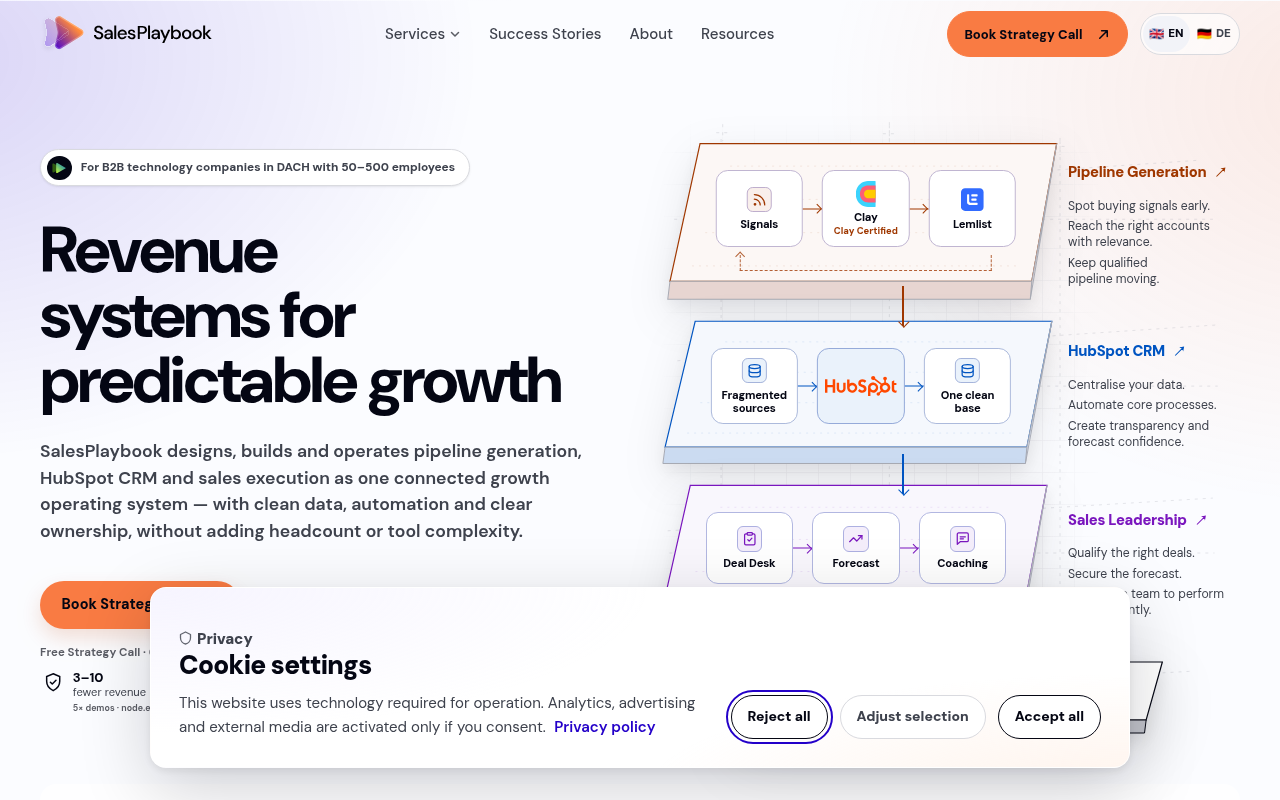
What they doSalesPlaybook builds and runs revenue systems for B2B software companies, with a clear focus on the DACH region: Germany, Austria, and Switzerland. Its three services, pipeline generation, HubSpot CRM, and revenue enablement, map to what a Series B software company needs as it moves from founder-led selling to a repeatable motion. It is a HubSpot Diamond Partner with Clay certifications, names its senior team, and, helpfully, publishes pricing: pipeline generation runs from about 4,000 Swiss francs a month, with CRM and enablement scoped separately. Its own search footprint is real but modest, and a chunk of it comes from client case-study pages ranking for client names rather than category terms, which is borrowed demand more than earned. The main filter is geography: if you are not selling into DACH, another firm will fit better.
Best forSeries B B2B software companies selling into DACH that are moving from founder-led sales to a repeatable motion.
Pros
- HubSpot Diamond Partner with Clay certifications, and it publishes pricing from about 4,000 Swiss francs a month.
- Purpose-built for the founder-led to repeatable shift, with pipeline, CRM, and enablement as one system.
Cons
- Focused on the DACH region, so a poor fit outside German-speaking Europe.
- Some of its own visibility is borrowed from client case-study pages.
What they doVeza Digital comes at demand from the website. It is a B2B and SaaS Webflow agency that pairs design and development with SEO, answer engine optimization, and growth marketing, under a method it calls WAIO for turning sites into AI-search answers. For a Series B company whose site has fallen behind its story, that is a practical entry point: rebuild the site to convert, then keep feeding it search and AI-answer content. It practises what it sells, with a working content hub, low paid reliance, and AI-search signals like an llms.txt file, and it names clients such as Chili Piper, Grata, Northbeam, and Luno. The thing to be clear about is its center of gravity: the core specialty is Webflow and web development, with demand generation attached, so a pure pipeline mandate may want a demand-first shop.
Best forSeries B SaaS teams whose website has fallen behind and needs to convert, with ongoing SEO and AEO.
Pros
- Rebuilds the site to convert, then feeds it SEO and AI-answer content, with real AI-search signals of its own.
- Names strong SaaS clients like Chili Piper, Grata, and Northbeam, and leans on organic over paid.
Cons
- Core specialty is Webflow and web development, with demand generation attached.
- No public review score or pricing.
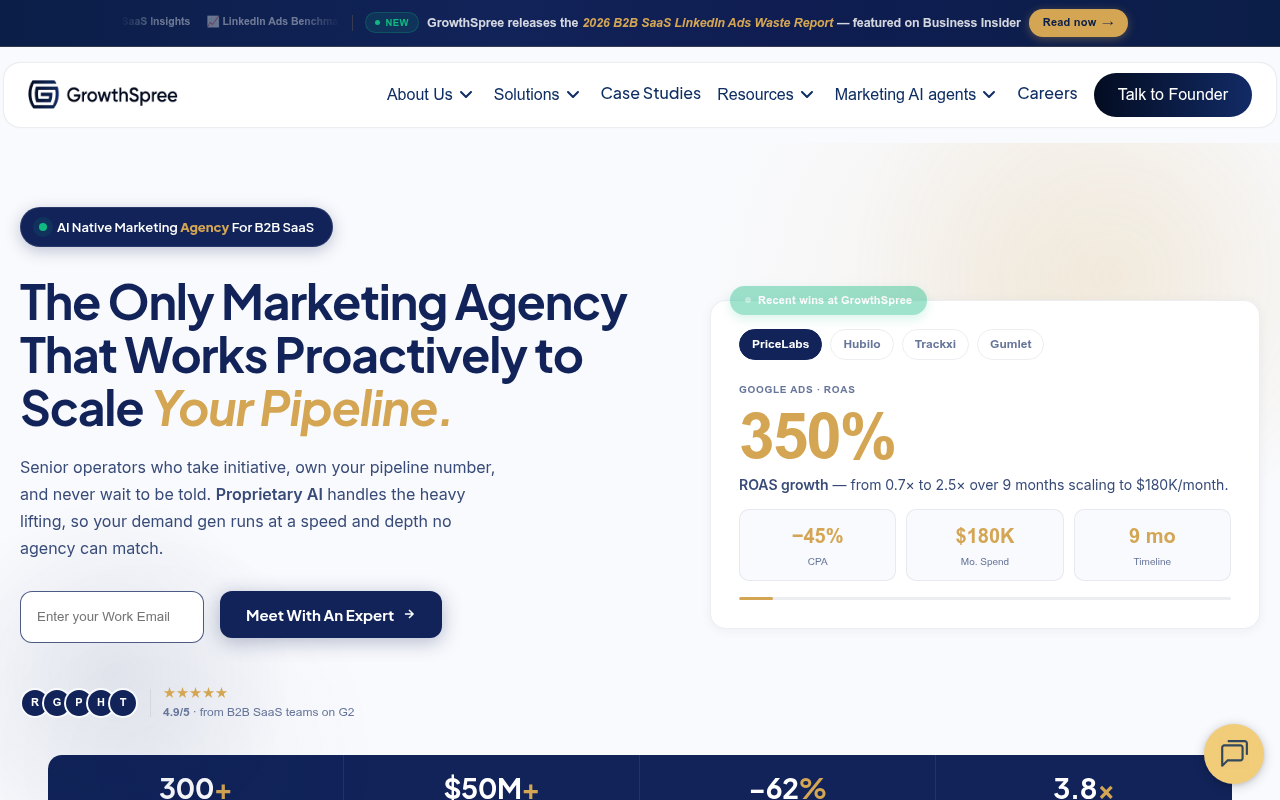
What they doGrowthSpree is an AI-native demand generation agency for B2B SaaS, pairing senior operators with six proprietary AI tools for Google Ads, LinkedIn Ads, ABM, and content, all pointed at CRM-tracked pipeline rather than lead volume. It sells on a flat monthly fee, month to month, which appeals to a Series B team that wants accountability and no long lock-in. It backs the positioning with genuine original research, like a LinkedIn Ads waste report picked up by Business Insider, and names clients including PriceLabs, Hubilo, Rocketlane, and Hasura. It holds a 4.9 rating from 48 reviews on G2, though those reviews skew heavily to one region. Two caveats: paid channels are the core of the business, so it leans performance over owned content, and it does not publish its flat fee, only that one exists.
Best forSeries B SaaS teams that want paid and demand run as one pipeline-accountable system on a flat fee.
Pros
- Senior operators plus proprietary AI tools, all pointed at CRM-tracked pipeline, on a flat monthly fee.
- 4.9 from 48 reviews on G2, plus original research picked up by Business Insider.
Cons
- Paid-media-led, so less suited if you want to build owned content.
- Its G2 reviews are concentrated in one region, and it does not publish its fee.
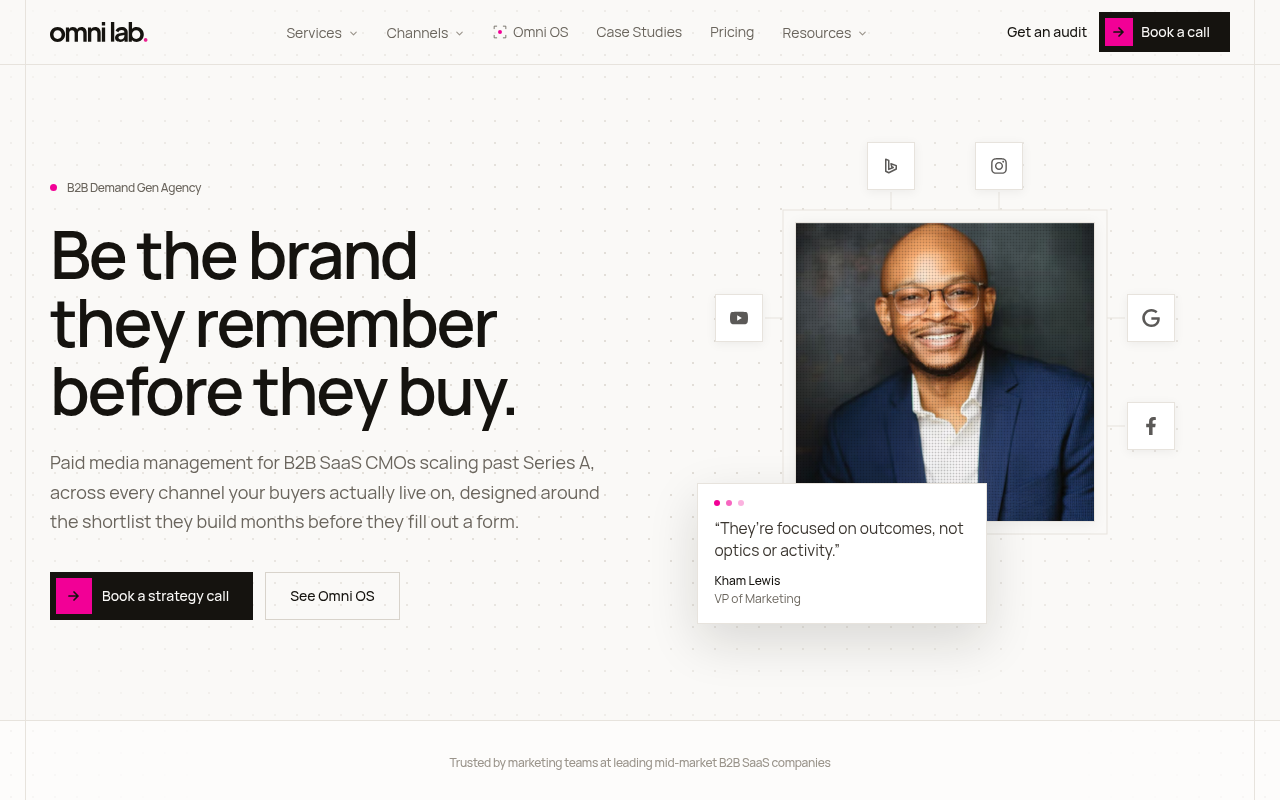
What they doOmni Lab is a paid media and demand generation agency for B2B SaaS, built around a sharp idea: buyers form a shortlist months before they ever fill out a form, so the job is to be on it. It runs pipeline programs across Google, LinkedIn, and Meta and reports on qualified revenue rather than raw leads. It is one of the few agencies here that ranks organically for the very category it sells, holding positions for b2b demand generation agencies on its own pages, so it clearly runs the play. It names clients including Shipwell, Cocoon, and Synthace. The fit signals are worth reading: its best-fit client is already spending around 10,000 dollars a month on paid media, so it suits a Series B team investing in paid, not one trying to cut it.
Best forSeries B SaaS teams investing in paid media that want it run toward qualified revenue, not raw leads.
Pros
- Ranks organically for b2b demand generation agencies on its own pages, real evidence it runs its own play.
- Reports on qualified revenue across Google, LinkedIn, and Meta, and names SaaS clients like Shipwell and Synthace.
Cons
- Paid-media-led, and its best fit already spends around 10,000 dollars a month on ads, so it suits scaling paid, not reducing it.
- No verifiable public review score.
Is your content pulling its weight at Series B?
Get a free Content RevOps audit. We show where your content leaks revenue and what a connected system would change, benchmarked against our 2026 data.
Frequently asked questions
What does a demand generation agency do for a Series B company?
It helps you turn early traction into a repeatable pipeline the board can count on. That means building content and campaigns your buyers find on their own, in search and in AI answers, then wiring them to your CRM so every lead is caught, scored, and traced back to revenue. At Series B the goal is efficient, predictable growth, not just more spend.
How much do these agencies charge?
Most do not publish prices. Where a floor is public it tends to start around 2,000 to 5,000 US dollars a month for consulting or focused work, and climbs from there with scope and paid budget. We mark pricing as not disclosed when an agency does not share it, and we show the real number when it does.
How did we choose and rank these agencies?
We reviewed 112 agencies that work with Series B and venture-backed companies, then kept the ones with real proof. We ranked them on fit for scaling companies, whether they run marketing for themselves, review evidence, transparency, and stage fit. The same checks apply to our own entry.