The best demand generation agencies for small and mid-sized businesses in 2026
Small and mid-sized B2B companies rarely lose deals on price. They lose them earlier, before sales ever hears about the buyer. Your customers research alone, ask colleagues and AI assistants, and only make contact once they already trust someone. With a small team and a careful budget, you cannot afford a year of marketing that does not pay. Hundreds of agencies say they serve SMBs. This year we studied over 1,700 demand generation agencies and found most cannot show their own marketing working, let alone yours. For this list we reviewed more than 500 that state they work with small and mid-sized businesses, and kept the 14 with real proof: verified prices, named clients, and results with numbers. Sector cuts of the same research cover construction, education and manufacturing, and pre-revenue teams should start with the startups list.

How we chose this list
We used the same checks on every agency, including our own. Here is what earns a spot and how we ordered them.
Who makes the list
Every agency here runs real demand generation for small and mid-sized B2B companies and has a working content presence of its own. We left out lead-list sellers, appointment-setters, enterprise-only shops, and agencies whose sites could not show a single named client.
How we rank them, in order
- A model that actually fits an SMB: fair minimums, lean-team support, no enterprise bloat
- Whether they run marketing for themselves, and it works
- Review proof, counting how many reviews back the score
- Whether they show prices and name their team
- Fit to trust-led, longer B2B sales rather than quick transactional funnels
What we promise on every entry
Every claim can be traced to a source, and we re-checked ratings and prices against the live pages before publishing. Ratings always show how many reviews they come from. Prices are shown, or marked not disclosed. We hold our own entry to the same checks.
The shortlist at a glance
All 14 entries, ranked by the criteria above. Full detail in the cards below.
| # | Name | Pros | Cons | Best for | Pricing |
|---|---|---|---|---|---|
| 1 | Content RevOps |
|
| Small and mid-sized B2B companies with long, consultative, trust-led sales that want a demand engine built from the ground up as one connected system, not another retainer of scattered campaigns. | $1-5k/mo |
| 2 | Scaled Consulting |
|
| UK founders of SMB service and SaaS companies who want pipeline and company value worked on together, with senior people rather than juniors. | From ~£1k/mo |
| 3 | Colony Spark |
|
| Founder-led industrial-economy vendors with long sales cycles that want one flat-fee partner to install and run marketing end to end. | $4,000/mo flat |
| 4 | Magnetude Consulting |
|
| SMB tech and services firms that need a whole marketing function on a fractional budget, especially in cybersecurity, MSP, or professional services. | Not disclosed |
| 5 | SalesPlaybook |
|
| DACH B2B software SMBs whose problem spans marketing and sales, and who want one system with published pricing rather than two vendors. | CHF 4-14k/mo |
| 6 | Disruptive Advertising |
|
| SMBs with real ad budgets that want a heavily reviewed, process-driven team to stop waste and scale paid channels. | $5-10k/mo min |
| 7 | The Growth Syndicate |
|
| Benelux and EMEA SMBs with a lean team that want one senior partner across strategy and execution instead of three specialist agencies. | $10-25k/mo min |
| 8 | farsiight |
|
| APAC SMBs, especially B2B SaaS, that want heavily reviewed paid media and creative with strategy attached. | $5-10k/mo min |
| 9 | XQL Group |
|
| Dev shops, agencies, and tech service SMBs that live on referrals and want inbound built at a price a services margin can carry. | From €1,500/mo |
| 10 | Marketopia |
|
| MSPs and channel vendors that want pipeline, appointment setting, and peer support from a team that only does the IT channel. | Not disclosed |
| 11 | Evenbound |
|
| Industrial SMBs and mid-market manufacturers ready to invest in a proper system, particularly if HubSpot is or will be the stack. | $10-25k/mo min |
| 12 | Orange Marketing |
|
| SMB SaaS and tech companies on HubSpot, or moving to it, whose real blocker is the revenue system behind the marketing. | $5-10k/mo min |
| 13 | Avid Demand |
|
| B2B technology SMBs with complex sales that want a veteran, measurement-first team and a low-risk 90-day start. | Not disclosed |
| 14 | Accelerated Digital Media |
|
| SMBs, especially health and ecommerce brands, whose growth blocker is paid media performance rather than the wider system. | $5-10k/mo min |
The list
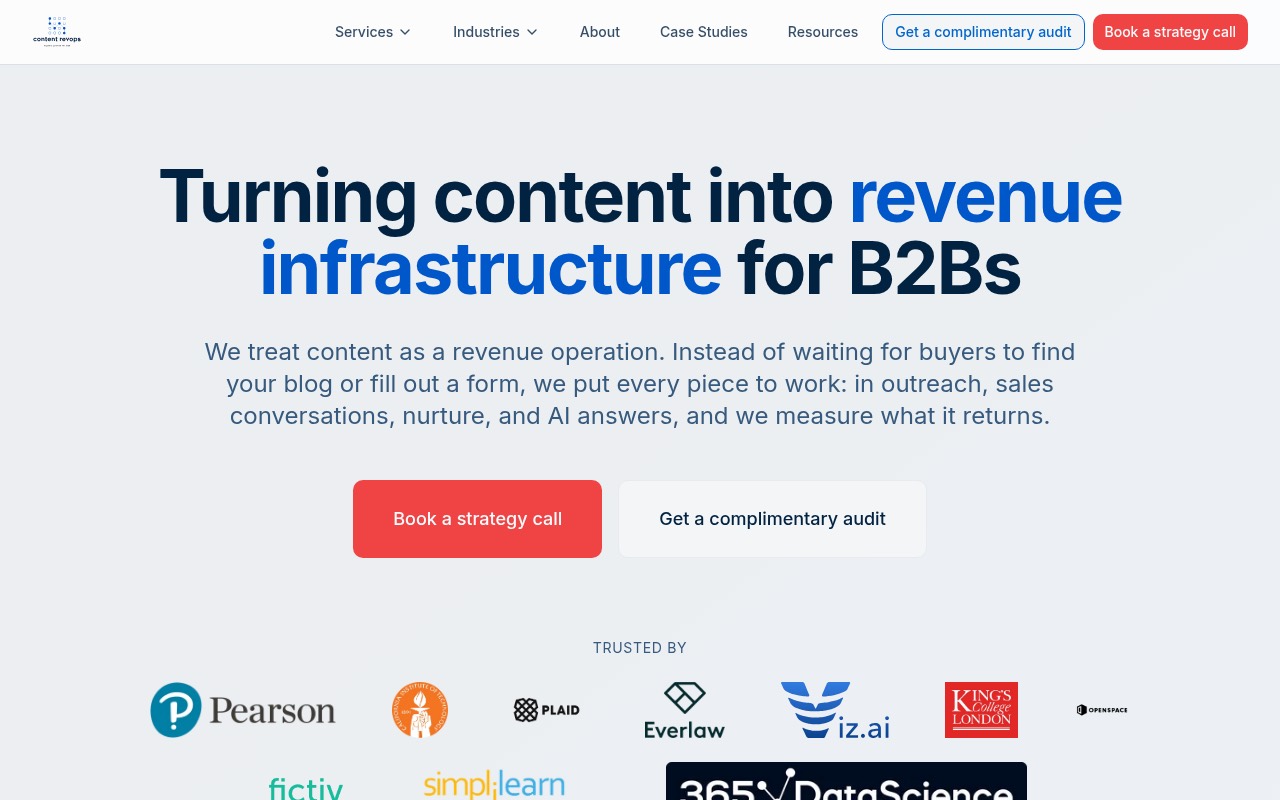
What they doContent RevOps is a content marketing and demand generation firm built for small and mid-sized companies that sell the way trust demands: long cycles, several decision makers, and buyers who quietly do their homework before they ever fill in a form. We work with B2B SaaS and service companies from about $1M to $100M in revenue, usually with a lean marketing team or none at all, across fields like education, life sciences, manufacturing, construction, and finance. What we do is build your demand engine from the ground up. Most SMBs never got real marketing infrastructure: growth came from referrals and the founder's network, and marketing stayed a website and a few scattered posts. We build the whole thing as one connected system, from the first piece of content to the CRM report. In practice, we map everyone in your buying group, write the decision-stage material they need but your market never publishes, place it where those buyers actually look, which now includes AI assistants as much as Google, and wire every piece into your CRM so you can see what each one earns in pipeline. The system is sized and priced for an SMB budget, and because it runs on owned content rather than ad spend, it keeps working when the spend stops.
Best forSmall and mid-sized B2B companies with long, consultative, trust-led sales that want a demand engine built from the ground up as one connected system, not another retainer of scattered campaigns.
Pros
- Built specifically for SMBs selling complex, consultative deals: the system is designed around buying committees and months-long cycles, not quick transactional funnels. how we work ↗
- Took Westlab, a lab supplies manufacturer that grew on cold calls and conferences, to 241 inbound leads and an 869% ROI in three months. case study ↗
- Cut a small education firm's cost per lead from around $500 to $10, and its customer acquisition cost from over $2,500 to $600. case study ↗
- Turned webinars into an estimated $2.5M of influenced pipeline for a founder-led water technology company with 6 to 18 month sales cycles. case study ↗
- Builds for AI answers as well as Google: at one boutique banking intelligence firm, about 22% of inbound traffic now comes from AI assistants, and those leads convert at about 5 times the average rate. case study ↗
- Backs its method with published research across seven industries, so the advice rests on measured data rather than opinion. our research ↗
Cons
- A young firm with a small senior team, so it fits companies that want a hands-on system built, not a big-agency bench.
- Only for B2B considered sales. A transactional or ecommerce business is not a fit, and neither is a team that mainly wants ads managed.
What they doScaled is a consultancy rather than a retainer agency, and that is the real difference. Every partner has built and exited a business, and the firm pairs strategy with hands-on demand generation delivery for UK SMBs, measuring progress through its own ScaledOS enterprise-value platform. That suits an owner-managed company where marketing has to serve a bigger plan, like a raise or an exit, not just this quarter's leads. The proof is unusually strong for a small firm: it ranks first in UK search for the exact term demand generation agency, publishes example pricing, and names client results, including Onelink growing revenue 252% year on year and Kaizen trebling revenue.
Best forUK founders of SMB service and SaaS companies who want pipeline and company value worked on together, with senior people rather than juniors.
Pros
- Publishes example pricing, from about 1,000 pounds a month for RevOps support and 2,000 pounds a month for consulting.
- Ranks first in the UK for demand generation agency, so it demonstrably runs the play it sells.
- Every partner has exited a business, useful judgment for owner-led SMBs.
Cons
- No third-party review score on Clutch or G2 to check the claims against.
- A small UK-focused team, so a poor fit if you need a large delivery bench or US market depth.
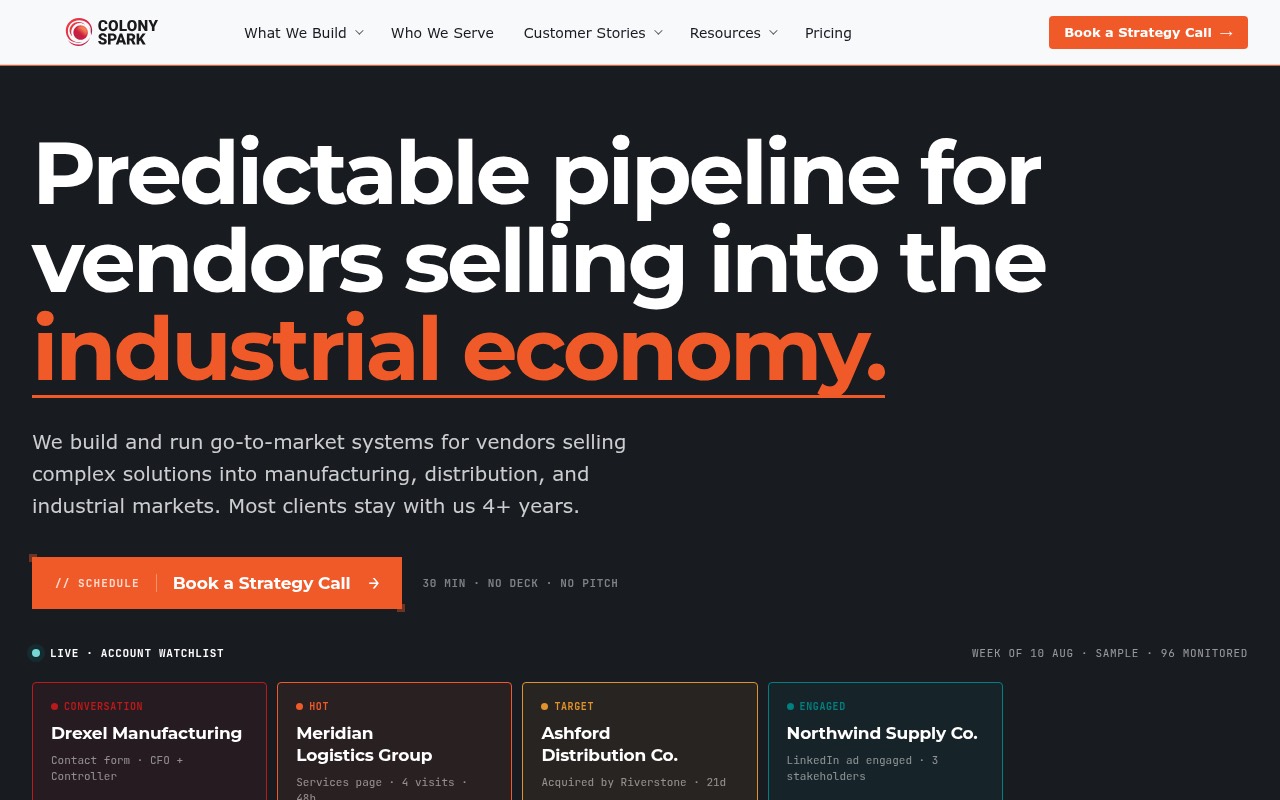
What they doColony Spark builds and runs the whole go-to-market engine for vendors selling into the industrial economy: NetSuite partners, MSPs, warehouse software, and industrial IoT companies, most of them founder-led and stuck on referrals with sales cycles past 180 days. That is exactly the long, trust-led SMB sale this list is about, and the model fits it: a flat $4,000 a month, all-inclusive, month to month, with no contract, which is rare candor in this market. Named clients include Nuage, Sunsoft ERP, and T2G Warehousing, and the firm has scored over 70 industrial vendor sites to build its own messaging framework. It also runs its content engine on itself before installing it for clients.
Best forFounder-led industrial-economy vendors with long sales cycles that want one flat-fee partner to install and run marketing end to end.
Pros
- A published flat price of $4,000 a month with no contract, so an SMB knows the cost before the first call.
- Genuinely deep in industrial markets, with named clients and a proprietary dataset of 70+ scored vendor sites.
- Built around 180+ day sales cycles rather than quick lead volume.
Cons
- No external review score to verify client satisfaction independently.
- A very small team serving one niche. If you are not selling into industrial markets, this is not your shop.
What they doMagnetude acts as a fractional marketing department for small and growth-stage B2B tech firms: strategy and execution from one team, sized for a company that cannot yet justify hiring the department itself. That model is often the honest answer for an SMB with no marketing lead. The firm has run thirteen years and claims over 140 clients, with real depth in cybersecurity, managed services, and professional services, each with its own content hub that ranks: professional services marketing at position five in US search, cybersecurity marketing at twelve. Named clients include Halo Security and Polycorp. For an SMB in one of its core fields, the bench already speaks the language.
Best forSMB tech and services firms that need a whole marketing function on a fractional budget, especially in cybersecurity, MSP, or professional services.
Pros
- The fractional-department model matches how SMBs actually need to buy marketing.
- Thirteen years of work and 140+ clients claimed, with vertical hubs that rank for the categories it sells.
- Deep, provable strength in cybersecurity, MSP, and professional services markets.
Cons
- Does not publish pricing.
- No external review score on Clutch or G2, so satisfaction has to be checked by reference.
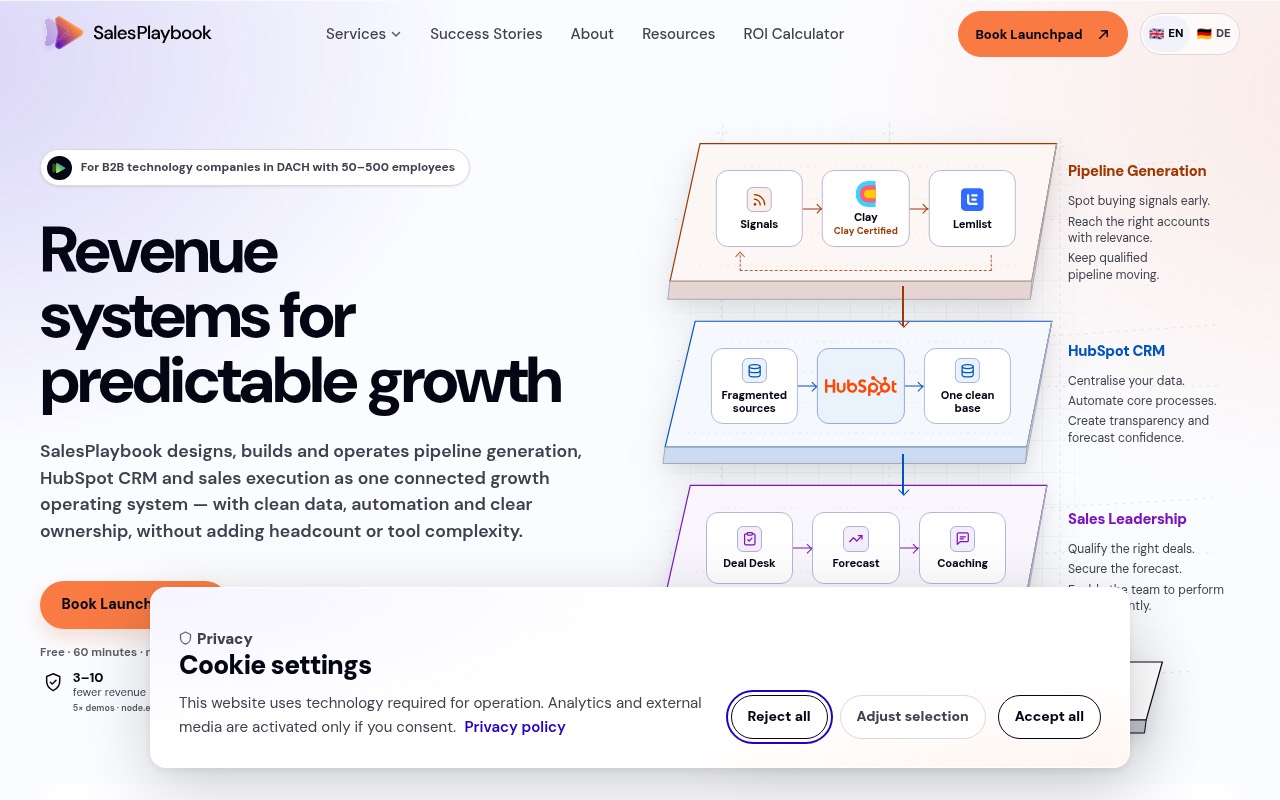
What they doSalesPlaybook builds and operates pipeline generation, HubSpot CRM, and sales execution as one connected system for B2B software companies in the DACH region, usually 50 to 500 people. Where most agencies stop at leads, this firm also works the sales side: playbooks, enablement, and CRM hygiene, which matters in consultative sales where deals die between marketing and sales. It publishes real prices, CHF 4,000 to 14,000 a month for pipeline generation, and even lists who is not a good fit. Named outcomes include FTAPI growing ARR 70% and Calibo closing a CHF 400k deal, alongside clients like Beekeeper and Pleo. It is a HubSpot Diamond partner.
Best forDACH B2B software SMBs whose problem spans marketing and sales, and who want one system with published pricing rather than two vendors.
Pros
- Publishes real price ranges and an explicit good-fit versus not-a-good-fit list.
- Covers the sales side too: CRM, playbooks, and enablement, where long-cycle deals usually stall.
- 15+ named clients with outcome numbers, including FTAPI at +70% ARR.
Cons
- No independent review score on Clutch or G2 to check against.
- Focused on DACH. A company selling mainly into the US or UK is outside its core.
What they doDisruptive is the review-proof heavyweight on this list: 4.8 on Clutch across 371 reviews, more public evidence than every other agency here combined. It is a 150-plus person performance agency running paid search, paid social, SEO, and creative, and its own marketing ranks first for the exact phrases its buyers search. For an SMB already spending meaningfully on ads, its audit-first approach has teeth: the firm says 76% of audited spend is wasted, a claim built from more than 10,000 of its own audits. The trade-off is focus. It serves everyone from SMBs to enterprise across dozens of industries, so you get process and scale rather than deep knowledge of your niche or your longer sales cycle.
Best forSMBs with real ad budgets that want a heavily reviewed, process-driven team to stop waste and scale paid channels.
Pros
- 4.8 across 371 Clutch reviews, the strongest public review proof on this list.
- Audit-first approach backed by data from more than 10,000 ad account audits.
- No long-term contracts, unusual for an agency this size.
Cons
- A generalist. Little specific depth in any one B2B niche or in long consultative sales.
- Ads-led by design, so it fits budget optimization better than building organic, owned demand.
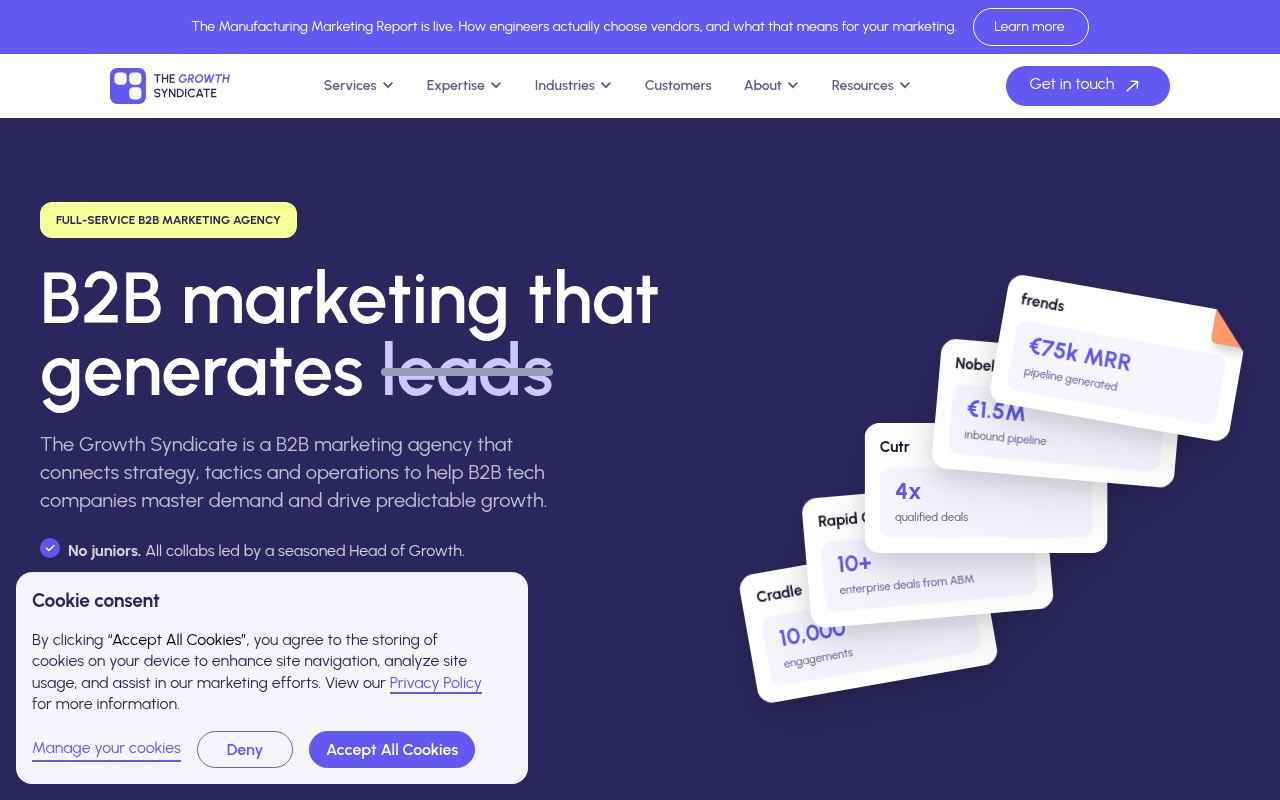
What they doThe Growth Syndicate is an Amsterdam firm built to replace the pile of point agencies an SMB tends to accumulate: strategy, demand generation, ABM, brand, and web from one senior team. For a lean marketing team of one or two, that consolidation is the draw. Young as it is, founded in 2024, its own marketing already ranks for the categories it sells and it publishes original research, including a 2026 manufacturing marketing report, with named client stories for Cutr, Cradle, and Rapid Circle. The evidence base is thinner than the veterans on this list: a perfect Clutch score but from only two reviews, and its site talks about transparent hourly pricing without printing a number.
Best forBenelux and EMEA SMBs with a lean team that want one senior partner across strategy and execution instead of three specialist agencies.
Pros
- One team covering strategy through execution, built for lean SMB marketing teams.
- Publishes original research, including a 2026 manufacturing marketing report.
- Its own site ranks for competitive category terms rather than relying on ads.
Cons
- The 5.0 Clutch score rests on just 2 reviews, so treat it as early evidence.
- Talks about transparent pricing but publishes no actual number, and the minimum sits above $10k a month.
What they dofarsiight is an Australian growth agency pairing paid media with creative and strategy, and its review record is remarkable: a 5.0 on Clutch across 78 reviews, which is very hard to sustain at that volume. It works with B2B SaaS and ecommerce companies across APAC, with named clients including Go1, and backs the media work with a resources hub that ranks for its own category terms and a State of B2B Paid Media study of its own. For an SMB in Australia or New Zealand it is one of the most credible growth partners available. It is still a paid-media-first shop, so it suits companies with budget to deploy on ads more than those needing an owned, organic engine built from scratch.
Best forAPAC SMBs, especially B2B SaaS, that want heavily reviewed paid media and creative with strategy attached.
Pros
- A perfect 5.0 across 78 Clutch reviews, exceptional at that volume.
- Publishes its own paid media research rather than only borrowing benchmarks.
- Real B2B SaaS client proof in APAC, including Go1.
Cons
- Does not publish pricing.
- Paid-media-first, so the engine slows when the ad spend stops.
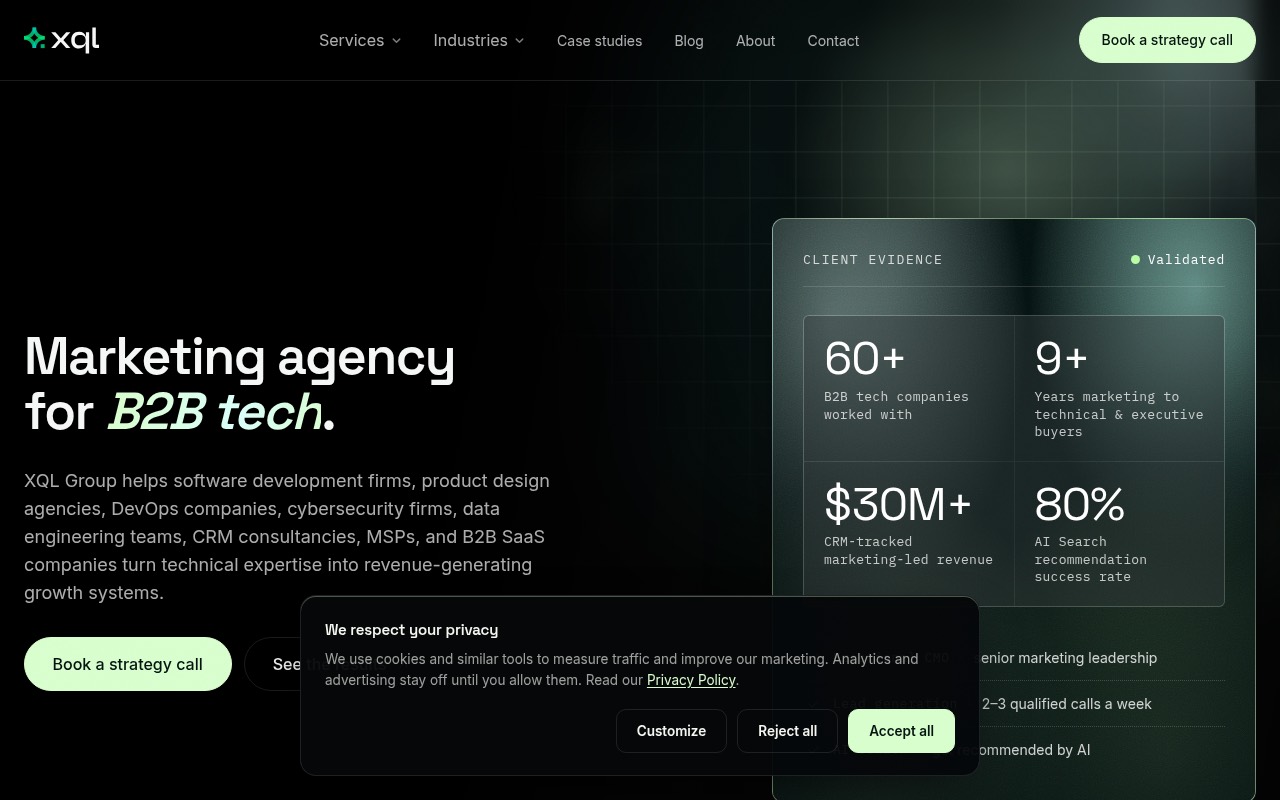
What they doXQL is built for one buyer: high-ticket B2B tech service providers, meaning software development shops, design agencies, Salesforce partners, and DevOps firms, almost all of them SMBs selling consultative deals on trust and referrals. The client wall shows it, with more than 20 named firms like Relevant Software, Computools, and Cieden, each with metrics and most with a quote, and a 5.0 Clutch score across 14 reviews. Pricing is genuinely public and SMB-sized: a 1,000 euro audit, revenue SEO from 1,500 euros a month, AI search optimization from 2,000, and a fractional team from 3,000. Its own search footprint is small, which is the honest caveat, though its AI-search work shows in client results.
Best forDev shops, agencies, and tech service SMBs that live on referrals and want inbound built at a price a services margin can carry.
Pros
- Published prices from 1,500 euros a month, among the most accessible on this list.
- Deep single-niche focus on tech service firms, with 20+ named clients and metrics.
- 5.0 on Clutch across 14 verified reviews.
Cons
- Its own organic search footprint is small, seven ranked keywords at review time.
- Only fits tech service sellers. A product or manufacturing SMB is outside the niche.
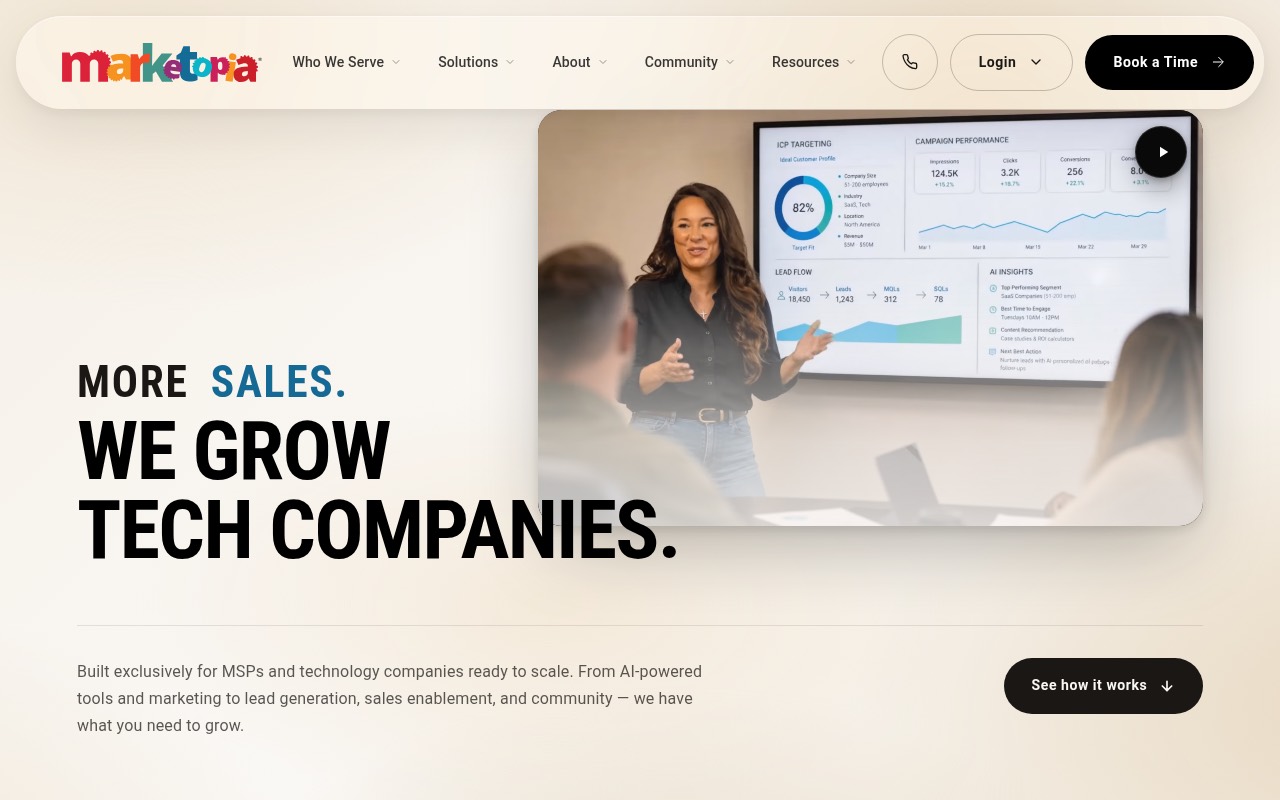
What they doMarketopia serves one market: managed service providers and the technology vendors who sell through them. Most MSPs are classic SMBs, local, founder-run, and referral-dependent, and Marketopia wraps marketing, appointment setting, sales training, and a peer community around that exact business. The depth is real: dedicated MSP and vendor programs, the GROW peer groups and GROWCON conference, quantified case studies like Data Tech Cafe growing profit 450%, and named clients including CMIT Solutions alongside vendor partners like ConnectWise and Datto. It has made the Inc. 5000 nine times. What it lacks is public proof of satisfaction: no published pricing and no review score on any major platform.
Best forMSPs and channel vendors that want pipeline, appointment setting, and peer support from a team that only does the IT channel.
Pros
- Complete focus on the MSP and IT channel, with community and training built in.
- Quantified case studies and recognizable channel names on the client wall.
- Nine-time Inc. 5000 company, so its own growth is documented.
Cons
- No review score on Clutch or any major platform, unusual for a firm this size.
- Does not publish pricing.
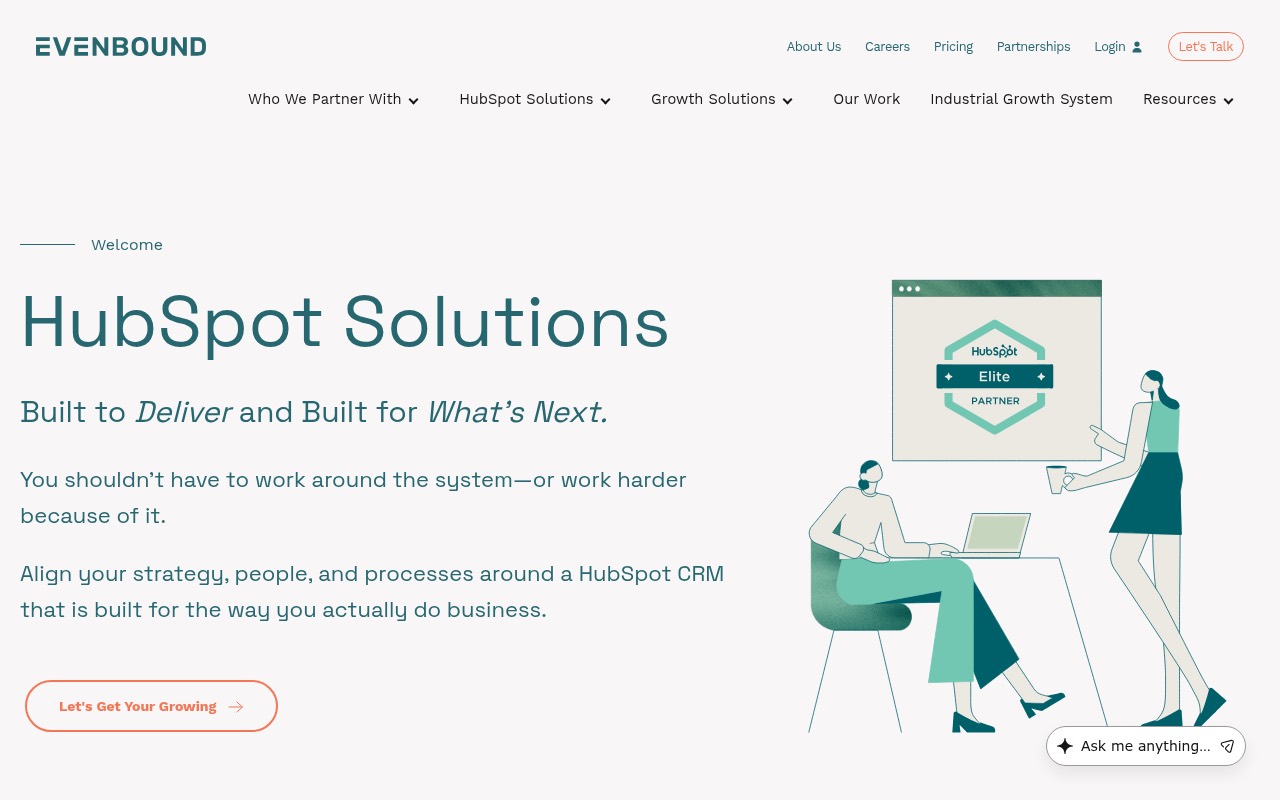
What they doEvenbound is an industrial growth firm and HubSpot Elite partner, one of the highest HubSpot tiers, built for manufacturers, contractors, and industrial B2B companies. Those are businesses with long, quote-driven, trust-led sales and usually no marketing department, and Evenbound sells them a system: strategy, website, HubSpot, and demand generation as one program. Client stories are named and specific, like Ramtech lifting HubSpot adoption 40%, and the firm carries HubSpot's manufacturing accreditation plus three Inc. 5000 appearances. It holds a 4.9 on Clutch, though from only 8 reviews. The floor matters for this list: minimum projects start around $10,000, at the top of what many SMBs can carry.
Best forIndustrial SMBs and mid-market manufacturers ready to invest in a proper system, particularly if HubSpot is or will be the stack.
Pros
- HubSpot Elite tier with a dedicated manufacturing accreditation, rare specialization.
- Industrial-only positioning that matches long, quote-driven sales.
- 4.9 on Clutch, albeit from 8 reviews.
Cons
- Minimum engagement around $10,000 a month is a real barrier for smaller SMBs.
- Its blog wins HubSpot glossary terms more than its own industrial category, and no senior team is named on the site.
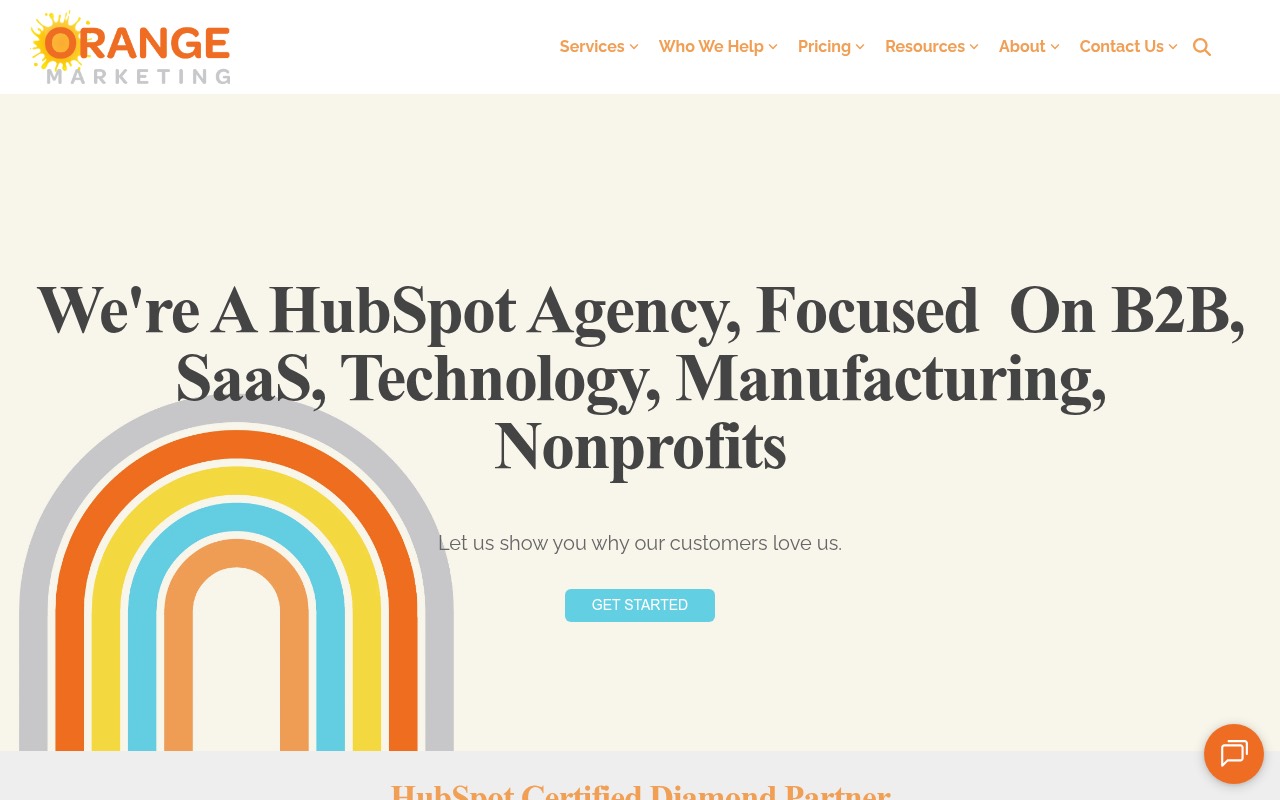
What they doOrange Marketing builds CRM and marketing systems in HubSpot and then runs them, which is often the unglamorous thing an SMB actually needs before demand generation can work at all. It is a HubSpot Diamond partner with over 250 clients served, and its proof lives where its buyers are: a 5.0 average across 158 reviews on the HubSpot Solutions Marketplace, every one five stars. The focus is B2B SaaS and technology SMBs, with around 30 clients named on the homepage, including FreightPOP and Amberdata, and its own content ranks for the HubSpot and answer-engine topics it sells. If your pipeline problem is really a systems problem, messy CRM, no attribution, marketing and sales disconnected, this is that specialist.
Best forSMB SaaS and tech companies on HubSpot, or moving to it, whose real blocker is the revenue system behind the marketing.
Pros
- 5.0 across 158 HubSpot Marketplace reviews, all five stars.
- Deep operator focus: builds the CRM system and then runs the demand programs on it.
- Around 30 named SMB clients on the site, so the track record is inspectable.
Cons
- Does not publish pricing.
- HubSpot-centric. If you will not run on HubSpot, most of the value disappears.
What they doAvid Demand has been doing B2B demand generation since 1999, longer than anyone else on this list, and it is explicitly built for companies with complex sales. It pairs SEO, paid media, content, and conversion optimization with a custom ROI dashboard, and offers a 90-day trial engagement instead of a long contract, a structure that suits a cautious SMB buyer. Its own marketing walks the talk: it ranks first in US search for b2b seo agency, the exact category it sells. The client wall runs from Cisco and SAP down to smaller technology firms, with quantified outcomes like demo requests up 59%. The gaps are transparency ones: no published pricing, no named senior team, and only a single 2018 Clutch review, too thin to count as a score.
Best forB2B technology SMBs with complex sales that want a veteran, measurement-first team and a low-risk 90-day start.
Pros
- Twenty-five plus years of B2B demand generation focus, with a 90-day trial instead of a long contract.
- Ranks first for b2b seo agency, proof it can do for you what it does for itself.
- Custom ROI dashboard ties the work to pipeline, not activity.
Cons
- Effectively no public review record, one Clutch review from 2018.
- No published pricing and no named senior team on the site.
What they doADM is a Chicago paid media specialist staffed only with senior media managers, no junior handoffs, which addresses the most common SMB complaint about big ad agencies. It runs paid search and paid social for growth-stage companies, holds a 4.7 on Clutch across 30 reviews, and its own site ranks for sem agency, the category it sells. It has an unusual compliance niche: deep experience with regulated health brands, backed by a LegitScript content cluster that actually ranks. Founders are visible and named. This is a scalpel, not a system: it will not build your content engine or your CRM, so it belongs in this list for the SMB whose specific bottleneck is making paid channels efficient.
Best forSMBs, especially health and ecommerce brands, whose growth blocker is paid media performance rather than the wider system.
Pros
- Senior-only media team, no junior account handoffs.
- 4.7 across 30 Clutch reviews with named founders.
- Rare, provable experience with regulated health advertising.
Cons
- Paid media only. Nothing here builds owned, organic demand.
- Does not publish pricing.
What would a real demand engine be worth to your business?
Get a free Content RevOps audit. We map what you have today, what is missing, and what a ground-up system would change, in pipeline terms, benchmarked against our 2026 research.
Frequently asked questions
What does a demand generation agency do for a small or mid-sized business?
It helps buyers find and trust you before they talk to sales. For an SMB that means content and campaigns built for your real buying group, placed in search, AI answers, and email, then tied to your CRM so you can see what each piece earns. The good ones act like a missing department, not a vendor waiting for briefs.
How much do demand generation agencies charge SMBs?
Most do not publish prices. Where numbers are public on this list, they run from about 1,000 pounds a month for lean consulting support to a flat $4,000 a month all-inclusive, with fuller retainers at $5,000 to $25,000. We verified every published price against the live page and mark the rest as not disclosed.
How did we choose and rank these agencies?
We started from a database of over 1,700 demand generation agencies, kept more than 500 that state they serve small and mid-sized businesses, and ranked the shortlist on SMB fit, whether their own marketing works, review evidence, and transparency. The same checks apply to our own entry, which is pinned first because this is our directory. Positions below the top few are directional, not a precise score.