Growth Marketing vs Demand Generation: Are They Really That Different?
Want “growth” that actually compounds into pipeline? Let’s build your demand gen operating system.
Book a CallIn modern B2B marketing, “growth marketing” and “demand gen” get used like synonyms. One week the mandate is growth—run more tests, add more channels, ship faster. The next week it’s demand gen—fill the pipeline, hit the lead number, prove ROI. The result is usually the same: channel chaos, mismatched expectations with sales, and a lead model that rewards volume even when quality collapses.
Part of The Complete Guide to B2B Demand Generation Strategy.
That’s why “growth marketing” is so appealing. It sounds expansive and ambitious—covering acquisition, retention, product, brand, and experimentation all at once. But that breadth is also the problem: it’s often operationally vague. Without a central narrative or a consistent content engine, teams default to stacking isolated experiments that reset every quarter.
The confusion in modern B2B marketing
On the ground, the pressure is rarely philosophical. It’s immediate: create pipeline now. When that pressure hits, “growth” tends to become shorthand for activity—more paid tests, more webinars, more outbound support, more tools—without an organizing system. That’s how you end up with “ridiculous” pressure to deliver more leads regardless of quality, and a lead machine that looks busy but underperforms commercially.
Common symptoms show up fast:
Channel chasing instead of a cohesive buyer journey
Short-term lead targets that degrade quality over time
Fragmented messaging that never compounds into trust or authority
You can see this in how many B2B teams still optimize for MQL volume while admitting their approach “is not fit for purpose,” or in survey data showing that only a small minority of marketers have a documented, demand-focused content strategy that actually connects to revenue. As sales cycles lengthen and buying behavior moves online, this activity-first mindset becomes even more brittle: buyers are doing the majority of their research independently, forming shortlists long before they talk to a rep, which means random experiments and disconnected campaigns rarely add up to commercial impact.
The core argument
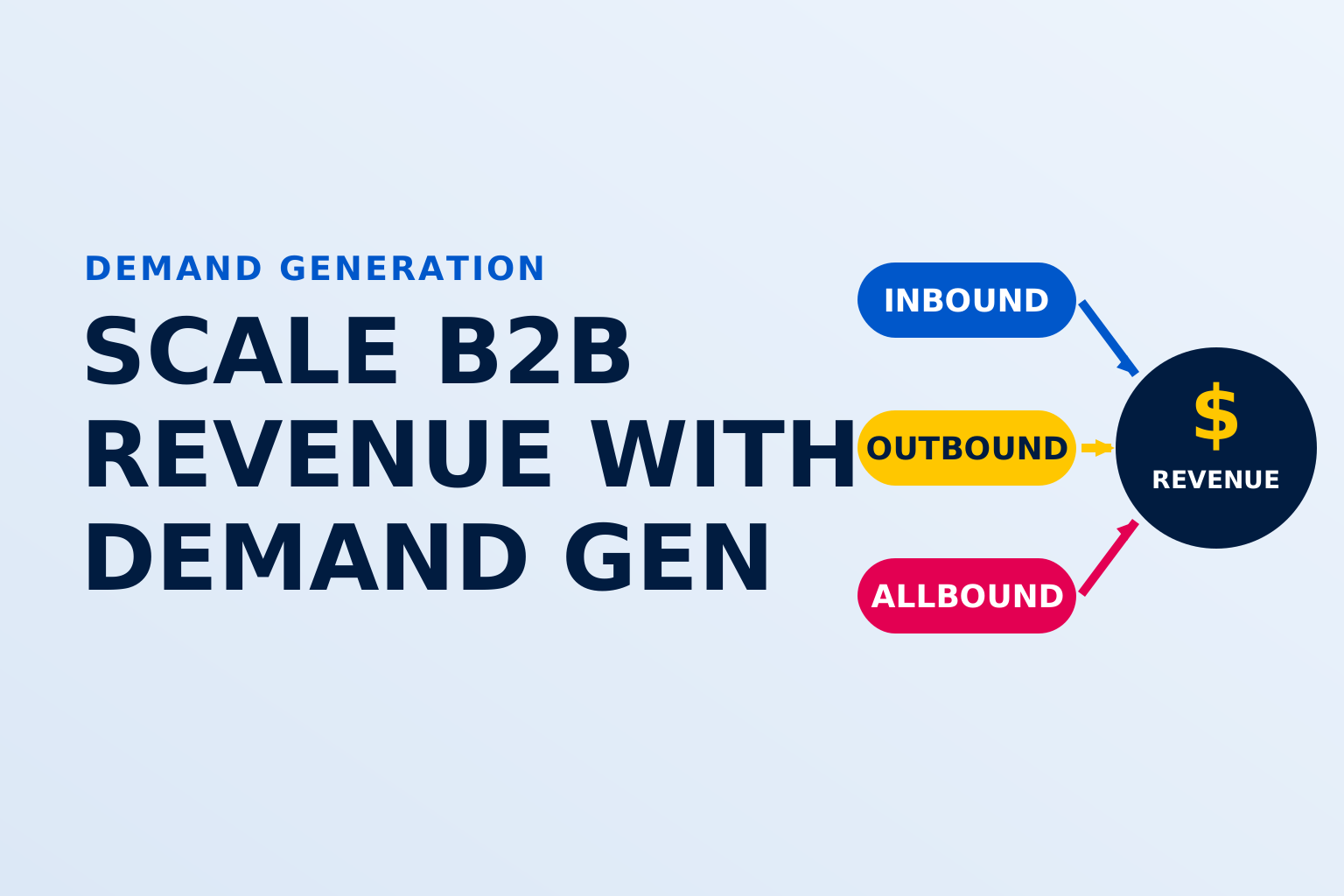
Here’s the distinction this article will defend: growth marketing is an umbrella philosophy; demand generation is the repeatable system inside it. Growth sets the appetite for learning and scale. Demand gen builds the machine that reliably turns attention into pipeline—by treating content as an asset and distribution as a discipline, anchored to a specific ICP and a consistent narrative.
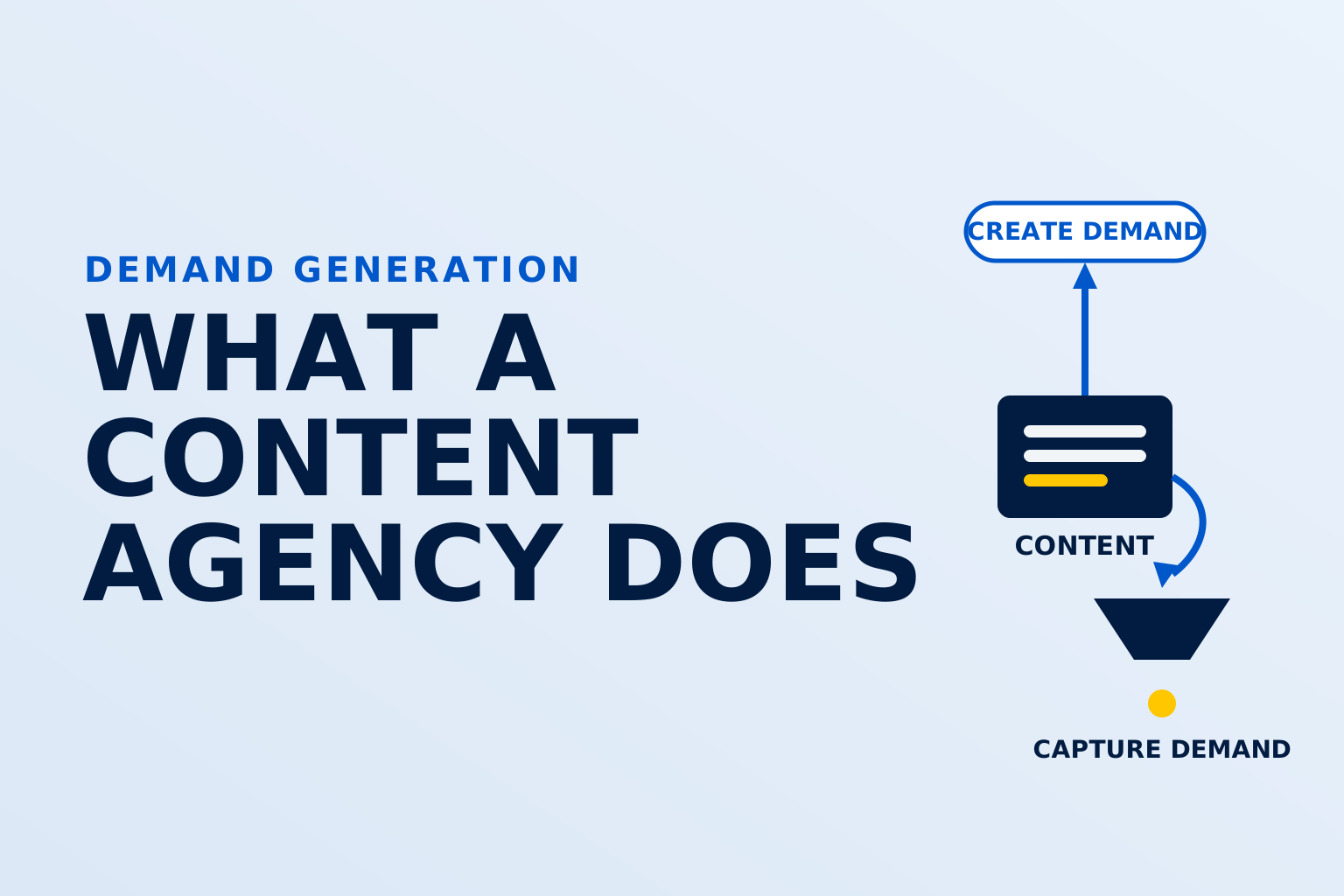
That system-level view is increasingly how high-performing B2B teams describe their work: demand gen is positioned as a strategic growth partner that owns predictable pipeline, not just a campaign function. It looks less like “run more tests” and more like building a branded demand engine that integrates brand, content, and performance into one operating model. It treats content as a product that both creates and captures demand across the full journey, from thought leadership that shapes a category to mid- and bottom-funnel assets that directly influence opportunities and revenue.
Sustainable growth doesn’t come from piling on experiments. It comes from building a compounding content + distribution system that educates the market, earns trust, and converts demand when buyers are ready—an always-on engine that can be optimized with experimentation, rather than replaced by it every quarter.
What “Growth Marketing” Really Means (and Why It’s So Vague)
Growth marketing as a philosophy, not an operating model
In practice, “growth marketing” usually means an organization-wide mindset: find growth levers, test them quickly, and scale what works. The scope is intentionally broad—acquisition, retention, monetization, product, and brand can all fall under the same label. That breadth is why the term is attractive inside leadership teams: it signals ambition, speed, and cross-functional thinking, and it maps neatly to the way many teams now talk about “full-funnel” growth, from acquisition through expansion.
At its best, growth marketing does three useful things:
Encourages experimentation instead of relying on one channel or one playbook
Breaks silos by pulling in product, sales, and lifecycle teams
Stays open to new levers (new platforms, formats, partnerships, automation)
The problem is that none of this tells a team how to operate week to week. “Do growth” is a philosophy. It’s not a system, which is why so many B2B teams end up bolting demand generation, ABM, and lifecycle programs under the same vague heading without a clear operating model behind them.
How growth marketing drifts into channel and experiment chasing
Because the mandate is vague, teams often translate growth into volume: more tests, more channels, more tactics. Paid variations, SEO pushes, webinars, social series, outbound sequences, AI tools—anything that can move a metric this month. This is the pattern you see when growth is treated as a grab bag of performance tactics rather than a defined system for creating and capturing demand.
Without a defined system, the work tends to drift into:
Fragmented tests with no shared thesis (every experiment is “worth trying,” so nothing compounds)
Short-term measurement bias toward what’s easy to track quickly (clicks, form fills, MQL counts)
Constant tactic switching when performance plateaus, even if the underlying story and audience fit were never solved
That short-term bias is reinforced by the way many teams still over-index on top-of-funnel content and MQL volume, even though only a small fraction of B2B content is aimed at bottom-of-funnel decision making and most sales leaders do not rate MQLs as a critical success metric. When the KPI stack is built around surface-level activity, growth naturally becomes channel and experiment chasing rather than a durable engine.
This is where “growth” becomes motion: high activity, unclear direction.
Failure modes of vague growth mandates
When growth marketing isn’t grounded in a buyer-centric operating model, three failure modes show up again and again:
No central narrative: each campaign tells a different story, so buyers never build a clear mental model of what you solve. Over time, this erodes brand salience and makes it harder to land on the all-important initial shortlist when a buying cycle finally starts.
No consistent content engine: content happens in bursts (launches, quarterly pushes), then disappears. There is no “content product” that ships on a predictable cadence to a clearly defined ICP, so you never build the trust and familiarity that research shows underpin high-ROI, mid- and late-funnel content like case studies.
No compounding mechanism: results reset to zero when campaigns stop because nothing durable was built—no owned audience, no search footprint around high-intent queries, no always-on programs that meet buyers where they already research.
You can see the organizational side effects of this in the way many B2B teams describe their lead gen and “growth” efforts: volume pressure on MQLs regardless of quality, misalignment with sales over what a good lead looks like, and a creeping sense that the traditional playbook of more campaigns and more channels is delivering less each year. Those are symptoms of a philosophy without a system.
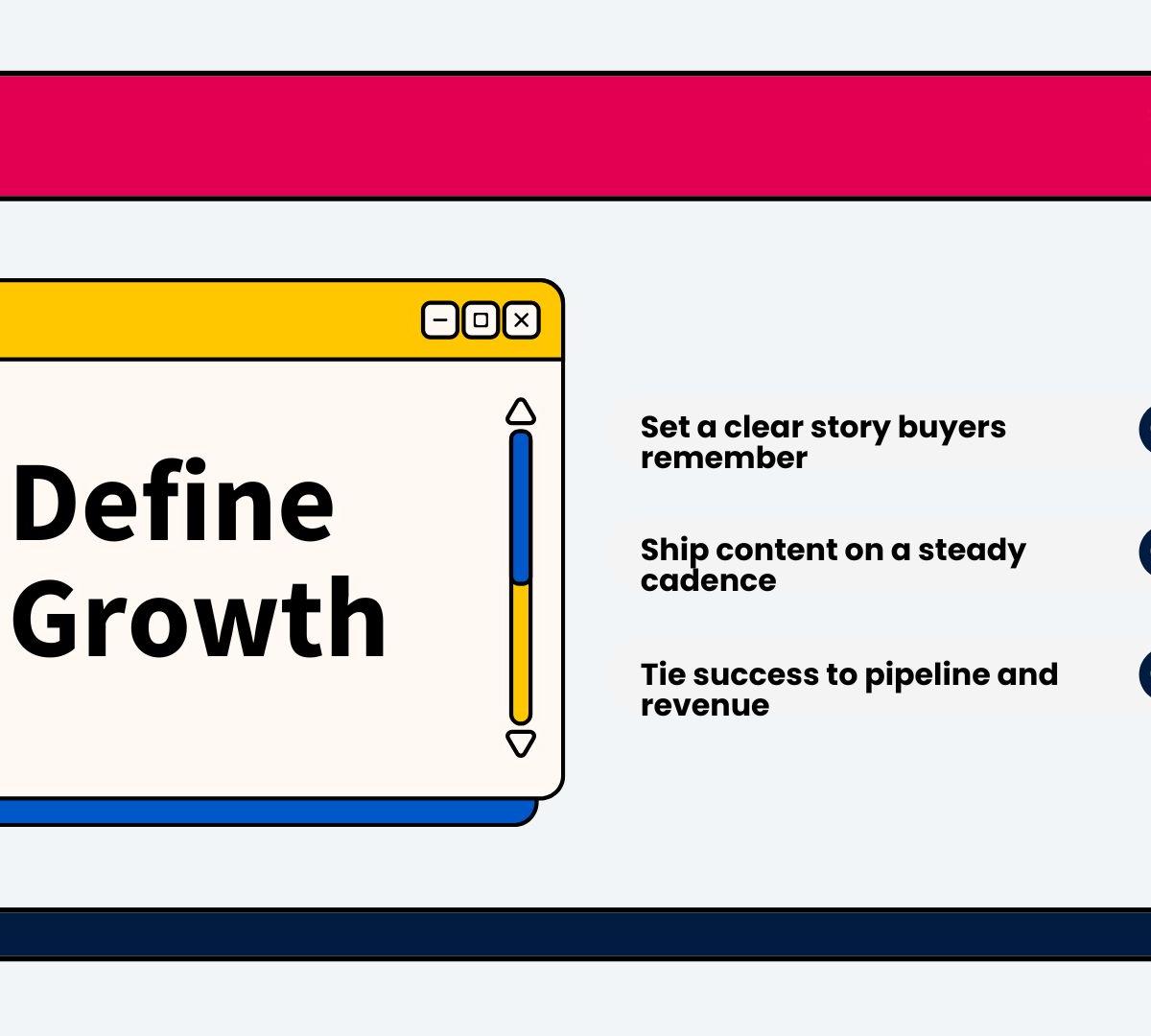
Growth marketing is powerful as an umbrella mindset. But without a system—content as a product, distribution as infrastructure, and success tied to pipeline and revenue—it often produces activity instead of predictable demand. The teams that break out of this pattern treat demand generation as that system: a branded, content-led engine designed to build future demand, capture in-market intent, and compound results over time instead of starting from scratch every quarter.
Demand Generation as the System Inside the Umbrella
A practical definition of demand generation
If growth marketing is the umbrella (a broad philosophy that can include anything from paid tests to product-led motions), demand generation is the operating system underneath it: structured, always-on, and built to produce pipeline predictably.
A practical definition: demand generation is a repeatable, content-led model that creates, captures, and converts demand for a clearly defined ICP. It’s organized around three anchors:
A specific ICP and their jobs-to-be-done (triggers, objections, alternatives, buying committee dynamics)
A central narrative that threads through campaigns, sales motions, and customer touchpoints
A content product + distribution network designed to educate, qualify, and move deals forward across the journey
Most importantly, demand gen is judged by business outcomes. Not “how many leads did we get?” but pipeline created, pipeline velocity, conversion rates by stage, and revenue impact. That discipline is what generic “growth” efforts often miss—especially when teams are pressured into volume goals that reward activity over value and treat demand gen as a lead factory rather than a strategic growth partner embedded in revenue planning.
Content as the product, not the byproduct
Demand gen works when content stops being a calendar habit and becomes infrastructure. In other words: content isn’t an output; it’s an asset you build, maintain, and compound. Each asset has a job—create trust, shape problem awareness, qualify fit, handle objections, or unblock next steps.
In practice, that looks like:
One commercial narrative tied to a painful, high-cost ICP problem (not a rotating set of “campaign themes”), so the market is consistently “conditioned” to connect that problem with your solution
Cornerstone assets (guides, webinars, frameworks, customer stories) that generate dozens of derivative pieces (blogs, clips, social, emails) without diluting the message—more like a content operating system than isolated campaigns
Content wired into the go-to-market flow: CRM fields, nurture sequences, sales enablement, and outbound plays—so it actually changes pipeline outcomes instead of just generating attention, and can be measured against stage movement and opportunity value
This is how demand gen avoids the “reset to zero every quarter” trap: the library grows, distribution gets sharper, and message-market fit improves over time. Teams that treat content as a genuine product—anchored in buyer research and mapped to both demand creation and demand capture—see it compound into higher-intent inbound, stronger brand preference, and better close rates.
Buyer-centric, measurable, and compounding
Effective demand gen starts with buyer reality: the language buyers use, what forces them to change, what they’re afraid of, and what they’ll compare you against. Keyword and audience research matter here—but less as an SEO checklist and more as a way to surface buying signals and content gaps across the journey, from early problem awareness to late-stage validation.
Instead of one-off campaigns, demand gen builds an always-on engine: recurring series, evergreen libraries, and serialized webinars that train the market and capture intent when it appears. Measurement follows the same system mindset: shared stage definitions (MQL/SAL/SQO and, when useful, MQAs), attribution that connects programs to qualified pipeline rather than just MQL volume, and reporting that ties content to stage movement, payback, and pipeline efficiency.
Demand generation is the machine that turns growth marketing’s broad ideals into a repeatable, revenue-facing system—one that compounds because it builds an owned asset: content plus distribution, anchored to a narrative your ICP actually trusts and reinforced by a shared language, processes, and metrics across marketing, sales, and revenue operations.
Why experiment- and channel-led growth often stalls
A common “growth marketing” playbook is deceptively simple:
Pick a promising channel (paid social, search, outbound tooling, event series)
Run fast tests on offers, creatives, and targeting
Optimize for cheaper leads and quick wins
The problem is that this motion often optimizes the measurable instead of the meaningful. When MQL volume becomes the target, quality tends to collapse: you can always buy more form fills by widening targeting, weakening gating, or overpromising in the offer. As Goodhart’s Law predicts, once a measure becomes a target, it stops being a good measure of effectiveness, and many B2B teams now report “ridiculous” pressure to deliver leads regardless of quality, with nearly half saying that setup is hurting real performance and alignment between sales and marketing. It looks like progress right up until sales rejects the leads or cycles stretch.
Even when the leads are decent, channels saturate. Costs rise, audiences fatigue, deliverability degrades, and the team “resets” to the next channel. The deeper issue: nothing durable is being built. You end up with disconnected tests, scattered learnings, and results that snap back to zero each quarter. That pattern is exactly what’s playing out as traditional, volume-led B2B playbooks fade and marketers acknowledge that channel-first tactics alone are no longer enough to grow and capture demand in complex buying environments.
Demand generation’s different center of gravity
In practice, growth marketing often centers on experiments, channels, and short-term gains. Demand generation shifts the center of gravity to something more stable: a central narrative, a consistent content engine, and long-term trust with a defined ICP. Recent research shows B2B marketers explicitly elevating this kind of work, with more than six in ten saying their role has become more strategic and less about just executing campaigns.
Treating content as a product changes the game:
Before buyers are in-cycle: it conditions the market with a clear point of view and builds familiarity, which matters when as much as 80% of the B2B buying journey now happens before prospects ever talk to Sales
When buyers start researching: it captures declared intent through evergreen hubs, focused offers, and nurture that reflect how demand is actually created and captured across the funnel
When sales engages: it supplies proof, education, and objection handling that can shorten cycles and improve win rates, especially through mid- and bottom-of-funnel assets such as detailed case studies and thought leadership
Instead of “what should we test next?”, the question becomes “what asset are we compounding?”—a shift many teams are making as they re-architect content and demand programs to operate as a single, branded demand system rather than a series of one-off growth plays.
Experiments and channels inside a system, not instead of one
Experiments and channels still matter—but they work best after the demand gen system exists.
Inside a content-led engine, testing becomes more disciplined:
Experiments are anchored to buyer insights and journey stages (not just registrations or clicks), reflecting a broader move from “conversion” to “influence” as the primary goal of B2B lead activity
Channels are distribution levers for the content product, not standalone strategies, with growth-style tests used to refine how a consistent narrative and content suite show up across search, social, events, and partners
Performance is evaluated through a revenue lens (pipeline influenced, stage progression), not just CTR or CPL, mirroring how high-performing demand gen teams now tie programs directly to opportunities, deal velocity, and account-level impact
When growth thinking is subordinated to a strong demand gen system, experiments stop replacing strategy—and start accelerating compounding. That is why more organizations are positioning demand generation as a strategic growth partner inside the business, using it as the operating system for sustainable pipeline while letting “growth” experiments plug in as controlled inputs rather than the main event.
Start with a sharp ICP and commercial theme
A demand gen operating model starts by narrowing who you’re building for—because “everyone” forces generic messaging and random channel tests. The ICP should be chosen with commercial reality in mind:
Market size you can actually win, not just total addressable market
Reachable opportunity (can you consistently get in front of them?)
LTV and payback potential
Urgency of the pain (is it a now problem or a someday problem?)
Online reachability (do they research, compare, and self-educate in public channels?)
This is where a lot of teams move from a vague “growth” mandate to a defined demand engine: a clear ICP, specific problems, and a content + distribution system built around them. Research on modern B2B buying shows that up to 80% of the journey now happens before Sales is involved, which makes a sharp ICP and narrative far more valuable than a long list of “possible” segments.
From there, pick one primary commercial theme tied to a high-intent pain in that ICP. This becomes the spine: the narrative that content, offers, and campaigns hang off of. Without that throughline, “growth” quickly becomes channel-chasing—lots of motion, little compounding. In contrast, teams that treat demand gen as a repeatable system anchored in a single, buyer-led story see much higher returns from content, events, and paid programs over time.
Build a structured content and activation system
Demand gen works when content is treated like infrastructure: a product you can reuse, distribute, measure, and improve. That means a planned system, not sporadic publishing.
Core components typically include:
Research: jobs-to-be-done, intent mapping, keyword patterns, and competitive alternatives (including DIY and “do nothing”). This is where you translate ICP pains into search intent and buying signals, using things like intent-rich “money keywords” and behavioral data from your existing funnel.
Content architecture: cornerstone assets supported by articles, tools, webinars, and case studies mapped to journey stages. High-performing teams systematically over-index on mid- and late-funnel proof content (especially case studies and product education) because it drives higher ROI than top-of-funnel volume pieces.
An operational calendar: every asset tagged by persona, purpose, funnel role, channel, and activation plan—so it functions more like a content product roadmap than a loose list of blog ideas.
There is plenty of evidence that most B2B content still skews heavily to the top of the funnel while only a small fraction directly targets decision and evaluation stages, even though those assets are disproportionately powerful in converting pipeline. Treating demand content as a product—documented strategy, clear objectives, and mapped buying journeys—instead of a stream of posts is what separates durable engines from “random acts of content.”
Distribution is designed upfront, not bolted on later. Each asset should have built-in paths into email nurture, sales sequences, community/social repurposing, and outbound follow-up—so content does work across the GTM, not just in one channel. Teams that align this system with Sales (shared definitions, SLAs, and revenue-facing KPIs) consistently report better lead quality, higher conversion, and stronger internal credibility for marketing as a strategic growth partner.
Tie the engine directly to pipeline
This is where demand gen separates itself from vague “growth marketing.” The goal isn’t visibility; it’s a durable, revenue-facing asset that compounds.
A practical pipeline link looks like:
Clear jobs by stage: aware → interested → engaged → qualified
Capture + scoring aligned to buying behavior, not form fills alone—shifting from single-touch MQL logic to multi-signal qualification that reflects real intent and account-level readiness
Handover logic and reporting that explains what changed, why it changed, and what gets adjusted next (including feedback loops from Sales back into content, scoring, and channels)
When content is connected to pipeline this way, you stop resetting to zero each quarter—and start building a system that earns trust, creates demand, and captures it predictably. Research on modern B2B engines shows that organizations treating demand gen as an always-on, buyer-centric system (rather than a series of campaigns) see multiples of improvement in lead-to-revenue performance and are far more likely to be viewed internally as strategic growth partners, not just a cost center.
Reframing the question: are they really that different?
They’re different in the way a mindset differs from a machine. Growth marketing is a useful umbrella for finding and scaling levers across acquisition, activation, retention, and monetization—but it’s so broad that teams often translate it into “run more tests” and “add more channels,” without a clear, shared definition of success across the funnel (a common failure mode in growth-heavy teams).
Demand generation makes that philosophy operational. It’s a buyer-centric system that turns attention into pipeline by anchoring work to a clear narrative, a defined ICP, and a consistent content-and-distribution engine—essentially a branded demand model where brand and revenue goals are designed as one system rather than competing agendas (now a priority in modern B2B programs). The teams that win don’t choose one label—they put a rigorous demand gen machine at the center of their growth efforts, then use experiments to improve it, not replace it, building assets that compound instead of one-off “growth hacks” that peak and fade (a pattern seen in long-running content-led engines).
Sustainable growth comes from assets, not isolated experiments
Most “growth” initiatives fail to compound because they reset every quarter: new channel bets, new creative, new targets—without a story buyers can repeat or a system that stacks results over time. Survey work on B2B effectiveness shows this clearly: marketers are testing more tactics than ever, but a majority still miss pipeline targets when efforts stay campaign-led and channel-first instead of system-led (53% of digital teams fall short on pipeline).
Demand generation compounds because it builds infrastructure:
A central narrative buyers recognize and trust
A consistent content engine that educates and qualifies over time
A distribution system that keeps the message present before buyers are in-market
Teams that treat content as this kind of operating system—rather than a loose publishing calendar—tend to grow faster and more efficiently, because every asset feeds the same ICP, storyline, and funnel mechanics (what some researchers describe as a content “product” that underpins demand). That’s also where trust-building formats like thought leadership, case studies, and webinars stop being random campaigns and become compounding proof assets that move real opportunities (especially among out-of-market buyers who later enter a buying cycle).
Where our work fits
This is how we operate. We treat content as a go-to-market operating system, not a publishing schedule. That means research-heavy, ICP-specific content paired with activation models that align with sales—and stay accountable to pipeline and revenue, not just top-of-funnel engagement or MQL volume (a shift many B2B organizations are making as they move from volume to quality). In practice, that looks like building a persistent narrative, mapping it to a documented buyer journey, and using a small number of scalable programs—flagship series, event engines, and proof libraries—as the backbone of acquisition and expansion (an approach echoed in “perpetual demand” models that run 24/7 around the buyer’s path).
If you want growth marketing to mean more than “run more experiments,” you need a demand generation engine at the core. That’s the kind of system our work is built to design and run: a defined, measurable asset (content + distribution + sales alignment) that compounds over time instead of resetting with every new test (the same evolution many CMOs describe as moving from a traditional playbook to a long-term, system-based model).
Is your growth motion building assets—or just burning budget on tests?
Turn content into revenue infrastructure: a clear ICP, one narrative, and an always-on engine tied to pipeline—not MQL volume.
Frequently Asked Questions
About the Author

Founder & CEO, Content RevOps
Stefan Kalpachev is the founder and CEO of Content RevOps, where he helps B2B SaaS companies transform their content into predictable pipeline. With a background in content marketing and revenue operations, Stefan has developed a unique methodology that bridges the gap between content creation and revenue generation.
Connect on LinkedIn