The Relationship Between Product Marketing & Demand Generation
"Ready to stop shipping decks and campaigns—and start running one revenue-driving content system? Let’s talk."
Book a CallProduct marketing and demand generation are often treated like separate (or competing) functions: one team “does messaging,” the other “runs campaigns.” That framing is directionally right, but it’s also the reason so many go-to-market motions feel noisy without getting sharper.
Part of The Complete Guide to B2B Demand Generation Strategy.
In SMBs especially, the split becomes structural. Product marketing creates positioning decks and narrative docs that don’t travel far beyond internal reviews. Demand gen builds channel-specific programs that optimize for activity, not belief. The outcome is predictable: generic creative, inconsistent stories across touchpoints, and content that earns clicks but doesn’t earn trust—or pipeline.
This article argues for a more useful model: product marketing and demand generation are interdependent layers of the same GTM system. Product marketing defines why the right buyer should care (and why you’re different). Demand generation operationalizes how that belief is created, distributed, and reinforced over time.
Content is the bridge between them. Тhe place where positioning becomes usable in the market, and where demand gen becomes a compounding system instead of a series of disconnected launches.
Context: The false dichotomy
When teams reduce the relationship to “messaging vs. execution,” two things happen:
Product marketing stays theoretical (smart POV, weak adoption)
Demand gen stays tactical (high output, low distinctiveness)
In practice, this looks like positioning that never leaves the slide deck and campaigns that could belong to any competitor. Buyers then experience your company as a collection of disconnected claims, not a coherent story that builds confidence over time. That pattern shows up repeatedly in research on brand vs. demand silos and “brand-gen” efforts that try to stitch them back together as one continuum of influence rather than two opposing camps.
Core argument
A better division of responsibility is simple:
Product marketing owns the “why”: POV, narrative, positioning, differentiation, and a clear definition of who it’s for (including buying roles, triggers, and emotional drivers).
Demand generation owns the “how”: turning that strategy into a content product and distribution system that builds preference while also capturing in-market demand.
In mature GTM systems, that “why” is not just a positioning deck, it is encoded in a documented content strategy, shared ICP, and journey map that marketing, sales, and product actually use day to day. When those inputs are missing or static, demand gen defaults to volume-centric campaigns and vanity metrics instead of a metrics ladder tied to qualified pipeline and revenue.
The connective tissue is content, because it forces translation. Positioning only matters when it becomes:
thought leadership that educates and “conditions” the market around your POV, not just your features
content assets that sales and buyers actually use at specific journey stages, instead of one-off collateral
campaigns and outreach that reinforce one story across channels, rather than isolated channel-first experiments
sales enablement that makes the narrative actionable in deals and measurably different from competitors’ materials
Teams that use content as an operational bridge, not just an asset factory, are better at connecting brand and demand. They also keep messaging consistent across teams and avoid the “unbranded lead” problem, where buyers remember the resource but not the company behind it.
The rest of this article unpacks where the handoff breaks, why it’s measurable, and how to connect the two through a content-led operating model.
What Product Marketing Really Owns (and Why It’s Not Just Messaging)
From feature lists to market beliefs
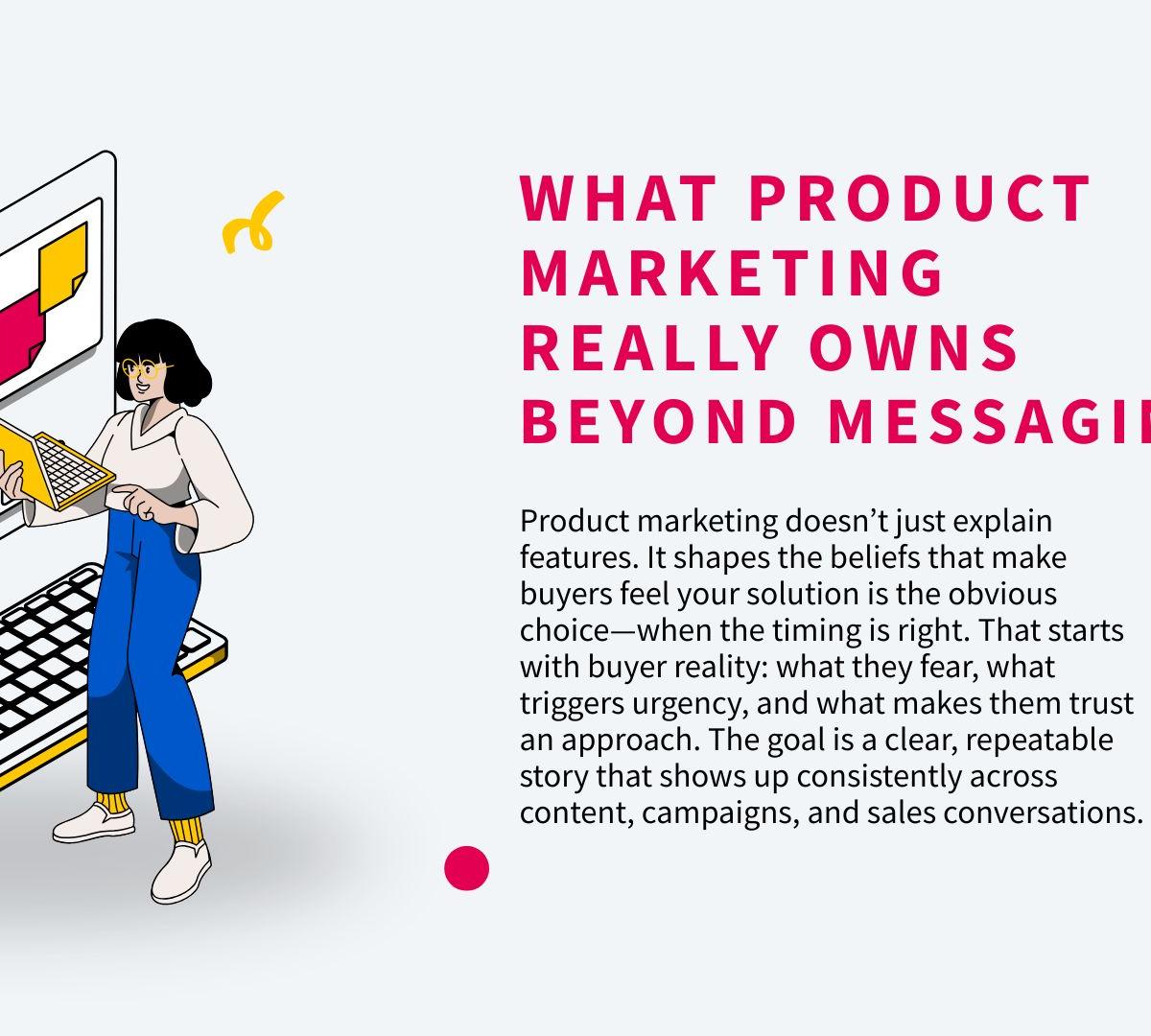
Product marketing’s real job isn’t to describe what the product does. It’s to shape the beliefs that make your product feel like the obvious choice when the timing is right. That means moving beyond feature comparisons and into a clear point of view about the problem, the stakes, and what “good” looks like—essentially your ongoing market conditioning, not a one-off launch moment.
When product marketing is done well, it doesn’t start with internal assumptions. It starts with customer reality: what buyers fear, what they’re trying to protect, what triggers a search, and what makes them trust one approach over another. In B2B, buyers may spend up to 80% of their journey researching independently before talking to Sales, so these beliefs are often formed long before a sales conversation ever happens. Messaging is just the surface layer. Underneath it is a deliberate narrative that explains why this category matters now and why your approach wins, then shows up consistently in content, campaigns, and sales conversations rather than living only in decks.
Defining the “why” and “for whom”
Product marketing owns the hardest clarity in go-to-market: who the product is for, why they should care, and what changes for them if they act.
That includes mapping the buying committee—not as a persona slide, but as decision dynamics:
Who decides vs. who uses vs. who blocks
What risks each role is trying to avoid
What triggers urgency (and what keeps them in “do nothing” mode)
Why your solution beats DIY (and the hidden costs of waiting)
Done properly, that mapping is a living, shared view of your ideal customer profile and buying unit, grounded in real conversations and behavior, not just internal opinions. It becomes the basis for an integrated content and campaign system instead of a static artifact no one uses. This is where value becomes specific: not “save time,” but save time doing the work that leadership actually rewards—and prove it in ways Sales can see moving deals forward.
Market conditioning and differentiation
Positioning isn’t a one-time launch artifact. It’s ongoing market conditioning: repeated, consistent reinforcement of your story until it becomes familiar, credible, and easy to retell. Your narrative, pillars, and proof points should become the organizing principles for everything downstream—content, campaigns, outbound, and sales materials—so that brand, product, and demand efforts reinforce the same idea rather than pulling in different directions.
When that doesn’t happen, content becomes interchangeable because the positioning never escapes slideware. You end up with assets that look like everyone else’s. That is why many marketing and sales teams say their journey-mapped, persona-labeled content still does not stand out or get used consistently in the field.
The constraint without demand gen
If product marketing stops at the deck, the beliefs may be defined—but they won’t be systematically introduced, distributed, or reinforced. That creates a fragile GTM where results depend on hero sellers and one-off campaigns, not a repeatable system that compounds. The gap shows up as “unbranded” or undifferentiated leads, generic channel activity, and content that performs on vanity metrics but doesn’t translate into pipeline quality or win rates. Product marketing provides the strategic spine; demand gen’s job is to turn it into a content and distribution engine that conditions the market over time instead of starting from zero with every new campaign.
What Demand Generation Actually Does: Operationalizing Belief
From “more leads” to a belief-creation system
Demand generation isn’t a channel mix, a paid budget, or a form-fill machine. It’s the operating system that scales belief—taking product marketing’s point of view and turning it into something buyers repeatedly encounter, learn from, and eventually act on.
In practice, demand gen has two intertwined jobs:
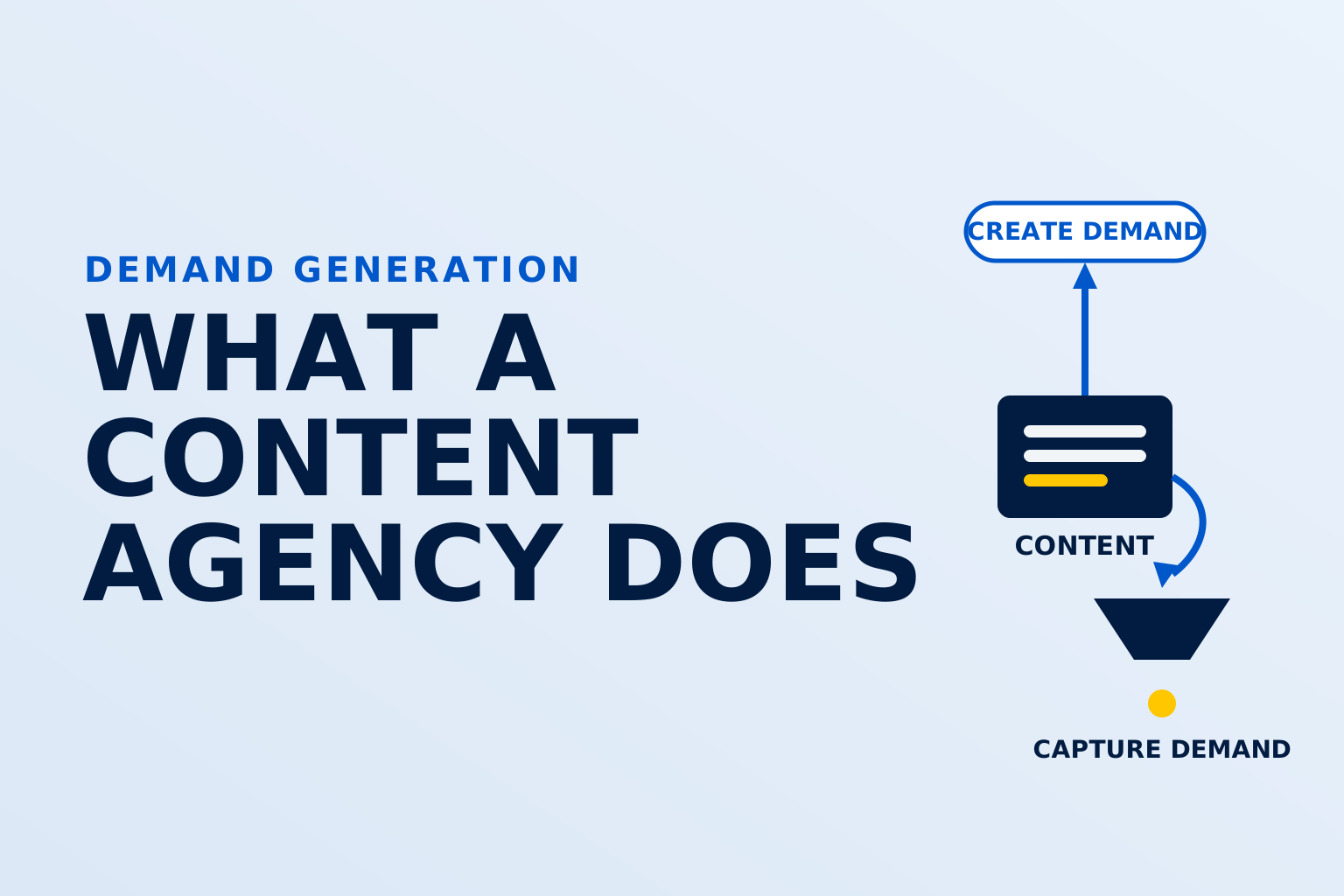
Demand creation: shaping how your market thinks over time through education and POV-led thought leadership (especially for people who aren’t buying yet).
Demand capture: converting active buyers through product-centric paths that make it easy to evaluate, trust, and choose you.
That “create vs. capture” split matches how modern content programs are being redesigned: to simultaneously build future demand and generate sales-qualified opportunities, not just top-of-funnel traffic. When teams only optimize for capture, they might spike leads—but they don’t build preference or long-term “brand gravity” in the buying group. When they only create, they build attention without a clear path to revenue. The work is connecting both into one continuous system.
Content as a product, not a project
Operationalizing belief means treating content like a product. It should be a designed experience for a specific ICP. With each iteration, it should become better, clearer, and more valuable. It should not be just a stream of one-off assets. This mirrors how leading B2B orgs are shifting from “campaign collateral” to durable content products that build owned audiences over time.
That means demand gen doesn’t just “request content.” It builds a content supply chain that turns positioning into reusable building blocks:
Customer and market inputs (calls, objections, win/loss patterns, category confusion) that feed a living ICP instead of static personas
Cornerstone assets (the few pieces that carry your core narrative) that can anchor integrated, full-funnel campaigns
Modular derivatives (posts, snippets, emails, talk tracks, landing pages) created from those cornerstones so every channel reinforces the same POV
Refresh cycles (updating what’s working instead of constantly starting over), so the system compounds value rather than churning out disconnected assets
The result is compounding output: fewer, stronger narratives that show up everywhere buyers look, operating more like a media brand than a traditional “asset factory.”
Distribution as an operating layer
Content doesn’t work because it exists; it works because it’s activated. Demand gen should operate like a media function with planned themes, consistent editorial angles, and formats designed for where buyers actually consume—often without clicking. That includes zero-click environments where your story has to land in the feed, inbox, or search result itself, not just on the destination page.
Distribution is designed up front: every asset has an activation path across owned, earned, paid, outbound, and sales enablement so the story gets repeated, not posted once and forgotten. In high-performing systems, brand-building and demand motions share a single, integrated media plan, treating each touch as another chance to reinforce the same core belief rather than a stand-alone “blast.”
The constraint without strong product marketing
When product marketing hasn’t clearly defined the POV, demand gen defaults to the easiest thing to ship: generic content and copycat campaigns. That usually produces:
Vanity metrics (volume, CTR, MQLs) that don’t predict win rate or deal quality
Weak buyer beliefs entering the funnel—forcing Sales to re-educate from scratch and turning “leads” into unbranded, low-intent contacts
You see the symptoms in sales enablement too: content that looks like everyone else’s, is mostly promotional, and rarely gets used at the right moment in the journey. Without a differentiated narrative grounded in real product advantage, even sophisticated demand engines tend to devolve into channel-first activity—optimizing throughput instead of relevance.
Demand gen can’t manufacture differentiation. It can only scale what product marketing makes true—and make it real in the market through content and distribution that are planned as part of one integrated go-to-market system, not parallel tracks.
Content as the Bridge Between Product Marketing and Demand Gen
Where the GTM system currently breaks
In many SMBs, product marketing does its job: it distills a clear point of view, sharp positioning, and a compelling “why now” into a deck. Then demand generation does its job: it ships campaigns to hit goals. The problem is there’s often no operating model connecting the two, so the narrative never becomes repeatable market influence—exactly the “decks vs. campaigns” gap that shows up in research on GTM silos and in analyses of brand vs. demand fragmentation.
The pattern usually looks like this:
Product marketing lives in decks: strong story, weak activation
Demand gen lives in campaigns: strong motion, watered-down message
Sales lives in scramble mode: searching for content that’s missing, outdated, or too generic to use
When content is treated as ad hoc output, every launch becomes a reset and every campaign becomes channel-native improvisation. The result is activity without compounding advantage—what some researchers call a system that optimizes for “conversion, not influence”, and that underperforms over long buying cycles.
Thought leadership: conditioning the market to your POV
Thought leadership is where positioning becomes believable before a buyer is ready to buy. Instead of “posting,” you’re consistently teaching the market to see the problem your way—so when timing shifts, your solution feels like the obvious path. That’s the essence of “market conditioning” in B2B: building trust and preference across the 95% of buyers who are not in-market yet, not just the 5% who are actively evaluating solutions, a pattern backed by longitudinal B2B studies on brand vs. demand balance.
Product marketing provides the commercial spine (the POV, the stakes, the differentiation). Demand gen makes it a program: validated topics, a recurring cadence, and distribution that builds an owned audience over time. When those two functions are aligned, thought leadership stops being a side project and becomes the engine of what some call “branded demand”—brand and demand working as one system instead of competing for budget.
That translation often takes the form of:
Signature POV series (articles, LinkedIn, podcast themes) tied to one commercial idea
Benchmark-style narratives that dramatize the problem and define “good”
Executive voice formats (essays, webinars, roundtables) that make your stance visible
This is demand creation with intent: not random reach, but market conditioning that strengthens future conversion. It matches what full-funnel practitioners describe as shifting lead gen “from conversion to influence,” where content is designed to earn a place on the buyer’s future shortlist rather than just trigger a form fill.
Content assets, campaigns, and outreach: from deck to system
Once the POV is clear, content turns it into infrastructure. Instead of one-off assets, you build a content product: reusable, modular, and mapped to how buying committees actually evaluate risk and build confidence. This is the move from content “operations” (everyone doing their own thing) to content “orchestration,” where teams follow a shared playbook and reuse core stories across channels—a shift many marketing leaders now see as the next maturity step for content systems.
A practical structure is:
Cornerstone guides aligned to key problems and buying stages
Modular derivatives (clips, threads, nurture emails, sales snippets) built for distribution
SEO that follows intent, anchored in roles and solution needs, not just keyword volume
Demand gen then orchestrates this library into integrated programs—where the same narrative shows up across ads, email, SDR outreach, events, and retargeting—so every touchpoint reinforces the same belief. Teams that do this well treat content as an actual product with its own audience and roadmap, not a project-based service line, echoing the “content as product, not project” model outlined in modern content strategy frameworks.
This is also where a demand-generation–driven content approach pays off: mapping assets intentionally to demand creation and demand capture, and correcting the common bias toward high-level traffic at the expense of journey-stage content that actually drives SQLs.
Sales enablement as proof of integration
Sales enablement is the clearest test: if content can’t be found, used, and personalized quickly, the positioning isn’t operational. Research on marketing–sales alignment shows the same pattern over and over: most teams say they create journey-specific materials, but far fewer see reps actually using the right content at the right stage—a gap that exposes where the PMM narrative and demand gen programs are not truly connected.
Product marketing defines the narrative, objections, and competitive angles. Demand gen turns that into role- and stage-specific materials (decks, one-pagers, case stories, short explainers), housed where reps actually work. Then usage and deal outcomes feed back into the next wave—so the narrative stays living, not static. In more mature organizations, that loop is part of a broader integrated planning process where content, campaigns, and enablement are planned from a single, content-first view of the story rather than bolted on to isolated launches, an approach reflected in integrated brand-to-demand planning models and in case studies of full-funnel overhauls that reposition marketing from event support to strategic growth driver.
Building a Shared Content Operating System (Content RevOps)
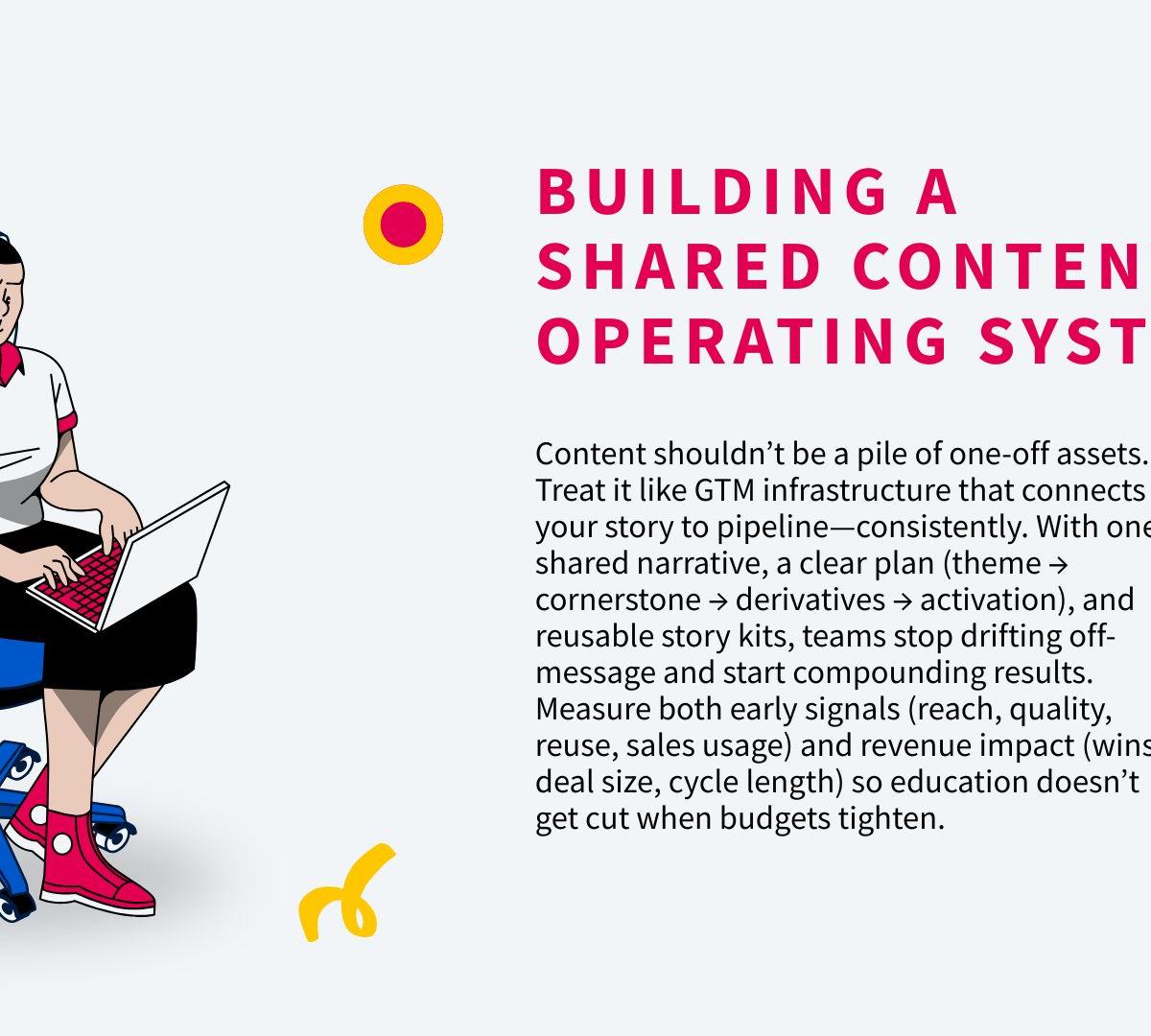
Treat content as GTM infrastructure
In SMBs, the product marketing story often stops at a positioning deck, while demand gen runs campaigns that reset every quarter. A content operating system fixes that by treating content as the layer that connects narrative to pipeline—continuously, not episodically. That shift mirrors how integrated brand-and-demand systems are redefining modern B2B marketing, where content becomes the operational bridge between story and sales motion rather than a downstream deliverable.
When content is infrastructure, it does real work across the journey:
Educates buyers before they ever talk to Sales, in a digital-first journey where most evaluation happens before contact
Qualifies (and disqualifies) demand by making the “best-fit” clear, preventing the “unbranded lead” effect where people remember the content but not the company behind it
Shortens cycles by pre-answering objections, comparisons, and FAQs in formats Sales actually uses, not just in internal docs
Compounds value through reuse, sequencing, and distribution (not one-off publishing), especially when content is treated as a product with its own audience and lifecycle—not a series of isolated projects
This is where product marketing’s POV becomes tangible, and where demand gen stops being generic activity and starts acting like a content-powered GTM system.
Shared planning and themes
The fastest way to break alignment is to run ten competing storylines. Instead, run one shared commercial narrative at a time, co-owned by product marketing, demand gen, and Sales. That aligns with integrated marketing approaches where a single narrative spine powers both brand-building and demand capture across the funnel.
Operationally, that means:
Quarterly themes tied to business priorities and ICP pain (not internal launches), mirroring how high-performing teams translate positioning into a few durable editorial platforms
A clean chain from theme → cornerstone asset → derivatives → activation plan, so positioning moves from decks into actual content products and campaigns
A single calendar that tracks audience, funnel stage, channel, owner, and intended outcome, turning campaign planning into a visible, shared system instead of siloed channel boards
This shared plan forces the key translation step: positioning does not “live in messaging”—it ships as thought leadership, campaigns, and sales enablement with the same spine. In practice, that is how you avoid the split-personality problem where strategic narratives and in-market content diverge.
Modular story kits and reuse
To keep teams from reinventing the story every week, turn positioning into modular story kits: reusable components anyone can deploy without drifting off-message. This is the same logic behind content orchestration: a shared playbook where everyone pulls from the same core stories instead of creating net-new assets for every request.
Include items like: claims, proof points, customer examples, stats, diagrams, analogies, competitive contrasts, and role-based FAQs. Demand gen can then pull from the same kit for ads, outbound sequences, webinars, nurture flows, and sales decks—without diluting differentiation. Over time, those kits become the “content product” that encodes your POV and value prop across channels, rather than a loose collection of one-offs. Run reuse/refresh sprints so the library stays current instead of constantly starting from scratch and so top-performing narratives get deliberately repackaged for new channels and stages.
Measurement that protects both brand and demand
Align on shared outcomes with a simple metric ladder:
Leading: ICP reach, engagement quality, reuse rate, sales usage
Lagging: sales-qualified opportunities, win rate, deal size, cycle length, expansion
Most importantly, connect early exposure to later-stage behavior (for example, the content paths common in closed-won vs. lost deals). Teams that link brand exposure and thought leadership consumption to downstream conversion see higher performance than those optimizing only for last-touch lead volume, and they are less likely to cut the education layer when budgets get tight. That is how you protect market education from being cut—and keep demand capture grounded in the narrative that actually moves revenue, instead of chasing vanity metrics or short-term spikes that do not compound.
Conclusion – One System, Not Two Teams
Recap the relationship
Product marketing and demand generation aren’t competing functions; they’re interdependent layers of the same GTM system. Product marketing defines why the right buyer should care—your POV, narrative, positioning, and differentiation for specific ICPs. Demand generation turns that belief into reality through a content product + distribution system that creates and captures demand over time, a pattern that shows up repeatedly in research on integrated brand and demand strategy and demand-gen-driven content systems.
Content is where these layers meet: where the story becomes a repeatable buyer experience, and where programs become more than channel activity. When content is treated as a product in its own right—rather than a set of one-off assets—it becomes the operational bridge between the strategic “why” and the executional “how.”
The cost of keeping them separate—and the upside of integration
When the split persists, you get unused positioning, generic campaigns, and sales teams reinventing the story deal by deal. It’s the same “split personality” dynamic seen between brand and product marketing, where rational messages and emotional narratives never fully connect in-market. You also see it in sales enablement data: most teams say they create journey-specific content, but far fewer see Sales actually using the right assets at the right time.
When you connect them through a disciplined content operating model, you get:
Clearer, consistent market beliefs that compound over time rather than resetting with each campaign
More qualified, self-educated opportunities, because your narrative shows up coherently across brand, content, and demand motions
A GTM engine that compounds instead of restarting every quarter, closer to a content-orchestrated system than a series of disconnected campaigns
In practice, that looks like a single, shared narrative feeding your editorial themes, content programs, campaigns, and sales enablement—what some call “brand-to-demand” or “brand-gen,” where awareness-building and demand capture are planned as one continuum rather than separate agendas.
How our philosophy fits
Our approach treats content as the operating layer: research-driven positioning translated into campaigns, assets, and enablement that are measurable, reusable, and tied to pipeline. That means starting with a clear product narrative, turning it into a modular content “product,” and then orchestrating how that product shows up across channels, formats, and journey stages. It mirrors how high-performing teams use content as the connective tissue between product marketing, demand gen, and sales, and how modern GTM orgs fix silos by working from a single ICP, shared goals, and a visible content plan instead of parallel tracks.
For teams serious about unifying product marketing and demand gen, the work isn’t “more content”—it’s building the shared system where one narrative powers brand, demand, and sales together, and where every asset, campaign, and touchpoint plays a defined role in conditioning the market over time, not just chasing the next quarter’s numbers.
Are product marketing and demand gen driving one story—or two disconnected motions?
Build a Content RevOps operating system that turns positioning into compounding pipeline, not quarterly resets.
Frequently Asked Questions
About the Author

Founder & CEO, Content RevOps
Stefan Kalpachev is the founder and CEO of Content RevOps, where he helps B2B SaaS companies transform their content into predictable pipeline. With a background in content marketing and revenue operations, Stefan has developed a unique methodology that bridges the gap between content creation and revenue generation.
Connect on LinkedIn