The best content marketing agencies for product-led (PLG) companies in 2026
Product-led companies let people try the software before they talk to anyone. A user finds you, signs up, and decides in the first few days whether to stay. Bigger accounts still bring in a manager and finance before they pay, and most people ask Google or an AI assistant which tool to pick first. Plenty of agencies say they do content for SaaS. Fewer can show content that brings in signups and helps users get value, rather than traffic that never tries the product. We started from the agencies in our database, checked the strongest against their live sites, clients, reviews, and prices, and kept the ones that fit, each with a label for what it does best.

How we chose this list
We used the same checks on every agency, including our own. Here is what earns a spot and how we ordered them.
Who makes the list
Every agency here makes content as a main part of its work, shows work for software companies that sell through free trials, free plans, or self-serve signups, and has a live site with work you can check. We left out firms that only serve sales-led enterprise deals, firms that are not really content agencies, and anyone whose basics we could not verify.
How we rank them, in order
- Real product-led fit: content built around the product, pages for comparisons, use cases, and integrations, and results reported in signups, trials, or active users
- Whether their own content marketing works, since they should be able to do it for themselves
- Review proof, counting how many reviews back the score
- Whether they show prices, name their team, and explain their method
- Whether they tie content to pipeline and revenue, or stop at traffic
What we promise on every entry
Every claim can be traced to a source. Ratings always show how many reviews they come from. Prices are shown, or marked not shown. We do not give any agency a made-up score, and we hold our own entry to the same checks.
The shortlist at a glance
All 13 entries, ranked by the criteria above. Full detail in the cards below.
| # | Name | Pros | Cons | Best for | Pricing |
|---|---|---|---|---|---|
| 1 | Content RevOpsBest overall |
|
| Product-led software companies that already publish, want content that brings signups and sales-ready accounts they can trace in the CRM, and want to see the method and the price before the first call. | From $4,100/mo |
| 2 | Grow and ConvertBest for content strategy |
|
| Self-serve software companies that want search content picked for buying intent and measured in signups, and can afford a five-figure monthly retainer. | From $10,000/mo |
| 3 | Ten SpeedBest for SEO traffic |
|
| SaaS teams that want organic search and AI answers to bring in trial signups, and want senior search people rather than a large agency. | Not disclosed |
| 4 | Rank LyxBest for startups |
|
| Early-stage self-serve SaaS companies that want search content reported in signups and trial starts, on a small monthly budget. | From $1,500/mo |
| 5 | Miha Cacic MarketingBest for lean teams |
|
| Self-serve SaaS teams with a small in-house marketing staff that need comparison and alternatives pages that turn readers into trials. | Not disclosed |
| 6 | SERPsculptBest for SEO traffic |
|
| B2B SaaS companies with an in-house marketer that want existing blog content reworked and new bottom-of-funnel posts written to lift trials. | Not disclosed |
| 7 | HackmambaBest for technical content |
|
| Developer-tool and API companies that need tutorials, docs, and onboarding content that help signups reach their first working use of the product. | From $5,000/mo |
| 8 | Siege MediaBest for enterprise scale |
|
| Larger product-led software companies that want search traffic and AI visibility at scale and can commit to a long engagement. | From $8,000/mo |
| 9 | LiterallyBest for brand awareness |
|
| Developer-tool startups that want to be talked about and recommended, through published features and AI answers, with content written by engineers who used the product. | From $4,990/mo |
| 10 | PerceptricBest for thought leadership |
|
| SaaS teams that want product-led search pages and a founder's voice on LinkedIn from one agency, and are happy to sign a 12-month plan. | From $4,000/mo |
| 11 | theorytwenty7Best for startups |
|
| SaaS startups without a marketing team that want a whole marketing function, including help deciding and setting up a product-led motion, more than content alone. | From $4,428/mo (USD view) |
| 12 | CodecontentBest on a budget |
|
| Developer-tool companies with free tiers that need working tutorials and integration guides and cannot spare their own engineers to write them. | From $1,250/mo |
| 13 | RevvGrowthBest for content volume |
|
| SaaS companies that need a large number of search pages produced quickly, plus the automation and paid campaigns around them, from one agency. | Not disclosed |
The list
What they doContent RevOps is a content marketing and demand generation firm for B2B software companies, including product-led ones that grow through free trials, free plans, and self-serve signups. Many of our clients are lean teams, from a founder with one marketer to companies where content, product, and sales sit in separate lanes and nobody owns how a reader becomes a paying account. Most already publish: a blog, help docs, some comparisons, maybe a webinar library. Little of it has a job, so we give it one and run it as revenue infrastructure. First we check where you show up on Google and in AI answers for the questions people ask before they pick a tool, and who gets named instead of you. Then we build the pages that move someone from reading to trying: comparisons and alternatives, use cases, integrations, pricing answers, and how-to content that shows the product doing the job. We place that content where buyers and AI assistants look, and put it to work in outreach and referrals so it starts conversations while search catches up. Last, we wire it to your CMS and CRM, so you can see which page brought each signup and which accounts are ready for a sales conversation. We report in signups, leads, pipeline, and revenue, not only traffic. Our method and prices are published.
Best forProduct-led software companies that already publish, want content that brings signups and sales-ready accounts they can trace in the CRM, and want to see the method and the price before the first call.
Pros
- Backs the approach with its own study of about 14,000 B2B company websites across seven industries, which found most companies run content as a publishing habit rather than a revenue operation. our research ↗
- Builds decision-stage content meant to bring in qualified buyers each week, not only top-of-funnel posts. how we work ↗
- Wires content to your CMS and CRM, so you can see which page brought each signup and each deal. our method ↗
- Checks where you appear in AI answers across repeated runs, and builds pages to be named there as well as on Google. our method ↗
- Publishes its prices: consulting from 4,100 US dollars a month and the done-for-you system from 8,500. our pricing ↗
- Has named case studies in education, manufacturing, fintech, and construction that report leads, cost per lead, and pipeline. case studies ↗
Cons
- Founded in 2024 with a team under ten, so it has a much shorter track record than Siege Media, founded in 2012, or Ten Speed, founded in 2020.
- Small review base so far: 5.0 from 5 Google reviews and 5.0 from 2 Clutch reviews, one of them from VertexED, a company connected to ours. Siege Media has 48 Clutch reviews and Grow and Convert has 10.
- No published case study yet from a self-serve or free-trial product, so its product-led proof is the method rather than a signup result.
- Not a developer documentation shop. If you mainly need tested tutorials and docs for a developer tool, Hackmamba or Codecontent is a more direct fit.
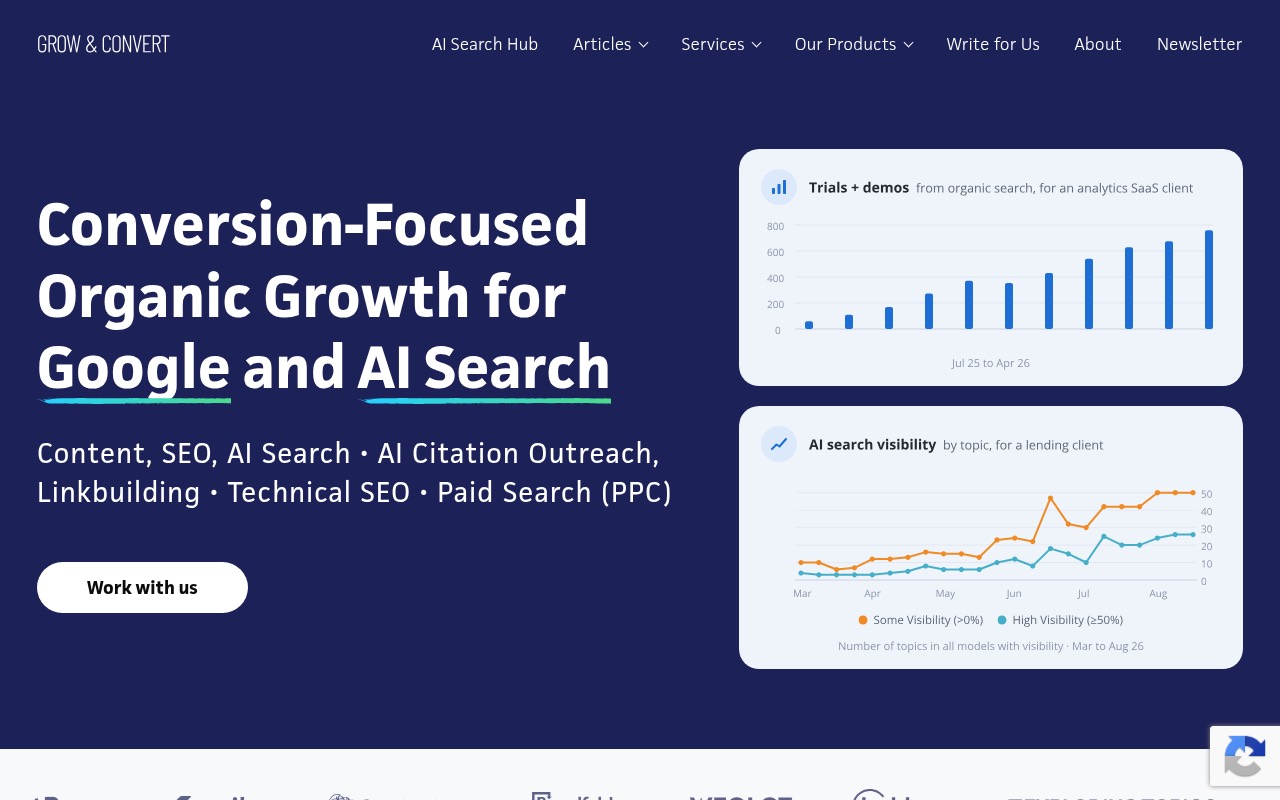
What they doGrow and Convert is a content, SEO, and AI search agency on monthly retainers, with about 20 writers and strategists working remotely across the US and Europe. Clients work straight with a strategist, with no account manager in between. It is known for Pain Point SEO, a method that picks topics by how close a reader is to buying, not by search volume, which suits a product people can sign up for today. Its own site sorts its work into self-serve SaaS and demo-based SaaS. Clients include Smartlook, Patreon, Brandfolder, Weglot, Leadfeeder, and ServiceTitan. For Smartlook it reports more than 600 conversions a month from content within 16 months, counted as free account signups and demo requests. It also gives every client its own AI visibility tracker, Traqer.ai, at no extra cost.
Best forSelf-serve software companies that want search content picked for buying intent and measured in signups, and can afford a five-figure monthly retainer.
Pros
- A 4.8 rating from 10 Clutch reviews.
- Reports results as signups and conversions, such as 600+ monthly conversions for Smartlook.
- Publishes its price: retainers from 10,000 US dollars a month.
Cons
- Its 10,000 US dollar monthly floor is the highest starting price published on this list.
- Now sells SEO, AI search, link building, and paid search too, so content is one part of a wider service.
- Its main signup case study, for Smartlook, was published in 2023.
What they doTen Speed is a retainer agency for B2B SaaS that grows organic search and AI search visibility, with a fully remote US team of about 15 marketers and an office in Chicago. Its work covers SEO strategy, content, comparison pages, core website pages, call-to-action reviews, digital PR, and original research. The founders came from Sprout Social, where Nate Turner was the first marketer, and they started Ten Speed in 2020 to give smaller teams senior search help for less than a full-time hire. Clients include Visible, TechSmith, ProsperOps, Teamwork.com, Bitly, and Workvivo. For Visible, which sells a self-serve product to founders, it reports a 313 percent rise in monthly traffic and an average of twice as many monthly trial signups over two years, partly by changing calls to action to drive more conversions.
Best forSaaS teams that want organic search and AI answers to bring in trial signups, and want senior search people rather than a large agency.
Pros
- A 5.0 rating from 5 Clutch reviews.
- Reports results in trial signups, not only traffic, as in its Visible case study.
- Builds the pages close to the signup, such as comparison pages and core website pages, and reviews the calls to action on them.
Cons
- No price on its service pages. Its own blog lists a floor of 6,000 US dollars a month.
- Its main trial signup case study covers 2020 to 2022, and the homepage shows a different traffic figure for the same client.
- Search-led, so it does not cover onboarding or in-product content.
What they doRank Lyx is a small retainer agency that does SEO, AI search, and content writing only for SaaS companies, led by its founder, Piaff Dibota. It sells monthly packages, not single blog posts, and its plans start at 1,500 US dollars a month for five articles, rising to 3,900 with landing pages and links. Its monthly reports cover rankings, signups, trial starts, demo requests, and AI visibility, which is the set of numbers a product-led team cares about. Clients include nRev AI, Famewall, Zencal, Easytools, and Meetergo, most of them tools people can sign up for on their own. For nRev AI it reports monthly signups going from 3 to 128, helped by comparison pages and a product tutorial page. The founder also posts video teardowns of other SaaS companies' search strategy.
Best forEarly-stage self-serve SaaS companies that want search content reported in signups and trial starts, on a small monthly budget.
Pros
- Publishes its prices, from 1,500 US dollars a month, with the option to cancel on one day's notice.
- Reports signups, trial starts, and demo requests every month, not only rankings.
- Clients are mostly self-serve SaaS tools, such as Famewall, Zencal, and Meetergo.
Cons
- All plans are paid up front, and it does not take one-off projects.
- No Clutch profile, and its case study numbers are self-reported.
- A young, small team, with its location and founding year not stated on its site.

What they doMiha Cacic Marketing is a small specialist agency that makes one kind of content for SaaS companies: comparison, alternatives, and best-of pages. It works as an extension of your own team, with writers, editors, and positioning and SEO people, and offers done-for-you, done-with-you, or a three-month engagement. The founder started out running a SaaS blog that brought only 19 free-trial signups a month, and built the agency around the comparison pages that fixed it. Its process signs up for and tests every product it compares, and it spends 30 to 50 hours on each article. Clients include YouCanBookMe, RightInbox, Toggl, Simple Booth, Mailtrap, and Baremetrics. It says its content brings at least 2 to 8 trial signups for every 100 search clicks, and that it usually breaks even after 12 to 15 months.
Best forSelf-serve SaaS teams with a small in-house marketing staff that need comparison and alternatives pages that turn readers into trials.
Pros
- Built entirely around content that turns readers into free trials, with named self-serve clients such as Toggl and RightInbox.
- Signs up for and tests every product it compares, so pages are based on hands-on use.
- Can work done-with-you alongside an in-house team, not only done-for-you.
Cons
- Does not publish prices.
- No Clutch or G2 reviews, only testimonials on its own site.
- Makes one format, so you will need someone else for the rest of your content plan.
What they doSERPsculpt is a small retainer agency that does SEO, AI search, and content marketing only for B2B SaaS, run by two co-founders, Bill Gaule on SEO and Tanja Gavrilovic on content, with a pool of more than ten writers. Its own site describes the work as product-led content that turns readers into paying customers, with a focus on alternatives articles and product list posts close to the signup. It reports results in trials and signups. In a Clutch review, the CEO of Link My Books reports a 58.1 percent rise in trials from the blog, and an unnamed accounting software client on its site saw trials up 195 percent over two months, after 18 old posts were updated and two new ones written. It is aimed at established companies that already have a marketing team.
Best forB2B SaaS companies with an in-house marketer that want existing blog content reworked and new bottom-of-funnel posts written to lift trials.
Pros
- A 5.0 rating from 2 Clutch reviews, both from founders or CEOs of software companies.
- Reports results in trials and signups, such as a 58.1 percent rise in blog trials for Link My Books.
- Updates old posts as well as writing new ones, which can move trials faster than starting from zero.
Cons
- No price on its site. Clutch lists a 5,000 US dollar minimum project.
- Most case studies on its site do not name the client.
- Founded in 2024 with a small team, so a short track record.
What they doHackmamba is a developer marketing agency founded in 2021 by William Imoh. It runs technical content, documentation, developer relations, events, and paid programmes for developer-tool and API companies, on retainers or fixed engagements. Its pitch is aimed at the product-led problem in developer tools: people who sign up and then stall. It writes onboarding content meant to shorten time to first value and lift trial-to-paid conversion, and runs paid campaigns aimed at developers who make a first API call. Clients include Actian, OpenRouter, Cloudinary, Auth0, Novu, and Netlify. For OpenRouter it reports 49,139 organic clicks from 39 technical articles in three months. It also pays outside developers to write and speak about client products, and says it has paid out more than 250,000 US dollars in those fees.
Best forDeveloper-tool and API companies that need tutorials, docs, and onboarding content that help signups reach their first working use of the product.
Pros
- Publishes its prices: technical content retainers and focused engagements from 5,000 US dollars a month.
- Covers the content that helps developers activate after signup, such as onboarding guides, tutorials, and docs.
- Named developer-tool clients, including Cloudinary, Auth0, and Netlify.
Cons
- Built for developer products only, so not a fit for non-technical self-serve software.
- No reviews on Clutch or G2.
- Its fuller programmes start at 15,000 US dollars a month.
What they doSiege Media is a large retainer agency founded in 2012, with 50 to 249 people and offices in Austin, Chicago, New York, and San Francisco. It now calls itself an AI search agency and sells content marketing alongside SEO consulting, digital PR, and Reddit marketing. Its client list includes some of the best-known product-led software companies, such as Zapier, Zendesk, Asana, Zoom, and Mentimeter, along with consumer brands. For Zapier it built in-depth comparison pages and moved toward lower-funnel content, and it reports a 290 percent rise in monthly organic traffic to the blog. Its CEO, Ross Hudgens, wrote a book on AI search, Generative Engine Optimization, published by Wiley. It reports results in traffic value, rankings, and AI citations rather than signups.
Best forLarger product-led software companies that want search traffic and AI visibility at scale and can commit to a long engagement.
Pros
- A 4.9 rating from 48 Clutch reviews, by far the most reviews on this list.
- Works with large product-led brands, including Zapier, Zendesk, Asana, and Zoom.
- Publishes its minimum: content marketing from 8,000 US dollars a month.
Cons
- Asks for a 12-month contract, though it includes a 30-day out clause.
- Reports traffic, rankings, and AI citations, not signups or active users.
- Many clients are consumer and ecommerce brands, so B2B software is one part of its book.
What they doLiterally is a small Oslo agency that writes technical content for developer-tool and SaaS startups, aimed at getting them recommended in AI answers and coding assistants. Its main product is a 90-day sprint: ten expert articles a month plus guaranteed features in a large tech publication and a major tech newsletter, for 4,990 US dollars a month with a three-month minimum. It also runs a four-week training programme for in-house teams. Its writers are engineers who sign up for the client's product, use it, and take their own screenshots, so the product is inside the content. Clients include QA.tech, AppSignal, GlassFlow, Hatchet, Kapa.ai, and Superlinked. It says QA.tech's mentions in AI answers grew 4.4 times, and that a QA.tech launch backed with its content reached number two on Product Hunt for the day.
Best forDeveloper-tool startups that want to be talked about and recommended, through published features and AI answers, with content written by engineers who used the product.
Pros
- Publishes its prices, with a promise to keep working at no charge if numbers have not moved by day 90.
- Writers are engineers who use the product and take their own screenshots.
- Includes guaranteed features in a large tech publication and newsletter, which helps a launch get seen.
Cons
- No Clutch or G2 reviews, and its results are self-reported.
- A very small core team that takes only two new clients a month.
- Has a three-month minimum.
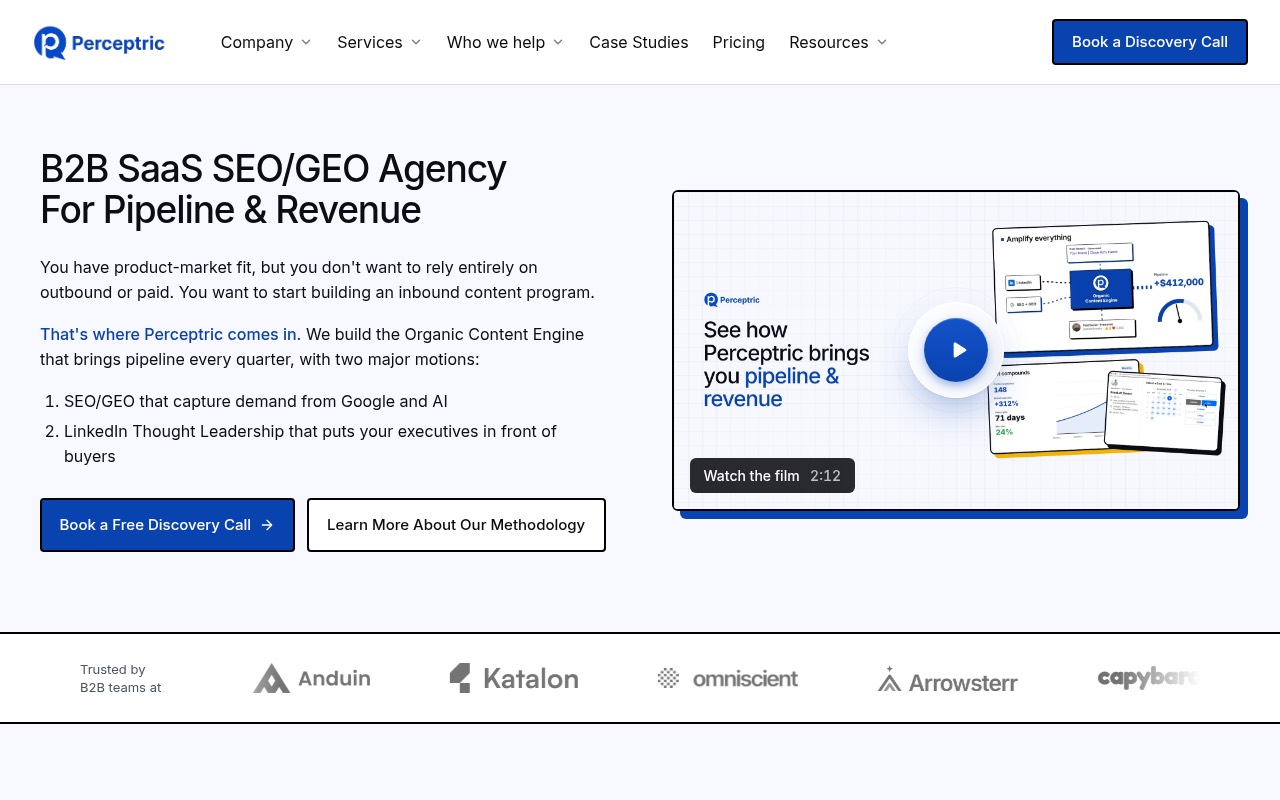
What they doPerceptric is a retainer agency for B2B SaaS that sells two things: SEO and AI search content, and LinkedIn ghostwriting for founders and leaders. Its search plans start at 4,000 US dollars a month, and its Growth plan at 8,000 adds comparison, alternative, use-case, and integration pages, the formats a product-led buyer reads before signing up. Its LinkedIn plans run from 2,500 to 5,000 US dollars a month per profile. It connects analytics, Search Console, and the client's CRM to trace visits through to booked calls, and builds small interactive calculators into articles. Named clients are Katalon, ScoutQA, and Anduin. For ScoutQA, an AI testing tool, it reports users up 120 percent in three months. Most of its results are reported as demo requests and revenue rather than trials.
Best forSaaS teams that want product-led search pages and a founder's voice on LinkedIn from one agency, and are happy to sign a 12-month plan.
Pros
- Publishes its prices for both search and LinkedIn plans.
- Its Growth plan includes comparison, alternative, use-case, and integration pages.
- Traces content to booked calls by connecting analytics, Search Console, and the CRM.
Cons
- Published prices assume a 12-month term, and shorter terms cost 5 to 10 percent more.
- No reviews on Clutch, G2, or GoodFirms.
- Its case study figures, including Katalon and ScoutQA, differ between pages of its site.
What they dotheorytwenty7 is a small, founder-led agency run by James Milsom that acts as an outsourced marketing department for SaaS startups, sold as monthly packages from 4,428 US dollars with a six-month minimum. Content and SEO are one part of a wider service that also covers positioning, HubSpot, and campaigns. It is the only agency here with a dedicated product-led growth service: it checks whether PLG fits your product, maps the moments users first see value, plans the path from free to paid, and sets up product-qualified lead tracking. It holds a ProductLed accreditation. Clients include i-nexus, Glide, Pluxee, and AQA. Its headline results, such as 170,000 US dollars in monthly recurring revenue for i-nexus over four years, are sales-led numbers rather than signups.
Best forSaaS startups without a marketing team that want a whole marketing function, including help deciding and setting up a product-led motion, more than content alone.
Pros
- The only agency here with a dedicated product-led growth service, covering free-to-paid journeys and product-qualified leads.
- Publishes full package prices and compares them to the cost of hiring a team.
- Clients own every asset it produces.
Cons
- Content is one slice of a full marketing service, not its main focus.
- A six-month minimum with no shorter pilot.
- No reviews on Clutch or G2, and its results are self-reported.
What they doCodecontent is a small technical content studio for developer-tool companies, founded around 2021 by Mostafa Ibrahim, a former software engineer at GoCardless and Arm. Every writer is a working software engineer who installs the SDK, starts in a fresh environment, and runs the code before writing, so tutorials work when a new user follows them. It writes tutorials, integration guides, and onboarding content meant to shorten the time from signup to first value. Plans start at 1,250 US dollars a month for four technical posts, and every engagement begins with a paid pilot article. Clients include Weights and Biases, SuperTokens, Roboflow, Civo, Ultralytics, and Zilliz. It describes its Weights and Biases work as a two-year embedded partnership with more than 50 articles.
Best forDeveloper-tool companies with free tiers that need working tutorials and integration guides and cannot spare their own engineers to write them.
Pros
- The lowest published price on this list: 1,250 US dollars a month, with a paid pilot article first.
- Writers are software engineers who run and test the code in every tutorial.
- Named self-serve developer platforms as clients, such as Weights and Biases and Roboflow.
Cons
- Developer tools only, and writing only, with no wider SEO or distribution programme.
- Reports views and article counts, not signups or activation.
- No reviews on Clutch or G2, and some figures differ between pages of its site.
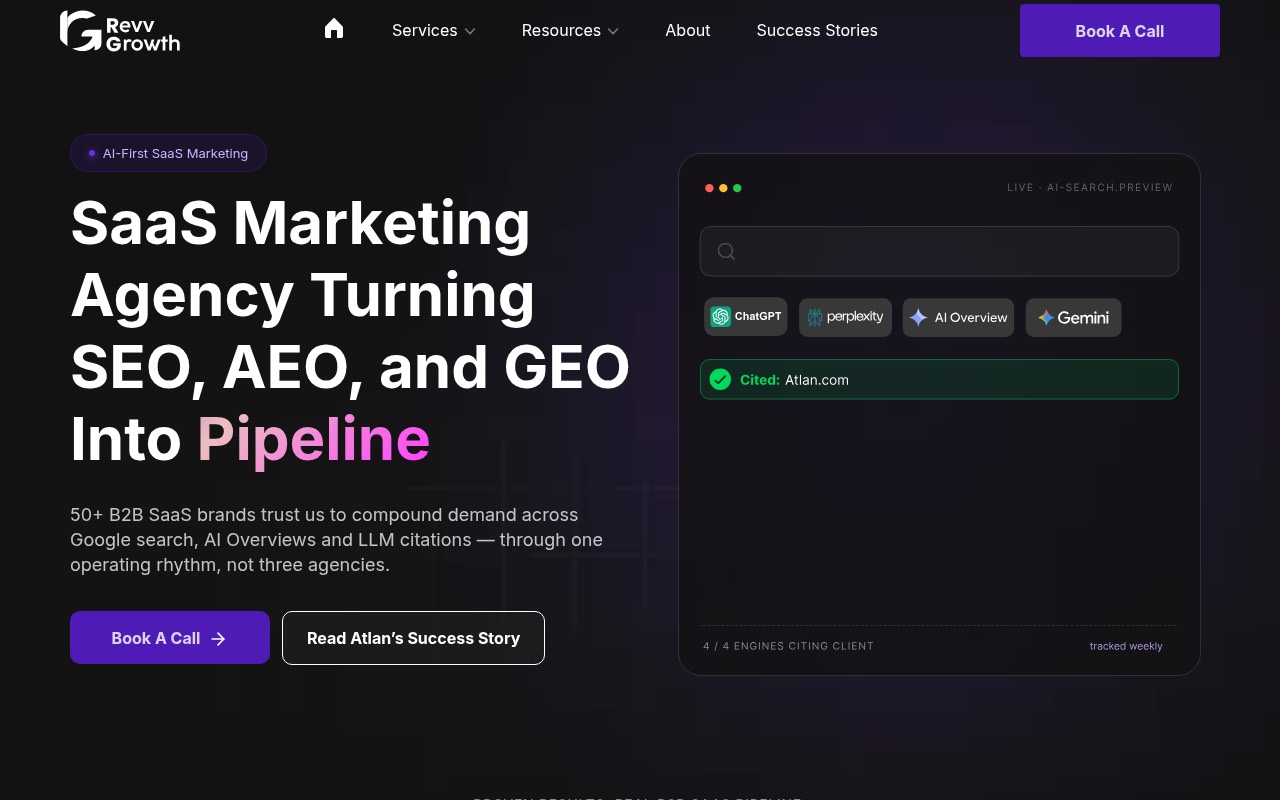
What they doRevvGrowth is a full-service marketing agency for B2B SaaS based in Chennai, India, with 10 to 49 people. Content is one of seven service lines, next to SEO, paid search, account-based marketing, AI search, marketing automation, and demand generation. It writes with a mix of AI and human writers and interviews subject experts, and it can build the automation around the content in n8n, Make, and HubSpot. Clients include Everstage, Vymo, HyperVerge, Docsumo, LeadSquared, and Atlan. For Everstage it grew a set of 20 glossary pages into more than 400 search pages, at about 40 pages a month. For Docsumo it reworked a landing page around a 14-day free trial and reports a 2 percent lift in trial signups.
Best forSaaS companies that need a large number of search pages produced quickly, plus the automation and paid campaigns around them, from one agency.
Pros
- Has produced content at volume, growing Everstage from 20 to more than 400 pages.
- Can build the automation around content in n8n, Make, and HubSpot.
- Covers paid search and account-based marketing too, if you want one agency for several channels.
Cons
- Does not publish prices. Clutch lists a 5,000 US dollar minimum project.
- Content is one of seven service lines, and its strongest numbers come from paid search and landing pages.
- Only one G2 review so far.
Is your content bringing in signups?
Get a free Content RevOps audit. We show where you appear on Google and in AI answers, who gets named instead of you, and what that gap is worth in pipeline.
Frequently asked questions
What does a content marketing agency do for a product-led company?
It makes the content people read before and after they sign up: comparison and alternatives pages, use cases, integration guides, tutorials, and onboarding content. The better agencies pick topics by how close the reader is to trying the product, put the product inside the content, and report results in signups, trials, and active users rather than traffic.
How much do these agencies charge?
Nine of the 13 agencies here publish a price. Monthly plans start at 1,250 US dollars at Codecontent, 1,500 at Rank Lyx, 4,000 at Perceptric, 4,100 for our consulting, 4,428 at theorytwenty7, 4,990 at Literally, 5,000 at Hackmamba, 8,000 at Siege Media, and 10,000 at Grow and Convert. The rest do not publish a price on their service pages, and we mark those as not disclosed. Check the contract term too, since some prices assume six or twelve months.
Is content for a PLG company different from content for a sales-led one?
Yes, in where it has to lead. In a sales-led company content leads to a demo request. In a product-led company it has to lead to a signup, and then help the new user get value fast enough to stay. That puts more weight on pages that show the product doing the job, on comparisons people read while choosing a tool, and on onboarding content. Larger accounts still bring in a buyer and finance, so content that helps sales spot and win those accounts matters too.
Why is Content RevOps ranked first on its own list?
This is our list, so read our entry with that in mind. We rank ourselves first because we connect content to signups, accounts, and deals in the CRM, which we think matters most to a product-led company paying for content. We held our entry to the same checks as the rest. We show our price, and we list our weak points, including our small size, our short track record, and our small number of reviews.
How did we choose these agencies?
We started from our database of more than 400 vetted content marketing agencies, picked the ones that show signs of working with product-led software companies, and checked 22 of them against their live sites, clients, case studies, pricing, and review profiles on Clutch and G2 in November 2026. We dropped 10: one had closed, some showed no work for product-led companies, and some had basics we could not verify. We kept 12, plus ourselves. Many agencies in this space are small and have few or no platform reviews, so each card shows ratings with their review count where they exist. The order of the lower half is a guide, not an exact science.