Fintech Marketing Trends 2026 and Where B2B Fintechs Stand on Each
Where does your fintech stand on these trends? See every trend in depth in our State of Content Marketing for Fintech 2026 report.
Book a CallThe six fintech marketing trends shaping 2026 for B2B fintechs are below, each graded against our own census of fintech websites and job posts. We wrote this for go-to-market leaders, growth leaders, and marketing operators at fintechs that sell to banks, lenders, and finance teams, the same teams we support through our B2B thought leadership agency work and our financial services practice.
Part of Fintech Content Marketing for B2B Fintechs That Already Have Content.
1. AI answers decide which fintechs get discovered.
2. AI becomes the baseline for content, so expertise and specificity decide who stands out.
3. Proof and decision-stage content beat awareness content.
4. Compliance fluency becomes a marketing skill and a source of positioning.
5. Go-to-market moves to partners, events, and ecosystems, not paid ads.
6. A ladder of next steps replaces "Book a demo" on fintech websites.
In 2025 the fintech marketing conversation centred on personalisation, creators, and app growth. The 2026 shift is about how a buyer finds a vendor at all. If you are new to the function, start with what fintech marketing covers for B2B teams; for the raw numbers behind this page, see our fintech marketing statistics for 2026.
We grade each trend against our State of Content Marketing for Fintech 2026 report and our fintech marketing hiring trends 2026 study, then say what to do about it. This page covers B2B only. For the same exercise across every B2B sector, see our cross-vertical State of B2B Content Marketing 2026 and the broader demand generation trends for 2026.
How do the fintech marketing trends for 2026 grade at a glance?
Trend | Where B2B fintech stands in 2026 | Grade |
1. AI answers decide discovery | About 3 in 5 established fintechs appear in AI answers to high-intent discovery queries; answer-engine optimisation sits in low single digits of job posts | Partway |
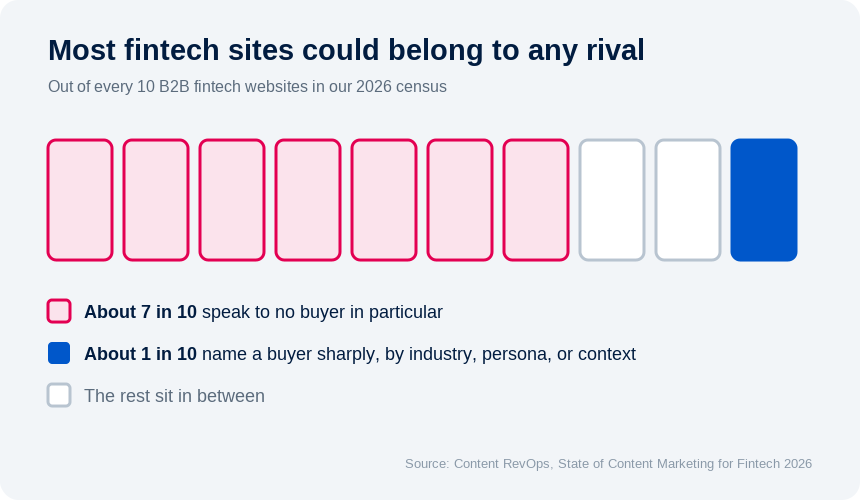
2. AI is baseline, judgement is the edge | About 7 in 10 fintech sites speak to no buyer in particular; about 1 in 10 name a buyer sharply | Behind |
3. Proof beats awareness | Fewer than 1 in 4 sites publish case studies; 61% of the average keyword portfolio is informational | Behind |
4. Compliance fluency becomes positioning | About 2 in 5 roles ask for it; about 1 in 4 firms that cover regulation reach expert depth | Partway |
5. Partners and events over paid | Partnerships named in 44% of job posts, events in 40%; about 8% of fintechs run detectable Google Ads | Partway |
6. A ladder of next steps replaces "Book a demo" | Demo or quote asks on 40–46% of sites; newsletter capture on under 3 in 10 | Behind |
The grades are our read of the figures in each row.
Trend 1. Do AI answers now decide which fintechs get discovered?
The biggest fintech marketing trend in 2026 is that AI answers now shape the shortlist. A buyer asks ChatGPT, Gemini, or Google's AI Overview which vendors handle a problem, and the answer names a few. A fintech that is not named may never reach the buyer's shortlist.
AI here works as the discovery layer, not as a writing tool. We cover the wider shift in how AI is changing top-of-funnel demand generation.
What are fintech buyers doing?
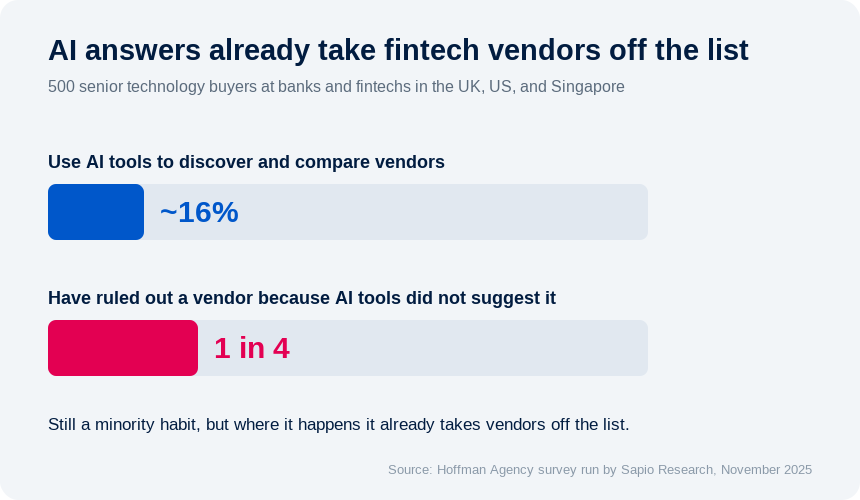
A Hoffman Agency survey, run by Sapio Research in November 2025, asked 500 senior technology decision-makers at banks and fintechs in the UK, US, and Singapore how they buy.
A quarter of them said they have ruled out a vendor because AI tools did not feature it as a suggested provider, while around 16% use AI tools to discover and compare vendors.
So AI vendor research is still a minority habit. But where it happens, it already takes vendors off the list.
Where does B2B fintech stand?
Grade: Partway.
Our fintech report found that around 3 in 5 established fintech brands appear in AI answers to high-intent discovery queries. That is a decent start for the leaders.
The inputs AI rewards are thinner across the field:
Only about 1 in 3 active fintech publishers share original data or research.
FAQ sections and key-takeaway boxes each appear at only about 1 in 10 fintechs, and those are the formats answer engines lift cleanest.
Hiring shows the same pattern. In our fintech hiring study, three in five fintech marketing roles reference AI, while answer-engine optimisation appears in only low single digits of posts. So fintech teams already hire for AI, and very few roles ask for being found by it yet.
What should a fintech do about it?
Publish the substance as HTML pages. Answer engines extract poorly from PDFs and gated forms, and much of fintech's best material sits in exactly those formats. Keep the PDF as a secondary download.
Turn talks into answer pages. Moira Vetter of the agency Yes&, speaking at Fintech South 2026, put it simply: "Take the transcript of the webinar, convert it into a Q&A." She adds press releases to the list "because it gets indexed", and says that "collectively, it makes you referenceable."
Earn third-party coverage. Our report found that strong coverage on review sites such as G2 and Capterra, and consistent mentions across authoritative publications, drive which fintechs AI answers surface. We unpack the mechanism in why one brand gets cited in AI answers while a better-known rival gets ignored.
Build comparison and alternative pages. They give AI tools a page of yours to cite when a buyer asks for the best vendor for a use case.
Add a "how did you hear about us?" field to every form, so AI-driven discovery shows up in your CRM, and decide which prompts to track so you can see whether visibility is improving.
Our work with Banking Crowded, which operates in a niche at the intersection of banking, fintech, and financial services innovation and serves senior, hard-to-reach professionals, shows what this is worth. About 22% of its inbound traffic comes from AI and LLM referrals, and LLM-referred leads convert at about 5x the baseline rate.
We set out the full approach in how we help you show up in AI search and the ultimate AEO guide.
Trend 2. With AI as the baseline for fintech content, what makes one fintech stand out?
When every fintech drafts with AI, the copy converges on the same category words. In 2026 the edge goes to fintechs that name a buyer, name an expert, and say something only they could say. That is the core of thought leadership done properly.
Our fintech report puts it directly: AI "is no longer a differentiator in fintech marketing, it is ambient." Employers want it used "with sound judgement about where it adds real value and where it introduces risk."
Where does B2B fintech stand?
Grade: Behind.
About 7 in 10 fintech sites speak to no buyer in particular. Only about 1 in 10 name a buyer sharply, by industry, persona, or buyer context.
Authority is mostly anonymous too. Only about a quarter of active fintech publishers attach author bios or credentials to their content, so even deep pages often carry no named expert.
And in our hiring study, content marketing and SEO each appear explicitly in only about 1 in 6 fintech marketing job posts.
Which me-too words give a fintech away?
Vetter, in the same Fintech South talk, lists the phrases every fintech uses:
"AI-enabled"
"embedded finance" (she calls it "like all the rage")
"fraud detection"
"compliance by design"
Her fix is to say what the AI enabled the customer to do, and to state "what's your unique take." If a sentence on your homepage would fit a rival's homepage unchanged, it is doing no work.
What should a fintech do about it?
Put a named, credentialed expert on every key page. A head of risk or a product lead with a real bio beats an anonymous byline, and the same people can carry your fintech social media presence.
Mine sales calls and customer interviews for the buyer's own words, objections, and deal blockers. Our guide to mining the problem space walks through it, and from research to positioning shows how that turns into a point of view.
Rewrite category pages to name the buyer, the use case, and the institution type: "for credit unions under $5B in assets" says more than "for financial institutions."
Strike the me-too words and replace each with the outcome a customer got.
Our fintech content marketing maturity 2026 breakdown shows where your positioning sits against the field.
Trend 3. Why do proof and decision-stage content beat awareness content in B2B fintech?
B2B fintech is a high-risk purchase for a bank or finance team, so the content that wins in 2026 is proof: case studies, business cases, and answers to objections. More top-of-funnel posts do little for a buyer who has to defend the choice inside a committee.
Who has to be convinced?
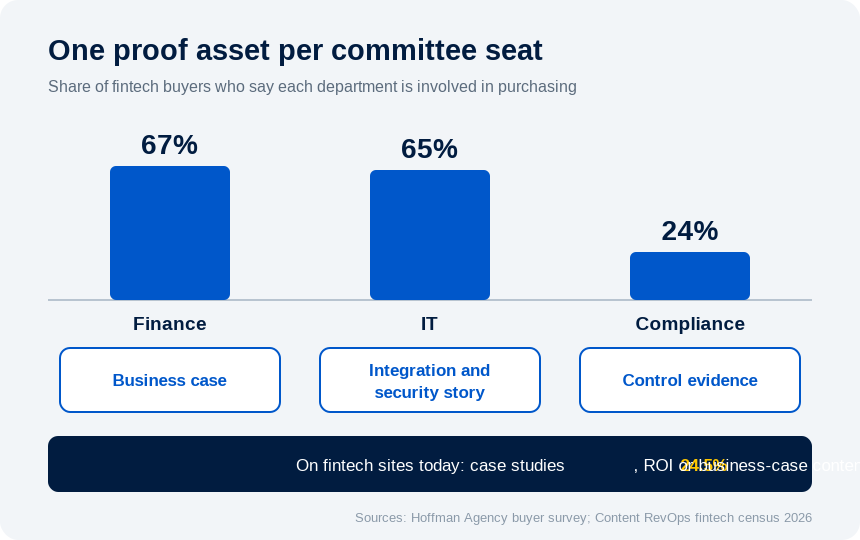
The Hoffman Agency survey asked which departments are involved in purchasing:
Department | Share of buyers who say it is involved in purchasing |
Finance | 67% |
IT | 65% |
Compliance | 24% |
The same buyers rank case studies as the most important format at the selection stage. And 25% have ruled out a vendor because of a "lack of relevant case studies."
Where does B2B fintech stand?
Grade: Behind.
Fewer than 1 in 4 fintech sites publish case studies (24.5%).
About a third offer ROI or business-case content (34.2%), so on most sites a champion finds no business case to carry into the budget meeting.
The average fintech keyword portfolio is 61% informational, which is pure top-of-funnel.
All three figures come from our fintech report. Fintech sells a high-risk product with little public proof. Informational content still has a job, as we explain in the informational layer, but it cannot carry a committee decision on its own.
What should a fintech do about it?
Build one proof asset per committee seat. Finance needs the business case, IT needs the integration and security story, and compliance needs the control evidence. Our guide to building supporting assets covers the formats.
Publish named case studies and an ROI model as HTML, not as a PDF behind a form.
Add objection pages and comparison pages for the questions sales hears every week. Getting those questions out of sales is the first step in aligning sales and marketing in a fintech.
Our fintech content marketing execution 2026 page shows how thin decision-stage content is across the sector. For what a full proof story looks like, see our B2B demand generation case studies.
Trend 4. How does compliance fluency become a fintech marketing skill and a source of positioning?
Regulation reaches a B2B fintech's marketing through its bank customer. In 2026, the fintechs that can write about regulation at expert depth turn that constraint into authority that rivals cannot fake.
How does regulation reach the vendor?
The 2023 interagency guidance on third-party relationships from the Federal Reserve, FDIC, and OCC states that using third parties "does not diminish or remove banking organizations' responsibilities" to operate safely and in compliance with the law.
The bank stays responsible. So its oversight reaches the vendor, including what the vendor says about the product.
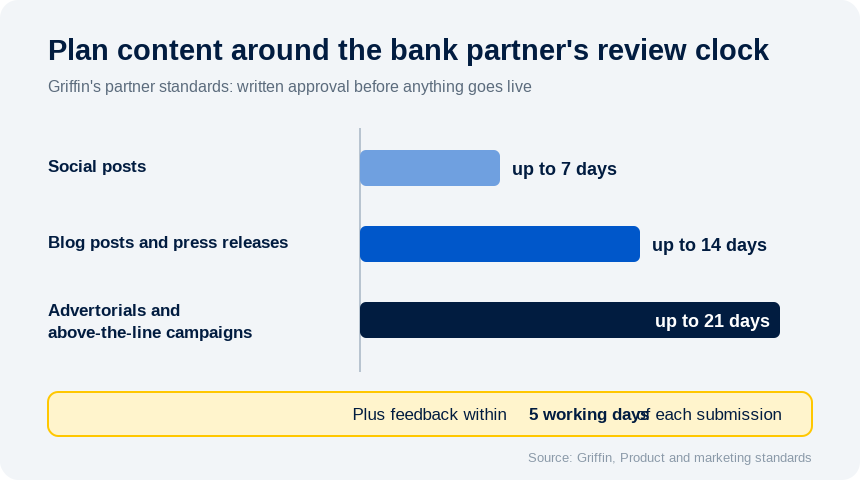
Griffin, a UK bank-as-a-service provider, shows what that looks like in practice. Its partner standards require written approval of a partner's marketing before anything goes live, with:
feedback within 5 working days
up to 7 days of review for social posts
up to 14 days for blog posts and press releases
up to 21 days for advertorials and above-the-line campaigns
A fintech partner that plans content without those windows risks missing its launch dates.
Where does B2B fintech stand?
Grade: Partway.
About 2 in 5 fintech marketing roles in our hiring study ask for compliance or regulatory fluency. That is unusually high for marketing.
On the content side, our fintech report found that among fintechs that cover regulation at all, only about 1 in 4 reach genuine expert depth.
What should a fintech do about it?
Publish regulatory explainers at expert depth on the rules your buyers live with: KYC, AML, SOC 2, GDPR, and the regimes specific to your customers.
Name the compliance reviewer on those pages, the same way you name the author.
Set a review workflow with turnaround targets, so compliance review runs on a calendar instead of stalling launches. The same discipline applies to fintech email marketing, where every nurture step needs sign-off.
Our approach for these teams is on our financial services page.
Trend 5. Why is fintech go-to-market moving to partners, events, and ecosystems instead of paid ads?
B2B fintech buys trust through proximity. In 2026 that means bank partners, platform ecosystems, co-marketing, and events, with content as the way in: co-authored research, partner webinars, and speaker invites.
Vetter puts it in one line at Fintech South 2026: "What is working in Fintech is systemness." She advises fintechs to "really look for alliance partnerships to fuel both the marketing and the sales."
What does a partner-led example look like?
Finastra and Microsoft show content working as the gateway. Microsoft introduced Finastra to the agency Merit Mile, which put Finastra's existing Omdia and Datos analyst reports and webinars to work in three co-sell ABM campaigns over 14 weeks. The agency reports that 42% of the leads were C-level.
The research already existed. The partnership gave it a second audience.
Where does B2B fintech stand?
Grade: Partway.
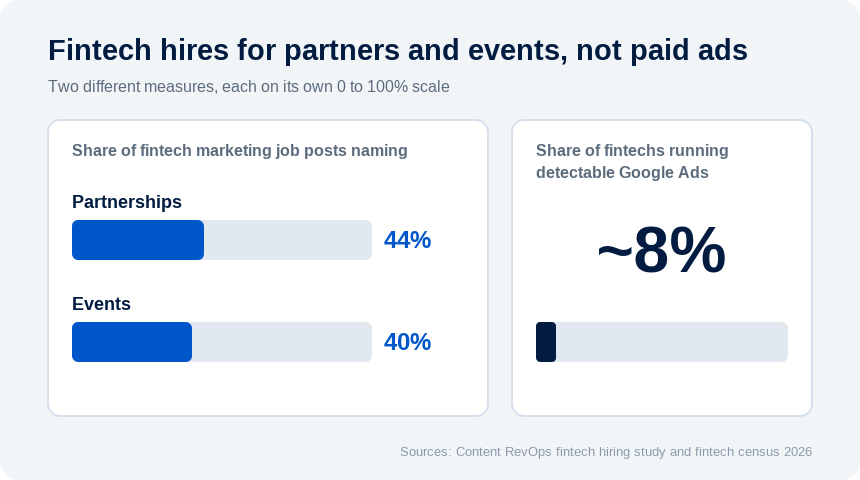
In our hiring study, partnerships are named in 44% of fintech marketing job posts and events in 40%. Partnership and event skills are already a common ask.
Paid looks different. Our fintech report found that about 8% of fintechs run detectable Google Ads, and only about 1 in 13 fintech LinkedIn advertisers use ads to promote content.
What should a fintech do about it?
Build content for named partners and target accounts: joint research, partner pages, and assets for each event follow-up.
Offer research as the invitation. A data study gives a partner a reason to co-host a webinar and gives a prospect a reason to be interviewed. Our guide to building your flagship content product shows how we scope one.
Route partner and event leads into the CRM with source tracking, so you can see which relationships produce pipeline.
Our fintech content marketing performance 2026 page covers channel and paid benchmarks in depth, and how we make your expensive channels work harder shows how content sits under events, outbound, and ads.
Trend 6. What replaces "Book a demo" on fintech websites?
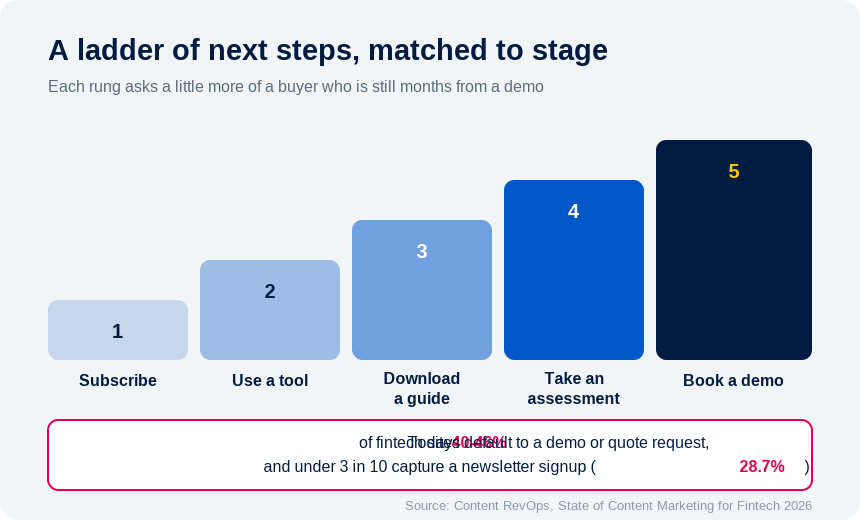
B2B fintech sales cycles are long, so most visitors are not ready to talk to sales. The 2026 trend is a ladder of next steps on fintech websites, matched to stage: subscribe, use a tool, download a guide, take an assessment, then book a demo.
Why does the demo-only ask leak buyers?
In the Hoffman Agency survey, 56% of fintech buyers report a 6–12 month sales cycle, up from 49% in 2023. A reader on your blog today may be months from a demo.
Speed matters once they do raise a hand. "Slow to respond" is the most cited reason these buyers give for ruling out a vendor, at 28%.
Where does B2B fintech stand?
Grade: Behind.
From our fintech report:
40–46% of fintech sites default to a demo or quote request.
Under 3 in 10 capture a newsletter signup (28.7%).
About half show no clear next step at all.
And our execution page found that fewer than 1 in 5 active sites match the CTA to the funnel stage. Traffic without a next step is the same leak we describe in getting AI traffic that does not convert.
What should a fintech do about it?
Add a soft first step to every article: a subscription, a benchmark, or a checklist.
Put stage-matched CTAs inside the content, not just in the header.
Build a nurture path in the CRM for readers who are not ready yet, and route hand-raisers to sales fast. Our pages on lead capture and qualification and lead nurture and database reactivation explain the wiring.
With Banking Crowded, we built topic-specific conversion paths, gated assets mapped to intent, and MQL logic based on content interaction. The Banking Crowded case study reports more than 1,500 MQLs from the resource hub and cost per lead under $15, down from $180–220.
Our guide to the conversion layer explains how we design these ladders.
How does your fintech compare on these 2026 trends?
The fastest way to grade yourself is to put your own numbers beside the census. The median fintech ranks for about 110 keywords and earns organic traffic worth about $4,900 a month.
Our fintech content benchmarking tool lets you compare your site with the census, and the full State of Content Marketing for Fintech 2026 report covers every trend above in depth. For how the pieces fit into one program, start with our fintech content marketing guide.
We build content systems and the go-to-market wiring around them, so what a fintech publishes turns into conversations, accounts, and referrals. See how we do that for financial services firms.
How does your fintech compare on these 2026 trends?
We build content systems and the go-to-market wiring around them, so what you publish turns into conversations, accounts, and referrals. Start with the fintech content benchmarking tool to put your numbers beside the census.
Frequently Asked Questions
About the Author

Founder & CEO, Content RevOps
Stefan Kalpachev is the founder and CEO of Content RevOps, where he helps B2B SaaS companies transform their content into predictable pipeline. With a background in content marketing and revenue operations, Stefan has developed a unique methodology that bridges the gap between content creation and revenue generation.
Connect on LinkedIn