Content Marketing Trends for Asset Managers (2026)
Not sure whether your asset management firm is ahead of these trends or behind them? A content revenue audit shows you exactly where you stand.
Book a CallMost "asset management marketing trends" lists for 2026 say the same handful of things. Use more AI. Make more video. Write better thought leadership. Measure more carefully. None of that is wrong, and none of it tells you what is actually changing underneath.
Part of Content Marketing for Asset Managers: The 2026 Playbook.
Here is the shift that matters. Asset managers are moving away from content as a press function and toward content that a buyer, and increasingly a machine, can actually use. It is happening because AI search is rewriting how investors and advisors find managers in the first place, and because the firms that built a real content system are starting to pull away from the ones that did not.
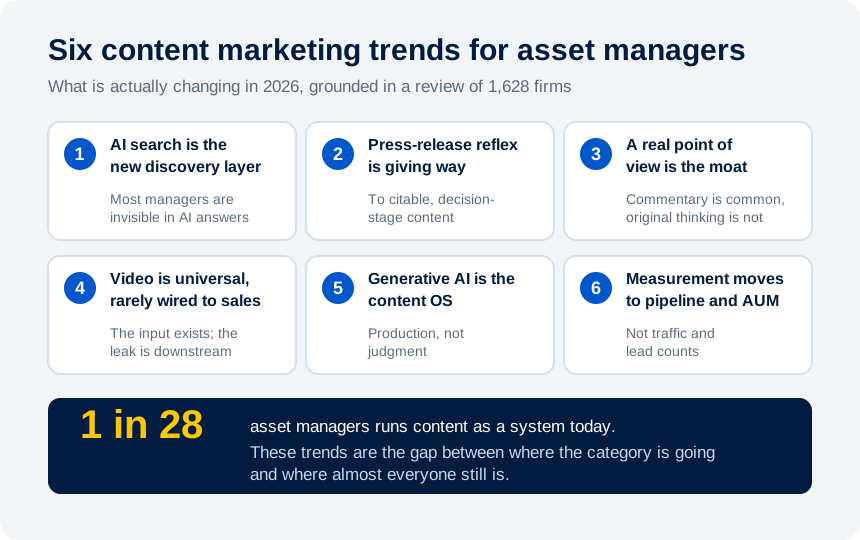
We reviewed 1,628 asset management firms by hand for our 2026 census of content in the sector, 657 of them with any meaningful content at all. That data sits under every trend below. The headline from it is blunt. Only about 1 in 28 asset managers runs content as a system; the rest is brochure or noise. So most of these trends are not things most firms are doing. They are the gap between where the category is going and where almost everyone still is.
Here are the six content marketing trends for asset managers worth your attention in 2026.
- AI search is the new discovery layer, and most asset managers are invisible in it.
- The press-release reflex is giving way to citable, decision-stage content.
- A real point of view is the moat, because commentary is everywhere and original thinking is not.
- Video and audio are near-universal, and almost nobody wires them to pipeline.
- Generative AI is becoming the content operating system, as production not judgment.
- Measurement is moving from traffic to pipeline and AUM.
Trend 1. AI search is the new discovery layer, and most asset managers are invisible in it
The biggest content marketing trend for asset managers in 2026 is not about the content you make. It is about where investors go to find you, and that place is now an AI answer.
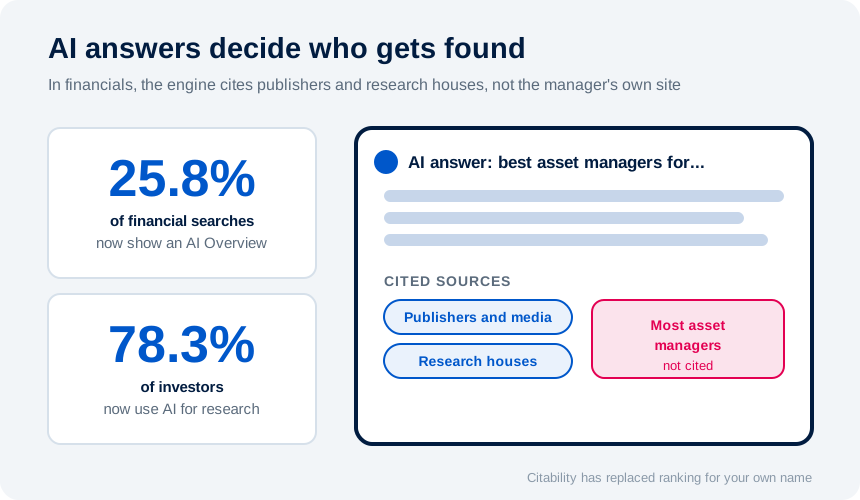
Google AI Overviews already appear on 25.8% of searches in the financials sector, according to Conductor's 2026 AEO benchmarks, which analyzed 21.9 million searches. Just over one in four financial queries now returns an AI summary before any website. On the buyer's side the shift is sharper still. BridgeWise's 2026 survey of 2,100 investors found that 78.3% already use AI tools for investment research, and 65.1% plan to replace manual research with AI within a year.
The front door moved, and most managers have not noticed.
Who AI answers actually name
When an engine does answer a financial question, it does not reach for the asset manager's own site. In the financials industry, Conductor found that a publisher like NerdWallet wins more AI citations than many traditional banks, and that article content is by far the most-cited page type in AI Overviews.
Our own data shows the same thing from the manager's side. Only a small minority of asset managers surface in AI answers at all, and the citations that do exist concentrate on five giants, Vanguard, BlackRock, Fidelity, State Street, and J.P. Morgan Asset Management. The race below them is wide open.
You can see the whole trend in one place. Ask an AI engine about content marketing for asset managers and it will cite research houses and agencies, not the managers themselves. Citability has replaced ranking as the game, and it rewards a different kind of page.
What to do about it
Getting cited is not the same as ranking for your own name. It means structuring your content so an engine can lift a clean, correct answer out of it. Lead with the answer, use plain headings a model can map to a question, add a short FAQ, and keep the facts current. As the team at Wealthtender has documented, a quarter of higher-net-worth consumers now plan to start their search for an advisor in a tool like ChatGPT, and roughly 65% of searches end without a click at all. Being the most useful, most liftable answer is how you show up when the click never happens.
Trend 2. The press-release reflex is giving way to citable, decision-stage content
For years, asset management content has mostly meant announcements. A fund launch, a quarterly letter, a market-commentary post when something moves. Our census shows 44.1% of asset management content is still news and press releases, published as a press function rather than a demand engine.
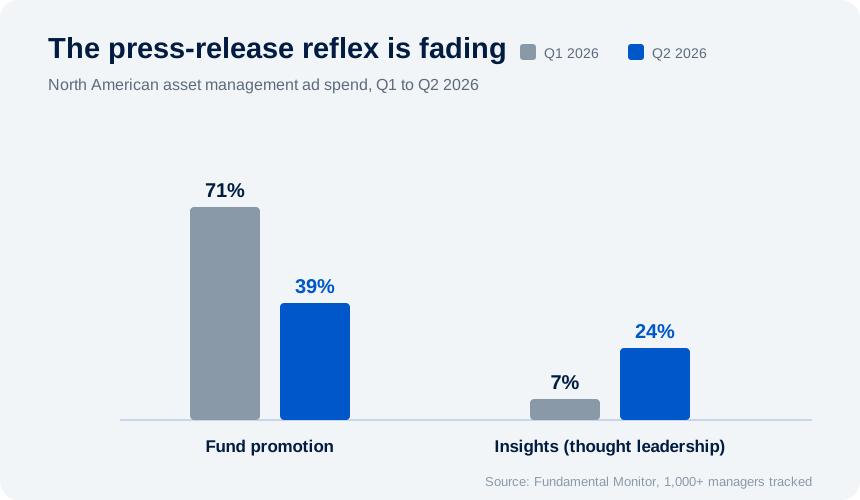
That reflex is starting to break, and you can watch it happen in where firms spend. In North America in the second quarter of 2026, thought-leadership "insights" advertising tripled to 24% of asset management ad spend, up from 7%, while fund promotion fell to 39% from 71%, according to Fundamental Media's Fundamental Monitor, which tracks the campaigns of more than 1,000 asset managers. The default lever, promote the product, is losing ground to content built to teach.
The content that is actually missing
The firms moving first are filling the part of the funnel almost everyone skips. 62.3% of asset managers publish no decision-stage content, the material a ready-to-act buyer needs to choose. The specific formats are rarer still.
Decision-stage format | Share of asset managers who publish it |
Comparison content | 0.1% |
ROI or business-case content | 3.6% |
Objection-handling content | 3.4% |
Those three numbers come straight from the 2026 census. They describe a category that creates plenty of awareness and then abandons the buyer at the exact moment of the decision.
Peregrine Communications found the same pattern from the outside. In its study of 100 managers across Europe and the US, 56% of websites were mostly promotional and 62% leaned on market commentary, while only 14% carried genuinely educational, varied content. The firms that mixed real educational content in saw a 16% bounce rate, against 36% for the commentary-and-promotion sites. Useful content keeps people on the page. Announcements do not.
Trend 3. A real point of view is the moat, because commentary is everywhere and original thinking is not
Every list tells asset managers to "do thought leadership." It is the one piece of standard advice worth keeping, as long as you are honest about what counts. Posting another macro-commentary note is not it.
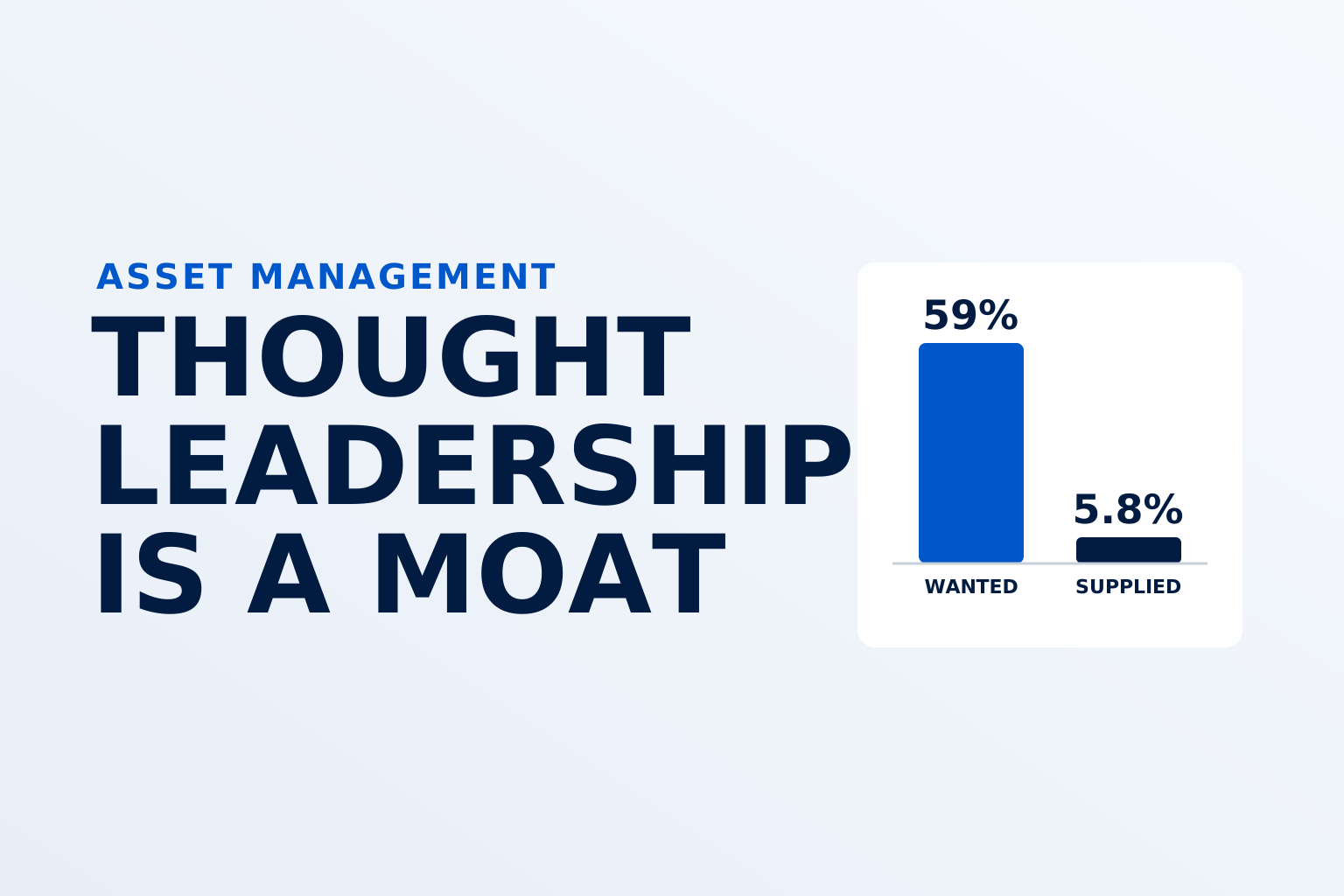
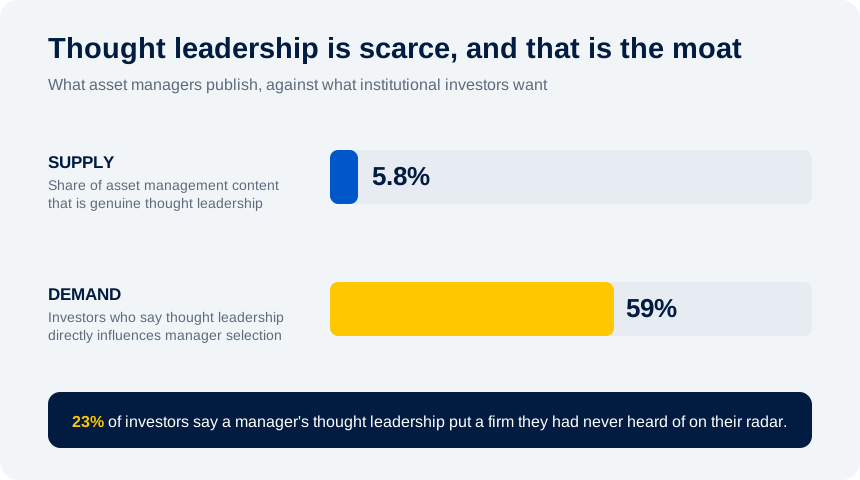
The supply tells the story. Genuine thought leadership is just 5.8% of asset management content, while plain industry commentary runs at 14.9%. Commentary is about two and a half times as common as a real point of view. That scarcity is exactly why original thinking is a moat.
Why original ideas, not spend, win
When ten managers sell a near-identical global dividend fund, none of them can differentiate on performance or fees, and an advertising war just becomes an arms race the biggest firm wins. FT Longitude makes the case plainly: original, well-reasoned ideas are what make institutional investors reach out to you instead of the other way around. The deep explanation of why an asset class will behave a certain way travels where another commentary post does not.
The demand is already there
This is no longer a soft claim. CoreData Research surveyed about 150 institutional investors and consultants overseeing roughly $5 trillion and found that 59% say thought leadership directly influences which manager they choose, and 23% say it put a firm they had never heard of before on their radar. One chief investment officer in the study summed it up: thought leadership "rarely clinches a deal but helps keep brands on the shortlist." It is the price of entry.
The catch is quality. Across B2B, the 2024 Edelman and LinkedIn thought leadership study of 3,500 decision-makers found 60% will pay a premium to work with firms that produce strong thought leadership, yet an earlier edition found only 15% rate the thought leadership they read as very good or excellent. Most of it is mediocre. That gap is the opening. One asset manager in five already turns the regulatory calendar into real authority content; far fewer put a named, credentialed author on it, which is its own easy edge since only about 22% show named author bios.
Trend 4. Video and audio are near-universal, and almost nobody wires them to pipeline
The advice to "start a podcast" or "invest in video" is a few years too late to be a trend. The input already exists almost everywhere. About 90% of asset managers already have a YouTube presence, and 64% have an organic presence on LinkedIn. Peregrine's Global 100 study found 71% of the largest managers already use YouTube, with the best-marketed firms running a multi-platform mix of video, podcasts, and webinars.
So the real trend is not making more video. The expensive input, a portfolio manager on camera, is already produced. The leak is everything downstream of the camera.
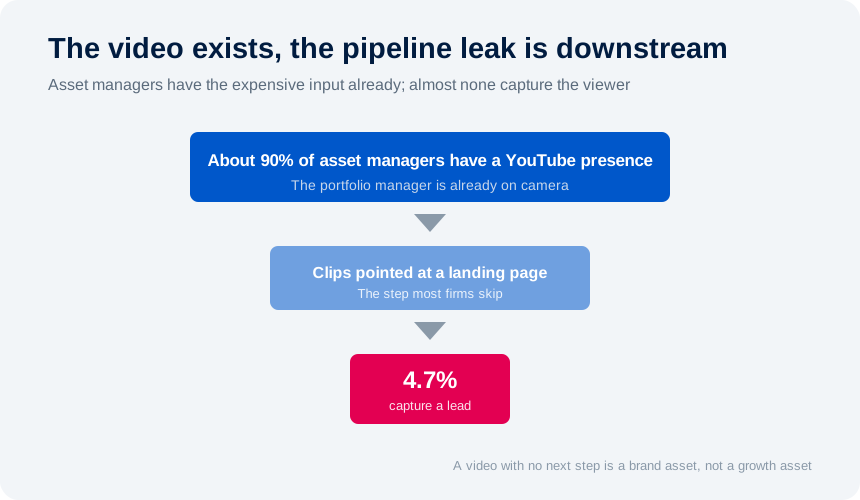
A video that lives on YouTube with no path back to the firm, no next step, and no way to tell whether anyone who watched it became a lead is a brand asset, not a growth asset. The trend worth following in 2026 is treating video and audio as the top of a system, cutting a long manager interview into clips, pointing each one at a specific landing page, and capturing the viewer who wants more. The managers who do that get compounding value from footage they are already paying to make.
Trend 5. Generative AI is becoming the content operating system, as production not judgment
Generative AI is now ambient in how asset management content gets made. Morningstar calls AI integration "essential to modern operations" in its 2026 trends, and the drafting, summarizing, and repurposing work that used to eat a marketing team's week is increasingly automated. Assette argues the old model of manual content production is simply outdated, and CSG points to AI-driven personalization as the near-term shift.
The risk hides inside the opportunity. AI scales whatever job your content already has. If your content job is the press-release reflex, AI lets you publish more announcements, faster, that still do not move a buyer. Pointing the same tools at the citable, decision-stage layer is what turns speed into pipeline.
Morningstar's own framing is the right one: harness the speed, keep human intelligence in the loop. In a regulated sector where every claim touches someone's money, the judgment about what is true, compliant, and genuinely original cannot be automated. Use AI to produce and repurpose; keep a credentialed human on what the content actually says.
Trend 6. Measurement is moving from traffic to pipeline and AUM
The last trend is quieter and harder than the rest, and it is where most asset managers are furthest behind. The category is moving off vanity metrics and onto attribution that connects content to flows.
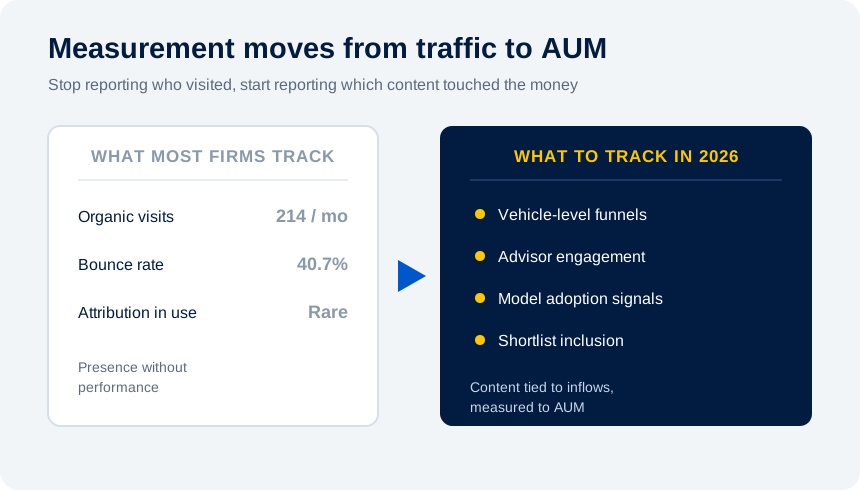
Right now that connection barely exists. Attribution and marketing automation are rare across the sector, and the typical firm earns around 214 organic visits a month, presence without performance. Even the traffic that arrives often leaves, with a median bounce rate of 40.7%.
Morningstar names the shift directly: traditional lead counts are no longer enough, and marketers should track vehicle-level funnels, advisor engagement, and buying signals such as model adoption or shortlist inclusion. In plain terms, stop reporting how many people visited and start reporting which content touched the money. The firms that can draw a line from a piece of content to an inflow will keep their budgets through the next round of fee pressure. The firms reporting pageviews will not.
How to tell if your asset management firm is behind on these trends
You do not need an audit to get a first read. Three questions place you against the category.
- Would an AI engine cite you? If your content is not answer-first and liftable, you are invisible in the discovery layer from Trend 1.
- Do you have anything a decision-ready buyer can use? If your content is mostly announcements and commentary, you are in the 62.3% with no decision-stage content.
- Does your content ask for anything? This is where most firms fail hardest. Only 4.7% of asset managers capture a lead, and 96.5% end their content with a weak or dead-end call to action. Content with no next step is a brochure, whatever else is on the page.
If more than one of those lands uncomfortably, you are not behind the trends so much as behind the 1 in 28 firms that run content as a system, which is most of the market.
The fastest way to get a real number is to benchmark your own firm against the 2026 census and see exactly where you sit on each of these trends. It takes a few minutes and it turns this list from reading into a plan.
Want to see where your asset management firm sits against the 2026 trends?
Our content revenue audit benchmarks your firm against the field, finds where you are invisible or leaking, and puts a number on the gap.
Frequently Asked Questions
About the Author

Founder & CEO, Content RevOps
Stefan Kalpachev is the founder and CEO of Content RevOps, where he helps B2B SaaS companies transform their content into predictable pipeline. With a background in content marketing and revenue operations, Stefan has developed a unique methodology that bridges the gap between content creation and revenue generation.
Connect on LinkedIn